


Community hub
Recent from talks
Contribute something to knowledge base
Content stats: 0 posts, 0 articles, 1 media, 0 notes
Members stats: 0 subscribers, 0 contributors, 0 moderators, 0 supporters
Subscribers
Supporters
Contributors
Moderators
Hub AI
Single-track road AI simulator
(@Single-track road_simulator)
Hub AI
Single-track road AI simulator
(@Single-track road_simulator)
Single-track road
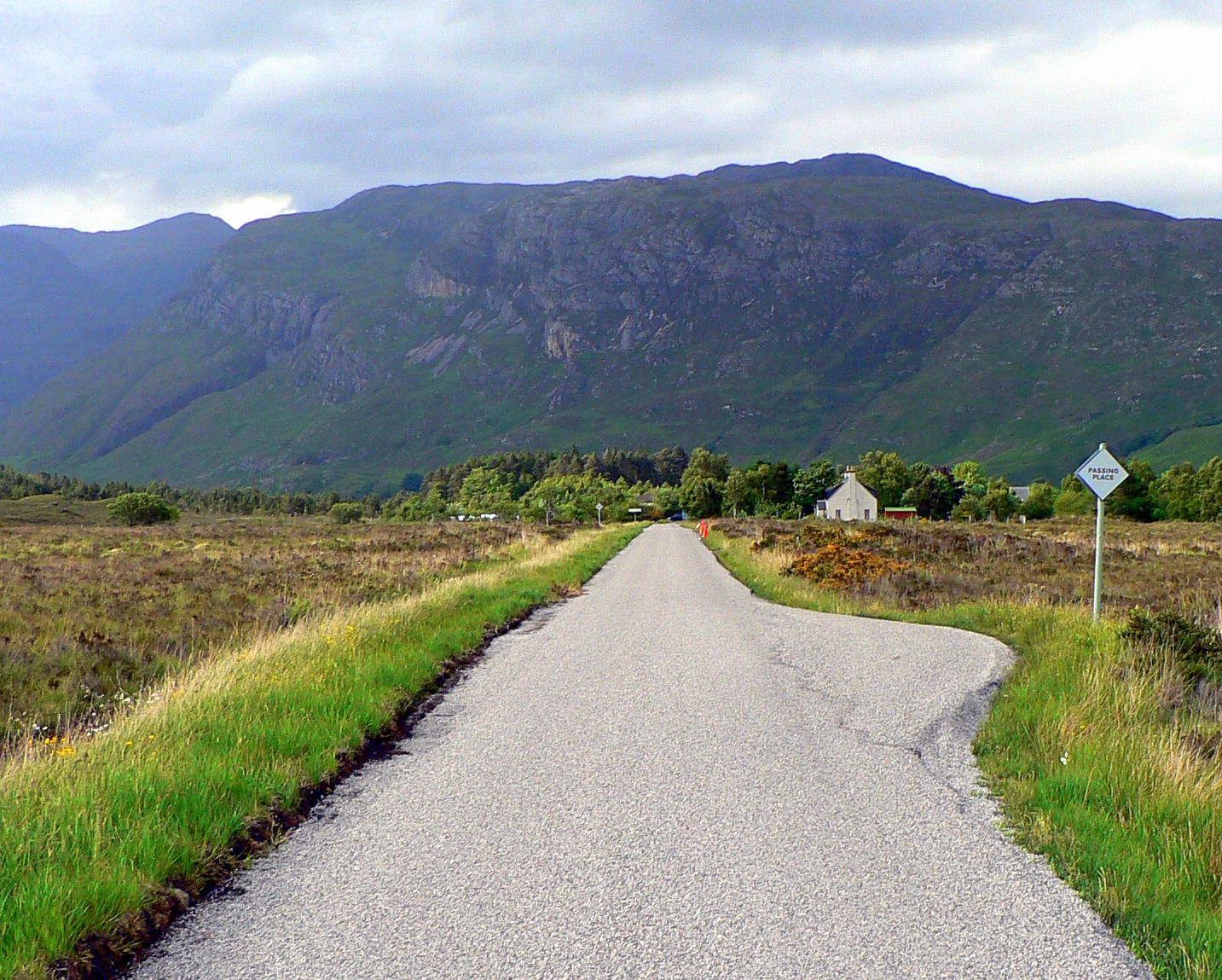
A single-track road or one-lane road is a road that permits two-way travel but is not wide enough in most places to allow vehicles to pass one another (although sometimes two compact cars can pass). This kind of road is common in rural area across the United Kingdom and elsewhere. To accommodate two-way traffic, many single-track roads, especially those officially designated as such, are provided with passing places (United Kingdom) or pullouts or turnouts (United States), or simply wide spots in the road, which may be scarcely longer than a typical car using the road. The distance between passing places varies considerably, depending on the terrain and the volume of traffic on the road. The railway equivalents of passing places are passing loops.
The term is widely used in Scotland, particularly the Highlands, to describe such roads. Passing places are generally marked with a diamond-shaped white sign with the words "passing place" on it. New signs tend to be square rather than diamond-shaped, as diamond signs are also used for instructions to tram drivers in cities. On some roads, especially in Argyll and Bute, passing places are marked with black-and-white-striped posts. Signs remind drivers of slower vehicles to pull over into a passing place (or opposite it, if it is on the opposite side of the road) to let following vehicles pass, and most drivers oblige. The same system is found very occasionally in rural England and Wales, as well as Sai Kung District in Hong Kong. Sometimes two small vehicles can pass one another at a place other than a designated passing place.
Some A-class and B-class roads in the Highlands are still single-track, although many sections have been widened for the sake of faster travel. In 2009, the A830 "Road to the Isles" and A851 on the Isle of Skye have had their single-track sections replaced with higher-quality single-carriageway road.
In remote backcountry areas around the world, particularly in mountains, many roads are single-track and unmarked. These include many U.S. Forest Service and logging roads in the United States. In Peru, the second of two overland transportation routes between Cuzco and Madre de Dios Region, a 300 km heavy-truck route, is a single-track road of gravel and dirt.
When practical, it is usually considered better for the vehicle going downhill to yield the right of way by stopping at a wide spot. The reason seems to be that it may be harder for the vehicle going up to get started again. At least in California, it is also the vehicle going downhill that must back up, if it is too late to stop at a wide spot.
Chicanes are often placed on residential streets as a more aesthetic means to slow down cars.
Sometimes, for budget reasons, and where traffic is fairly low, bridges exist as single-track corridors. Tunnels in remote areas can also be one lane when the tunnel is short and traffic is low, when building a hill or blasting away the mountain is too cost-prohibitive.
Single-track roads also exist as one-way stretches. Exit and entrance ramps for freeways and motorways are among common examples of one-way single-track roads.
Single-track road
A single-track road or one-lane road is a road that permits two-way travel but is not wide enough in most places to allow vehicles to pass one another (although sometimes two compact cars can pass). This kind of road is common in rural area across the United Kingdom and elsewhere. To accommodate two-way traffic, many single-track roads, especially those officially designated as such, are provided with passing places (United Kingdom) or pullouts or turnouts (United States), or simply wide spots in the road, which may be scarcely longer than a typical car using the road. The distance between passing places varies considerably, depending on the terrain and the volume of traffic on the road. The railway equivalents of passing places are passing loops.
The term is widely used in Scotland, particularly the Highlands, to describe such roads. Passing places are generally marked with a diamond-shaped white sign with the words "passing place" on it. New signs tend to be square rather than diamond-shaped, as diamond signs are also used for instructions to tram drivers in cities. On some roads, especially in Argyll and Bute, passing places are marked with black-and-white-striped posts. Signs remind drivers of slower vehicles to pull over into a passing place (or opposite it, if it is on the opposite side of the road) to let following vehicles pass, and most drivers oblige. The same system is found very occasionally in rural England and Wales, as well as Sai Kung District in Hong Kong. Sometimes two small vehicles can pass one another at a place other than a designated passing place.
Some A-class and B-class roads in the Highlands are still single-track, although many sections have been widened for the sake of faster travel. In 2009, the A830 "Road to the Isles" and A851 on the Isle of Skye have had their single-track sections replaced with higher-quality single-carriageway road.
In remote backcountry areas around the world, particularly in mountains, many roads are single-track and unmarked. These include many U.S. Forest Service and logging roads in the United States. In Peru, the second of two overland transportation routes between Cuzco and Madre de Dios Region, a 300 km heavy-truck route, is a single-track road of gravel and dirt.
When practical, it is usually considered better for the vehicle going downhill to yield the right of way by stopping at a wide spot. The reason seems to be that it may be harder for the vehicle going up to get started again. At least in California, it is also the vehicle going downhill that must back up, if it is too late to stop at a wide spot.
Chicanes are often placed on residential streets as a more aesthetic means to slow down cars.
Sometimes, for budget reasons, and where traffic is fairly low, bridges exist as single-track corridors. Tunnels in remote areas can also be one lane when the tunnel is short and traffic is low, when building a hill or blasting away the mountain is too cost-prohibitive.
Single-track roads also exist as one-way stretches. Exit and entrance ramps for freeways and motorways are among common examples of one-way single-track roads.
Recent media
Recent media