Hubbry Logo
SinnarSinnarMain
Open search
Sinnar
Community hub
Sinnar
logo
8 pages, 0 posts
0 subscribers
Be the first to start a discussion here.
Sinnar
Sinnar
from Wikipedia

Sinnar (Pronunciation: [sinːəɾ]) is a city and a municipal council in Sinnar taluka of Nashik district in the Indian state of Maharashtra. Sinnar is the third largest city in Nashik district after Nashik and Malegaon.

Key Information

History

[edit]

According to local tradition, Sinnar was founded by the Gavli chieftain Rav Singuni,[1] and his son Rav Govinda built the temple of Gondeshwara at a cost of 2 lakh rupees.[2]

Modern historians identify Sinnar with Seuna-pura, a town established by the Seuna (Yadava) king Seuna-chandra.[3] At its peak, the Yadava dynasty (850 - 1334) ruled a kingdom stretching from the Tungabhadra to the Narmada Rivers, including present-day Maharashtra, north Karnataka and parts of Madhya Pradesh. Their later capital was at Devagiri, now known as Daulatabad in Maharashtra.

Geography

[edit]
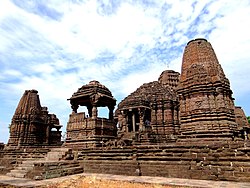
Gondeshwar temple

Sinnar is located at 19°51′N 74°00′E / 19.85°N 74.0°E / 19.85; 74.0.[4] It has an average elevation of 651.4 metres (2135 feet). Sinnar is one of the major industrial zones of Malegaon (MIDC) built around the city of Nashik which have multiple international production companies. It lies 30 km southeast of Nashik city on the Pune - Nashik Highway.

Demographics

[edit]

As of 2001 India census,[5] Sinnar had a population of 65,299. Males constitute 52% of the population and females 48%. Sinnar has an average literacy rate of 71%, higher than the national average of 59.5%: male literacy is 77%, and female literacy is 64%. In Sinnar, 15% of the population is under 6 years of age.

Culture

[edit]

The Gondeshwar Temple, an 11th-12th century temple dedicated to Shiva, is located in Sinnar.

The Gargoti Museum houses a collection of mineral specimens native to the region.

References

[edit]
Revisions and contributorsEdit on WikipediaRead on Wikipedia
from Grokipedia
Sinnar (also spelled Sennar) is a city in east-central Sudan, located on the left bank of the Blue Nile approximately 250 km (160 mi) southeast of Khartoum. It serves as the capital of Sennar State, one of Sudan's 18 states, which covers an area of 37,844 km² (14,612 sq mi) and had a population of about 1.9 million as of 2018, though figures have been impacted by ongoing displacement from the Sudanese civil war. The city is a key agricultural and trade hub in the fertile Gezira plain, supporting cotton, sorghum, and sesame production through irrigation systems like the Sennar Dam, built in 1925. As of November 2025, Sinnar has been affected by the 2023–present conflict between the Sudanese Armed Forces and Rapid Support Forces, including drone attacks on infrastructure and risks of famine in surrounding areas. Historically, Sinnar gained prominence as the capital of the Funj Sultanate (also known as the Sultanate of Sinnar or Blue Sultanate), an Islamic kingdom founded around 1504 by ʿAmārah Dunqas following the collapse of the Christian Kingdom of Alwa. The sultanate dominated the Nile Valley until its conquest by Turco-Egyptian forces in 1821, controlling territories from Kordofan to the third cataract and fostering trade, agriculture, and a slave-based economy in the Gezira region. Ruled by Funj leaders of Nilotic origin who adopted Islam and Arab-Islamic culture, it operated as a loose confederation of tribal dars under the central mek in Sinnar, blending Sufi Islam with local practices among groups like the Shilluk and others. At its 17th–18th century peak, notable rulers included Bādī II (r. 1644/45–1680), who expanded trade, and Bādī IV (r. 1724–1762), amid growing internal strife; power eroded after a 1718 coup by the Funj aristocracy and the 1761–1762 overthrow of Bādī IV by vizier Muhammad Abu al-Kaylak, reducing the mek to a figurehead. The sultanate's legacy endures in Sudan's Islamic institutions and ethnic dynamics.

Overview

Location and Significance

Sinnar is a city situated on the Blue Nile in central Sudan, approximately 300 km southeast of Khartoum, at coordinates 13°34′N 33°34′E. This strategic position along the river has historically facilitated trade, transportation, and settlement in the region, placing Sinnar at the heart of the fertile Al Jazirah plain. Historically, Sinnar holds profound significance as the former capital of the Funj Sultanate, established in the early 16th century and serving as the political and cultural center of this influential Islamic kingdom until its decline in 1821. The city's founding under Amara Dunqas marked the rise of a major urban hub that controlled vast territories in Sudan, blending indigenous African traditions with Arab-Islamic influences. Today, remnants of this era underscore Sinnar's role in shaping Sudan's medieval history. In contemporary Sudan, Sinnar functions as a key town in Sennar State, where administrative functions are centered in Sinja. It serves as an economic center for agriculture, leveraging the Blue Nile's fertility to support crop production, particularly maize, in one of Sudan's leading agricultural zones. The city is also home to the University of Sinnar, established in 1994 from the former Abuna'ama College of Agriculture and Natural Resources, which focuses on education and research in regional development. Additionally, its proximity to the Sennar Dam—built in 1925 to irrigate the expansive Gezira Scheme—continues to drive agricultural expansion and hydropower, influencing local economic growth and water management. Since April 2023, the ongoing Sudanese civil war between the Sudanese Armed Forces and the Rapid Support Forces has significantly impacted Sennar State, including Sinnar. The RSF captured the state capital Sinja in June 2024, displacing over 55,000 people, before the Sudanese Armed Forces recaptured it in November 2024. As of November 2025, the region experiences fragile stabilization amid nationwide humanitarian challenges, with over 11 million internally displaced persons and famine risks in parts of Sudan, though improvements in access have been noted in Sennar.

Etymology and Nomenclature

The name Sinnar, commonly transliterated as Sennar in English, has roots in ancient Nubian nomenclature, proposed as deriving from the term Issi-n-ar, where issi means "water" in Nubian languages and the suffix -n-ar likely denotes an "obstacle to water," alluding to the site's position along the Blue Nile where natural or constructed barriers affect water flow, as evidenced by the nearby Sennar Dam. This etymology underscores the area's historical significance as an old Nubian settlement predating its prominence under later rulers. In historical records, the name appears with variations reflecting linguistic and orthographic shifts; "Sennar" predominates in British colonial documentation, such as reports in Sudan Notes and Records, while "Sinnar" is used in some Arabic-influenced texts describing the Funj Sultanate, whose capital the city became in 1504. The broader Sennar region derives its name from the city and the sultanate it anchored. Contemporary Sudanese administration officially employs "Sennar" for the state and city, as reflected in governmental designations like Sennar State (Wilāyat Sinnār in Arabic). Nonetheless, "Sinnar" endures in certain literary works and oral traditions within Sudanese communities, preserving phonetic elements of local pronunciation.

History

Ancient and Pre-Funj Periods

The Sennar region, situated along the Blue Nile in central Sudan, exhibits evidence of human habitation dating back to the Paleolithic era, as part of broader Nile Valley settlements. Archaeological surveys have identified numerous sites in Sennar East, including 35 locations with artifacts indicative of early communities engaged in hunting, fishing, and rudimentary agriculture during the Mesolithic and Neolithic periods. These findings, encompassing stone tools and pottery fragments, align with regional patterns of prehistoric Nile Valley societies that transitioned from nomadic lifestyles to semi-sedentary villages around 5000–2000 BCE. From approximately 750 BCE to 350 CE, the Sennar area fell under the influence of the Kingdom of Kush, which exerted control over much of the Middle Nile region through trade networks and administrative outposts. During the Meroitic phase of Kushite rule (c. 300 BCE–350 CE), archaeological evidence from a cemetery on the east bank of the Blue Nile at Sennar reveals direct cultural ties, including burials with carnelian beads, faience amulets, iron implements, and glass artifacts typical of Meroitic craftsmanship. These remains suggest Sennar served as a peripheral trading hub connected to major centers like Meroë, facilitating exchanges of iron goods, livestock, and exotic materials along Nile routes. Following the decline of Meroitic power around 350 CE, the region transitioned into the Christian Nubian kingdoms, particularly integrating into the southern Kingdom of Alwa (Alodia), which adopted Christianity in the 6th century CE and maintained influence over central Sudan until the medieval period. In the medieval era, beginning around the 7th century CE, Arab migrations gradually transformed the Sennar region's socio-political landscape, accelerating Islamization by the 14th century. Early Arab incursions via Egypt and the Red Sea introduced Islamic trade and settlement, with groups like the Ja'aliyin and Juhaynah tribes intermarrying locals and establishing communities along the Nile, fostering a blend of Nubian and Arab customs. The Kingdom of Alwa, centered at Soba near modern Khartoum, initially resisted but weakened under these pressures, leading to the rise of the Abdallab, an Arabized dynasty that assumed control over northern territories including Sennar by the late 15th century. This period was characterized by tribal conflicts among incoming Arab nomads and indigenous groups, alongside vibrant Nile-based trade in slaves, ivory, and agricultural goods, which sustained economic vitality amid shifting alliances.

Funj Sultanate (1504–1821)

The Funj Sultanate was established in 1504 by Amara Dunqas, a leader of the Funj people who had migrated northward from regions south of the Nile confluence, overthrowing the remnants of the Christian kingdom of Alwa and founding the new state known as the Black Sultanate or Blue Sultanate. Shortly thereafter, around 1504–1505, Amara Dunqas established Sinnar as the capital on the left bank of the Blue Nile, selecting the site for its strategic position along trade routes and fertile lands, which facilitated the consolidation of Funj authority over central Sudan. This founding marked the beginning of a centralized monarchy that integrated diverse tribal groups under Funj rule, transforming Sinnar into a burgeoning political and economic hub. The sultanate reached its zenith in the 17th century, particularly under rulers such as Badi II (r. 1644/45–1680), whose reign saw territorial expansion from the Third Cataract in the north to the borders with Ethiopian territories in the south, encompassing key regions like the Gezira plain and parts of Kordofan. This growth was driven by military campaigns and alliances, with Sinnar serving as the administrative and military core, from which expeditions projected Funj power across a loose confederation of dependent sultanates and tribal chieftaincies. Prosperity flourished through royal caravans dispatched from Sinnar, which controlled trade in slaves, gold, and ivory, attracting merchants from the Middle East and Africa and elevating the capital's status as a vibrant commercial center. Governance was structured around a monarchy led by the mek (sultan) in Sinnar, supported by hamaj as viceroys overseeing provinces and faqih as religious scholars advising on Islamic law and legitimacy, blending indigenous African traditions with adopted Islamic elements to maintain cohesion over the diverse realm. The administrative system relied on tribute from vassal territories and a cavalry-based military, with Sinnar functioning as the nerve center for taxation, justice, and diplomacy, ensuring the sultan's oversight of economic flows like the royal caravans. By the 18th century, the sultanate entered a phase of decline marked by internal revolts and factionalism, including the significant uprising led by Ajib al-Manjilak of the Abdallabi in the late 16th to early 17th century, which temporarily vassalized Funj rulers and exposed vulnerabilities in central authority. Subsequent unrest in the 18th century, including challenges from military commanders and provincial leaders, further weakened the monarchy, reducing sultans to figureheads amid power struggles centered in Sinnar. The final sultan, Badi VII (r. 1805–1821), ruled over a fragmented state and offered no resistance to the invading Ottoman-Egyptian forces led by Ismail Pasha, who captured Sinnar on June 14, 1821, leading to the sultanate's dissolution and the capital's abandonment as ruins.

Ottoman Rule and Modern Developments

In 1821, Turco-Egyptian forces under Ismail Pasha invaded and conquered Sinnar, marking the end of the Funj Sultanate through a formal surrender ceremony at the ruins of the old palace, and integrating the region into the broader administration of Turco-Egyptian Sudan. Sinnar subsequently functioned as a key administrative outpost and regional center of commerce along the Blue Nile, facilitating Egyptian control over local trade and taxation in the central Sudan provinces. This period of rule, lasting until 1885, imposed heavy tribute demands on the local population, exacerbating economic strains and social disruptions in the area. The outbreak of the Mahdist Revolt in 1881 severely disrupted the region, as Muhammad Ahmad's forces mobilized against Turco-Egyptian authority, culminating in the Mahdists' capture and destruction of Sinnar in 1885, which drastically altered the local demography through violence and displacement. The revolt persisted until 1899, when Anglo-Egyptian forces under British command reconquered the area, establishing the Anglo-Egyptian Condominium (1899–1956) that restored order and shifted focus toward agricultural development. Under this joint administration, Sinnar revived as an agricultural hub, with the British constructing the Sennar Dam between 1925 and 1927 to irrigate the adjacent Gezira plain, significantly enhancing cotton production and economic output in the region. The town itself was reconstructed near the ancient Funj ruins, serving as a rail and trade nexus that supported colonial export-oriented farming. Following Sudan's independence in 1956, Sinnar experienced the broader impacts of the two civil wars (1955–1972 and 1983–2005), including influxes of displaced populations from southern conflict zones that strained local resources and infrastructure while positioning the area as a northern reception point for refugees. In 1994, as part of a national reorganization into 26 states, Sennar State was formally established, encompassing the historic region and promoting localized governance amid ongoing federal tensions. The area has since grown as a trade hub along key transport routes, though the 2023 outbreak of conflict between the Sudanese Armed Forces and Rapid Support Forces has inflicted severe damage on infrastructure, including roads and the Sennar Dam, while triggering retaliatory violence and mass displacement in Sennar State. By early 2025, the Sudanese Armed Forces had recaptured most of Sennar State from the Rapid Support Forces, though fighting persisted, exacerbating displacement and infrastructure damage as of November 2025.

Geography

Physical Features and Topography

Sinnar is situated in the central clay plains of Sudan, within the expansive Gezira Plain, a wedge-shaped alluvial fan bounded by the Blue Nile to the east and the White Nile to the west. The topography consists primarily of flat savanna plains with gentle slopes, averaging a northwestward inclination of about 0.2 meters per kilometer from Sennar toward Khartoum. Elevations in the region range from approximately 400 to 500 meters above sea level, with the modern town of Sinnar at around 427 meters. This low-relief landscape is occasionally interrupted by small inselbergs and low hills, such as Jebel Gargada, rising up to 60 meters, composed of ancient basic rocks, granite, and gneiss—the oldest geological formations in Sudan. The Blue Nile River dominates the physical features of Sinnar, incising the plain to a depth of about 12 meters and creating fertile floodplains through seasonal inundations that deposit nutrient-rich sediments. These floodplains, part of the broader Nile system, have shaped the region's landforms over millennia, with palaeochannels of the Blue Nile contributing to the alluvial fan structure of the Gezira. Geologically, the area is underlain by Quaternary sedimentary deposits from ancient Nile overflows, primarily Pleistocene-era alluvia derived from basaltic sources in the Ethiopian Plateau. The modern town lies approximately 2 kilometers south-southeast of the ancient Funj ruins, whose placement was influenced by the stable, elevated terrain overlooking the river. Soils in Sinnar are predominantly alluvial and clay-rich vertisols, known locally as black cotton soils, which reach depths of up to 17 meters in the central Gezira and are dominated by montmorillonite clay minerals. These heavy, cracking clays form on low terraces and levees, supporting agriculture through their high fertility from calcium carbonate concretions and fine silt-loam textures, though they exhibit gilgai microrelief with 10-12 centimeter amplitudes due to shrink-swell cycles. The landscape supports acacia woodlands, featuring species such as Acacia senegal and Acacia seyal, which thrive in the sandy-clay mixtures along riverine edges. Biodiversity includes diverse habitats for migratory birds, as the Blue Nile serves as a key corridor on the East African flyway, hosting seasonal populations in adjacent wetlands and woodlands.

Climate and Environmental Conditions

Sennar experiences a hot arid climate classified under the Köppen system as BWh, characterized by subtropical desert conditions with extreme heat and low humidity throughout much of the year. Average annual temperatures range from 25°C to 40°C, with daily highs often exceeding 40°C during the hot season from March to May and occasionally surpassing 45°C in peak summer months. The coolest period, from December to February, sees average lows around 17°C, though daytime highs remain above 32°C, contributing to a consistently warm environment influenced by the region's flat topography that limits cooling breezes. Precipitation in Sennar is limited and seasonal, with annual rainfall averaging 400–600 mm, primarily concentrated in the wet season from June to September when monsoon influences bring the bulk of the moisture. This period accounts for over 90% of the yearly total, peaking in August with up to 136 mm in a single month, while the dry season from October to May receives negligible amounts, often less than 20 mm combined. High evaporation rates, exceeding 2,000 mm annually due to intense solar radiation and low humidity, far outpace precipitation, leading to significant water loss from surface bodies and soil moisture depletion during the extended dry months. Environmental challenges in Sennar are compounded by desertification, driven by overgrazing, deforestation, and prolonged dry periods, which have degraded arable land and reduced soil fertility across central Sudan. Siltation in the Nile River and associated reservoirs, such as the Sennar Dam, has significantly diminished storage capacity—losing up to 71% due to sediment accumulation from upstream erosion—threatening water availability and downstream fertility. Climate change has intensified these issues since the 2000s, manifesting in erratic rainfall patterns, prolonged droughts, and increased flood frequency, which disrupt hydrological cycles and heighten vulnerability to food insecurity in the region.

Demographics

Population Statistics and Growth

Sinnar's population has demonstrated substantial growth throughout the late 20th and early 21st centuries, driven by national census records that highlight its role as a regional hub. The 1973 census enumerated 28,546 residents, rising to 42,803 in 1983 and reaching 72,187 by the 1993 census. An estimate for 2007 placed the population at 143,059, reflecting continued expansion amid broader urbanization trends in Sudan. This demographic increase aligns with an average annual growth rate of 3–4% observed in the post-independence period, influenced by internal migration patterns. However, no comprehensive census has been conducted since 2008 due to ongoing conflicts, and current figures are uncertain. The 2023–ongoing Sudanese civil war has significantly impacted the region, with clashes in Sinja (Sennar city) and surrounding areas leading to the displacement of over 136,000 people from Sennar State since June 2024, many from the city itself, potentially reducing the local population. Key drivers of this growth include rural-to-urban migration from the adjacent Gezira Scheme, where large-scale irrigation projects implemented since the 1920s have transformed agricultural landscapes, prompting shifts in livelihoods and encouraging movement to nearby towns like Sinnar for employment opportunities. Additionally, waves of displacement from regional conflicts, particularly the Second Sudanese Civil War (1983–2005), contributed to population inflows as internally displaced persons sought safety in relatively stable areas such as Sinnar. The city's demographic distribution features a dense urban core situated along the Blue Nile River, supporting commercial and administrative functions, while peri-urban settlements remain more sparse and agriculturally oriented. Within the defined city limits, the overall population density approximates 3,800 inhabitants per square kilometer, illustrating the concentration of activity in the central areas. Ethnic diversity from these migrations has further enriched the social fabric, though detailed compositions are addressed elsewhere in demographic analyses.

Ethnic Composition and Languages

Sennar State exhibits a rich ethnic diversity shaped by its position as a historical hub of migration and interaction between northern Arabized populations and southern African groups. The core ethnic identity revolves around descendants of the Funj people, who founded the Funj Sultanate in the 16th century, with subgroups like the Gule asserting direct descent from Funj royalty and maintaining a distinct cultural heritage tied to the region's medieval Islamic legacy. Arab-Bedouin influences are significant, particularly through the Ja'aliyin tribe, an Arabized Nubian group that has long inhabited the Nile Valley areas of central Sudan, including Sennar, where they engage in agriculture and pastoralism. Migrations from the south have introduced Nilotic peoples such as the Shilluk, Nuer, and Dinka, whose presence dates to historical border interactions with the Funj Sultanate and has been reinforced by 20th-century displacements, forming settled communities amid the state's agricultural zones. Smaller Nubian and Beja communities exist in peripheral and older settlements, contributing to the overall mosaic of Arab and African-origin groups. Linguistically, Sudanese Arabic serves as the dominant tongue and lingua franca, spoken by the majority across ethnic lines due to its role in trade, administration, and daily communication in this central Sudanese state. In northern and older settlements, Nubian languages such as Kenzi-Dongolawi persist among Nubian communities, preserving elements of pre-Arabization heritage along the Nile. Southern migrant groups maintain Nilo-Saharan languages, including Shilluk (Dhøg Cøllø) among the Shilluk, reflecting their Nilotic roots and used in familial and cultural contexts. English functions as a secondary language in formal education and official settings, as one of Sudan's co-official languages post-independence. Social dynamics among these groups are influenced by the multi-ethnic Funj legacy, which historically integrated diverse tribes under a shared sultanate framework, fostering relative coexistence despite occasional tensions from resource competition. Post-independence integration policies, emphasizing Arabization, have promoted Sudanese Arabic as a tool for national unity, aiming to bridge ethnic divides while encouraging assimilation into a broader Sudanese identity.

Economy

Agriculture and Irrigation Systems

Agriculture in Sinnar, a key region in central Sudan, is predominantly centered on irrigated farming through the Gezira Scheme, where cotton has been the staple cash crop since the scheme's establishment in 1925. Other major crops include sorghum as a primary subsistence cereal, sesame for oilseed production, and groundnuts, which are rotated in the scheme's cropping patterns to maintain soil fertility. In the surrounding savanna areas, livestock rearing plays a significant role, with cattle and goats being the dominant animals raised by pastoralist communities for milk, meat, and hides. The region's irrigation infrastructure is primarily supported by the Sennar Dam on the Blue Nile, constructed between 1925 and 1927, which features a reservoir capacity of 930 million cubic meters and generates 15 MW of hydropower. Equipped with 80 sluice gates, the dam regulates water flow to irrigate approximately 2 million acres of farmland in the Gezira Scheme via a gravity-fed canal system, enabling year-round cultivation without reliance on pumps or fuel. This system has been crucial for transforming arid lands into productive agricultural zones, though climatic conditions like seasonal Nile floods influence cropping calendars. Historically, during the Funj Sultanate from 1504 to 1821, agriculture in the Sennar area was largely subsistence-oriented, involving small-scale mixed farming of cereals and legumes alongside livestock herding to meet local needs. British colonial administration marked a shift to mechanized, large-scale production with the introduction of the Gezira Scheme and Sennar Dam, aimed at export-oriented cotton cultivation to supply British textile industries. In the modern era, challenges such as reservoir siltation—estimated at an annual rate of 0.9%, leading to a 71% capacity loss over 95 years as of 2020—and disruptions from the ongoing civil war since 2023 have severely impacted yields, with multiple failed planting seasons and collapsing agriculture as of 2025, halting planting and damaging infrastructure in Sennar and adjacent areas. As of 2025, the civil war has resulted in catastrophic losses, with two to three consecutive farming seasons under-utilized or failed, particularly in the Gezira Scheme.

Industry, Trade, and Infrastructure

Sennar's industrial sector remains predominantly small-scale and tied to agricultural processing, with ongoing conflict severely limiting expansion and operations. Key activities include cotton ginning facilities, such as the historic Makwar Ginning Factory near the region, which processes raw cotton from Blue Nile plantations to support export-oriented production. Food processing is centered on sugar manufacturing, exemplified by the West Sennar Sugar Factory, which has seen its output drop to approximately 40,000 tonnes annually due to war-related disruptions, including supply chain interruptions and facility damage. Limited manufacturing persists in areas like brick production for local construction, though broader industrial development is hampered by insecurity and inadequate investment. As a vital southeastern trading hub, Sinnar facilitates regional commerce, particularly as a market for surplus produce from the adjacent Gezira Scheme, including sorghum and other grains that flow through its markets for distribution across Sudan. The area's trade networks have evolved from historical Funj-era caravan routes along the Blue Nile into contemporary connections via road and rail, linking to major centers like Khartoum and export ports such as Port Sudan. Local markets in Sinja serve as key nodes for agricultural goods, though recent shelling incidents have disrupted operations, exacerbating food shortages and inflating prices amid the civil war. Infrastructure in Sinnar supports connectivity but faces significant challenges from conflict and underinvestment. The primary road network includes the critical Sennar-Sinjia Highway, recently reopened by government forces to restore links between eastern Sudan and southern regions, alongside routes like the Kosti-Sennar road that connect to White Nile State. Rail access is provided by the Sudan Railways Corporation's main line, with Sennar Junction serving as a pivotal station on the Khartoum-El Obeid route, facilitating freight for agricultural exports despite aging tracks. Sennar Airport (HSNR) operates with limited commercial flights, primarily supporting regional travel and aid deliveries. Electricity is generated by the Sennar Dam's 15 MW hydropower plant on the Blue Nile, providing supplementary power to local grids, though outages are frequent due to attacks on facilities. Water supply struggles persist amid urbanization and conflict, with contamination risks and infrastructure damage leading to shortages in urban areas like Sinja.

Culture and Society

Religious Practices and Beliefs

Islam has been the dominant religion in Sinnar since the establishment of the Funj Sultanate in the early 16th century, with the majority of the population adhering to Sunni Islam under the Maliki school of jurisprudence. This tradition took root during the Funj era, when Islam began to spread widely in central Sudan, blending with local customs while formalizing Islamic legal practices. Sufi orders, such as the Shādhaliyyah and Sammāniyyah during the Funj era and later the Khatmiyya, have played a significant role in shaping religious life, providing spiritual guidance and community organization across northern and central Sudan, including Sinnar. The ruins of the Grand Mosque in Sennar, reconstructed between 1616 and 1645, stand as a testament to the architectural and devotional legacy of this period, serving as a central site for communal prayers and Islamic scholarship. Prior to the 16th century, the region encompassing Sinnar was part of the medieval Nubian Kingdom of Alwa, where Christianity flourished as the primary faith from the 6th century onward, leaving archaeological remnants such as church foundations and artifacts in the Gezira area. Nubian Christianity, influenced by Coptic traditions, persisted in isolated communities until the Funj conquest accelerated Islamization, though some Christian practices lingered in rural areas. Under Ottoman-Egyptian rule in the 19th century, a small Coptic Christian presence reemerged briefly through Egyptian administrators and merchants, but it remained marginal and was largely supplanted by the dominant Islamic framework. Minority religious practices in Sinnar include small-scale animist traditions among Nilo-Saharan ethnic groups, such as beliefs in ancestral spirits and natural forces, which coexist syncretically with Islam in some rural communities. These practices, rooted in pre-Islamic indigenous customs, involve rituals for protection and fertility but have diminished due to ongoing Islamization efforts. In Sinnar's multi-ethnic context, interfaith dynamics have generally been accommodative, though tensions have arisen during broader Sudanese conflicts, including the civil wars, where religious identities sometimes intersect with ethnic and political divides, leading to sporadic discrimination against Christian and animist minorities.

Traditions, Arts, and Education

Sennar's traditions are deeply rooted in the legacy of the Funj Sultanate (1504–1821), which fostered a blend of indigenous Nilotic and Islamic influences across the region. Oral histories from the Funj era, passed down through generations of storytellers, recount the origins and migrations of the Funj people, often portraying them as heroic figures who established the sultanate after conflicts with neighboring groups like the Dinka along the Nile. These narratives emphasize themes of unity and resilience, serving as a cultural anchor for local communities. Annual Nile harvest celebrations, such as the Gada'a Al-Nar festival in the Blue Nile region encompassing Sennar, bring residents together for rituals honoring agricultural cycles, including communal feasts, music, and dances that express gratitude for the river's bounty. Wedding customs in Sennar reflect a fusion of Arab and indigenous elements, featuring multi-day events with henna application rituals (agid), bridal processions (jirtig) involving red dyes and incense, and dances like the subheya, where the bride performs to symbolize fertility and joy. The arts and crafts of Sennar highlight women's pivotal role in preserving practical and aesthetic traditions tied to daily life and the environment. Pottery production, a longstanding craft among women in the Middle Nile area including Sennar, involves hand-building vessels from local clay using techniques dating back millennia, creating items for storage, cooking, and water transport that embody functional beauty. Basket-weaving similarly thrives, with artisans fashioning trays (tabar) and mats from riverine plant fibers like palm, employing intricate patterns that denote regional identity and utility in household and ceremonial contexts. Music forms a vibrant expression, centered on the kissar—a five- or six-stringed lyre with ancient Nubian roots—played during social gatherings and accompanied by percussion instruments like the tambour (frame drum) to evoke rhythms of harvest and celebration. Literature from the sultanate era endures through the Funj Chronicle, a 19th-century Arabic text compiled in Sennar that chronicles rulers, battles, and governance, offering invaluable insights into the political and social fabric of the Blue Sultanate. Education in Sennar encompasses a network of primary and secondary schools that provide foundational learning, aligned with Sudan's national system of eight years of basic education followed by three years of secondary, though access remains challenged by regional disparities. The adult literacy rate in Sudan was 60.7% as of 2018, though the ongoing civil war since 2023 has significantly impacted access to education and likely reduced this figure. Sinnar University, tracing its origins to the Abu Naama College of Agriculture and Natural Resources founded in 1977, was formally established as a university in 1993 and plays a central role in higher education with a focus on agriculture, natural resources management, and engineering disciplines through diploma and degree programs. These academic pursuits, including studies in local history, contribute to safeguarding the Funj heritage by documenting and analyzing the sultanate's enduring cultural impact on the region. The 2023 civil war between the Sudanese Armed Forces and the Rapid Support Forces has profoundly affected culture and education in Sennar. The conflict led to the displacement of thousands, school closures across the state, and damage to cultural heritage sites, including risks to Funj-era ruins. As of 2025, over 90% of school-age children in affected areas like Sennar have faced disruptions, with universities operating under severe constraints amid ongoing offensives and humanitarian crises. Efforts to preserve traditions continue through community initiatives, but interfaith tensions and ethnic divides have intensified in the war context.

References

Add your contribution
Related Hubs
User Avatar
No comments yet.