



Community hub
Recent from talks
Contribute something to knowledge base
Content stats: 0 posts, 0 articles, 1 media, 0 notes
Members stats: 0 subscribers, 0 contributors, 0 moderators, 0 supporters
Subscribers
Supporters
Contributors
Moderators
Hub AI
Sinopec AI simulator
(@Sinopec_simulator)
Hub AI
Sinopec AI simulator
(@Sinopec_simulator)
Sinopec
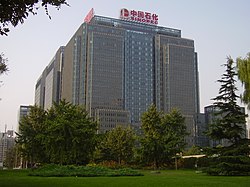
China Petroleum and Chemical Corporation, or Sinopec Group, is a Chinese oil and gas enterprise based in Chaoyang District, Beijing. The SASAC administers China Petroleum and Chemical Corporation for the benefit of State Council of China. China Petroleum and Chemical Corporation operates a publicly traded subsidiary, called Sinopec, listed in Hong Kong and Shanghai stock exchanges. China Petroleum and Chemical Corporation is the world's largest oil refining conglomerate, state owned enterprise, and second highest revenue company in the world behind Walmart.
In 1994, Sinopec was among the large industrial state-owned enterprises of China which were selected for a pilot program of restructuring as state holding companies, thereby enabling partial public listings of its subsidiaries' assets.
Sinopec Limited was established as a joint stock entity under the China Petrochemical Corporation Group (Sinopec Group) in February 2000. The company was simultaneously listed in Hong Kong, New York, and London in October 2000. The IPO raised $3.5 billion. A Shanghai listing was completed in June 2001.[citation needed] Prior to its operation as a company Sinopec's assets came from the Ministry of Petroleum Industry and the Ministry of Chemical Industry which partially privatized in the 1980s. Given its legacy asset base from Sinopec Group, analysts have categorized it as a more downstream oil player than PetroChina. However, since 1998 Sinopec has expanded into upstream endeavors. This expansion began with a state mandated asset swap with China National Petroleum Corporation (CNPC) which gave some of Sinopec's refineries to CNPC in return for Sinopec acquiring some of CNPC's upstream assets.
China entered the WTO in 2001 which some experts claim put additional pressure on their domestic oil industry to be efficient. In the lead up to going public, Sinopec cut over 200,000 jobs from its roster.
BP partnered with Sinopec, in 2005, to build SECCO an ethylene derivatives plant with an initial investment of $2.7 billion. It is located in the Shanghai Chemical Industry Park, and generates over 3.2 million tons of petrochemical products annually. In 2017, Sinopec bought out the remainder of BP's stake in SECCO through its Gaoqiao subsidiary for $1.68 billion. Gaoqiao's operations predate the creation of Sinopec and it operates 75 plants for producing finished petroleum products such as fuels, oils, organic compounds. Ineos bought out half of Sinopec's share of SECCO in 2022 as part of a broader partnership deal.
Sinopec operates the Jiujang Petrochemical Complex which was originally constructed in 1975 and has received a series of improvements over time. The refinery processes 8 million tonnes of crude oil per year. Xi Jinping visited the refinery, in 2023, when the company highlighted the importance of Socialism with Chinese characteristics and presented awards.
Sinopec posted a 6.8% operating margin for the 2006 financial year. Profit was limited in part by government price controls on downstream petrochemical products. The National Development and Reform Commission sets gasoline and diesel prices and the Ministry of Finance collects windfall tax on upstream profits. At the beginning of 2006, Chinese retail gasoline and diesel sales were not profitable for Sinopec and sales were hurting the company's financials. To pressure the NDRC, Sinopec and CNPC cut production causing long lines at the pump. This led to NDRC approving a 15% increase in the price at the pump. To offset losses from the price controls, the state gave Sinopec $1.1 billion in subsidy during 2005 and $647 million in 2006. This finance example demonstrates of Sinopec's implementation of policy adjusted profit. Chinese methods on how to articulate, quantify, and report the sometimes conflicting interests of profit and political policy have evolved during over time. Some commentators on the Shanghai Stock Market, where Sinopec trades, call these methods "valuation with Chinese characteristics". Sinopec demonstrated the "one profit, five rates" method in 2023. This method calls for assessing the company's performance with profit, "asset-liability ratio, return on equity, operating cash ratio, overall labor productivity, and R&D investment intensity".
In February 2007, Saudi Aramco and Exxon signed a deal with Sinopec to revamp the Fujian oil refinery and triple its capacity to 240,000 barrels per day (38,000 m3/d) by 2009. The Saudi Aramco investment is strategically aligned because Saudi Aramco produces a heavier crude oil which is not preferable for other Chinese refining facilities. Aramco, Exxon and Sinopec also signed contracts for a fuel marketing venture that will manage 750 service stations and a network of terminals in Fujian province. Their subsidiaries also expanded cooperation in Tianjin the following year. They invested over $3 billion from 2008 to 2019 expanding the ethylene production capacity multiple times and finally achieving 1.3 million tons per year of production. In Fujian, Sinopec also operates the Gulei Industrial Park. It began as a joint venture with a group of Taiwanese companies operating as Dynamic Ever Investments in 2015. The venture took $4 billion of investment and has a production capacity of 1 million tonnes of ethylene per year. At the time of its approval it was the only Taiwanese petrochemical joint venture in mainland China. It was approved by the Fujian branch of the NDRC which owns a 25% stake in the project. The plant began producing downstream chemicals in 2018 and became fully online in 2021. Phase two began, in 2024, when Saudi Aramco made an additional $9.8 billion investment in the facilities. These expansions are scheduled to be fully operational in 2030.
Sinopec
China Petroleum and Chemical Corporation, or Sinopec Group, is a Chinese oil and gas enterprise based in Chaoyang District, Beijing. The SASAC administers China Petroleum and Chemical Corporation for the benefit of State Council of China. China Petroleum and Chemical Corporation operates a publicly traded subsidiary, called Sinopec, listed in Hong Kong and Shanghai stock exchanges. China Petroleum and Chemical Corporation is the world's largest oil refining conglomerate, state owned enterprise, and second highest revenue company in the world behind Walmart.
In 1994, Sinopec was among the large industrial state-owned enterprises of China which were selected for a pilot program of restructuring as state holding companies, thereby enabling partial public listings of its subsidiaries' assets.
Sinopec Limited was established as a joint stock entity under the China Petrochemical Corporation Group (Sinopec Group) in February 2000. The company was simultaneously listed in Hong Kong, New York, and London in October 2000. The IPO raised $3.5 billion. A Shanghai listing was completed in June 2001.[citation needed] Prior to its operation as a company Sinopec's assets came from the Ministry of Petroleum Industry and the Ministry of Chemical Industry which partially privatized in the 1980s. Given its legacy asset base from Sinopec Group, analysts have categorized it as a more downstream oil player than PetroChina. However, since 1998 Sinopec has expanded into upstream endeavors. This expansion began with a state mandated asset swap with China National Petroleum Corporation (CNPC) which gave some of Sinopec's refineries to CNPC in return for Sinopec acquiring some of CNPC's upstream assets.
China entered the WTO in 2001 which some experts claim put additional pressure on their domestic oil industry to be efficient. In the lead up to going public, Sinopec cut over 200,000 jobs from its roster.
BP partnered with Sinopec, in 2005, to build SECCO an ethylene derivatives plant with an initial investment of $2.7 billion. It is located in the Shanghai Chemical Industry Park, and generates over 3.2 million tons of petrochemical products annually. In 2017, Sinopec bought out the remainder of BP's stake in SECCO through its Gaoqiao subsidiary for $1.68 billion. Gaoqiao's operations predate the creation of Sinopec and it operates 75 plants for producing finished petroleum products such as fuels, oils, organic compounds. Ineos bought out half of Sinopec's share of SECCO in 2022 as part of a broader partnership deal.
Sinopec operates the Jiujang Petrochemical Complex which was originally constructed in 1975 and has received a series of improvements over time. The refinery processes 8 million tonnes of crude oil per year. Xi Jinping visited the refinery, in 2023, when the company highlighted the importance of Socialism with Chinese characteristics and presented awards.
Sinopec posted a 6.8% operating margin for the 2006 financial year. Profit was limited in part by government price controls on downstream petrochemical products. The National Development and Reform Commission sets gasoline and diesel prices and the Ministry of Finance collects windfall tax on upstream profits. At the beginning of 2006, Chinese retail gasoline and diesel sales were not profitable for Sinopec and sales were hurting the company's financials. To pressure the NDRC, Sinopec and CNPC cut production causing long lines at the pump. This led to NDRC approving a 15% increase in the price at the pump. To offset losses from the price controls, the state gave Sinopec $1.1 billion in subsidy during 2005 and $647 million in 2006. This finance example demonstrates of Sinopec's implementation of policy adjusted profit. Chinese methods on how to articulate, quantify, and report the sometimes conflicting interests of profit and political policy have evolved during over time. Some commentators on the Shanghai Stock Market, where Sinopec trades, call these methods "valuation with Chinese characteristics". Sinopec demonstrated the "one profit, five rates" method in 2023. This method calls for assessing the company's performance with profit, "asset-liability ratio, return on equity, operating cash ratio, overall labor productivity, and R&D investment intensity".
In February 2007, Saudi Aramco and Exxon signed a deal with Sinopec to revamp the Fujian oil refinery and triple its capacity to 240,000 barrels per day (38,000 m3/d) by 2009. The Saudi Aramco investment is strategically aligned because Saudi Aramco produces a heavier crude oil which is not preferable for other Chinese refining facilities. Aramco, Exxon and Sinopec also signed contracts for a fuel marketing venture that will manage 750 service stations and a network of terminals in Fujian province. Their subsidiaries also expanded cooperation in Tianjin the following year. They invested over $3 billion from 2008 to 2019 expanding the ethylene production capacity multiple times and finally achieving 1.3 million tons per year of production. In Fujian, Sinopec also operates the Gulei Industrial Park. It began as a joint venture with a group of Taiwanese companies operating as Dynamic Ever Investments in 2015. The venture took $4 billion of investment and has a production capacity of 1 million tonnes of ethylene per year. At the time of its approval it was the only Taiwanese petrochemical joint venture in mainland China. It was approved by the Fujian branch of the NDRC which owns a 25% stake in the project. The plant began producing downstream chemicals in 2018 and became fully online in 2021. Phase two began, in 2024, when Saudi Aramco made an additional $9.8 billion investment in the facilities. These expansions are scheduled to be fully operational in 2030.
Recent media
Recent media