

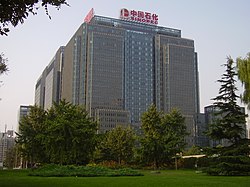

Sinopec
View on Wikipedia
Key Information


| Sinopec | |||||||
|---|---|---|---|---|---|---|---|
| Simplified Chinese | 中国石油化工股份有限公司 | ||||||
| Traditional Chinese | 中國石油化工股份有限公司 | ||||||
| |||||||


China Petroleum and Chemical Corporation, or Sinopec Group, is a Chinese oil and gas enterprise based in Chaoyang District, Beijing. The SASAC administers China Petroleum and Chemical Corporation for the benefit of State Council of China. China Petroleum and Chemical Corporation operates a publicly traded subsidiary, called Sinopec, listed in Hong Kong and Shanghai stock exchanges. China Petroleum and Chemical Corporation is the world's largest oil refining conglomerate, state owned enterprise, and second highest revenue company in the world behind Walmart.
History
[edit]Domestic
[edit]| year | Domestic | International |
|---|---|---|
| 2013 | ||
| 2014 | ||
| 2015 | ||
| 2016 | ||
| 2017 | ||
| 2018 | ||
| 2019 | ||
| 2020 | ||
| 2021 | ||
| 2022 | ||
| 2023 |
In 1994, Sinopec was among the large industrial state-owned enterprises of China which were selected for a pilot program of restructuring as state holding companies, thereby enabling partial public listings of its subsidiaries' assets.[5]: 49
Sinopec Limited was established as a joint stock entity under the China Petrochemical Corporation Group (Sinopec Group) in February 2000. The company was simultaneously listed in Hong Kong, New York, and London in October 2000. The IPO raised $3.5 billion.[6]: 146 A Shanghai listing was completed in June 2001.[citation needed] Prior to its operation as a company Sinopec's assets came from the Ministry of Petroleum Industry and the Ministry of Chemical Industry which partially privatized in the 1980s.[7]: 592 Given its legacy asset base from Sinopec Group, analysts have categorized it as a more downstream oil player than PetroChina.[8][7]: 592–593 However, since 1998 Sinopec has expanded into upstream endeavors.[7]: 592–593 This expansion began with a state mandated asset swap with China National Petroleum Corporation (CNPC) which gave some of Sinopec's refineries to CNPC in return for Sinopec acquiring some of CNPC's upstream assets.[6]: 146 [9]
China entered the WTO in 2001 which some experts claim put additional pressure on their domestic oil industry to be efficient.[9][10] In the lead up to going public, Sinopec cut over 200,000 jobs from its roster.[11]
BP partnered with Sinopec, in 2005, to build SECCO an ethylene derivatives plant with an initial investment of $2.7 billion.[12] It is located in the Shanghai Chemical Industry Park, and generates over 3.2 million tons of petrochemical products annually.[13][14] In 2017, Sinopec bought out the remainder of BP's stake in SECCO through its Gaoqiao subsidiary for $1.68 billion.[13][15] Gaoqiao's operations predate the creation of Sinopec and it operates 75 plants for producing finished petroleum products such as fuels, oils, organic compounds.[16][14] Ineos bought out half of Sinopec's share of SECCO in 2022 as part of a broader partnership deal.[12]
Sinopec operates the Jiujang Petrochemical Complex which was originally constructed in 1975 and has received a series of improvements over time.[17][18][19] The refinery processes 8 million tonnes of crude oil per year.[19] Xi Jinping visited the refinery, in 2023, when the company highlighted the importance of Socialism with Chinese characteristics and presented awards.[20]: 3
Sinopec posted a 6.8% operating margin for the 2006 financial year. Profit was limited in part by government price controls on downstream petrochemical products. The National Development and Reform Commission sets gasoline and diesel prices and the Ministry of Finance collects windfall tax on upstream profits.[6]: 147–148 At the beginning of 2006, Chinese retail gasoline and diesel sales were not profitable for Sinopec and sales were hurting the company's financials. To pressure the NDRC, Sinopec and CNPC cut production causing long lines at the pump. This led to NDRC approving a 15% increase in the price at the pump. To offset losses from the price controls, the state gave Sinopec $1.1 billion in subsidy during 2005 and $647 million in 2006.[6]: 152 This finance example demonstrates of Sinopec's implementation of policy adjusted profit.[20]: 8 Chinese methods on how to articulate, quantify, and report the sometimes conflicting interests of profit and political policy have evolved during over time. Some commentators on the Shanghai Stock Market, where Sinopec trades, call these methods "valuation with Chinese characteristics".[21] Sinopec demonstrated the "one profit, five rates" method in 2023.[21][20]: 8 This method calls for assessing the company's performance with profit, "asset-liability ratio, return on equity, operating cash ratio, overall labor productivity, and R&D investment intensity".[21]

In February 2007, Saudi Aramco and Exxon signed a deal with Sinopec to revamp the Fujian oil refinery and triple its capacity to 240,000 barrels per day (38,000 m3/d) by 2009.[22] The Saudi Aramco investment is strategically aligned because Saudi Aramco produces a heavier crude oil which is not preferable for other Chinese refining facilities.[23] Aramco, Exxon and Sinopec also signed contracts for a fuel marketing venture that will manage 750 service stations and a network of terminals in Fujian province.[22] Their subsidiaries also expanded cooperation in Tianjin the following year.[24] They invested over $3 billion from 2008 to 2019 expanding the ethylene production capacity multiple times and finally achieving 1.3 million tons per year of production.[25][26][27] In Fujian, Sinopec also operates the Gulei Industrial Park. It began as a joint venture with a group of Taiwanese companies operating as Dynamic Ever Investments in 2015. The venture took $4 billion of investment and has a production capacity of 1 million tonnes of ethylene per year.[28][29][30][31] At the time of its approval it was the only Taiwanese petrochemical joint venture in mainland China.[32] It was approved by the Fujian branch of the NDRC which owns a 25% stake in the project. The plant began producing downstream chemicals in 2018 and became fully online in 2021.[31][29] Phase two began, in 2024, when Saudi Aramco made an additional $9.8 billion investment in the facilities. These expansions are scheduled to be fully operational in 2030.[33]
Sinopec completed construction of a new ethylene plant in Wuhan at the end of 2012. The construction of this plant was done as a joint venture with the South Korean SK Group. This facility was planned in alignment with the National Development and Reform Commission's goal of producing more ethylene domestically in order to rely less heavily on foreign imports. It will provide 800,000 tons/year which is a significant step towards the NDRC's 2015 goal of raising domestic production by 7.5 millions tons/year.[34][35] In March 2013, Sinopec agreed to pay $1.5 billion for its parent company's overseas oil and gas-producing assets.[36]
Zhejiang Oil Products Company was originally founded in 1950, but began operating under Sinopec in 1998. It is Sinopec's highest selling oil refinery and one of the most important companies in Zhejiang.[37] Sinopec has continuously improved the refining capacity and it ranks as one of the largest refineries in the world.[38][39] The refinery prioritizes output of non-fuel chemicals at a notably higher rate than comparable refineries. This large scale production, particularly of aromatic compounds hurt foreign competitors.[39] This attracted further investment in China from Saudi Aramco which acquired a 10% stake in Zhejiang Oil Products Company in 2023.[40][41]
Due to the COVID-19 pandemic, Sinopec reported a loss of 23 billion yuan in the January to June time frame of 2020. In 2021, they reported a 22% increase in revenue as the demand for fuel and oil slowly returned to normal.[42] In 2022, the company reported a 25% net income increase in the first quarter. Diesel output was increased by almost 10% that year and the gasoline production saw only a 0.7% increase.[43]
In 2021, Sinopec began a partnership with NIO, when they unveiled that a NIO Power Swap Station 2.9 would be put into the Sinopec Chaoying Station in Beijing. Additionally, the partnership was to include cooperation between the two companies in new materials, smart EV technology, Battery-as-a-Service (BaaS), construction of recreational facilities, as well as the purchase of vehicles.[44]
China's imports of U.S. natural gas will more than double.[when?][45][46] In March 2022, a memorandum of understanding was signed between Sinopec and Aramco to strengthen the already existing ties between the companies and to improve their downstream operations.[47]
The Hainan Baling Chemical New Material Company, a Sinopec subsidiary in Hainan, opened a one million tonne per year Styrene-butadiene (SBC) plant in 2023. This new facility made Sinopec the largest producer of SBC in the world at the time.[48] Sinopec began operating the deepest oil well in Asia in 2023. As part of Project Deep Earth the drill went 9432m below Xinjiang.[49] Sinopec and BP have worked together since Sinopec formed.[50][15] Their joint venture in Zhejiang had 2024 gas stations in 2021.[51] They signed a memorandum of strategic cooperation with BP at the Davos Economic Forum in 2024. Sinopec has set a goal of building 5000 new EV charging stations by 2025 and plans to cooperate with BP on achieving that goal.[52][53] These and other of Sinopec's environmental goals are aligned with the Fourteenth five-year plan.[20]: 7
International
[edit]Sinopec has demonstrated a willingness, characteristic Chinese national oil companies, to invest in foreign, often risky, infrastructure. These firms work in concert with the Chinese state owned financial sector via direct low cost financing and indirect infrastructure agreements between foreign nations and Chinese banks.[54][36][7]: 593 Several experts claim that the role of direct financing support is not as important as indirect support.[6]: 160 [7]: 593–603 [55] Large foreign purchases are particularly notable in the Chinese context because they require approval by the National Development and Reform Commission and the State Council.[56] Sinopec made failed attempts to acquire Iranian oil reserves in 2001 and Kazakh reserves in 2003.[57]: 569 [58]: 272 In subsequent years, Sinopec relied more heavily on off-taker agreements to gain access to foreign markets.[58]: 272 [59]: 12 The 2008 financial crisis made a large impact on Chinese foreign policy and Chinese oil companies put a higher priority on mergers and acquisitions in the following years.[7]: 593 [59]: 14
According to the OECD, foreign oil ventures are an attractive investment for Chinese national oil companies because China is a large importer of oil and wants to control its supply chain.[60]: 10–15 Some Chinese observes agree with this assessment and highlight Sinopec's 2005 goal of importing 15 million tons of crude oil for refinement in China. China's Go Out policy explicitly stated, in 2001, that Sinopec should "make effective use of overseas resources, build the overseas oil and gas supply bases and diversify the oil imports". This was revised in 2006 to "broaden international oil and gas cooperation".[57]: 568, 579 According to the company, in 2022, foreign operations were staffed 74% by local workers rather than Chinese employees.[61]
Sinopec began its partnership with Iran in 2001, and signed a 30 year deal to invest $70 billion in the development of Yadavaran Field in 2004.[57]: 569 [58]: 282 [62][63] Contract negotiation for this program took three years such that technical work and funding did not actually begin until 2007.[63][64] The US pressured China to block the investment due to sanctions, but Iran claims that pressure did not delay the deal.[58]: 282 [63] Iran expressed pleasure with the deal and stated the goal of replacing Japan with China as the primary exporter of Iranian oil.[58]: 282 There is little agreement about the exact amount of oil and gas available through the Yadavaran project, but all claim that it is a large oil field by global standards.[62][63][64] The first phase of drilling was completed in 2012 and production continued to expand.[64] Sinopec claims to have ceased buying this oil due to US sanctions in 2019.[65][66]
Sinopec established its first drilling rig in Saudi Arabia in 2000.[citation needed] In 2004, Sinopec began exploring in Saudi Arabia.[58]: 282
Unipec, a subsidiary of Sinopec, signed a contract with French oil company Total Gabon in February 2002. Under the contract China, for the first time, bought Gabonese crude oil.[67] During his African visit, in 2004, Hu Jintao signed a series of bilateral trade accords with his Gabonese counterpart Omar Bongo, including a "memorandum of agreement aimed at showing the parties' desire to develop exploration, exploitation, refining and export activities of oil products". Three onshore fields were to be explored. One of the three blocks, LT2000, is some 200 kilometers (120 mi) southeast of Gabon's economic hub, Port Gentil, which lies south of the capital, Libreville, on the Atlantic coast. The other two — DR200 and GT2000 - are around 100 kilometres (62 mi) northeast of Port Gentil, according to the Gabonese oil ministry.[68] In 2013 and 2014 Sinopec and the Gabonese government had significant disputes over licensing and fees. The Gabonese government nationalized one of the oilfields that Sinopec was previously licensed to extract from.[69][70] Ultimately negotiations between the parties resulted in new leases for Sinopec's further extraction.[71]
In 2004, the Export–Import Bank of China signed a $2 billion loan with Angola to finance infrastructure projects by Chinese companies. This led to the Angolan government blocking a deal between Shell and India's Oil and Natural Gas Corporation in favor of a deal with Sinopec.[55][59]: 9
In 2005, Sinopec and CNPC jointly purchased EnCana an Ecuadorian Petrochemical company for $1.42 billion. The purchase gave the joint venture, called Andes Petroleum Company, access to over 62,000 barrels per day of crude and the OCP pipeline which can pump 450,000 barrels per day.[72][73] It was the largest petrochemical deal in Ecuadorian history.[73] Beginning in 2012, Chinese banks began large financing agreements with Ecuador to pre-pay for oil procured via Andes Petroleum.[74]: 13–14 [75] Ecuador conducted major oil industry reforms in 2007 and 2010 which promoted many international oil companies to exit the Ecuadorian market. Sinopec, on the other hand, remained. As part of these reforms, Ecuador required that local labor be used for over 90% of unskilled and administrative positions. This put an end to further disputes about local job creation. International observers note that Andes Petroleum's operations were among the most successful in Ecuador through 2014. This success prompted an expansion of its operations. The company has generally had better relations with the local population than EnCana did.[74]: 17–23 Most of the planned expansions were halted in 2019 when opposition from environmental activists and small indigenous tribes prompted Ecuadorian courts to find that the tribes had not been properly consulted.[76][77]
Sinopec is a partner in Petrodar Operating Company Ltd., a consortium whose partners also include China National Petroleum Corporation and Sudapet (the Sudanese state-owned oil company), among others.[78] In 2005, Petrodar commenced production of oil in blocks 3 and 7 in South-east Sudan and transported them via its new pipeline. Petrodar's operations represent a major increase in overall Sudanese oil production.[79] Sinopec is also looking into other companies such as ERHC Energy which has multiple oil block assets in the Joint Development Zone.[citation needed] When South Sudan seceded it took most of Sudan's oil reserves with it.[80][81] The Petrodas pipeline is used to transport South Sudan's oil for export in Sudan.[81] In 2024, fighting in the vicinity of Singa, Sudan halted the flow.[82][81][83]
In 2006, Sinopec began operations in Russia with a Rosneft partnership.[84] The companies invested in Sakhalin-III and oil was first drilled in 2006.[85][86] Rosneft expanded its cooperation with Sinopec in a joint venture called Udmurtneft.[87] They acquired access to 551 million barrels of proven reserves and facilities capable of producing 120,000 barrels per day. The entirety of the deal was financed by Sinopec, but the total price was not disclosed. The sellers claimed offers were $4 billion.[84]

In 2007, in eastern Ethiopia's Ogaden Desert, a raid by an ethnic Somali rebel group on a Sinopec drilling site left 74 dead including 9 Chinese oil workers, and 7 kidnapped.[88][89] The rebels, the Ogaden National Liberation Front (ONLF), later released the seven abductees and warned foreign companies against working in the area. Sinopec said it had no plans to pull out of the resource-rich region despite the attack. Chinese Foreign Ministry spokesperson Liu Jianchao says that China strongly condemns the violent attack carried out by Somali insurgents on the premises of the oil company Sinopec in Ethiopia.[88][6]: 158
In 2008, Sinopec bought Tanganyika Oil for $2 billion giving Sinopec access to its Syrian oil fields.[90][91] These fields were reported to have over a billion barrels of crude reserves and a trillion cubic feet of natural gas reserve. However, the Syrian investments became significantly less valuable in 2012 when the Syrian civil war began.[92] The turmoil forced Sinopec to stop regular operations in Syria.[93] The company negotiated with several parties in Syria on multiple occasions in an attempt to restart operations.[92]
Sinopec also began investing in Australia in 2008 with its $594 million purchase of a 60% stake in AED Oil. AED was heavily indebted at the time of the purchase in part due to the Puffin oil fields producing less than expected. Sinopec took over operation of these fields after the sale.[94][95]
In 2009, Sinopec acquired Addax Petroleum Corp for $7.24 billion. This was the largest foreign purchase by a Chinese company. Addax was producing an average of 136,500 barrels per day. Addax was based in Geneva at the time, but the Geneva office was closed in 2017 after Sinopec agreed to pay $31.8 million to settle a Swiss bribery investigation of their operations in Nigeria.[54][96] Sinopec claimed the office closure was due to low oil prices.[97] The alleged bribes stemmed from a tax dispute between Sinopec Addax and the Nigerian government. Both sides claimed they had not received their fair share of benefits. The dispute was settled in 2015.[98] Addax's resources were concentrated in West Africa and Kurdistan.[54][59]: 14 Sinopec's assumption of the agreements with the Kurds created difficulty in forming new agreements with the Iraqi government because Iraq has a long standing policy against dealing with anyone who makes agreements with the Kurds. However these issues did not spread to other Chinese energy companies.[99][100]
On 13 April 2010 the company announced acquisition of Conoco Phillips's 9% stake in the Canadian oil sand firms, Syncrude, for $4.65bn.[101][60]: 10 While largely welcomed by industry, Sinopec's Syncrude stake has raised concerns about the influence the Chinese government may try to exert on Canadian policy makers.[102] The following year, Sinopec took over Daylight Energy for C$2.2 billion ($2.1 billion). Daylight was then renamed Sinopec Daylight Energy Ltd..[103][104] The OECD and Chinese observers note Sinopec's attraction to the Syncrude deal is partly explained by a desire to acquire technical knowledge on oil sands extraction which can be used to boost domestic oil production.[60]: 15 [57]: 580
Sinopec invested $7.1 billion in Repsol Brazil to begin a new partnership in 2010.[105][106][60] Chinese observers note that part of Sinopec's motivation for the deal was to bring deep water drilling expertise to China.[57]: 580 In 2011, Sinopec additionally invested $5.2 billion for a 30 percent stake in the Brazilian unit of Galp Energia SGPS SA which owns the rights to biggest discovered oil reserve in the western hemisphere since 1976. This brought the total investment of Chinese energy companies in foreign oil assets for the year to $16 billion.[107]
Sinopec partnered with Chevron Corporation on a deep water drilling operation in Indonesdia in 2011. The project is located in the Kutai Basin and has access to 15 million barrels of crude oil reserve and 700 billion cubic feet of natural gas. The deal closed with Sinopec getting an 18% stake for $680 million.[108] This project aligned with China's goal of doubling gas' share of energy production during the 2009-2015 period.[60]: 34 [109]
Unipec first became involved in Ghana in December 2011 when Ghana National Petroleum Corporation agreed to supply 13,000 barrels of oil per day for the following 15 years in return for the Master Facility Agreement. The MFA was a $3 billion six year loan from CDB which Ghanaian President Mills and Hu-Jintao directly negotiated on.[7]: 599–603 [59]: 12 The MFA also required Ghana to spend most of the funds on projects constructed by Chinese contractors. Unipec was awarded the first $750 million of these funds to build the Atuabo Gas Plant. In 2013, Unipec halted work on the project to pressure Ghana into making amendments to the MFA that CDB had requested. By 2014, Ghana had only received $600 million of the promised MFA funds.[7]: 599–603
On 31 October 2011 Sinopec Addax acquired[110] Shell Oil Company's 80% share of an exploration firm called Pecten that explores and drills in various offshore locations including the oil basin near Douala, Cameroon in cooperation with TotalEnergies.[111]
BP and Sinopec was expanded on an existing base of joint ventures via new bunker fuel projects in 2015.[112] Bunker fuel was then delivered to ports in Singapore, China, and Europe in 2020.[113] Sinopec Addax made a $1.5 billion investment in North Sea drilling operations in 2012.[114][106] The investment was rebranded multiple times. Originally, the deal was with Talisman Energy and Sinopec exited this investment after a dispute with Repsol was settled for $2.1 billion. The dispute began in 2015 over amounts paid by Sinopec and was settled in 2023.[115] In 2013, company sold a 30 percent stake of an oil and gas block in Myanmar to Taiwan's CPC Corp.[116] This was followed by Sinopec's acquisition of a 33% stake in Apache Corporation's oil and gas business in Egypt for $3.1 billion.[117]
In June 2013, Sinopec agreed to acquire Marathon Oil Corp's Angolan offshore oil and gas field for $1.52 billion.[118] As of at least 2023, Sinopec is a part minority owner of several offshore projects via Sinopec's half ownership of a joint venture with the private company Sonangol Sinopec International.[119]: 165 Sinopec is also a part owner of the joint venture POLY-GCL Petroleum, which as of 2023 is developing a $4 billion natural gas project in Ethiopia, which will include a pipeline to the Djiboutian coast and an export terminal.[119]: 165 According to David H. Shinn and academic Joshua Eisenman, the Ethiopian project underscore China's commitment to expanding its import of liquified natural gas from African countries.[119]: 165 In November 2021, U.S. producer Venture Global LNG signed a twenty-year contract with Sinopec to supply liquefied natural gas (LNG).[120][46]
In January 2022 they offered to re-sell LNG to take advantage of high Asian spot prices.[121] Following the 2022 Russian invasion of Ukraine the company continued doing business in Russia. For this reason Ukraine listed Sinopec as an International Sponsors of War.[122] Unipec, a subsidiary of Sinopec, is an intermediary for banned Russian oil.[123][124] In March 2025, Sinopec reportedly halted purchases of Russian oil due to international sanctions.[125] In April 2023, an agreement was signed between Sinopec and QatarEnergy, making Sinopec the first Asian buyer to participate in the eastern expansion of Qatar's North Field liquefied natural gas project, with a 5% stake in an 8 million tonnes per year LNG train.[126][127][128] The contract has a 27-year term making it the longest ever purchase agreement for LNG.[129] At the end of June 2023, Sinopec Overseas Investment Holding was established as a vehicle for investment, construction and operation of overseas refineries. Overseas investments at the time amount to 400,000 barrels per day at the Yasref refinery, as well as the $10 billion Amur Gas Chemical Complex in East Siberia.[130][additional citation(s) needed] In September 2023, Sinopec used a tender to purchase 30 cargoes of LNG from more than 10 suppliers for additional supply to begin in October 2023. This additional supply helped China during the winter months as well as offset the lacking supply from Venture Global.[131] On 17 October 2023, an equity agreement was signed between Sinopec and KazMunayGas JSC for a 30% stake in a $7.7bn polyethylene project in Kazakhstan, which is expected to start construction in the second half of 2024.[132] In 2023, Sinopec was approved to invest $4.5 billion in refinery construction at Hambantota International Port, Sri Lanka.[133][134][135]
Governance
[edit]Sinopec is one of the "core" central SOEs overseen by SASAC.[136]: 10
The chairman of China Petroleum and Chemical Corporation, like all Chinese National Oil Companies, is a vice minister. This is a political appointment set by the Ministry of Personnel. This means that the post is always given to high ranking communist party members as a reward for career achievement in the industry.[6]: 151 Due to the high ranking nature of China Petroleum and Chemical Corporation's leaders in the Chinese communist party, the party does not have total control over the company and the company can exert influence on the government to get support in financing, international agreements, and pricing. For example, even though the state owns China Petroleum and Chemical Corporation, the company did not pay the state any dividends until 2008. China Petroleum and Chemical Corporation also appoints a member to the Central Committee of the Chinese Communist Party.[60]: 24–26 Chinese officials have seen some of Sinopec's investments as too politically risky. The Iran and Sudan oil partnerships in particular led to regulatory change by State-owned Assets Supervision and Administration Commission of the State Council to hold Sinopec's leaders personally responsible if risky investments cost the government financially.[57]: 580

Sinopec is governed by a Board of directors. The members are nominated by a committee including the chairman of the board and then board makes decisions on these nominations. The board has highlighted its achievement on diversity, including gender diversity, in its annual report. The report highlights that 10% of the members of Board of Directors are female and 31% of the employees are female.[2]: 29 Sinopec's audits, like other publicly traded Chinese firms, are not subject to independent oversight.[137]: 15
The former head of the companies' board of directors Chen Tonghai was sentenced to death in July 2009 after being accused of corruption. He had been relieved of his post in 2007.[138] He was replaced by Su Shulin who was formerly the head of CNPC. The company culture moved on from Chen and acted as if he had never existed.[139]
Environmental and safety record
[edit]
In 2004, Sinopec prospected for oil in the 1,550 square kilometers of Loango National Park in southern Gabon and encountered criticism for what domestic and foreign environmental critics said were poor and damaging methods.[140][141] Primatology professor Christophe Boesch of the US-based environmental organization, the Wildlife Conservation Society (WCS), criticized the use of dynamite and heavy machinery in exploration and road construction by Sinopec through park, noting that it might drive native gorillas deeper into the jungle, where they would be outside legal restrictions on hunting.[142] Gabonese law states that industries can extract oil from national parks, but must rehabilitate them to the prior condition. Boesch, and other international experts, have suggested that Sinopec use other methods such as horizontal drilling to minimize its environmental footprint.[141] Sinopec's activities in Gabon's national parks were suspended in September 2006, by the Gabonese national parks council.[141] In 2007, Sinopec redid its earlier environmental study, this time in conjunction with the Gabonese environmentalist group Enviropass and the World Wildlife Foundation, winning high marks from Gabonese, Western, and Chinese conservation experts. Shortly thereafter, Sinopec resumed production with more environmentally friendly methods.[143]
On 21 December 2006, gas started leaking during the drilling of a test well by the Sinopec Southern Prospecting and Development Branch in Quingxi. 12,380 people were evacuated after the leakage occurred. It took at least three attempts and two weeks for the company to seal the leak.[144]
China's top environmental watchdog warned Sinopec in 2007 to stop operations at one of its oil fields due to chronic river pollution. Zhongyuan Oilfields Petrochemical Company, a unit of Sinopec, had failed to meet waste water treatment requirements and had been ordered to pay a pollution fine and operations had to be halted, according to the State Environmental Protection Administration (SEPA).[145]
Guangdong Provincial Environment Bureau (GPEB) had also issued a red sign warning to 19 companies, including Sinopec Guangzhou, in February 2008. By GPEB's standard, the companies that have involved in excessive emissions or caused serious environmental pollution accidents will be given the red sign warning and will be placed under strict supervision.[146]
An oil pipeline explosion on Friday, 22 November 2013, in Qingdao, Shandong province killed at least 62 people, injuring 136, and displacing hundreds more after oil previously leaking onto a street during the day ignited.[citation needed]
In 2021, the company's total climate-warming greenhouse gases emissions reached 172.56 million tonnes of CO2 equivalent.[147] By 2023, emissions were down slightly to 169 million tonnes of CO2 equivalent but the company still ranked second for greenhouse gas emissions among oil companies worldwide.[148]
Renewable energy
[edit]As of 2021 Sinopec was the largest supplier of geothermal energy in China. Sinopec plans to expand this with the goal of creating what their leadership calls "smogless cities".[149]
Sinopec has developed a megatonnes carbon capture, utilisation and storage (CCUS) project in China. It consists of two parts, the Sinopec Qilu carbon capture and the Shengli Oil Field CO2 shifting and storage. The project has been operational since January 2022.[150][151][152] Sinopec has partnered with other firms for additional research and development CCUS projects.[153][154]
By 2021, Sinopec was already the largest Chinese producer of grey hydrogen which is hydrogen fuel produced via petrochemical processing without recapturing the carbon.[149] In 2023, Sinopec constructed its first solar powered green hydrogen facility in Xinjiang which plans to produce annually 20,000 tonnes be transported to and consumed by Sinopec's Tahe refinery.[155][156][157][158] Sinopec's Demonstration Project of Hydrogen Transmission Pipeline from Ulanqab to Beijing-Tianjin-Hebei Region will connect additional grey, blue, and green hydrogen projects to Beijing by building a pipeline transportation network from Inner Mongolia to Beijing.[20]: 7 [159] Sinopec claims a lack of transportation infrastructure is one of the main barriers to hydrogen adoption.[159] One such example is a 20,000 tonne per year green hydrogen wind farm built outside Ordos City in 2023.[160]
Research Institutions
[edit]Sinopec operates several research institutions.[9][20]: 10 It has operated the Research Institute for Petroleum Processing (RIPP) since before its IPO.[9] The RIPP began operation in 1956 and continues to create new patents which Sinopec can leverage in its operations.[161] In addition to fuels and petrochemicals, Sinopec develops lubricants for use in automotive, industrial and marine applications.[162]
See also
[edit]


References
[edit]- ^ "Board of Directors Sinopec Corp". www.sinopec.com. Retrieved 25 August 2024.
- ^ a b c d "2022 Annual reports and accounts" (PDF). www.sinopec.com. Retrieved 28 March 2023.
- ^ Annual Results for the Year Ended 31 December 2023 (PDF). www.sinopec.com (Report). Retrieved 3 December 2024.
- ^ "Sinopec's crude oil production 2023". Statista. Retrieved 15 September 2024.
- ^ Leutert, Wendy (2024). China's State-Owned Enterprises: Leadership, Reform, and Internationalization. Business and Public Policy Series. Cambridge: Cambridge University Press. ISBN 978-1-009-48654-5.
- ^ a b c d e f g Houser, Trevor (2008). "The Roots of Chinese Oil Investment Abroad". Asia Policy (5): 141–166. ISSN 1559-0968. JSTOR 24904649.
- ^ a b c d e f g h Hardus, Sarah (8 October 2014). "Chinese National Oil Companies in Ghana: The Cases of cnooc and Sinopec". Perspectives on Global Development and Technology. 13 (5–6): 588–612. doi:10.1163/15691497-12341319.
- ^ Agencies (26 September 2009). "Quick facts: Petrochina vs. Sinopec and CNOOC". Chinavestor. Archived from the original on 17 March 2012. Retrieved 12 January 2011.
- ^ a b c d YUAN, S; CHEN, Y; Weeks, Ann (2000). "An Update on China's Oil Sector Overhaul". China Business Review. 27 (2): 36.
- ^ "WTO China - Member information". www.wto.org. Retrieved 16 December 2024.
- ^ "Sinopec to slash jobs". Chemical Week. 159 (26): 8. 2 July 1997.
- ^ a b Tullo, Alexander H. (29 July 2022). "Ineos makes major China push through deals with Sinopec". Chemical & Engineering News. ISSN 0009-2347. Retrieved 19 September 2024.
- ^ a b "Who We Are". www.secco.com.cn. Archived from the original on 23 May 2024. Retrieved 19 September 2024.
- ^ a b "Sinopec to buy BP's interest in SECCO for $1.68 billion". Oil & Gas Journal. 27 April 2017. Retrieved 19 September 2024.
- ^ a b "BP agrees sale of interest in SECCO to Sinopec". BP. 27 April 2017. Retrieved 19 September 2024.
- ^ "Gaoqiao". www.sinopecgroup.com. Sinopec. Retrieved 19 September 2024.
- ^ "SINOPEC Jiujiang Company". www.sinopec.com. Sinopec. Retrieved 25 November 2024.
- ^ "The Overall Design of Jiujiang Petrochemical Project Passed the Review |". lpec.sinopec.com. Sinopec. Retrieved 25 November 2024.
- ^ a b Wells, Wendy (16 March 2018). "Refinery news: China's Sinopec Jiujiang cuts run rate after hydrotreater blast". S&P Global. Singapore. Retrieved 25 November 2024.
- ^ a b c d e f Supporting social progress Improving people's well being Building inspirational legacy (PDF) (Report). Sinopec Group. 2023.
- ^ a b c "The Necessity and Suggestions for Enhancing Central SOEs' Market Value (Source: Chin@Moments) | SHANGHAI STOCK EXCHANGE". english.sse.com.cn. 22 February 2024. Retrieved 26 November 2024.
- ^ a b "Aramco, Sinopec, Exxon sign Fujian refinery deal". Reuters. 25 February 2007.
- ^ "Aramco, Sinopec, Exxon sign Fujian refinery deal". Reuters. Retrieved 21 November 2024.
- ^ "Sabic, Sinopec To Form Joint Venture". Chemical & Engineering News. No. 5. Chemical and Engineering News. 4 February 2008. Retrieved 13 September 2024.
- ^ "OGJ FOCUS:Global ethylene production". Oil & Gas Journal. 26 July 2010. Retrieved 13 September 2024.
- ^ Brelsford, Robert (18 October 2019). "Sinopec, SABIC combine to expand Tianjin ethylene production". Oil & Gas Journal. Retrieved 13 September 2024.
- ^ "中沙合资天津100万吨/年乙烯及配套项目通过核准" [The Sino-Saudi Joint Venture Tianjin 1 Million Tons/Year Ethylene and Supporting Project Approved]. www.ndrc.gov.cn. 14 July 2009. Retrieved 13 September 2024.
- ^ "Sinopec in $4-B petrochemical JV with Taiwan firm". Reuters. Retrieved 21 November 2024.
- ^ a b "The latest progress of China's 9 major refining and chemical projects!". ECHEMI. Retrieved 27 April 2025.
- ^ aranyamondal (19 November 2024). "petrochemical complex in Fujian province of China". Offshore Technology. Retrieved 27 April 2025.
- ^ a b "China, Taiwan JV break ground on ethylene complex". Oil & Gas Journal. 17 December 2015. Retrieved 27 April 2025.
- ^ Brelsford, Robert (24 January 2024). "SABIC, partner approve investment for new ethylene complex in China". Oil & Gas Journal. Retrieved 21 November 2024.
- ^ Aizhu, Chen. "Sinopec, Aramco start building $10 billion petchem complex in China's Fujian". Reuters. Retrieved 21 November 2024.
- ^ "China approves 35 percent SK stake in $2.7 billion Sinopec ethylene plant". Reuters. 5 June 2013. Retrieved 13 September 2024.
- ^ "武汉80万吨/年乙烯工程变更投资主体通过核准" [The Change of Investment Entity for the Wuhan 800,000 Tons/Year Ethylene Project Approved]. www.ndrc.gov.cn (in Chinese). 27 May 2013. Retrieved 13 September 2024.
- ^ a b Charlie Zhu (25 March 2013). "Sinopec to pay $1.5 billion for parent's oil, gas assets". Reuters.
- ^ "SINOPEC Zhejiang Oil Products Company". www.sinopec.com. Retrieved 1 December 2024.
- ^ "REFINERY NEWS ROUNDUP: China's Zhejiang to raise capacity by 2025; Japan's runs down on earthquake". S&P Global. 26 February 2021. Retrieved 1 December 2024.
- ^ a b Tullo, Alexander (12 March 2024). "China's aromatics building boom rattles the petrochemical industry". Chemical & Engineering News. 102 (8). Retrieved 1 December 2024.
- ^ Brelsford, Robert (26 October 2018). "Aramco to partner on Zhejiang Petrochemical's integrated complex". Oil & Gas Journal. Retrieved 1 December 2024.
- ^ "Aramco completes $3.4bn purchase of Rongsheng Petrochemical stake". www.aramco.com. 21 July 2023. Retrieved 1 December 2024.
- ^ "China's Sinopec posts $6 bln H1 profit on rebounding oil prices, better demand". Reuters. 29 August 2021. Retrieved 21 April 2023.
- ^ "Sinopec Q1 net income jumps 25% on high oil prices". Reuters. 27 April 2022. Retrieved 21 April 2023.
- ^ "NIO and Sinopec enter strategic partnership; launch of inaugural Gen2 battery swap station". Green Car Congress. Retrieved 5 April 2023.
- ^ "Sinopec signs huge LNG deals with US producer Venture Global". Financial Times. 20 October 2021.
- ^ a b "Sinopec signs China's largest long-term LNG contract with U.S. firm". Reuters. 4 November 2021. Retrieved 28 March 2023.
- ^ "Aramco and Sinopec to work on downstream projects in China". Hydrocarbon Engineering. 9 March 2022. Retrieved 20 July 2022.
- ^ Tullo, Alexander (30 April 2023). "Sinopec opens copolymer plant". Chemical & Engineering News. Retrieved 23 November 2024.
- ^ Procyk, Alex (28 November 2023). "Sinopec flows Asia's deepest well". Oil & Gas Journal. Retrieved 25 November 2024.
- ^ Sharushkina, Nelli; Yen Ling, Song (20 June 2006). "Sinopec, Rosneft Clinch Udmurtneft Deal - ProQuest". Oil Daily. ProQuest 199124746. Retrieved 22 September 2024.
- ^ "浙江石油分公司 主页" [Zhejiang Petroleum Branch Company Homepage]. zjsy.sinopec.com (in Chinese). Retrieved 22 September 2024.
- ^ "Energy giants Sinopec and BP to strengthen ties in China, explore potential cooperation in EV charging". South China Morning Post. 18 January 2024. Archived from the original on 19 January 2024. Retrieved 17 February 2024.
- ^ "Rankings and Analysis: Largest Refining Companies in the World". Offshore Technology. 12 November 2020. Retrieved 25 August 2024.
- ^ a b c Haggett, Scott; Bergin, Tom; Jordan, Pav; Bryan, Victoria; Sandle, Paul; Rajan, Amitha (24 June 2009). "China's Sinopec to buy Addax for C$8.27 billion". Reuters. Retrieved 26 August 2024.
- ^ a b Downs, Erica; Evans, Peter. "Untangling China's Quest for Oil through State-backed Financial Deals". Brookings. Retrieved 15 September 2024.
- ^ Yelery, Aravind (December 2014). "China's 'Going Out' Policy: Sub-National Economic Trajectories" (PDF). Institute of Chinese Studies Analysis. 24: 4. Retrieved 14 September 2024.
- ^ a b c d e f Liu, Dong (8 October 2014). "China's Resource Demand and Market Opportunities in the Middle East: Policies and Operations in Iran and Iraq". Perspectives on Global Development and Technology. 13 (5–6): 564–587. doi:10.1163/15691497-12341318.
- ^ a b c d e f Lee, P (June 2005). "China's Quest for Oil Security: Oil (Wars) in the Pipeline?" (PDF). Pacific Review. 18 (2): 265–301. doi:10.1080/09512740500162949.
- ^ a b c d e Alves, Ana (January 2013). "China's Economic Statecraft and African Mineral Resources: Changing Modes of Engagement". Global Powers and Africa Programme. 131.
- ^ a b c d e f g Jiang, Julie; Sinton, Jonathan (February 2011). Overseas Investments by Chinese National Oil Companies (Report). Paris: OECD/IEA.
- ^ "Absorbing overseas talents". www.sinopecgroup.com. Retrieved 17 September 2024.
- ^ a b "China, Iran sign biggest oil & gas deal". China Daily. 31 October 2004. Retrieved 26 September 2024.
- ^ a b c d "China's Sinopec, Iran ink Yadavaran deal". AP. China Mining. 11 December 2007. Archived from the original on 14 February 2008. Retrieved 26 September 2024.
- ^ a b c "Early Production from Yadavaran Oil Field Starts". Shana. Tehran. 6 May 2012. Archived from the original on 11 May 2012. Retrieved 26 September 2024.
- ^ Xu, Muyu (10 November 2023). "Explainer: Iran's expanding oil trade with top buyer China". Reuters. Retrieved 26 September 2024.
- ^ Sharafedin, Bozorgmehr; Fenton, Susan (2 May 2019). "Iran says China's Sinopec might not develop Yadavaran oilfield". Reuters. Retrieved 26 September 2024.
- ^ "China's Sinopec, Total Gabon Sign Oil Deal". Archived from the original on 30 October 2007.
- ^ Agencies (4 February 2004). "Sinopec signs evaluation deal for three oil blocks in Gabon". China Daily. Retrieved 5 February 2007.
- ^ Lawson, Antione; Jaas, Benjamin (6 June 2013). "Gabon to Seize Field as Dispute With Sinopec Unit Worsens". Bloomberg.com. Retrieved 27 August 2024.
- ^ Farge, Emma (6 June 2013). "Addax 'locked in $1 bln oil dispute with Gabon'". Reuters. Retrieved 27 August 2024.
- ^ Farge, Emma; Miles, Tom (16 January 2014). "Sinopec's Addax says ends talks with Gabon over disputed oil licence". Reuters. Retrieved 27 August 2024.
- ^ Ying, Wang (16 September 2005). "Oil consortium buys EnCana Ecuador assets". www.chinadaily.com.cn. Retrieved 18 September 2024.
- ^ a b "Consorcio chino asume activos de Encana en Ecuado" (PDF). Xinhua (in Spanish). Quito. 7 March 2006. Retrieved 18 September 2024.
- ^ a b Ray, Rebecca; Chimienti, Adam (28 April 2015). A Line in the Equatorial Forests Chinese Investment and the Environmental and Social Impacts of Extractive Industries in Ecuador (PDF) (Report). Boston University Global Development Policy Center.
- ^ Gill, Nathan (3 July 2014). "Ecuador Says China Signed $2 Billion Oil Deal to Access Crude". Bloomberg.com. Retrieved 18 September 2024.
- ^ Moloney, Anastasia (12 July 2019). "Ecuador tribe wins legal battle over the Amazon". Thomson Reuters Foundation. Bogota. Retrieved 18 September 2024.
- ^ Koenig, Kevin; Mazabanda, Carlos (7 November 2019). "Historic Victory in the Fight for Indigenous Rights and to End Amazon Crude". amazonwatch.org. Retrieved 18 September 2024.
- ^ "Sudan to open new oil pipeline". Sudan Tribune. Reuters. 6 April 2006. Retrieved 27 August 2024.
- ^ "Sudan Energy Data, Statistics and Analysis - Oil, Gas, Electricity, Coal". eia.doe.gov. Energy Information Administration. April 2007. Archived from the original on 13 March 2008. Retrieved 27 August 2024.
- ^ "Sudan: Selected Issues". IMF Staff Country Reports. 20 (73). 10 March 2020. doi:10.5089/9781513536743.002. Retrieved 26 August 2024.
- ^ a b c Abdelaziz, Khalid (25 March 2024). "Sudan War Causes Stoppages on South Sudan Oil Pipeline, Officials Say". Reuters. Retrieved 27 August 2024.
- ^ Simon Wudu, Waakhe (28 May 2024). "Sudan oil pipeline resumption imminent, says South Sudan official". Reuters. Retrieved 27 August 2024.
- ^ "'Major rupture' in Sudan oil pipeline". sudanwarmonitor.com. 20 March 2024. Retrieved 27 August 2024.
- ^ a b Sharushkina, Nelli; Yen Ling, Song (20 June 2006). "Sinopec, rosneft clinch udmurtneft deal". Oil Daily. ProQuest 199124746. Retrieved 22 September 2024.
- ^ "Sakhalin-3". www.rosneft.com. Archived from the original on 25 May 2010. Retrieved 23 September 2024.
- ^ "Sakhalin Island". www.eia.doe.gov. May 2008. Archived from the original on 21 August 2010. Retrieved 23 September 2024.
- ^ Walters, Greg (21 June 2006). "Sinopec Sets Deal For Russian Oil, Aided by Rosneft". Wall Street Journal. Moscow. Retrieved 23 September 2024.
- ^ a b "China condemns raid on Sinopec oil field in Ethiopia - Radio86.co.uk". Archived from the original on 9 January 2016. Retrieved 30 April 2007.
- ^ Cody, Edward (26 April 2007). "China's expansion puts workers in harm's way; attack on ethiopian oil field highlights political perils of pursuing resources abroad". The Washington Post.
- ^ Kont, Memet; Friess, Chad (4 April 2007). Tanganyika Oil Company Ltd (PDF) (Report). UBS. Archived from the original (PDF) on 13 August 2010. Retrieved 17 September 2024.
- ^ "Sinopec pays $2 bln for Syria-based Tanganyika Oil". Reuters. 25 September 2008. Retrieved 17 September 2024.
- ^ a b Lerner, George Marshall (14 February 2017). "Why China Can't Ignore Syria's Rebel Factions". thediplomat.com. Retrieved 17 September 2024.
- ^ "Chinese Petroleum Firm Leave Syria". Qatar News Agency. 20 August 2013. Retrieved 17 September 2024.
- ^ Chen, Shu-Ching Jean (19 June 2013). "AED Oil Seeks Savior In Sinopec". Forbes. Retrieved 17 September 2024.
- ^ Wilkinson, Rick (7 March 2008). "AED, Sinopec form JV for AED's Timor Sea assets". Oil & Gas Journal. Retrieved 17 September 2024.
- ^ "Addax Petroleum to close operations in Geneva". swissinfo.ch. 7 August 2017. Retrieved 26 August 2024.
- ^ "Glencore Replaces Sinopec In Chevron's South Africa Asset Sale". Swisscham.org. 24 August 2017.
- ^ Sanyaolu, Adewale (1 September 2017). "US probes Sinopec over alleged $100m bribe to Nigerian officials". The Sun Nigeria. Retrieved 26 August 2024.
- ^ Al-SHAFIY, Haider Hamood Radhi (March 2015). "CNPC, CNOOC and SINOPEC in Iraq: Successful Start and Ambitious Cooperation Plan". Journal of Middle Eastern and Islamic Studies (In Asia). 9 (1): 78–98. doi:10.1080/19370679.2015.12023256.
- ^ Lee, John (15 October 2013). "Sinopec is Dealt a Setback in Iraq". Iraq Business News. Retrieved 26 August 2024.
- ^ "UPDATE 1-Canada clears Sinopec to buy Syncrude stake". Reuters. 25 June 2010.
- ^ Galvin, Terry (29 January 2012). "Scrutinizing Canada's pipeline to Beijing". National Post. Retrieved 12 September 2024.
- ^ "Sinopec makes C$2.2bn bid for Canada's Daylight". 10 October 2011. Archived from the original on 5 October 2013.
- ^ Globe and Mail, Report on Business p.B3, 2 August 2013
- ^ Dowsett, Sonya; Aizhu, Chen. "China's Sinopec buys Repsol Brazil stake for $7.1 billion". Reuters. Retrieved 26 August 2024.
- ^ a b Bennett, Magnus (24 July 2012). "China dives into North Sea waters". BBC News. Retrieved 26 August 2024.
- ^ Cao, Belinda (13 November 2011). "Sinopec Gains". Bloomberg.com. Archived from the original on 21 March 2015. Retrieved 26 August 2024.
- ^ Xu, Wan; Kills, Ken (11 October 2011). "Sinopec buys 18 pct of Chevron Indonesia deep-water project -official". Reuters. Retrieved 16 September 2024.
- ^ Winning, D (2 December 2010). "Sinopec to join chevron gas project". The Washington Post.
- ^ "Addax completes acquisition of Shell's stake in Pecten". Xinhua. 4 November 2011. Retrieved 27 December 2012.
- ^ "An MBendi Profile – Organisation: Pecten Cameroon Company". Mbendi.co.za. 31 July 2006. Archived from the original on 21 March 2008. Retrieved 19 April 2011.
- ^ "BP, Sinopec start Singapore-based bunker fuel joint venture". Reuters. 19 May 2015. Retrieved 22 September 2024.
- ^ "BP-Sinopec bunker venture to start fuel oil deliveries to Fujairah". SP Global. Dubai. 9 July 2020. Retrieved 22 September 2024.
- ^ "Sinopec makes $1.5bn investment in North Sea". Retrieved 17 December 2012.
- ^ Allister, Thomas (1 November 2023). "Repsol Sinopec gets rebrand after $2.1bn dispute deal is closed". Energy Voice. Retrieved 26 August 2024.
- ^ Chen Aizhu (25 April 2013). "China's Sinopec sells Myanmar energy stake to Taiwan's CPC". Reuters.
- ^ Avik Das (30 August 2013). "Apache sells Egyptian oil stake to Sinopec for $3.1 billion, forms global JV". Reuters.
- ^ China's Sinopec buys Marathon's Angola oil fields for $1.52 billion, International: Reuters, 2013, archived from the original on 6 March 2016
- ^ a b c Shinn, David H.; Eisenman, Joshua (2023). China's Relations with Africa: a New Era of Strategic Engagement. New York: Columbia University Press. ISBN 978-0-231-21001-0.
- ^ "Sinopec signs China's largest long-term LNG contract with U.S. firm". Reuters. 4 November 2021.
- ^ Chen Aizhu. (19 January 2022). "China Sinopec tenders to sell up to 45 LNG cargoes for 2022". Reuters website Retrieved 1 June 2022
- ^ Ukraine designates China's biggest oil firms as ‘sponsors of war’ for Russian joint ventures
- ^ Chen Aizhu and Florence Tan. (6 April 2022). "Exclusive: China state refiners shun new Russian oil trades, teapots fly under radar". Reuters website Retrieved 1 June 2022.
- ^ Anna Hirtenstein and Benoit Faucon. (1 June 2022). "Russian Oil Producers Stay One Step Ahead of Sanctions".Wall Street Journal website Retrieved 1 June 2022.
- ^ Aizhu, Chen; Tan, Florence (14 March 2025). "China state firms curb Russian oil imports on sanctions risks, sources say". dandelion.uk.com. Retrieved 16 March 2025.
- ^ Dahan, Maha El; Mills, Andrew (12 April 2023). "China's Sinopec to take stake in Qatar's North Field East". Reuters. Retrieved 9 May 2023.
- ^ "Sinopec to join QatarEnergy's $29bn North Field East expansion project". 13 April 2023. Retrieved 9 May 2023.
- ^ "QatarEnergy selects Sinopec as North Field East expansion partner". thepeninsulaqatar.com. 12 April 2023. Retrieved 9 May 2023.
- ^ "Sinopec and Qatar Energy Sign Longest LNG P&S Agreement". China Chemical Reporter. 6 December 2022.
- ^ Aizhu, Chen (31 August 2023). "Sinopec sets up new entity to expand refinery investment abroad". Reuters. Retrieved 26 September 2023.
- ^ "Sinopec buys over 30 LNG cargoes for winter demand, trading, sources say". Reuters. 20 September 2023. Retrieved 21 May 2024.
- ^ "China's Sinopec signs equity agreement for Kazakh polyethylene project". Reuters. 17 October 2023. Retrieved 18 December 2023.
- ^ "Sri Lanka to OK Sinopec's $4.5 bln refinery proposal on Monday -minister". Reuters. 25 November 2023. Retrieved 18 December 2023.
- ^ Mishra, Shivam (28 November 2023). "Sri Lanka selects China's Sinopec for $4.5bn refinery project". Offshore Technology. Retrieved 18 December 2023.
- ^ "Cabinet nod for SINOPEC to set up Petroleum refinery". DailyNews. 27 November 2023. Retrieved 18 December 2023.
- ^ Leutert, Wendy (2024). China's State-Owned Enterprises: Leadership, Reform, and Internationalization. Business and Public Policy Series. Cambridge: Cambridge University Press. ISBN 978-1-009-48654-5.
- ^ CHINA PETROLEUM & CHEMICAL CORPORATION 20-F (Report). Sinopec. 2020.
- ^ "Ex-Direktoriums-Chef von Sinopec in China zum Tode verurteilt". Reuters (in German). 15 July 2009. Retrieved 15 February 2023.
- ^ Aixhu, Chen (15 July 2009). "Corrupt ex-Sinopec boss gets suspended death sentence". Reuters. Retrieved 4 March 2025.
- ^ "Sinopec, Total Gabon sign deal". cei.gov.cn. 4 February 2004. Retrieved 5 February 2007.
- ^ a b c Alfoy, Philippe (29 September 2006). "China's Sinopec 'illegally' destroying Gabon". Business in Africa online. Retrieved 5 February 2007.
- ^ Haslam, Chris (October 2006). "Oil prospecting in Gabon". Wildlife Extra.com. Retrieved 5 February 2007.
- ^ Haslam, Chris (October 2009). "Gabon/DRC: Chinese companies in the extractive Industries". AfricaFiles. Archived from the original on 4 March 2016. Retrieved 12 January 2011.
- ^ "Official: 3rd attempt to cap SW China gas leak succeeds". Chinese Government's Official Web Portal. Archived from the original on 5 October 2013. Retrieved 29 May 2012.
- ^ "Sinopec punished for water pollution". Reuters. 4 July 2007. Archived from the original on 9 November 2008. Retrieved 10 May 2008.
- ^ "Sinopec Guangzhou Receives Warning For Pollution". chinacsr.com. 5 February 2008. Archived from the original on 7 June 2008.
- ^ "Sinopec's greenhouse emissions rise for second year in 2021". Reuters. 31 March 2022. Retrieved 3 March 2025.
- ^ Tiseo, Ian (2 October 2024). "GHG emissions of largest global oil companies 2023". Statista. Retrieved 3 March 2025.
- ^ a b Yihe, Xu (2 September 2021). "Ma has plans for greener growth at Sinopec". upstreamonline.com. Retrieved 12 September 2024.
- ^ "Sinopec Completes China's First Megaton Scale Carbon Capture Project". www.sinopecgroup.com. Retrieved 5 April 2023.
- ^ Shrestha, Priyanka (2 February 2022). "China's first megaton-scale CCUS project completed". Energy Live News. Retrieved 5 April 2023.
- ^ "Sinopec plans million-tonne carbon capture project to meet China's 2030 target". Global Construction Review. 7 July 2021. Retrieved 5 April 2023.
- ^ "Baosteel inks CCUS research agreement with Sinopec, Shell and BASF". Reuters. 8 August 2023. Retrieved 27 October 2023.
- ^ Battersby, Amanda (4 November 2022). "Shell, Sinopec to explore CCUS project in China". Upstream Online. Retrieved 27 October 2023.
- ^ "Sinopec's first green hydrogen plant starts production in Xinjiang". Reuters. 30 June 2023. Retrieved 26 September 2023.
- ^ "China's Sinopec says world-leading green hydrogen project will take longer than expected to ramp up". South China Morning Post. 3 January 2024. Archived from the original on 3 January 2024. Retrieved 16 February 2024.
- ^ Yihe, Xu (30 May 2021). "Sinopec's green hydrogen ambitions: Five-year growth plan crucial to refiner's transition". Upstream Online. Retrieved 16 July 2022.
- ^ "Sinopec starts construction of green hydrogen plant in Xinjiang - Xinhua". Reuters. 30 November 2021. Retrieved 16 July 2022.
- ^ a b Ng, Eric (10 April 2023). "Sinopec's parent to build China's first long-distance hydrogen pipeline". South China Morning Post. Archived from the original on 10 April 2023. Retrieved 26 November 2024.
- ^ "Sinopec Bags New Hydrogen Projects". Energy Intelligence. 29 December 2022. Retrieved 15 February 2023.
- ^ "中国石化石油化工科学研究院" [Sinopec Petroleum and Petrochemical Research Institute]. ripp.sinopec.com. Retrieved 16 December 2024.
- ^ "Sinopec Lubricant Product Catalogue". Sinopec Lubricants. Retrieved 29 August 2025.
External links
[edit]- Business data for Sinopec:

- Official website
 (in English)


Sinopec
View on GrokipediaCorporate Profile
Overview and Scale
China Petroleum & Chemical Corporation, commonly known as Sinopec Group, is a state-owned enterprise headquartered in Beijing, operating as a vertically integrated multinational in the energy and petrochemical sectors. Its business encompasses upstream oil and gas exploration and production, midstream transportation, downstream refining and marketing of petroleum products, and the production of chemicals, fertilizers, and synthetic fibers. As China's largest supplier of oil and petrochemical products, Sinopec Group maintains a dominant position in the domestic market, with extensive refining capacity and a broad distribution network serving transportation fuels, industrial raw materials, and consumer products.[1][8] In terms of scale, Sinopec Group ranked sixth on the 2024 Fortune Global 500 list, reporting revenues of approximately $430 billion for the fiscal year. The company employs around 531,000 people and manages total assets exceeding $300 billion, supporting operations across China and select international projects in exploration and refining. It operates the largest refining capacity in China, with over 200 million tons annually, positioning it as Asia's top refiner and among the world's largest by throughput volume. Sinopec's chemical segment ranks as China's second-largest producer, outputting key commodities like ethylene and polyethylene essential for manufacturing and infrastructure.[9][2][10] Sinopec's scale reflects its role as a pillar of China's energy security, with refining and marketing segments contributing the bulk of its output and profits amid fluctuating global oil prices. The group's integrated model enables cost efficiencies and supply chain resilience, though it faces challenges from domestic demand shifts toward cleaner energy and international competition in upstream assets.[11]Ownership and Corporate Structure
China Petrochemical Corporation, commonly known as Sinopec Group, is a wholly state-owned enterprise established by the State Council of the People's Republic of China in July 1998 through the reorganization of the former Ministry of Chemical Industry.[1][12] It operates under the direct supervision of the State-owned Assets Supervision and Administration Commission (SASAC), which exercises investor rights over its state assets, reflecting the centralized control typical of China's state-owned enterprises in strategic sectors like energy. The group's registered capital stands at RMB 326.5 billion, underscoring its scale as one of China's largest integrated energy and petrochemical conglomerates.[12] Sinopec Group's primary listed subsidiary, China Petroleum & Chemical Corporation (Sinopec Corp.), is majority-owned by the parent group, which holds approximately 68.5% to 69.7% of its shares, ensuring state dominance in decision-making.[13][14][15] Sinopec Corp. is dually listed on the Shanghai Stock Exchange (A shares) and the Hong Kong Stock Exchange (H shares), with the remaining public float owned by institutional investors such as BlackRock and Vanguard, though these holdings represent minority stakes under 5% each.[15] This structure maintains effective state control while allowing limited market participation, a common arrangement in China's partially reformed state firms to access capital without diluting ultimate ownership.[13] The corporate structure is hierarchical and integrated, comprising functional headquarters departments, specialized business units for upstream exploration, midstream refining, downstream marketing, and petrochemical production, as well as over 100 subsidiaries and branches.[16][13] Key subsidiaries include wholly-owned entities like Sinopec Shanghai Petrochemical Co., Ltd. (in which the group holds 51.8%) and Sinopec Yangzi Petrochemical Co., Ltd., alongside equity-sharing ventures in international operations.[17][18] This setup facilitates vertical integration across the oil and gas value chain, with centralized oversight from Beijing headquarters to coordinate domestic and overseas activities.[1]History
Founding and Pre-Reform Era (1950s-1970s)
The petroleum and petrochemical sectors that formed the foundation for Sinopec originated in the immediate post-liberation period of the People's Republic of China. Following the establishment of the PRC on October 1, 1949, the government rapidly nationalized foreign and Nationalist-held oil assets, including facilities previously operated by companies such as Standard Vacuum Oil and Texaco.[19] In April 1950, the Bureau of Petroleum Administration was created under the Government Administration Council to oversee initial consolidation and planning.[20] This evolved into the Ministry of Fuel Industry in 1952, which managed coal, petroleum, and power under the Soviet-inspired centralized planning model.[21] By 1955, the ministry was restructured, with petroleum activities spun off into the dedicated Ministry of Petroleum Industry (MPI), responsible for exploration, production, refining, transportation, and sales of oil and gas, while petrochemical development fell under the emerging Ministry of Chemical Industry.[22][19] The MPI prioritized domestic self-reliance amid limited imports and technology, launching the "Songjiao Campaign" in northeast China for exploration. The pivotal 1959 discovery of the Daqing oil field—proven reserves exceeding 3 billion tons by initial estimates—shifted China from importer to producer, with output reaching 1.1 million tons annually by 1960 under intense mobilization efforts led by figures like Wang Jinxi.[19] This breakthrough, celebrated as a model of Maoist industrial drive, supplied feedstock for nascent petrochemical plants, including early ethylene and synthetic rubber facilities built with Soviet assistance in the late 1950s.[23] Through the 1960s and 1970s, the MPI expanded refining capacity from under 5 million tons in 1960 to over 30 million tons by 1978, constructing major facilities like the Lanzhou and Dalian refineries to process Daqing and Shengli crudes (the latter discovered in 1964).[19] Petrochemical output grew modestly, focusing on basic products such as fertilizers, plastics, and fibers, with plants in Shanghai and Tianjin emphasizing import substitution despite technological constraints and the disruptions of the Great Leap Forward (1958–1962) and Cultural Revolution (1966–1976), which halted progress and emphasized ideological campaigns over efficiency.[24] National oil production surged to 104 million tons by 1978, enabling China to achieve self-sufficiency in petroleum products, though the sector remained rigidly state-directed with minimal market mechanisms or foreign involvement.[19] These ministries' integrated operations laid the asset base later reorganized into Sinopec, prioritizing quantity over quality in a command economy framework.Restructuring and Market Reforms (1980s-1990s)
In February 1983, the Communist Party of China Central Committee and the State Council approved the formation of China Petrochemical Corporation (Sinopec), marking a pivotal shift from the centralized planning model of the pre-reform era toward greater enterprise autonomy in the petrochemical sector.[25] This restructuring separated downstream refining, petrochemical production, and chemical manufacturing functions from the upstream petroleum ministry, aiming to enhance specialization and efficiency amid Deng Xiaoping's broader economic liberalization policies that emphasized pragmatic incentives over ideological rigidity.[26] Sinopec was officially incorporated on July 28, 1983, with initial capital focused on building a modern industrial system, including expanded refining capacity and synthetic chemical output to meet rising domestic demand driven by industrial growth.[27] Throughout the 1980s, Sinopec implemented pilot reforms aligned with national state-owned enterprise (SOE) experiments, such as profit retention schemes allowing subsidiaries to keep a portion of earnings for reinvestment and worker bonuses, which boosted operational incentives in a sector previously constrained by rigid quotas.[28] These measures, part of the "contract responsibility system" extended from agriculture to industry, enabled Sinopec to increase petrochemical production by integrating foreign technology transfers and joint ventures, though state controls on pricing and procurement persisted to prioritize energy security over full market pricing. By the late 1980s, Sinopec's network expanded to include over 100 refineries and chemical plants, contributing to China's self-sufficiency in basic petrochemicals like ethylene and polyethylene, with output rising from negligible levels in the early 1980s to millions of tons annually by decade's end.[29] The 1990s saw accelerated market-oriented adjustments under Premier Zhu Rongji's SOE overhaul, prompting Sinopec to rationalize redundant facilities and adopt performance-based contracting to address inefficiencies from overstaffing and subsidized operations.[30] In 1998, a comprehensive reorganization merged the Ministry of Chemical Industry with Sinopec's operations, forming the expanded Sinopec Group as a vertically integrated entity handling exploration, refining, and marketing, while divesting non-core assets to reduce fiscal burdens on the state.[31] This restructuring, effective July 1998, aimed to foster competition between Sinopec and CNPC, introducing elements of commercial accountability such as debt restructuring and managerial incentives tied to profitability, though government oversight retained veto power over strategic decisions to align with national resource allocation priorities.[1] By 1999, these changes had streamlined Sinopec's structure, positioning it for international expansion while mitigating losses from legacy inefficient plants, with refining throughput exceeding 100 million tons per year.[19]Listing, Expansion, and Modernization (2000s-2025)
China Petroleum & Chemical Corporation, the principal listed subsidiary of Sinopec Group, marked its entry into public markets with an initial public offering on October 19, 2000, listing on the Hong Kong Stock Exchange, New York Stock Exchange, and London Stock Exchange through 16.78 billion H shares and American depositary shares.[32] Incorporated earlier that year on February 25, 2000, the IPO provided capital for expansion amid China's economic reforms.[32] In 2001, it issued 2.8 billion A shares on June 20 and listed on the Shanghai Stock Exchange on August 8, broadening domestic investor access.[32] Post-listing, Sinopec Corp. expanded through strategic acquisitions and mergers, focusing on integrating assets from its state-owned parent to consolidate refining, petrochemical, and upstream operations. From 2001 to 2009, it acquired refining and chemical units, oil fields, and pipelines cumulatively valued at RMB 23.896 billion, alongside research institutes for RMB 3.946 billion in March 2009.[32] Domestic consolidations included merging Beijing Yanhua Co., Ltd. in December 2004, Zhenhai Refining & Chemical Company in November 2005, and a tender offer in April 2006 for four A-share subsidiaries: Qilu Petrochemical, Yangzi Petrochemical, Zhongyuan Petrochemical, and Jinling Petrochemical.[32] Internationally, it ventured into upstream assets, acquiring ConocoPhillips' 9% stake in Canada's Syncrude oil sands project for $4.65 billion in April 2010 to secure heavy crude supplies,[33] and a 50% interest in Angola's deepwater Block 18 from Sinopec Group for $2.46 billion in March 2010, boosting proven reserves by 3.6% and daily production by 8.8%.[34] Further overseas expansion in March 2013 involved stakes in Sinopec Group's projects in Kazakhstan (CIR), Russia (UDM), and Colombia (Mansarovar).[32] Modernization efforts in the 2010s emphasized financial instruments and operational restructuring, including HKD 11.7 billion convertible bonds in 2007, RMB 30 billion warrant bonds in 2008, and a 2.8 billion H-share placement in 2013.[32] By 2020, Sinopec completed restructurings of subsidiaries like Zhongke (Guangdong) Refining Chemical and sold oil and gas pipeline assets to China Oil & Gas Pipeline Network Corp. in September 2020 to streamline focus on core segments.[32] In the 2020s, responding to energy transition pressures, the company invested in low-carbon initiatives; it established a 5 billion yuan ($696 million) hydrogen-focused venture capital fund in May 2025 to support its 2020 goal of becoming China's largest hydrogen energy firm, having built 11 hydrogen refueling centers by then.[35] Complementary projects included a floating solar array expansion at Qingdao Refinery in July 2025 to lower green hydrogen costs via on-site renewables,[36] construction start on an upgraded integrated refining-petrochemical complex in Xinjiang in September 2025,[37] and formation of a 1 billion yuan ($140 million) environmental governance firm in Guangzhou in September 2025.[38] These steps aimed to diversify beyond traditional hydrocarbons while leveraging state directives for technological and sustainable upgrades.Governance and Leadership
State Oversight and Board Composition
China Petroleum & Chemical Corporation (Sinopec Corp.), the listed subsidiary of Sinopec Group, operates under direct oversight from the State-owned Assets Supervision and Administration Commission (SASAC) of the State Council, which wholly owns Sinopec Group and exercises authority over strategic planning, senior appointments, major investments, and performance evaluations to align with national priorities such as energy security and industrial policy.[39][40] SASAC's supervision includes annual assessments of key metrics like profitability and asset efficiency, with Sinopec Group consistently ranking highly among central state-owned enterprises in these evaluations as of 2023.[10] This structure ensures that operational decisions prioritize state directives over purely shareholder returns, reflecting the integrated role of state capitalism in China's energy sector.[41] The board of directors of Sinopec Corp. comprises 12 members as of the latest composition announced in August 2025, including a chairman, vice chairman and president, several executive directors serving as senior vice presidents, one non-executive director, and four independent non-executive directors.[42][43] Key figures include Hou Qijun as Chairman and Secretary of the Leading Party Members Group, ensuring Communist Party of China (CPC) integration into governance; Zhao Dong as Vice Chairman and President; and executive directors such as Li Yonglin, Lv Lianggong, Niu Shuanwen, and Wan Tao, who oversee upstream, downstream, and other core functions.[44][42] Independent directors, including Xu Lin, Zhang Liying, Liu Tsz Bun Bennett, and Zhang Xiliang, provide external perspectives, though their influence is constrained by the majority state-appointed executives and non-executives nominated by Sinopec Group.[42] The board operates through five specialized committees—Strategy, Audit, Sustainable Development, Remuneration and Appraisal, and Nomination—chaired by senior directors to handle oversight of risk, compliance, executive compensation, and long-term planning, with decisions subject to SASAC approval for matters impacting state assets.[45] This composition reflects a hybrid model where CPC party mechanisms, embedded via the Leading Party Members Group, coordinate with formal corporate governance to enforce ideological and policy alignment alongside operational management.[44][46]Key Executives and Decision-Making Processes
The leadership of China Petroleum & Chemical Corporation (Sinopec Group), as a state-owned enterprise under the supervision of the State-owned Assets Supervision and Administration Commission (SASAC), features executives appointed through government processes, with Hou Qijun serving as Chairman and Secretary of the Leading Party Members' Group since August 2025.[44][47] Hou, a professor-level senior engineer with a Ph.D., previously held the position of general manager at rival China National Petroleum Corporation (CNPC), reflecting cross-entity mobility in state energy leadership.[48] Zhao Dong acts as President, Vice Chairman, and Deputy Secretary of the Leading Party Members' Group, overseeing operational execution across upstream, downstream, and international segments.[42][44]| Position | Name | Key Responsibilities |
|---|---|---|
| Chairman and Secretary of the Leading Party Members' Group | Hou Qijun | Strategic oversight, party integration in governance; elected August 2025.[47] |
| President and Vice Chairman | Zhao Dong | Day-to-day management, business operations; member since May 2020.[49] |
| Senior Vice President | Li Yonglin | Petrochemicals and refining leadership.[49] |
| Senior Vice President | Lv Lianggong | Executive director role in corporate strategy.[49] |
| Senior Vice President | Niu Shuanwen | Operational and executive functions.[49] |
| Chief Financial Officer | Shou Donghua | Financial reporting and risk management.[50] |
Business Operations
Upstream Exploration and Production
Sinopec's upstream segment encompasses the exploration, development, and production of crude oil and natural gas, with primary operations in China's eastern mature basins and expanding shale plays, supplemented by overseas assets. In 2024, the company reported total oil and gas equivalent production of 515.35 million barrels, a 2.2% year-on-year increase, driven by domestic crude output and natural gas growth amid efforts to stabilize mature fields and unlock unconventional resources.[53] Proven crude oil reserves reached 2,097 million barrels by year-end, up 4.7% from 2023, including 1,805 million barrels domestically and 292 million barrels overseas; natural gas reserves expansions supported a first-half 2024 output of approximately 258 million barrels of oil equivalent, rising 3.1% year-on-year.[54][55] Domestic exploration has prioritized shale oil and gas in basins such as Sichuan, Junggar, and the Tarim, yielding significant reserve additions. In 2024, Sinopec certified proven oil reserves of 247 million tonnes, with newly added proven natural gas reserves of 373.9 billion cubic meters; shale oil production hit 705,000 tonnes, up from the prior year, following certifications like the east China Shengli oilfield's 1.3 billion barrels (over 100 million tonnes) in shale oil reserves—the first such field-scale certification by China's Ministry of Natural Resources.[56][57][58] Key discoveries include the August 2025 Yongchuan shale gas field in Sichuan Basin, with 124.588 billion cubic meters of proven geological reserves, and deep shale gas fields in western China exceeding 100 billion cubic meters each, enhancing energy security through onshore unconventional development.[59][60] In 2023, new proven oil reserves added totaled 155 million tonnes, alongside probable and possible additions of 525 million and 562 million tonnes, respectively, reflecting aggressive drilling in low-permeability formations.[61] Internationally, Sinopec pursues joint ventures and exploration blocks to diversify reserves, though overseas production remains secondary to domestic efforts. Partnerships include a 2025 accord with Algeria's Sonatrach for hydrocarbon evaluation in the Gourara and Berkine basins, and agreements with Kazakhstan's state firms for exploration funding, retaining 50% local stakes.[62][63] Strategic ties with TotalEnergies, formalized in May 2024, target new opportunities in global upstream projects, building on prior collaborations.[64] These initiatives contributed to the 292 million barrels of overseas proved reserves in 2024, with capex increases since 2017 yielding modest domestic production gains of 2% from 2021 to 2024 despite global expansion focus.[54][65]Downstream Refining and Petrochemicals
Sinopec operates one of the world's largest integrated refining systems, with a crude distillation capacity of approximately 230 million metric tons per year as of 2024, enabling the processing of diverse crude grades into transportation fuels, lubricants, and petrochemical feedstocks.[1] In 2024, the company processed 252.3 million metric tons of crude oil, equivalent to about 5.05 million barrels per day, reflecting a 2% decline from the prior year due to maintenance and market dynamics, while producing 153 million tons of refined products including gasoline, diesel, and jet fuel.[66][67] These operations emphasize efficiency through advanced hydrocracking and catalytic reforming units, with refineries strategically located along China's eastern coast and inland regions to minimize logistics costs and align with domestic demand. Key refining assets include the Zhenhai Refinery in Zhejiang Province, upgraded in 2024 to a 40 million tons per year capacity as part of China's largest petrochemical industrial base, integrating high-conversion units for cleaner fuels.[68] The Ningbo Zhonghai Refining and Chemical (ZRCC) facility completed a second-phase expansion in December 2024, enhancing integrated refining-petrochemical synergies with additional aromatics and olefins production.[69] Other major sites, such as the Zhanjiang Dongxing Refinery with 5 million tons annual capacity, support regional supply in southern China.[70] Sinopec's refining strategy prioritizes margin optimization via crude slate diversification and residue upgrading, achieving utilization rates above 90% in peak periods despite periodic turnarounds.[71] In petrochemicals, Sinopec ranks as China's second-largest producer, focusing on ethylene, propylene, and downstream polymers to capture value-added margins amid rising domestic consumption. Ethylene output reached 13.47 million tons in 2024, supported by cracker expansions and cost-competitive naphtha feedstocks from integrated refineries.[72] The segment emphasizes olefins and aromatics integration, with facilities like Zhenhai boasting 2.2 million tons per year ethylene capacity post-upgrades.[73] Recent initiatives include the Tahe project's upgrade in Xinjiang, initiated in September 2025, which will expand refining to 8.5 million tons annually while adding 16 petrochemical units for paraxylene and polyethylene by 2029, leveraging local oil and gas resources.[37] Sinopec advances downstream integration through joint ventures, such as the September 2025 partnership with Saudi Aramco and Pakistan's FPCL for a Fujian complex featuring 20-30 million tons refining capacity and 1.5 million tons ethylene equivalent by 2030, aimed at exporting refined products and securing feedstock supplies.[74] These developments underscore a shift toward high-value chemicals, with capital investments in 2024 totaling 22.3 billion RMB for refining upgrades and new ethylene crackers to counter volatile fuel margins.[11] Environmental compliance drives adoption of hydrotreating for low-sulfur fuels, aligning with China's emission standards while maintaining operational resilience.Marketing, Distribution, and Retail
Sinopec operates one of the world's largest fuel retail networks, with over 31,000 branded service stations across China as of mid-2025, ranking second globally in scale and first in China's retail store network for oil and gas sales.[75] These stations primarily distribute refined petroleum products such as gasoline, diesel, and aviation fuel, alongside natural gas for vehicles (CNG/LNG) through more than 1,100 refueling stations.[11] The company has integrated convenience retail via its Easy Joy brand, offering non-fuel merchandise at many locations to boost station throughput and revenue diversification.[76] In response to energy transition demands, Sinopec has expanded retail infrastructure for alternative fuels and electrification, operating 10,285 electric vehicle (EV) charging and battery swapping stations and 142 hydrogen refueling stations by the end of 2024.[11] Marketing efforts emphasize integrated energy stations combining traditional fuels with renewables, including solar-equipped sites numbering 5,490 by 2024, to optimize quantity-price balance and accelerate non-oil business growth.[10] The subsidiary Sinopec Marketing Co., Ltd., established from the company's sales assets, manages wholesale and retail distribution, focusing on direct sales models like LNG refueling to enhance efficiency.[77][78] For petrochemical products, distribution relies on optimized networks coordinated by Sinopec Chemical Commercial Holding Company Limited, which handles over 50 million tons of annual sales through logistics, trading, and diversified procurement channels to increase domestic market share.[79][80] Marketing strategies for these commodities involve resource integration and customer relationship management systems to facilitate online communication and sales, prioritizing high-volume industrial clients.[81] Overall, the marketing and distribution segment generated RMB 752.6 billion in operating revenue in the first half of 2025, reflecting adaptations to fluctuating prices and demand via refined strategies.[75]Financial Performance
Historical Trends and Key Metrics
Since its establishment as a publicly listed company in 2000 through the restructuring of predecessor entities under the China Petrochemical Corporation, Sinopec has exhibited robust expansion in scale, driven by China's industrialization and rising energy demand. Revenue grew from $38.47 billion in 2001 to a peak of $470.26 billion in 2013, reflecting increased domestic refining capacity and petrochemical output, before stabilizing around $400-450 billion amid global oil price volatility in the mid-2010s.[82] Net income followed a similar trajectory, rising from $3.19 billion in 2002 to highs of $17.71 billion in 2011 and $17.03 billion in 2013, supported by favorable crack spreads and scale efficiencies, though it contracted sharply to $5.12 billion in 2008 amid the global financial crisis and elevated feedstock costs.[83] Total assets expanded steadily from $43.53 billion in 2001 to $266.61 billion by 2020, underpinned by investments in upstream reserves, downstream infrastructure, and international ventures, with compound annual growth exceeding 10% in the first decade.[84] Key performance indicators highlight operational leverage: return on assets (ROA) averaged around 7-8% in peak years (2010-2013), declining to 3-5% during low-price cycles like 2015-2016, as refining margins compressed under oversupply. Debt-to-asset ratios remained moderate at 40-50%, reflecting state-backed financing and conservative leverage relative to peers.[84]| Year | Revenue ($B USD) | Net Income ($B USD) | Total Assets ($B USD) |
|---|---|---|---|
| 2001 | 38.47 | N/A | 43.53 |
| 2005 | 98.05 | 8.36 | 64.52 |
| 2010 | 284.67 | 16.13 | 150.59 |
| 2013 | 470.26 | 17.03 | 228.51 |
| 2015 | 320.73 | 10.04 | 223.30 |
| 2020 | 307.10 | 9.31 | 266.61 |
Recent Results (2020-2026)
In 2020, Sinopec's revenue totaled 2.04 trillion RMB, reflecting the impacts of the COVID-19 pandemic, lockdowns, and depressed global oil demand that curtailed exploration, refining throughput, and sales volumes.[85] Recovery began in 2021 with revenue rising to 2.92 trillion RMB as restrictions eased and oil prices rebounded, followed by a peak of 3.62 trillion RMB in 2022 driven by elevated crude prices after Russia's invasion of Ukraine boosted upstream margins and export opportunities.[85] Net profit attributable to shareholders climbed to 66.2 billion RMB in 2022, supported by high refining cracks and petrochemical demand in China.[86] However, 2023 saw revenue decline to 3.31 trillion RMB and profit fall to 58.31 billion RMB amid softening global energy prices, increased competition from independent refiners, and slower domestic consumption growth.[10] This downward trend continued into 2024, with revenue at 3.10 trillion RMB—a 6.4% drop year-over-year—and net profit attributable to shareholders at 48.94 billion RMB, pressured by lower oil and chemical product prices, refinery overcapacity, and weak fuel demand in China.[85][87]| Year | Revenue (RMB trillion) | Net Profit Attributable to Shareholders (RMB billion) |
|---|---|---|
| 2022 | 3.62 | 66.2 |
| 2023 | 3.31 | 58.31 |
| 2024 | 3.10 | 48.94 |
International Expansion
Overseas Acquisitions and Projects
Sinopec's overseas acquisitions began gaining momentum in the late 2000s, with the landmark purchase of Addax Petroleum Corporation in August 2009 for approximately US$7.23 billion, marking China's largest foreign oil acquisition at the time and securing stakes in mature oil fields in Nigeria, Gabon, and Cameroon.[92][93] Subsequent deals in 2010 expanded holdings through the acquisition of oil and gas assets in Brazil and Argentina, alongside further development in Kazakhstan.[94] These moves established a foundation for upstream diversification, focusing on proven reserves in Africa, Latin America, and Central Asia. By the end of 2024, Sinopec operated 48 oil and gas exploration and production projects across 23 countries, encompassing onshore and offshore, conventional and unconventional resources, with equity production reaching 26.52 million tonnes of oil equivalent, including 18.10 million tonnes of crude oil and 9.78 billion cubic meters of natural gas.[95] Key ongoing projects include engineering contracts in Iraq, such as a September 2025 US$359 million agreement for Sinopec Oilfield Service to construct well pads, upgrade facilities, and lay pipelines to enhance output.[96] In 2024, the company added 5.11 million tonnes in proved and probable reserves plus contingent resources, drilled over 500 wells, and secured seven new projects while divesting non-core assets like the Kazakhstan ARMAN field.[95] Downstream, Sinopec invested in eight refining, chemical, warehousing, and storage projects across six countries and regions by the end of 2023, achieving a refining capacity of 7.5 million tonnes per year and polyolefin output of 688,500 tonnes annually.[97] Prominent among these is the Yanbu Aramco Sinopec Refining Company (YASREF) in Saudi Arabia, a joint venture with Saudi Aramco processing 400,000 barrels per day of Arabian heavy crude into premium fuels and products since its operational start in 2016.[98][99] In April 2025, Aramco, Sinopec, and YASREF signed a framework agreement to integrate advanced petrochemical facilities at YASREF, advancing engineering studies for expanded production and output diversification.[100] Other ventures include the Silleno polyethylene joint venture in Kazakhstan, completed equity transfer in 2023, and a refining project in Sri Lanka representing a strategic market entry.[97] Retail expansion features 232 service stations in Hong Kong, Singapore, Thailand, and Sri Lanka.[97]Strategic Partnerships and Belt and Road Initiatives
Sinopec has integrated its international expansion with China's Belt and Road Initiative (BRI) through strategic partnerships with national oil companies and investments in energy infrastructure across participating countries, facilitating market access, technology transfer, and resource security.[101] By 2018, the company operated 567 overseas agencies and 327 projects in 75 countries and regions, including 370 oilfield service contracts in 37 countries and 64 refining and chemical engineering projects, many aligned with BRI objectives.[102] These efforts emphasize upstream exploration, downstream refining, and petrochemical development, often incorporating local employment and environmental measures to support host nation goals.[101] A cornerstone partnership is with Saudi Aramco, forming the Yanbu Aramco Sinopec Refining Company (Yasref) joint venture in 2016 with an $8.6 billion investment and annual capacity of 20 million tons of crude oil processing.[102] In October 2023, the companies signed a memorandum of understanding in Dhahran for the "Yanbu Oil Refinery+" expansion, including a 1.8 million-tonne-per-year ethylene cracking unit to enhance petrochemical output.[101] This collaboration extends to broader oil and gas investments, trade, and technology exchanges, aligning with Saudi Vision 2030 and employing over 6,000 local workers at Yasref.[103][102] In South Asia, Sinopec committed $3.7 billion in January 2025 to construct a refinery near Hambantota Port in Sri Lanka, with a capacity of 200,000 barrels per day, marking the island nation's largest foreign direct investment and integrating with BRI-linked port infrastructure.[104][105] Construction is slated to commence imminently, focusing on modern refining to bolster Sri Lanka's energy security amid economic recovery.[104] Central Asia features the Atyrau Oil Refinery modernization in Kazakhstan, where Sinopec delivered aromatics and deep-processing facilities by 2016, enhancing regional refining capabilities under BRI connectivity frameworks.[101] In the Middle East and North Africa, partnerships include the Apache project in Egypt, achieving 350,000 barrels per day in production since 2013, and the Al-Zour Refinery in Kuwait with drilling services capturing 40% market share.[102] Russia hosts the Udmurtia Petroleum Corporation operations, supporting sustainable development and BRI energy corridors.[101] These initiatives collectively underscore Sinopec's role in BRI by securing overseas assets and fostering bilateral energy ties, with 17 upstream projects across 10 countries by 2018.[102]Research and Technological Innovation
Major R&D Institutions
Sinopec maintains eight directly affiliated research institutes, two overseas R&D centers, and more than 50 subsidiary-level research entities dedicated to advancing core technologies in refining, petrochemicals, exploration, production, and alternative energies. These institutions support national priorities through collaborative efforts with universities and state labs, including four State Key Laboratories, six National Engineering Research Centers, four National Energy R&D Centers, and six State Enterprise Technology Centers as of 2019.[106][107] The Research Institute of Petroleum Processing (RIPP), established in 1956, serves as Sinopec's flagship comprehensive R&D organization, specializing in petroleum refining processes, petrochemical integration, new fuels, and renewable energy technologies across eight key fields. It hosts multiple national and corporate research centers, laboratories, and professional journals such as Acta Petrolei Sinica and Petroleum Processing and Chemical Industry. RIPP's innovations underpin Sinopec's refining efficiency and have contributed to proprietary catalyst developments used in domestic refineries.[108][109] The Beijing Research Institute of Chemical Industry (BRICI), founded on June 1, 1958, pioneered petrochemical research in China, focusing on polymer synthesis, chemical engineering processes, and advanced materials. With multiple sites and a strong emphasis on R&D capabilities, BRICI has developed technologies for synthetic rubbers, resins, and specialty chemicals, supporting Sinopec's downstream operations through proprietary processes and patents.[110][111] Sinopec's Shanghai Research Institute of Petrochemical Technology, restructured in 2010 from facilities in Nanjing, Yueyang, Tianjin, and Yizheng, concentrates on petrochemical process optimization, catalyst design, and equipment engineering. It drives innovations in ethylene production, aromatics, and synthetic fibers, integrating computational modeling for scale-up from lab to industrial application.[112] The Exploration & Production Research Institute (PEPRIS), headquartered in Beijing and established in 2000, targets upstream technologies for oil and gas, including seismic interpretation, reservoir simulation, and enhanced recovery methods. PEPRIS supports Sinopec's domestic and international E&P assets through geophysical software development and core technology R&D.[113] The Research Institute of Petroleum Engineering (SRIPE) functions as a specialized R&D hub for advanced drilling, completion, and production engineering, providing technical consulting and software tools for complex reservoirs. Overseas, Sinopec Tech Houston, launched as the company's first international R&D center, emphasizes petroleum engineering, exploration-production integration, and petrochemical advancements, collaborating with U.S. universities and industry partners since its inception.[114][115]Breakthroughs in Energy Technologies
Sinopec has advanced hydrogen production technologies, including securing a patent in May 2025 for biomass-based hydrogen generation, which utilizes agricultural and forestry waste to produce clean hydrogen while reducing carbon emissions through integrated gasification and purification processes.[116] This innovation supports scalable low-carbon fuel production, with pilot demonstrations achieving hydrogen yields exceeding 70% efficiency in lab-scale tests. Additionally, Sinopec pioneered the industrial blending of green hydrogen into China's natural gas grid in July 2025 at its 260 MW Kuqa facility in Xinjiang, injecting 3% electrolytic hydrogen derived from renewable-powered electrolysis, marking a step toward hybrid energy infrastructure without requiring full pipeline retrofits.[117] In carbon capture, utilization, and storage (CCUS), Sinopec completed China's first million-tonne-scale facility in 2022 at the Qilu-Shengli Oilfield project, capturing CO2 from the Qilu refinery's flue gas via amine-based absorption and injecting it for enhanced oil recovery, sequestering over 1 million metric tons annually while boosting oil output by 20-30% in targeted reservoirs.[118][119] The company has developed proprietary low-cost CO2 solvents and multi-level capture systems applicable to refineries, power plants, and natural gas processing, with three operational capture units achieving capture rates above 90% and energy penalties below 10% of captured CO2 volume, as detailed in peer-reviewed assessments of Sinopec's full-chain CCUS industrialization.[120] These technologies extend to CO2 utilization in microalgae cultivation and mineralization, enabling byproduct conversion into chemicals and building materials. Sinopec achieved a milestone in refining innovation with China's first industrial application of crude oil steam cracking technology in November 2021 at its Zhenhai facility, directly converting heavy crude into ethylene and propylene with yields up to 40% for light olefins, bypassing traditional distillation and naphtha cracking to improve feedstock flexibility and reduce energy intensity by 15-20% compared to conventional routes.[121] Complementary advancements include the deployment of Smart Factory 3.0 systems in 2025 at Zhenhai Refining & Chemical and Zhongke facilities, integrating AI-driven process optimization, digital twins, and predictive maintenance to enhance operational efficiency and cut downtime by over 30%.[106] In upstream technologies, Sinopec reported breakthroughs in ultra-deep shale gas extraction in the Sichuan Basin in September 2025, employing horizontal drilling and multi-stage fracturing to access reserves beyond 7,000 meters, yielding daily production rates exceeding 100 million cubic meters from single wells and demonstrating economic viability for reserves previously deemed unrecoverable.[122] These developments, primarily validated through Sinopec's internal R&D via the Research Institute of Petroleum Processing, underscore a focus on integrating fossil-based efficiencies with low-emission pathways.[108]Environmental and Safety Record
Major Incidents and Violations (Pre-2020)
On November 22, 2013, a Sinopec crude oil pipeline in Qingdao, Shandong Province, leaked due to corrosion and poor maintenance, allowing oil to seep into a nearby sewage system where it formed a vapor cloud ignited by sparks from unrelated construction excavation work, resulting in two massive explosions.[123][124] The incident killed 62 people, including many construction workers, and injured 136 others, with direct economic losses estimated at 750 million yuan (approximately $123 million).[125][126] An official investigation attributed the disaster to Sinopec's failure to detect and repair pipeline defects during routine inspections, as well as inadequate coordination with local urban development that placed construction sites too close to the infrastructure.[125] In response, authorities detained nine Sinopec personnel, including senior executives, and punished 48 individuals and entities involved, highlighting systemic issues in pipeline integrity management at state-owned enterprises.[126][125] In July 2007, China's State Environmental Protection Administration ordered Sinopec to suspend operations at its Zhongyuan Oilfield in Henan Province after chronic wastewater discharges polluted local rivers, exceeding national effluent standards for oil and chemical oxygen demand.[127] The violations stemmed from inadequate treatment of produced water from oil extraction, leading to fines and a temporary halt in production until compliance measures were implemented, though specific penalty amounts were not publicly detailed.[127] This incident underscored broader challenges in managing environmental impacts from aging oilfields, where enforcement relied on periodic audits rather than real-time monitoring.[127] Additional environmental lapses included a 2012 case at Sinopec's Dongxing refinery in Guangxi, where inspectors discovered untreated industrial wastewater being diverted into stormwater drains, prompting accusations of falsified discharge records and regulatory evasion.[128] Such practices contributed to localized soil and water contamination, though the company contested the severity, claiming internal remediation efforts predated the probe.[128] By 2013, Sinopec faced further restrictions when the Ministry of Environmental Protection barred it from new project approvals for failing to meet national targets on nitrogen oxide emissions and energy intensity reductions, reflecting ongoing compliance gaps in its refining and petrochemical operations.[129] These pre-2020 events, drawn from official investigations and regulatory actions, illustrate patterns of safety oversights and pollution controls strained by rapid expansion and limited accountability mechanisms in China's state-dominated energy sector.[129][127]Compliance Improvements and Data-Driven Assessments (2020s)
In the early 2020s, Sinopec enhanced its integrity and compliance management system to align with domestic regulatory requirements and international standards, including regular internal audits and training programs aimed at preventing violations in operations.[130] By 2023, the company reported completing 128 safety improvement actions and 53 key targeted tasks, resulting in zero incidents of major production safety accidents across its facilities.[131] These efforts built on prior frameworks, incorporating stricter protocols for hazardous material handling and emergency response, as detailed in annual sustainability disclosures. Data-driven assessments became integral to Sinopec's compliance strategy, leveraging digital tools for real-time risk monitoring in pipeline and refinery operations. In pipeline management, the company adopted data-driven real-time risk assessment technologies, integrating sensor data and predictive analytics to identify potential failures before they escalate, as part of broader digital transformation initiatives launched in the 2020s.[132] Risk identification and control processes were formalized through a centralized system that conducts periodic evaluations of operational hazards, with quantitative metrics such as incident rates and compliance audit scores tracked via internal dashboards.[133] Contractor safety performance saw measurable gains, with 2024 marking a record high in workplace safety indicators, attributed to enhanced oversight and joint training protocols that reduced unsafe acts and conditions.[134] By the first half of 2025, Sinopec further refined its Health, Safety, and Environment (HSE) management system, emphasizing employee awareness and system-wide integration to preempt environmental non-compliance, though independent benchmarks noted persistent challenges in emissions intensity reductions.[135][136] These assessments relied on empirical data from operational logs and third-party verifications, prioritizing causal factors like equipment failure rates over anecdotal reporting.Comparative Analysis and Debunking Exaggerated Claims
Sinopec's environmental and safety performance in the 2020s compares favorably to many global peers when assessed by incident rates and emission intensity metrics, with self-reported data indicating sustained reductions in risks and no major publicized spills or fatalities akin to historical Western benchmarks such as BP's 2010 Deepwater Horizon disaster, which incurred over $60 billion in costs and remediation.[137] Sinopec achieved zero workplace fatalities in multiple operational segments through 2023 and completed projects with 15 million lost-time injury-free man-hours since 2021, reflecting enhanced protocols including comprehensive risk investigations for aging infrastructure.[138][139] In contrast, ExxonMobil accumulated $1.57 billion in penalties across 388 U.S. environmental incidents through the 2010s, underscoring that state-controlled models like Sinopec's can yield lower per-unit disruption when scaled with centralized compliance enforcement.[137] Claims of systemic environmental recklessness by Sinopec, often amplified in Western outlets citing pre-2020 data, are exaggerated given verifiable post-2020 advancements; for example, the company reduced methane emission intensity by advancing toward a 50% cut from 2020 baselines by 2025, corroborated by third-party benchmarks showing overall greenhouse gas intensity declines.[140][141] No large-scale environmental violations were reported for Sinopec between 2020 and 2025, unlike peers facing ongoing U.S. litigation over falsified reports or methane leaks.[142] Investments, such as the 2025 launch of a $140 million environmental governance subsidiary and operationalization of China's first commercial carbon capture and storage facility (injecting 10.68 million tonnes of CO2 over 15 years), demonstrate causal commitments to mitigation exceeding narrative portrayals of inaction.[38][143]| Metric | Sinopec (2020s) | ExxonMobil (Historical Benchmark) | BP (Deepwater Horizon) |
|---|---|---|---|
| Major Incident Fines | Minimal recent; pre-2020 focus | $1.57bn over 388 incidents | >$60bn total costs |
| Emission Intensity Target | 50% methane reduction by 2025 vs. 2020 | Ongoing Scope 1/2 reductions, but higher litigation exposure | Post-2010 reforms, yet persistent leaks |
| Efficiency Gains (2024) | 790,000 tons coal equivalent saved via 470 projects | Comparable projects, but scaled against higher absolute emissions | Similar, with added regulatory penalties |