



Community hub
Recent from talks
Knowledge base stats:
Talk channels stats:
Members stats:
Sky brightness
Sky brightness refers to the visual perception of the sky and how it scatters and diffuses light. The fact that the sky is not completely dark at night is easily visible. If light sources (e.g. the Moon and light pollution) were removed from the night sky, only direct starlight would be visible.
The sky's brightness varies greatly over the day, and the primary cause differs as well. During daytime, when the Sun is above the horizon, the direct scattering of sunlight is the overwhelmingly dominant source of light. During twilight (the duration after sunset or before sunrise until or since, respectively, the full darkness of night), the situation is more complicated, and a further differentiation is required.
Twilight (both dusk and dawn) is divided into three 6° segments that mark the Sun's position below the horizon. At civil twilight, the center of the Sun's disk appears to be between 1/4° and 6° below the horizon. At nautical twilight, the Sun's altitude is between –6° and –12°. At astronomical twilight, the Sun is between –12° and –18°. When the Sun's depth is more than 18°, the sky generally attains its maximum darkness.
Sources of the night sky's intrinsic brightness include airglow, indirect scattering of sunlight, scattering of starlight, and light pollution.
When physicist Anders Ångström examined the spectrum of the aurora borealis in 1868, he discovered that even on nights when the aurora was absent, its characteristic green line was still present. It was not until the 1920s that scientists were beginning to identify and understand the emission lines in aurorae and of the sky itself, and what was causing them. The green line Angstrom observed is in fact an emission line with a wavelength of 557.76 nm, caused by the recombination of oxygen in the upper atmosphere.
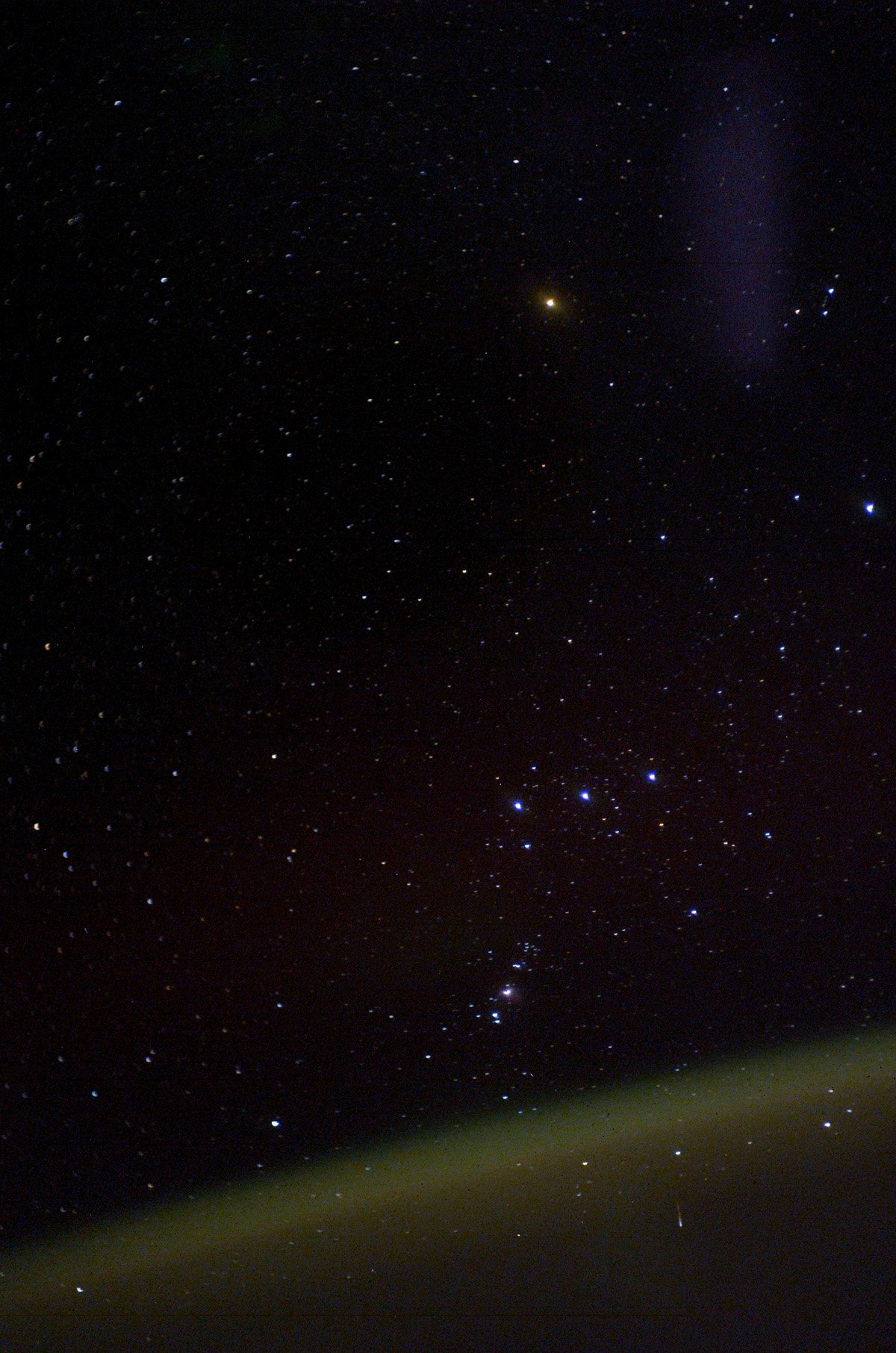
Airglow is the collective name of the various processes in the upper atmosphere that result in the emission of photons, with the driving force being primarily UV radiation from the Sun. It is about a tenth as bright as the collective glow of starlight, requiring clear, dark skies to photograph. Several emission lines are dominant: a green line from oxygen at 557.7 nm, a yellow doublet from sodium at 589.0 and 589.6 nm, red lines from oxygen at 630.0 and 636.4 nm, and various hydroxyl bands.
The sodium emissions come from a sporadic sodium layer approximately 10 km thick at an altitude of 90–100 km, above the mesopause and in the D-layer of the ionosphere. How sodium gets to mesospheric heights is not yet well understood, but it is believed to be mainly from meteor ablation. The red oxygen lines originate at altitudes of about 250 km, in the F-layer. The green oxygen emissions are more spatially distributed, with peaks in the upper mesosphere and lower thermosphere.
In daytime, sodium and red oxygen emissions are dominant and roughly 1,000[citation needed] times as bright as nighttime emissions because in daytime, the upper atmosphere is fully exposed to solar UV radiation. However, the effect is not noticeable to the human eye, since the glare of directly scattered sunlight outshines and obscures it.
Hub AI
Sky brightness AI simulator
(@Sky brightness_simulator)
Sky brightness
Sky brightness refers to the visual perception of the sky and how it scatters and diffuses light. The fact that the sky is not completely dark at night is easily visible. If light sources (e.g. the Moon and light pollution) were removed from the night sky, only direct starlight would be visible.
The sky's brightness varies greatly over the day, and the primary cause differs as well. During daytime, when the Sun is above the horizon, the direct scattering of sunlight is the overwhelmingly dominant source of light. During twilight (the duration after sunset or before sunrise until or since, respectively, the full darkness of night), the situation is more complicated, and a further differentiation is required.
Twilight (both dusk and dawn) is divided into three 6° segments that mark the Sun's position below the horizon. At civil twilight, the center of the Sun's disk appears to be between 1/4° and 6° below the horizon. At nautical twilight, the Sun's altitude is between –6° and –12°. At astronomical twilight, the Sun is between –12° and –18°. When the Sun's depth is more than 18°, the sky generally attains its maximum darkness.
Sources of the night sky's intrinsic brightness include airglow, indirect scattering of sunlight, scattering of starlight, and light pollution.
When physicist Anders Ångström examined the spectrum of the aurora borealis in 1868, he discovered that even on nights when the aurora was absent, its characteristic green line was still present. It was not until the 1920s that scientists were beginning to identify and understand the emission lines in aurorae and of the sky itself, and what was causing them. The green line Angstrom observed is in fact an emission line with a wavelength of 557.76 nm, caused by the recombination of oxygen in the upper atmosphere.
Airglow is the collective name of the various processes in the upper atmosphere that result in the emission of photons, with the driving force being primarily UV radiation from the Sun. It is about a tenth as bright as the collective glow of starlight, requiring clear, dark skies to photograph. Several emission lines are dominant: a green line from oxygen at 557.7 nm, a yellow doublet from sodium at 589.0 and 589.6 nm, red lines from oxygen at 630.0 and 636.4 nm, and various hydroxyl bands.
The sodium emissions come from a sporadic sodium layer approximately 10 km thick at an altitude of 90–100 km, above the mesopause and in the D-layer of the ionosphere. How sodium gets to mesospheric heights is not yet well understood, but it is believed to be mainly from meteor ablation. The red oxygen lines originate at altitudes of about 250 km, in the F-layer. The green oxygen emissions are more spatially distributed, with peaks in the upper mesosphere and lower thermosphere.
In daytime, sodium and red oxygen emissions are dominant and roughly 1,000[citation needed] times as bright as nighttime emissions because in daytime, the upper atmosphere is fully exposed to solar UV radiation. However, the effect is not noticeable to the human eye, since the glare of directly scattered sunlight outshines and obscures it.