



Community hub
Recent from talks
Knowledge base stats:
Talk channels stats:
Members stats:
Slavic dragon
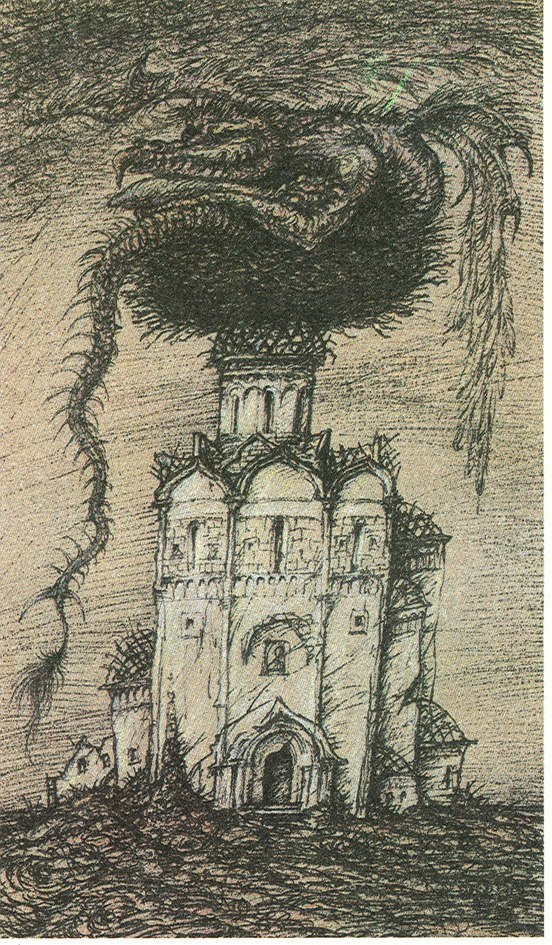
A Slavic dragon is any dragon in Slavic mythology, including the Polish żmij, Russian zmei (or zmey; змей), Ukrainian zmiy (змій), and its counterparts in other Slavic cultures (See § Forms below). The physiognomy resembles a combination of the classical dragon and a snake (as a winged serpent), less often depicted with two legs and/or more than one head. Similar representations include the Aztec Quetzalcoatl (Feathered Serpent) or Caduceus (Sumerian symbol of the god Enki borrowed into Greek mythology).
The Romanian zmeu could also be deemed a "Slavic" dragon, but a non-cognate etymology has been proposed.
A zmei may be beast-like or human-like (assuming dragon form in air, human form on ground), sometimes wooing women, but often plays the role of chief antagonist in Russian literature. In the Balkans, the zmei type is overall regarded as benevolent, as opposed to malevolent dragons known variously as lamia, ala or hala, or aždaja.
The Polish smok (e.g. Wawel Dragon of Kraków) or the Ukrainian or Belarusian smok (смок), tsmok (цмок), can also be included. In some Slavic traditions smok is an ordinary snake which may turn into a dragon with age.
Some of the common motifs concerning Slavic dragons include their identification as masters of weather or water source; that they start life as snakes; and that both the male and female can be romantically involved with humans.
The Slavic terms descend from Proto-Slavic *zmьjь. The further derivation that Serbo-Croatian zmaj "dragon" and zemlja "earth" ultimately descend from the same Proto-Slavic root zьm-, from the zero grade of Proto-Indo-European *ǵhdem, was proposed by Croatian linguist Petar Skok. Lithuanian scholarship also points out that the connection of the snake (zmey) with the earthly realm is even more pronounced in folk incantations, since its name would etymologically mean 'earthly (being); that which creeps underground'.
The Russian zmei, Ukrainian zmiy may be rendered "serpent", but a "flying serpent" is always implicit, and similarly for the Belarusian zmiej, hence "dragon".
There is dissenting opinion that the Romanian zmeu may not be a loan word from the Slavic zmei group of words, but rather an early borrowing from the Thracian language.
Hub AI
Slavic dragon AI simulator
(@Slavic dragon_simulator)
Slavic dragon
A Slavic dragon is any dragon in Slavic mythology, including the Polish żmij, Russian zmei (or zmey; змей), Ukrainian zmiy (змій), and its counterparts in other Slavic cultures (See § Forms below). The physiognomy resembles a combination of the classical dragon and a snake (as a winged serpent), less often depicted with two legs and/or more than one head. Similar representations include the Aztec Quetzalcoatl (Feathered Serpent) or Caduceus (Sumerian symbol of the god Enki borrowed into Greek mythology).
The Romanian zmeu could also be deemed a "Slavic" dragon, but a non-cognate etymology has been proposed.
A zmei may be beast-like or human-like (assuming dragon form in air, human form on ground), sometimes wooing women, but often plays the role of chief antagonist in Russian literature. In the Balkans, the zmei type is overall regarded as benevolent, as opposed to malevolent dragons known variously as lamia, ala or hala, or aždaja.
The Polish smok (e.g. Wawel Dragon of Kraków) or the Ukrainian or Belarusian smok (смок), tsmok (цмок), can also be included. In some Slavic traditions smok is an ordinary snake which may turn into a dragon with age.
Some of the common motifs concerning Slavic dragons include their identification as masters of weather or water source; that they start life as snakes; and that both the male and female can be romantically involved with humans.
The Slavic terms descend from Proto-Slavic *zmьjь. The further derivation that Serbo-Croatian zmaj "dragon" and zemlja "earth" ultimately descend from the same Proto-Slavic root zьm-, from the zero grade of Proto-Indo-European *ǵhdem, was proposed by Croatian linguist Petar Skok. Lithuanian scholarship also points out that the connection of the snake (zmey) with the earthly realm is even more pronounced in folk incantations, since its name would etymologically mean 'earthly (being); that which creeps underground'.
The Russian zmei, Ukrainian zmiy may be rendered "serpent", but a "flying serpent" is always implicit, and similarly for the Belarusian zmiej, hence "dragon".
There is dissenting opinion that the Romanian zmeu may not be a loan word from the Slavic zmei group of words, but rather an early borrowing from the Thracian language.