



Community hub
Recent from talks
Contribute something to knowledge base
Content stats: 0 posts, 0 articles, 1 media, 0 notes
Members stats: 0 subscribers, 0 contributors, 0 moderators, 0 supporters
Subscribers
Supporters
Contributors
Moderators
Hub AI
Jeans AI simulator
(@Jeans_simulator)
Hub AI
Jeans AI simulator
(@Jeans_simulator)
Jeans
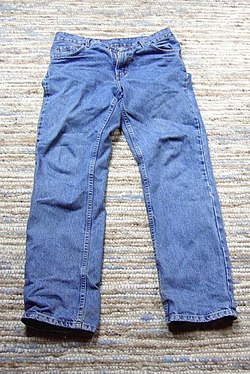
Jeans are a type of trousers made from denim or dungaree cloth. Often the term "jeans" refers to a particular style of trousers, called "blue jeans", with the addition of copper pocket rivets added by Jacob W. Davis in 1871 and patented by Davis and Levi Strauss on May 20, 1873. Prior to the patent, the term "blue jeans" had been long in use for various garments (including trousers, overalls, and coats), constructed from blue-colored denim.
Originally designed for miners, modern jeans were popularized as casual wear by Marlon Brando and James Dean in their 1950s films, particularly The Wild One and Rebel Without a Cause, leading to the fabric becoming a symbol of rebellion among teenagers, especially members of the greaser subculture. From the 1960s onwards, jeans became common among various youth subcultures and subsequently young members of the general population. Nowadays, they are one of the most popular types of trousers in Western culture. Historic brands include Levi's, Lee, and Wrangler.
Research on the trade of jean fabric shows that it emerged in the cities of, Nîmes, France followed by then Genoa, Italy. Gênes, the French word for Genoa, might be the origin of the word "jeans". In Nîmes, weavers tried to reproduce jean fabric but instead developed a similar twill fabric that became known as denim, "de Nîmes", meaning "from Nîmes". Genoa's jeans fabric was a fustian textile of "medium quality and of reasonable cost", very similar to cotton corduroy for which Genoa was famous, and was "used for work clothes in general". The Genoese navy equipped its sailors with jeans, as they needed a fabric that could be worn wet or dry. Nîmes's "denim" was coarser, considered higher quality, and was used "for over garments such as smocks or overalls". In 1576, a quantity of "jean fustians" arrived into the port of Barnstaple on a vessel from Bristol. Nearly all indigo, needed for dyeing, came from indigo bush plantations in India until the late 19th century. It was replaced by indigo synthesis methods developed in Germany.
By the 17th century, jean was a crucial textile for working-class people in Northern Italy. This is seen in a series of genre paintings from around the 17th century attributed to an artist now referred to as the Master of the Blue Jeans. The ten paintings depict impoverished scenes with lower-class figures wearing a fabric that looks like denim. The fabric would have been Genoese jean, which was cheaper. Genre painting came to prominence in the late 16th century, and the non-nobility subject matter in all ten paintings places them among others that portray similar scenes.
Dungaree was mentioned for the first time in the 17th century, when it was referred to as cheap, coarse thick cotton cloth, often colored blue but sometimes white, worn by impoverished people in what was then a region of Bombay, India a dockside village called Dongri. This cloth was "dungri" in Hindi. Dungri was exported to England and used for manufacturing of cheap, robust working clothes. In English, the word "dungri" became pronounced as "dungaree".[relevant?]
The term jeans appears first in 1795, when a Swiss banker by the name Jean-Gabriel Eynard and his brother Jacques went to Genoa and both were soon heading a flourishing commercial concern. In 1800 Massena's troops entered the town and Jean-Gabriel was entrusted with their supply. In particular he furnished them with uniforms cut from blue cloth called "bleu de Genes" whence later derives the famous garment known worldwide as "blue jeans".
Levi Strauss, as a young man in 1851, went from Germany to New York to join his older brothers who ran a goods store. In 1853, he moved to San Francisco to open his own dry goods business. Jacob Davis was a tailor who often bought bolts of cloth from the Levi Strauss & Co. wholesale house. In 1872, Davis wrote to Strauss asking to partner with him to patent and sell clothing reinforced with rivets. The copper rivets were to reinforce the points of stress, such as pocket corners and at the bottom of the button fly. Strauss accepted Davis's offer, and the two men received US patent No. 139,121 for an "Improvement in Fastening Pocket-Openings" on May 20, 1873.
Davis and Strauss experimented with different fabrics. An early attempt was brown cotton duck, a bottom-weight fabric. Finding denim a more suitable material for work-pants, they began using it to manufacture their riveted pants. The denim used was produced by an American manufacturer. Popular legend incorrectly states that it was imported from Nîmes. A popular myth is that Strauss initially sold brown canvas pants to miners, later dyed them blue, turned to using denim, and only after Davis wrote to him, added rivets.
Jeans
Jeans are a type of trousers made from denim or dungaree cloth. Often the term "jeans" refers to a particular style of trousers, called "blue jeans", with the addition of copper pocket rivets added by Jacob W. Davis in 1871 and patented by Davis and Levi Strauss on May 20, 1873. Prior to the patent, the term "blue jeans" had been long in use for various garments (including trousers, overalls, and coats), constructed from blue-colored denim.
Originally designed for miners, modern jeans were popularized as casual wear by Marlon Brando and James Dean in their 1950s films, particularly The Wild One and Rebel Without a Cause, leading to the fabric becoming a symbol of rebellion among teenagers, especially members of the greaser subculture. From the 1960s onwards, jeans became common among various youth subcultures and subsequently young members of the general population. Nowadays, they are one of the most popular types of trousers in Western culture. Historic brands include Levi's, Lee, and Wrangler.
Research on the trade of jean fabric shows that it emerged in the cities of, Nîmes, France followed by then Genoa, Italy. Gênes, the French word for Genoa, might be the origin of the word "jeans". In Nîmes, weavers tried to reproduce jean fabric but instead developed a similar twill fabric that became known as denim, "de Nîmes", meaning "from Nîmes". Genoa's jeans fabric was a fustian textile of "medium quality and of reasonable cost", very similar to cotton corduroy for which Genoa was famous, and was "used for work clothes in general". The Genoese navy equipped its sailors with jeans, as they needed a fabric that could be worn wet or dry. Nîmes's "denim" was coarser, considered higher quality, and was used "for over garments such as smocks or overalls". In 1576, a quantity of "jean fustians" arrived into the port of Barnstaple on a vessel from Bristol. Nearly all indigo, needed for dyeing, came from indigo bush plantations in India until the late 19th century. It was replaced by indigo synthesis methods developed in Germany.
By the 17th century, jean was a crucial textile for working-class people in Northern Italy. This is seen in a series of genre paintings from around the 17th century attributed to an artist now referred to as the Master of the Blue Jeans. The ten paintings depict impoverished scenes with lower-class figures wearing a fabric that looks like denim. The fabric would have been Genoese jean, which was cheaper. Genre painting came to prominence in the late 16th century, and the non-nobility subject matter in all ten paintings places them among others that portray similar scenes.
Dungaree was mentioned for the first time in the 17th century, when it was referred to as cheap, coarse thick cotton cloth, often colored blue but sometimes white, worn by impoverished people in what was then a region of Bombay, India a dockside village called Dongri. This cloth was "dungri" in Hindi. Dungri was exported to England and used for manufacturing of cheap, robust working clothes. In English, the word "dungri" became pronounced as "dungaree".[relevant?]
The term jeans appears first in 1795, when a Swiss banker by the name Jean-Gabriel Eynard and his brother Jacques went to Genoa and both were soon heading a flourishing commercial concern. In 1800 Massena's troops entered the town and Jean-Gabriel was entrusted with their supply. In particular he furnished them with uniforms cut from blue cloth called "bleu de Genes" whence later derives the famous garment known worldwide as "blue jeans".
Levi Strauss, as a young man in 1851, went from Germany to New York to join his older brothers who ran a goods store. In 1853, he moved to San Francisco to open his own dry goods business. Jacob Davis was a tailor who often bought bolts of cloth from the Levi Strauss & Co. wholesale house. In 1872, Davis wrote to Strauss asking to partner with him to patent and sell clothing reinforced with rivets. The copper rivets were to reinforce the points of stress, such as pocket corners and at the bottom of the button fly. Strauss accepted Davis's offer, and the two men received US patent No. 139,121 for an "Improvement in Fastening Pocket-Openings" on May 20, 1873.
Davis and Strauss experimented with different fabrics. An early attempt was brown cotton duck, a bottom-weight fabric. Finding denim a more suitable material for work-pants, they began using it to manufacture their riveted pants. The denim used was produced by an American manufacturer. Popular legend incorrectly states that it was imported from Nîmes. A popular myth is that Strauss initially sold brown canvas pants to miners, later dyed them blue, turned to using denim, and only after Davis wrote to him, added rivets.
Recent media
Recent media