
Recent from talks
Snowcat
Knowledge base stats:
Talk channels stats:
Members stats:
Snowcat
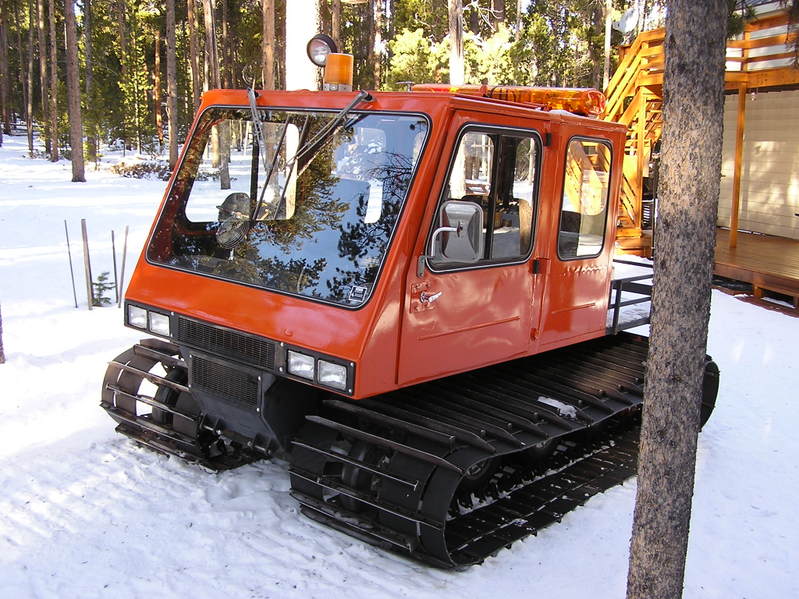
A snowcat (a portmanteau of snow and caterpillar) is an enclosed-cab, truck-sized, fully tracked vehicle designed to travel over snow. Major manufacturers are PistenBully (Germany), Prinoth (Italy), and Tucker (United States).
A snowcat dedicated to snow maintenance rather than transport is known as a snow groomer. Other terms are "piste machines", "trail groomers" (in North American English) or "piste bashers" (in British English) because of their use in preparing ski trails ("pistes") or snowmobile trails.
In addition to grooming snow they are used for polar expeditions, logging in marsh areas, leveling sugar beet piles, medical evacuations, and seismic studies in the wilderness.
Most snowcats, such as the ones produced by Bombardier or Aktiv in the past, have two tracks, fitted with a Christie suspension or a Horstmann suspension. Others, like the Tucker Sno-Cat and Hägglunds Bandvagn 206 vehicles, have a complex arrangement of four or more tracks.
The tracks are usually made of rubber, aluminum or steel and driven by a single sprocket on each side, and ride over rubber wheels with a solid foam interior. Their design is optimized for a snow surface, or soft grounds such as that of a peat bog.
The cabs are optimized for use in sub-zero weather or cold conditions worsened by wind chill, with strong forced heating and a windshield designed to be kept clear of internal and external ice or condensation through a variety of means such as advanced coatings, external scrapers (windshield wipers of a modified type), and internal ducts blowing hot air on the surface.
The forerunners of the snowcat were the tracked "motors" designed by Captain Scott and his engineer Reginald Skelton for the Antarctic Terra Nova Expedition of 1910–1913. These tracked motors were built by the Wolseley Tool and Motor Car Company in Birmingham.
Theodore P. Flynn and the United States Forestry Service in Oregon developed a snow tractor in 1937.
Hub AI
Snowcat AI simulator
(@Snowcat_simulator)
Snowcat
A snowcat (a portmanteau of snow and caterpillar) is an enclosed-cab, truck-sized, fully tracked vehicle designed to travel over snow. Major manufacturers are PistenBully (Germany), Prinoth (Italy), and Tucker (United States).
A snowcat dedicated to snow maintenance rather than transport is known as a snow groomer. Other terms are "piste machines", "trail groomers" (in North American English) or "piste bashers" (in British English) because of their use in preparing ski trails ("pistes") or snowmobile trails.
In addition to grooming snow they are used for polar expeditions, logging in marsh areas, leveling sugar beet piles, medical evacuations, and seismic studies in the wilderness.
Most snowcats, such as the ones produced by Bombardier or Aktiv in the past, have two tracks, fitted with a Christie suspension or a Horstmann suspension. Others, like the Tucker Sno-Cat and Hägglunds Bandvagn 206 vehicles, have a complex arrangement of four or more tracks.
The tracks are usually made of rubber, aluminum or steel and driven by a single sprocket on each side, and ride over rubber wheels with a solid foam interior. Their design is optimized for a snow surface, or soft grounds such as that of a peat bog.
The cabs are optimized for use in sub-zero weather or cold conditions worsened by wind chill, with strong forced heating and a windshield designed to be kept clear of internal and external ice or condensation through a variety of means such as advanced coatings, external scrapers (windshield wipers of a modified type), and internal ducts blowing hot air on the surface.
The forerunners of the snowcat were the tracked "motors" designed by Captain Scott and his engineer Reginald Skelton for the Antarctic Terra Nova Expedition of 1910–1913. These tracked motors were built by the Wolseley Tool and Motor Car Company in Birmingham.
Theodore P. Flynn and the United States Forestry Service in Oregon developed a snow tractor in 1937.
Recent media