
Recent from talks
Social collaboration
Knowledge base stats:
Talk channels stats:
Members stats:
Social collaboration
Social collaboration refers to processes that help multiple people or groups interact and share information to achieve common goals. Such processes find their 'natural' environment on the Internet, where collaboration and social dissemination of information are made easier by current innovations and the proliferation of the web.
Sharing concepts on a digital collaboration environment often facilitates a "brainstorming" process, where new ideas may emerge due to the varied contributions of individuals. These individuals may hail from different walks of life, different cultures and different age groups, their diverse thought processes help in adding new dimensions to ideas, dimensions that previously may have been missed. A crucial concept behind social collaboration is that 'ideas are everywhere.' Individuals are able to share their ideas in an unrestricted environment as anyone can get involved and the discussion is not limited to only those who have domain knowledge.
Social collaboration is also known as enterprise social networking, and the products to support it are often branded enterprise social networks (ESNs).
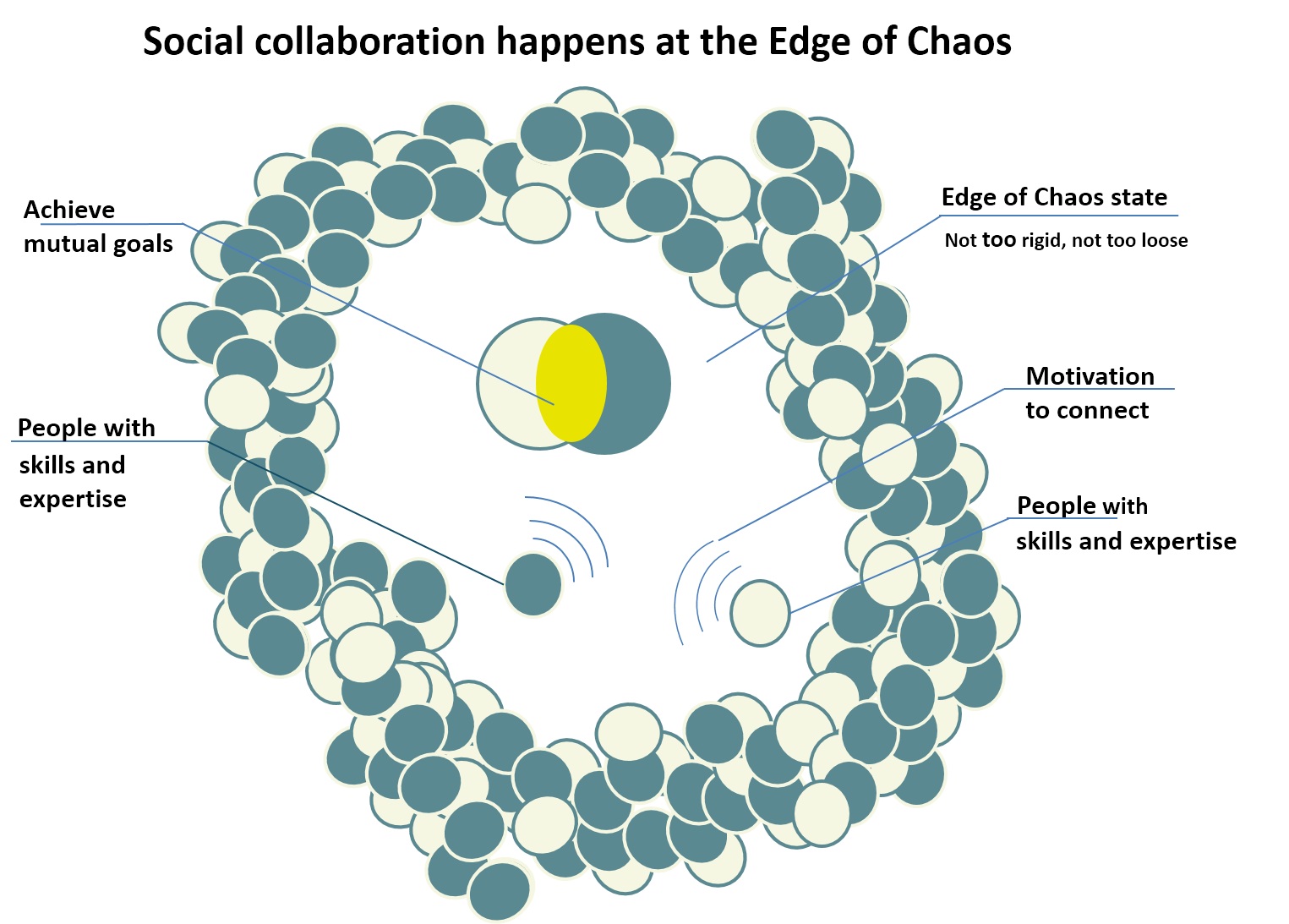
It is important that we understand the rhythm of social collaboration. There needs to be a balance, with ease to move from focused solitary work to brainstorming for problem solving in group work. This critical balance can be achieved by creating structures or a work environment where it is not too rigid to prevent brainstorming in group work nor too loose to result in total chaos. Social collaboration should happen at the edge of chaos.
Work practices should support social collaboration. The most effective environment is one that supports opportunistic planning. Opportunistic planning provides a general plan but then gives enough room for flexibility to change activities and tasks until the last moment. This way, people are able to cope up with unforeseen developments and not throwing away everything with one grand plan.
Social collaboration is related to social networking, with the distinction that while social networking is individual-centric, social collaboration is entirely group-centric. Generally speaking, social networking means socializing for personal, professional or entertainment purposes, for example, LinkedIn and Facebook. Social collaboration, on the other hand, means working socially to achieve a common goal, for example, GitHub and Quora. Social networking services generally focus on individuals sharing messages in a more-or-less undirected way and receiving messages from many sources into a single personalized activity feed. Social collaboration services, on the other hand, focus on the identification of groups and collaboration spaces in which messages are explicitly directed at the group and the group activity feed is seen the same way by everyone.
Social collaboration may refer to time-bound collaborations with an explicit goal to be completed or perpetual collaborations in which the goal is knowledge sharing (e.g. community of practice, online community).
Social collaboration is similar to crowdsourcing as it involves individuals working together towards a common goal. Crowdsourcing is a method for harnessing specific information from a large, diverse group of people. Unlike social collaboration, which involves much communication and cooperation among a large group of people, crowdsourcing is more like individuals working towards the common goal relatively independently. Therefore, the process of working involves less communication.
Hub AI
Social collaboration AI simulator
(@Social collaboration_simulator)
Social collaboration
Social collaboration refers to processes that help multiple people or groups interact and share information to achieve common goals. Such processes find their 'natural' environment on the Internet, where collaboration and social dissemination of information are made easier by current innovations and the proliferation of the web.
Sharing concepts on a digital collaboration environment often facilitates a "brainstorming" process, where new ideas may emerge due to the varied contributions of individuals. These individuals may hail from different walks of life, different cultures and different age groups, their diverse thought processes help in adding new dimensions to ideas, dimensions that previously may have been missed. A crucial concept behind social collaboration is that 'ideas are everywhere.' Individuals are able to share their ideas in an unrestricted environment as anyone can get involved and the discussion is not limited to only those who have domain knowledge.
Social collaboration is also known as enterprise social networking, and the products to support it are often branded enterprise social networks (ESNs).
It is important that we understand the rhythm of social collaboration. There needs to be a balance, with ease to move from focused solitary work to brainstorming for problem solving in group work. This critical balance can be achieved by creating structures or a work environment where it is not too rigid to prevent brainstorming in group work nor too loose to result in total chaos. Social collaboration should happen at the edge of chaos.
Work practices should support social collaboration. The most effective environment is one that supports opportunistic planning. Opportunistic planning provides a general plan but then gives enough room for flexibility to change activities and tasks until the last moment. This way, people are able to cope up with unforeseen developments and not throwing away everything with one grand plan.
Social collaboration is related to social networking, with the distinction that while social networking is individual-centric, social collaboration is entirely group-centric. Generally speaking, social networking means socializing for personal, professional or entertainment purposes, for example, LinkedIn and Facebook. Social collaboration, on the other hand, means working socially to achieve a common goal, for example, GitHub and Quora. Social networking services generally focus on individuals sharing messages in a more-or-less undirected way and receiving messages from many sources into a single personalized activity feed. Social collaboration services, on the other hand, focus on the identification of groups and collaboration spaces in which messages are explicitly directed at the group and the group activity feed is seen the same way by everyone.
Social collaboration may refer to time-bound collaborations with an explicit goal to be completed or perpetual collaborations in which the goal is knowledge sharing (e.g. community of practice, online community).
Social collaboration is similar to crowdsourcing as it involves individuals working together towards a common goal. Crowdsourcing is a method for harnessing specific information from a large, diverse group of people. Unlike social collaboration, which involves much communication and cooperation among a large group of people, crowdsourcing is more like individuals working towards the common goal relatively independently. Therefore, the process of working involves less communication.
Recent media