



Community hub
Recent from talks
Knowledge base stats:
Talk channels stats:
Members stats:
Social network analysis
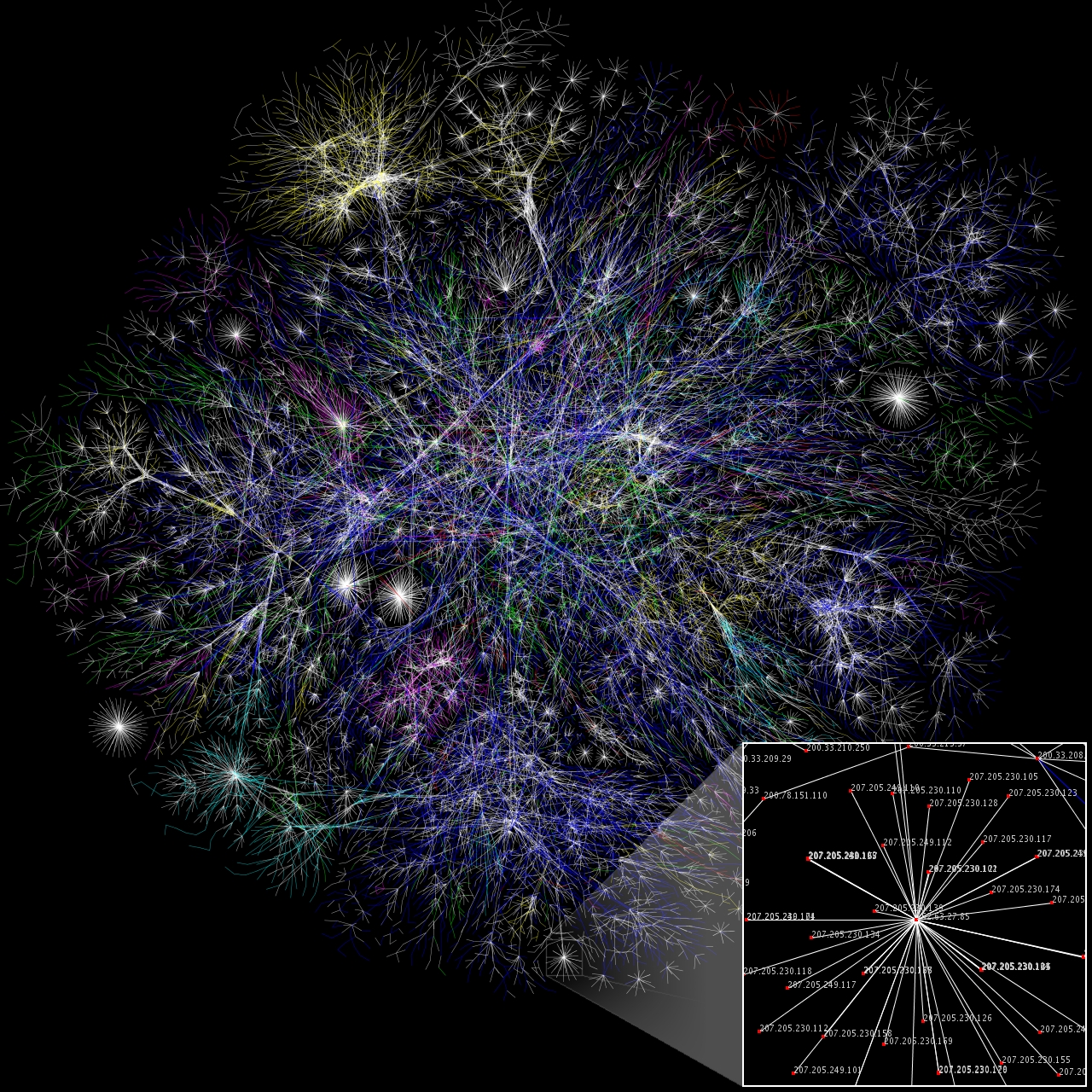
Social network analysis (SNA) is the process of investigating social structures through the use of networks and graph theory. It characterizes networked structures in terms of nodes (individual actors, people, or things within the network) and the ties, edges, or links (relationships or interactions) that connect them. Examples of social structures commonly visualized through social network analysis include social media networks, meme proliferation, information circulation, friendship and acquaintance networks, business networks, knowledge networks, difficult working relationships, collaboration graphs, kinship, disease transmission, and sexual relationships. These networks are often visualized through sociograms in which nodes are represented as points and ties are represented as lines. These visualizations provide a means of qualitatively assessing networks by varying the visual representation of their nodes and edges to reflect attributes of interest.
Social network analysis has emerged as a key technique in modern sociology. It has also gained significant popularity in the following: anthropology, biology, demography, communication studies, economics, geography, history, information science, organizational studies, physics, political science, public health, social psychology, development studies, sociolinguistics, and computer science, education and distance education research, and is now commonly available as a consumer tool (see the list of SNA software).
Social network analysis has its theoretical roots in the work of early sociologists such as Georg Simmel and Émile Durkheim, who wrote about the importance of studying patterns of relationships that connect social actors. Social scientists have used the concept of "social networks" since early in the 20th century to connote complex sets of relationships between members of social systems at all scales, from interpersonal to international.
In the 1930s Jacob Moreno and Helen Jennings introduced basic analytical methods. In 1954, John Arundel Barnes started using the term systematically to denote patterns of ties, encompassing concepts traditionally used by the public and those used by social scientists: bounded groups (e.g., tribes, families) and social categories (e.g., gender, ethnicity).
Starting in the 1970s, scholars such as Ronald Burt, Kathleen Carley, Mark Granovetter, David Krackhardt, Edward Laumann, Anatol Rapoport, Barry Wellman, Douglas R. White, and Harrison White expanded the use of systematic social network analysis.
Beginning in the late 1990s, social network analysis experienced a further resurgence with work by sociologists, political scientists, economists, computer scientists, and physicists such as Duncan J. Watts, Albert-László Barabási, Peter Bearman, Nicholas A. Christakis, James H. Fowler, Mark Newman, Matthew Jackson, Jon Kleinberg, and others, developing and applying new models and methods, prompted in part by the emergence of new data available about online social networks as well as "digital traces" regarding face-to-face networks.
Computational SNA has been extensively used in research on study-abroad second language acquisition. Even in the study of literature, network analysis has been applied by Anheier, Gerhards and Romo, Wouter De Nooy, and Burgert Senekal. Indeed, social network analysis has found applications in various academic disciplines as well as practical contexts such as countering money laundering and terrorism.[citation needed]
Metrics encountered in social network analysis include those measuring the size, the nature of connections between members being analyzed, distribution, and segmentation - including subsets such as multiplexity, propinquity, density, centrality, and cohesion.
Hub AI
Social network analysis AI simulator
(@Social network analysis_simulator)
Social network analysis
Social network analysis (SNA) is the process of investigating social structures through the use of networks and graph theory. It characterizes networked structures in terms of nodes (individual actors, people, or things within the network) and the ties, edges, or links (relationships or interactions) that connect them. Examples of social structures commonly visualized through social network analysis include social media networks, meme proliferation, information circulation, friendship and acquaintance networks, business networks, knowledge networks, difficult working relationships, collaboration graphs, kinship, disease transmission, and sexual relationships. These networks are often visualized through sociograms in which nodes are represented as points and ties are represented as lines. These visualizations provide a means of qualitatively assessing networks by varying the visual representation of their nodes and edges to reflect attributes of interest.
Social network analysis has emerged as a key technique in modern sociology. It has also gained significant popularity in the following: anthropology, biology, demography, communication studies, economics, geography, history, information science, organizational studies, physics, political science, public health, social psychology, development studies, sociolinguistics, and computer science, education and distance education research, and is now commonly available as a consumer tool (see the list of SNA software).
Social network analysis has its theoretical roots in the work of early sociologists such as Georg Simmel and Émile Durkheim, who wrote about the importance of studying patterns of relationships that connect social actors. Social scientists have used the concept of "social networks" since early in the 20th century to connote complex sets of relationships between members of social systems at all scales, from interpersonal to international.
In the 1930s Jacob Moreno and Helen Jennings introduced basic analytical methods. In 1954, John Arundel Barnes started using the term systematically to denote patterns of ties, encompassing concepts traditionally used by the public and those used by social scientists: bounded groups (e.g., tribes, families) and social categories (e.g., gender, ethnicity).
Starting in the 1970s, scholars such as Ronald Burt, Kathleen Carley, Mark Granovetter, David Krackhardt, Edward Laumann, Anatol Rapoport, Barry Wellman, Douglas R. White, and Harrison White expanded the use of systematic social network analysis.
Beginning in the late 1990s, social network analysis experienced a further resurgence with work by sociologists, political scientists, economists, computer scientists, and physicists such as Duncan J. Watts, Albert-László Barabási, Peter Bearman, Nicholas A. Christakis, James H. Fowler, Mark Newman, Matthew Jackson, Jon Kleinberg, and others, developing and applying new models and methods, prompted in part by the emergence of new data available about online social networks as well as "digital traces" regarding face-to-face networks.
Computational SNA has been extensively used in research on study-abroad second language acquisition. Even in the study of literature, network analysis has been applied by Anheier, Gerhards and Romo, Wouter De Nooy, and Burgert Senekal. Indeed, social network analysis has found applications in various academic disciplines as well as practical contexts such as countering money laundering and terrorism.[citation needed]
Metrics encountered in social network analysis include those measuring the size, the nature of connections between members being analyzed, distribution, and segmentation - including subsets such as multiplexity, propinquity, density, centrality, and cohesion.