Hubbry Logo
SociogramSociogramMain
Open search
Sociogram
Community hub
Sociogram
logo
8 pages, 0 posts
0 subscribers
Be the first to start a discussion here.
Sociogram
Sociogram
from Wikipedia
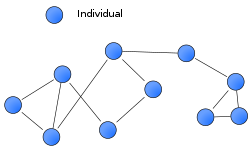
An example of a social network diagram

A sociogram is a graphic representation of social links that a person has. It is a graph drawing that plots the structure of interpersonal relations in a group situation.[1]

Overview

[edit]

Sociograms were developed by Jacob L. Moreno to analyze choices or preferences within a group.[2][3] They can diagram the structure and patterns of group interactions. A sociogram can be drawn on the basis of many different criteria: Social relations, channels of influence, lines of communication etc.

Those points on a sociogram who have many choices are called stars. Those with few or no choices are called isolates. Individuals who choose each other are known to have made a mutual choice. One-way choice refers to individuals who choose someone but the choice is not reciprocated. Cliques are groups of three or more people within a larger group who all choose each other (mutual choice).

Sociograms are the charts or tools used to find the sociometry of a social space.

Under the social discipline model, sociograms are sometimes used to reduce misbehavior in a classroom environment.[4] A sociogram is constructed after students answer a series of questions probing for affiliations with other classmates. The diagram can then be used to identify pathways for social acceptance for misbehaving students. In this context, the resulting sociograms are known as a friendship chart. Often, the most important person/thing is in a bigger bubble in relation to everyone else. The size of the bubble represents the importance, with the biggest bubble meaning most important and the smallest representing the least important.

[edit]

See also

[edit]

References

[edit]
[edit]
Revisions and contributorsEdit on WikipediaRead on Wikipedia
from Grokipedia
A sociogram is a graphical representation of the interpersonal relationships, attractions, and repulsions within a , typically depicted using nodes for individuals and directed lines or arrows to indicate choices or preferences among them. Developed by in the early as a core tool of —the quantitative study of and social structures—it maps patterns such as mutual choices (cliques), one-sided attractions, isolates (individuals with few connections), and stars (highly chosen members) to reveal underlying social configurations. Moreno, a Romanian-born American innovator in group psychotherapy, first applied sociograms empirically during his work with delinquent girls at the New York State Training School in Hudson in 1932, where he used sociometric tests to ask participants about preferences for roommates, work partners, or friends, then plotted the results to diagnose and improve group harmony. His seminal book, Who Shall Survive? Foundations of Sociometry, Group Psychotherapy and Sociodrama (first published in 1934 and revised in 1953), formalized sociograms as visual aids for understanding emotional expansiveness, tele (interpersonal feeling units), and sociodynamic effects like persistent social exclusion. This approach stemmed from Moreno's observations in Vienna starting in 1915, influenced by his theater background and critiques of traditional sociology's failure to capture psychological interpersonal bonds. In practice, sociograms are constructed through targeted questioning (e.g., "Who would you choose to sit next to?") followed by diagramming, often with symbols like circles for individuals and colored lines for tie strengths or types, making them effective for small groups of up to about 20 people to avoid visual clutter. Applications extend beyond therapy to fields like , , and ; for instance, Moreno used them to reassign girls in the Hudson study, reducing by fostering compatible subgroups and addressing racial or emotional tensions. Today, sociograms inform in social sciences, helping to study communication flows, leadership emergence, and stakeholder dynamics in participatory or migration research.

History and Development

Origins in Sociometry

, defined as the quantitative study of social relationships and the measurement of interpersonal attractions and repulsions within groups, was pioneered by psychiatrist in the early . , born in 1889 in and educated in , developed these ideas during his time in Austria, where he explored through theatrical and therapeutic methods before immigrating to New York in 1925. There, he expanded his work into empirical social research, founding the basis for sociometry as a scientific approach to understanding social structures. In 1933, the concept gained public attention through a New York Times article describing Moreno's mappings of relationships. The sociogram was developed by Moreno in the early 1930s and first systematically presented in as a graphical representation to visualize patterns of interpersonal choices and attractions in social groups, transforming abstract relational data into diagrammatic form. This tool emerged from Moreno's sociometric framework, allowing researchers to plot directed connections—such as preferences or rejections—between individuals, often using arrows to indicate direction and strength. The concept was first systematically presented in Moreno's seminal book Who Shall Survive?, published that year, where he illustrated the sociogram using data from schoolchildren's expressed preferences for playmates, demonstrating how such mappings could reveal underlying group cohesion and isolation. Moreno's early experiments applied sociograms to uncover social structures in institutional settings, including prisons and schools, highlighting phenomena like mutual choices (reciprocal attractions) and rejections (unilateral isolations). For instance, between 1931 and 1932, he conducted sociometric studies at Prison in New York, using choice-based questionnaires to map inmate relationships and inform rehabilitation efforts by identifying social cliques and isolates. Similarly, from 1932 to 1938, Moreno analyzed the New York State Training School for Girls at Hudson, where sociograms exposed patterns of interpersonal dynamics among residents, such as chains of mutual preferences that influenced group stability. These applications underscored sociometry's potential to quantify and intervene in social processes, laying groundwork for later developments in network analysis.

Key Contributors and Evolution

Helen Hall Jennings emerged as a pivotal figure in the application of sociograms during the 1940s and 1950s, collaborating closely with J.L. Moreno to extend their use in . Her work focused on adolescent friendships and social dynamics in school settings, notably through studies at institutions like the Hudson School for Girls. In her 1943 book Leadership and Isolation: A Study of Personality in Interpersonal Relations, Jennings employed sociometric methods to map interpersonal choices, revealing patterns of leadership and among youth. This research shifted sociograms toward practical insights into group formation and individual adjustment in educational environments. In the mid-20th century, particularly the and , sociograms evolved through integration with , transforming qualitative depictions into semi-quantitative tools for analyzing social structures. Researchers such as Frank Harary, Robert Norman, and Dorwin Cartwright formalized this shift by applying graph-theoretic concepts like cliques, paths, and to sociometric data, enabling the measurement of network properties in small groups. Their collaborative work, including the 1965 book Structural Models: An Introduction to the Theory of Directed Graphs, provided mathematical frameworks that enhanced the precision of sociogram interpretations. This period marked a transition from Moreno's intuitive diagrams to more rigorous, computational approaches in . Post-1970s developments saw sociograms fully incorporated into (SNA), with Mark Granovetter's 1973 paper "The Strength of Weak Ties" highlighting their utility in examining broader relational dynamics. Granovetter utilized sociogram-inspired visualizations to demonstrate how weak ties bridge dense clusters, facilitating information diffusion and in larger populations. This integration expanded sociometry's scope beyond therapy-focused applications, influencing SNA's emphasis on structural embeddedness and tie strength. Key milestones include the computerization of sociograms, which leveraged personal computers for automated generation and interactive displays, moving away from hand-drawn representations. Programs like early versions of network visualization software enabled color-coded and dynamic mappings of complex relations. In the , adaptations for online social networks have further digitized sociograms, applying them to platforms like to analyze vast digital interactions and connectivity patterns. Tools now incorporate algorithms for large-scale data, revealing trends in virtual communities and information spread.

Methodology

Data Collection Techniques

The primary technique for collecting data in sociometry is the , which uses fixed-choice questions to capture individuals' preferences and aversions toward others in a group, thereby mapping relational structures. Developed by in his foundational work, these questionnaires focus on spontaneous choices within specific social criteria, such as seating arrangements or work partnerships, to reveal attractions and repulsions without relying on self-reported traits. Questions in sociometric questionnaires are categorized into positive and negative types to comprehensively assess relational dynamics, with indifference derived from the absence of nominations. Positive questions elicit attractions, such as "Name three people you would most like to work with," while negative questions probe rejections, for example, "Who do you least prefer to sit beside?" To prevent respondent fatigue and ensure focused responses, choices are typically limited, such as nominating a top three ranked by preference (e.g., first, second, and third choices), with points assigned for ranking in some scoring systems. In modern practice, can also utilize digital tools such as online surveys and web applications to facilitate nominations in larger or remote groups. is crucial for accurate , prioritizing closed groups where all members interact regularly, such as classrooms of 20-30 students, to enable complete mapping of relations without external influences. In larger populations, sampling methods may be employed, such as selecting representative subgroups or using roster-based nominations from all grademates to maintain validity, though full participation is ideal for capturing total network effects. Ethical considerations are paramount in sociometric data collection due to the sensitive nature of relational revelations. must be obtained from participants (and parents or guardians for minors), explaining the study's purpose, voluntary participation, and potential emotional impacts, with high participation rates (e.g., over 90%) achieved through clear communication. in reporting is ensured by aggregating data and using codes or rosters instead of names in analyses, preventing individual identification. Handling negative nominations, which can highlight rejections and risk emotional harm, involves participants, emphasizing group-level insights over personal feedback, and avoiding direct sharing of results that could stigmatize individuals.

Constructing the Diagram

The construction of a sociogram begins with representing individuals in a group as nodes, commonly depicted as points, circles for females, or triangles for males, to visually encode demographic or role-based distinctions. Relationships derived from sociometric data, such as choices or preferences, are then illustrated as edges connecting these nodes: solid lines typically denote mutual or reciprocal ties, dashed lines indicate one-way relationships, and arrows specify directionality in asymmetric interactions, such as unilateral attractions or rejections. This symbolic system allows for clear differentiation of interpersonal dynamics, with additional conventions like colored lines—red for positive attractions and black for repulsions—enhancing interpretability in complex diagrams. Layout principles emphasize spatial organization to mirror the underlying , positioning mutually connected nodes closer together to form clusters, chains, or isolated stars that highlight central figures or peripheral individuals. For instance, in a star configuration, a highly chosen individual is placed at with radiating lines to others, minimizing edge crossings and revealing emergent patterns like subgroups or isolates without relying on predefined grids. These arrangements prioritize psychological proximity over physical space, often requiring iterative manual adjustments to balance clarity and fidelity to the data. Traditionally, sociograms for small groups are constructed manually by hand-drawing nodes and edges on paper or charts, a method suited to exploratory in settings like classrooms or groups where rapid visualization aids immediate insight. For larger datasets, digital tools have become standard since the ; software such as UCINET, which integrates matrix-based input with NetDraw for visualization, enables scalable construction of sociograms by importing relational data and applying layout algorithms to automate positioning. Similarly, , introduced in 2008, supports interactive editing of directed and undirected graphs, allowing users to filter edges and apply force-directed layouts for dynamic exploration of network patterns. Variations in sociogram construction distinguish directed forms, which use arrows to capture the flow of choices (e.g., from chooser to chosen), from undirected versions that employ simple lines for symmetric reciprocity, simplifying representation in egalitarian or balanced groups. These adaptations ensure the aligns with the study's focus, such as one-sided preferences in educational settings versus mutual bonds in workplaces.

Interpretation and Analysis

Basic Elements and Patterns

A sociogram represents social relationships through a network diagram where nodes depict individuals within a group, and directed edges, often shown as arrows, illustrate the nature and direction of interpersonal choices or attractions. Nodes are typically symbolized as circles or other shapes to distinguish categories, such as circles for girls and triangles for boys, allowing for immediate visual differentiation in diverse groups. Edges convey relational dynamics, with conventions like red lines for positive attractions, black for rejections, and numbering to indicate preference rank, such as first or second choices, enabling a clear mapping of one-sided or mutual connections. Isolates appear as nodes lacking any edges, signifying individuals who neither receive nor extend choices, which can highlight social exclusion within the group. These unconnected nodes are common in early sociograms, comprising up to 35% of participants in kindergarten settings and decreasing to around 18% by eighth grade as relational complexity grows. Dyads manifest as pairs of nodes linked by mutual edges, often visualized as crossed arrows, representing reciprocal attractions that form the simplest stable bonds, while triads extend this to three interconnected nodes forming a triangle, indicating emerging group cohesion or conflict if rejections are involved. Common patterns in sociograms include cliques, or dense subgroups of mutually connected nodes forming clusters like squares or bunches, which reveal tightly knit alliances isolated from the broader network. Chains depict linear sequences of directed edges linking multiple nodes, such as a series of one-way attractions propagating through the group, often leading toward more central figures. emerge as a single prominent node surrounded by numerous incoming edges, illustrating a hub of or influence surrounded by spokes of connections. Qualitative analysis begins with visual inspection to identify social roles: a node with many incoming edges typically signifies a leader or star, central to group cohesion, while a node with numerous outgoing edges but few reciprocals may indicate a seeker actively pursuing connections yet facing rejection. These patterns provide initial insights into dynamics like and isolation without requiring computational metrics. For instance, in a sociogram derived from students' choices of seating partners, an isolated appears as a lone node with no edges, underscoring potential and prompting early interventions to foster inclusion.

Advanced Analytical Methods

Advanced analytical methods in sociogram analysis extend beyond visual inspection by applying quantitative metrics from to measure structural properties such as , cohesion, and community structure. These techniques treat the sociogram as a graph where nodes represent individuals and directed or undirected edges represent social choices or relations, enabling precise computation of network characteristics. Seminal contributions, including those by Linton Freeman, formalized these measures to quantify positions and influences within social structures. Degree centrality is a foundational metric that quantifies an individual's prominence based on the number of direct connections, calculated as the degree of a node, which equals the number of edges connected to it. In directed sociograms, typical of sociometric choices, in-degree centrality measures the number of incoming ties (choices received, indicating or ), while out-degree centrality counts outgoing ties (choices made, reflecting expansiveness or initiative). For a node ii with degree kik_i, the raw degree is simply kik_i, often normalized relative to the maximum possible in the network for comparability. This measure highlights isolates (degree 0) versus hubs with high connectivity, providing insights into local influence without considering indirect paths. Other key metrics include , which assesses a node's role as a bridge or broker by measuring how often it lies on the shortest paths (geodesics) between other pairs of nodes, and the , which evaluates the density of subgroups around a node. for a node vv is the sum over all pairs of the proportion of geodesics passing through vv, normalized to range from 0 to 1, identifying gatekeepers who control in the network. The local CiC_i for node ii is given by Ci=number of triangles involving ipossible trianglesC_i = \frac{\text{number of triangles involving } i}{\text{possible triangles}}, where possible triangles equal (ki2)\binom{k_i}{2} for undirected graphs, revealing the tendency for an individual's connections to form tight-knit clusters. These metrics complement degree by capturing global connectivity and local cohesion, respectively. Software tools like Pajek facilitate the computation of these and additional metrics on sociograms, supporting analysis of large networks with up to billions of edges. Pajek calculates network density as the proportion of observed edges to possible edges, providing a global measure of connectivity (e.g., density = 2mn(n1)\frac{2m}{n(n-1)} for undirected graphs with mm edges and nn nodes), and employs modularity optimization for community detection, partitioning the network into densely connected subgroups while minimizing inter-group ties. The Louvain algorithm in Pajek, for instance, iteratively optimizes modularity Q=12mij(Aijkikj2m)δ(ci,cj)Q = \frac{1}{2m} \sum_{ij} \left( A_{ij} - \frac{k_i k_j}{2m} \right) \delta(c_i, c_j), where AijA_{ij} is the adjacency matrix entry, kik_i and kjk_j are degrees, and δ\delta indicates community membership, to reveal latent social clusters. These tools integrate centrality computations, such as degree and betweenness, with visualization for exploratory analysis. Statistical extensions involve representing sociograms as for eigenvalue analysis to detect cohesive subgroups through spectral decomposition. The AA, where Aij=1A_{ij} = 1 if a tie exists from ii to jj and 0 otherwise, can be row-normalized (dividing entries by row sums) before eigen decomposition, yielding eigenvectors that correspond to structural positions. The principal eigenvector often identifies the most cohesive core, as nodes with high loadings form densely interconnected subgroups, while methods like NEGOPY iterate on the matrix to converge on clusters in 4-8 steps. This approach, rooted in , quantifies subgroup cohesion by examining eigenvalue magnitudes and eigenvector patterns, distinguishing tight groups from peripheral actors.

Applications

In Education and Child Development

In educational settings, sociograms serve as a valuable tool for mapping classroom social networks, enabling educators to identify key patterns of interaction that influence student well-being. For instance, students exhibiting high out-degrees in negative nominations—such as those frequently rejecting or disliking peers—may indicate potential bullies, while those receiving high incoming rejections often emerge as victims prone to isolation or . Popular students, characterized by high in-degrees of positive choices, can be leveraged to promote positive dynamics. These insights allow teachers to address imbalances early, fostering a more inclusive environment without relying solely on subjective observations. In child development contexts, particularly preschools, sociograms track peer preferences to detect early signs of social isolation, helping professionals intervene before patterns solidify into long-term challenges. By visualizing choices for playmates or friends, educators can pinpoint neglected or rejected children who receive few nominations, signaling risks for emotional and behavioral issues. Seminal work in the 1930s by Helen Hall Jennings applied sociometric methods to adolescent groups, revealing how conformity pressures shape peer selections and leadership emergence, with isolated individuals often sidelined due to non-conforming traits. Her studies at institutions like the New York State Training School for Girls demonstrated that sociograms illuminate developmental shifts in social expansiveness during adolescence, informing strategies to build resilience. Teacher-led interventions based on sociograms promote inclusion by strategically regrouping students, such as pairing social isolates with highly chosen "stars" to encourage reciprocal interactions and reduce cliques. This approach, rooted in sociatric principles, links popular members to marginalized ones, gradually expanding networks and diminishing rejection. Post-2000 research supports the efficacy of such targeted programs; for example, a socioemotional intervention incorporating sociometric assessments in reduced peer rejection rates from 9.9% to 7.3% in experimental groups, representing a relative decrease of approximately 26%. Similarly, school-based initiatives using sociograms for identification have shown odds reductions in victimization by approximately 32% in intervention arms (adjusted 0.68), highlighting their role in curbing aggressive dynamics. In 2024, sociograms have been applied in to map relationships in socially vulnerable communities, aiding inclusive .

In Organizational and Workplace Settings

In organizational settings, sociograms are employed to map informal social networks within teams, revealing hidden communication patterns and relationships that formal hierarchies often overlook. By visualizing ties such as advice-seeking or , these diagrams identify key like knowledge brokers—individuals with high who bridge disconnected groups and facilitate information flow—enabling managers to optimize team structures for better coordination. For instance, in a small studied in the 1980s, sociometric of advice networks uncovered informal influencers who accelerated problem-solving across departments, demonstrating how such mapping enhances overall communication efficiency. Sociograms also serve as diagnostic tools in human resources for addressing structural challenges, such as during merger integrations or , by highlighting cliques, isolates, and bottlenecks in interpersonal dynamics. In the 1980s research by David Krackhardt on organizational advice networks, sociograms revealed discrepancies between perceived and actual relationships, allowing HR professionals to intervene in conflicts by realigning teams around trusted connections rather than rigid org charts. This approach has been applied in corporate interventions to foster integration post-merger, where mapping pre-existing networks helps preserve productivity and morale amid change. The benefits of sociogram-based interventions include boosted through targeted restructuring, such as dissolving by promoting cross-clique interactions, which can reduce collaboration overload and improve knowledge sharing. A notable in a large Dutch firm utilized sociograms derived from organizational network analysis of and meeting across 1,100 employees, uncovering in business units with low cross-team connectivity (e.g., 42.5% of teams exhibited suboptimal ). This revelation prompted cross-departmental initiatives, such as targeted programs, which strengthened inter-unit bonds and addressed post-pandemic isolation in remote-hybrid environments.

In Clinical and Social Psychology

In group therapy, sociograms originated with Jacob L. Moreno's development of , where they served as visual tools to map interpersonal attractions and repulsions, thereby revealing trust levels within the group to guide therapeutic interventions like and enactment. Moreno integrated into psychodrama sessions to identify relational patterns, enabling therapists to facilitate interventions that repair social atoms—individual networks of relationships—and promote spontaneity and emotional among participants. This approach, foundational to , emphasized diagnosing through sociograms to foster cohesion and address interpersonal barriers in therapeutic settings. In research, sociometric techniques have been used to examine and linking isolate positions to adverse outcomes such as increased depression and . For instance, research demonstrated that children identified as sociometric isolates—those receiving few or no positive choices—exhibited higher rates of emotional distress and withdrawal, informing theories on how contributes to psychological vulnerability. These experiments highlighted sociograms' utility in quantifying influence networks, showing that central figures often exerted greater pressure while isolates faced heightened risks of depressive symptoms due to exclusion. As clinical tools, sociograms are applied in family counseling and support groups to diagram alliances, coalitions, and conflicts, providing therapists with a clear representation of relational hierarchies and tensions. In , they help uncover hidden dynamics, such as cross-generational alliances or patterns, allowing interventions to redistribute power and improve communication. Similarly, in support groups for conditions like or , sociograms map emerging bonds and isolations to enhance group cohesion. Modern applications extend to interventions for autism spectrum disorder, where sociograms assess peer networks in social skills groups, targeting isolates for structured peer integration activities to build reciprocal interactions and reduce social withdrawal. Evidence from meta-analyses in the 2000s supports sociograms' role in psychodrama-based therapies for reducing by identifying and addressing relational gaps, such as low mutuality or isolation. A 2002 of psychodramatic techniques (excluding sociometry-focused studies) found an overall moderate to large (ES=0.95) in alleviating social avoidance and distress through techniques like and doubling. These outcomes underscore sociograms' contribution to therapeutic efficacy, with integrated approaches showing sustained reductions in anxiety symptoms through enhanced interpersonal awareness and connection.

Limitations and Modern Alternatives

Common Criticisms

One major criticism of sociograms is their heavy reliance on self-reported choices, which introduces subjectivity and vulnerability to biases such as , where participants may alter responses to appear more favorable or avoid . This can lead to inaccurate recall or distorted nominations, as individuals' moods or perceptions influence their reporting, undermining the method's validity in capturing true social preferences. For instance, in studies of peer relationships, respondents often overreport positive ties or underreport rejections to align with perceived social norms. Sociograms also suffer from their static nature, providing only a momentary snapshot of relationships that fails to account for dynamic changes over time or the intensity and of interactions. Ethical concerns are prominent, particularly the potential for stigmatization of isolates or individuals identified through the method, which can exacerbate feelings of exclusion and harm in vulnerable groups like children. In small groups, issues arise from the exposure of personal relationships, raising risks of psychological harm or if results are mishandled. Additionally, the labeling of participants as "popular" or "rejected" can perpetuate negative stereotypes, with studies highlighting long-term effects on peer interactions post-testing. Empirical critiques from the onward have highlighted low reliability of sociograms in diverse cultural settings, attributed to varying norms of disclosure and social expression that affect nomination patterns across groups.

Contemporary Tools and Extensions

Modern digital tools have significantly advanced the creation and analysis of sociograms by enabling processing, interactive visualizations, and integration with large-scale datasets, addressing limitations of traditional manual methods such as static representations. NodeXL, a plugin for developed by the Social Media Research Foundation, facilitates the import, analysis, and visualization of data from platforms like (now X) and , allowing users to generate dynamic sociograms that update with live feeds for interactive exploration of network structures. Similarly, Social Network Visualizer (SocNetV), an open-source cross-platform application, supports the construction of sociograms from adjacency matrices or edge lists, offering algorithms for measures, clustering, and layout optimization to produce customizable, animated visualizations suitable for both research and educational purposes. Extensions of sociogram methodologies now incorporate from online social networks, enabling the mapping of vast, dynamic interactions that were infeasible with paper-based approaches. For instance, tools like integrate Twitter API data to construct sociograms of user relationships within surveyed populations, revealing patterns in information diffusion and community formation through weighted edges representing interaction frequency. Multilayer sociograms extend this by modeling multiple relationship types simultaneously, such as directed interactions on Twitter analyzed via topic modeling and network layers, which capture evolving discussions across semantic dimensions like politics or . Beyond visualization, statistical alternatives like Exponential Random Graph Models (ERGMs) provide inferential frameworks for sociogram data, modeling network dependencies probabilistically to test hypotheses about tie formation rather than relying solely on graphical patterns. ERGMs, formalized in seminal works, simulate network configurations based on parameters for reciprocity, transitivity, and , offering rigorous validation of observed sociogram structures in empirical studies of social ties. Since the , AI-driven techniques have enhanced pattern detection in sociograms by automating the identification of anomalies and clusters; for example, algorithms applied to data detect bot behaviors or emergent communities through unsupervised clustering, improving scalability for large-scale analyses. Emerging trends point toward immersive and applied extensions, such as (VR) environments for sociogram interaction, where users can navigate 3D network models to analyze collaboratively. Systems like the Immersive Study Analyzer enable researchers to review recorded social VR interactions as interactive sociograms, coding behaviors like proximity and in real-time for deeper insights into team cohesion. In epidemiology, sociograms derived from data have supported response efforts by visualizing transmission networks; methods, including sociometric mapping, identified high-risk clusters in outbreak investigations, informing targeted interventions to curb spread.

References

Add your contribution
Related Hubs
User Avatar
No comments yet.