
Recent from talks
Socotra
Knowledge base stats:
Talk channels stats:
Members stats:
Socotra
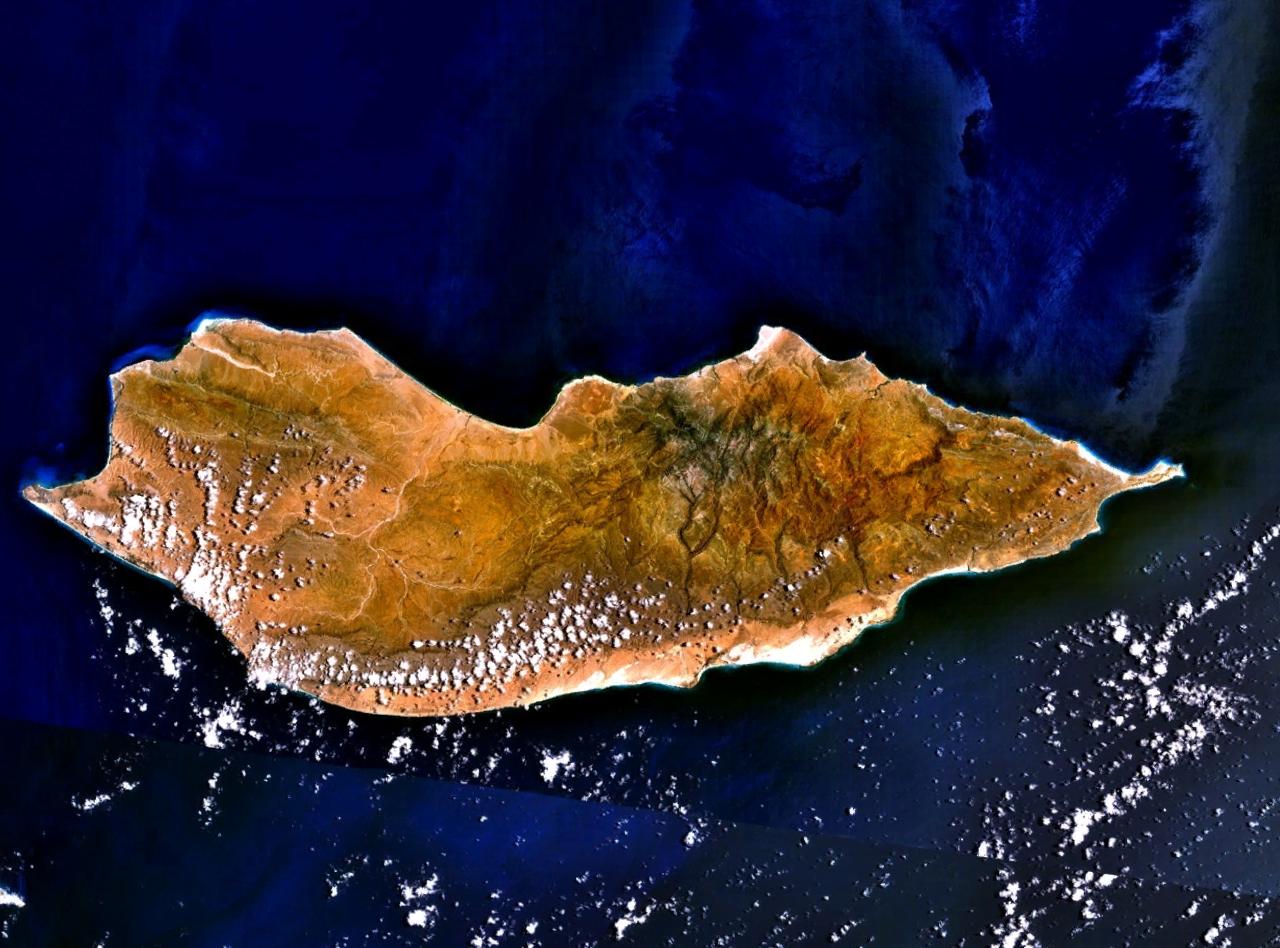
Socotra, locally known as Saqatri, is a Yemeni island in the Indian Ocean. Situated between the Guardafui Channel and the Arabian Sea, it lies near major shipping routes. Socotra is the largest of the six islands in the Socotra archipelago as it comprises around 95% of the landmass of the archipelago. It lies 380 kilometres (205 nautical miles) south of the Arabian Peninsula and 232 km (125 nmi) east of the Horn of Africa. The inhabitants of the island are called Socotrans, and they speak Arabic and Soqotri.
Socotra is home to a high number of unique species that are endemic to it. Up to a third of its plant life is unique. Due to the island's unusual geography, it has been described as "the most alien-looking place on Earth". The island measures 132 km (82 mi) in length and 42 km (26 mi) across at its widest. In 2008, Socotra was recognised as a UNESCO World Heritage Site.
The island is under the control of the Southern Transitional Council (STC), a United Arab Emirates-backed, pro-Presidential Leadership Council (PLC), "secessionist" faction in Yemen's ongoing civil war. The STC seized control of the island following a coup in 2020, ousting the local authorities and establishing its own governance.
Scholars' views vary regarding the origin of the island's name. One theory is that the term Socotra may derive from a Greek name that is derived from the name of a South Arabian tribe mentioned in Sabaic and Ḥaḍraumitic inscriptions as Dhū-Śakūrid (s³krd). Another theory is that the Arabic term Suqutra broken down as follows: Suq, means market, and qutra is a vulgar form of qatir, which refers to dragon's blood. The capital city of Socotra was Suq as reported by the Portuguese in the 16th century, which they referred to as market place.
There was initially an Oldowan lithic culture in Socotra. Oldowan stone tools were found in the area around Hadibo in 2008. Socotra played an important role in the ancient international trade and appears as Dioskouridou (Διοσκουρίδου νῆσος), meaning "the island of Dioscurides" in the Periplus of the Erythraean Sea, a first-century AD Greek navigation aid.
The Hoq Cave contains a large number of inscriptions, drawings and archaeological objects. Further investigation showed that these had been left by sailors who visited the island between the first century BC and the sixth century AD. The texts are written in the Indian Brāhmī, South Arabian, Ethiopic, Greek, Palmyrene and Bactrian languages. This corpus of nearly 250 texts and drawings constitutes one of the main sources for the investigation of Indian Ocean trade networks in that time period.
In 880, an Aksumite expeditionary force conquered the island, and an Oriental Orthodox bishop was consecrated. The Ethiopians were later dislodged by a large armada sent by Imam Al-Salt bin Malik of Oman. According to the Persian geographer Ibn al-Mujawir, who testifies having arrived in Socotra from India in 1222, there were two groups of people on the island, the indigenous mountain dwellers and the foreign coastal dwellers. There were large settlements of Indian traders from Sindh and Balochistan.
Ibn Hawqal, a 10th-century history chronicler, mentions Socotra in his book The Renaissance of Islam. He mentioned it as a prominent source of piracy, stating: "the island Socotra in particular was regarded as a dangerous nest of pirates, at which people trembled as they passed it. It was the point d'appui of the Indian pirates who ambushed the Believers there."
Hub AI
Socotra AI simulator
(@Socotra_simulator)
Socotra
Socotra, locally known as Saqatri, is a Yemeni island in the Indian Ocean. Situated between the Guardafui Channel and the Arabian Sea, it lies near major shipping routes. Socotra is the largest of the six islands in the Socotra archipelago as it comprises around 95% of the landmass of the archipelago. It lies 380 kilometres (205 nautical miles) south of the Arabian Peninsula and 232 km (125 nmi) east of the Horn of Africa. The inhabitants of the island are called Socotrans, and they speak Arabic and Soqotri.
Socotra is home to a high number of unique species that are endemic to it. Up to a third of its plant life is unique. Due to the island's unusual geography, it has been described as "the most alien-looking place on Earth". The island measures 132 km (82 mi) in length and 42 km (26 mi) across at its widest. In 2008, Socotra was recognised as a UNESCO World Heritage Site.
The island is under the control of the Southern Transitional Council (STC), a United Arab Emirates-backed, pro-Presidential Leadership Council (PLC), "secessionist" faction in Yemen's ongoing civil war. The STC seized control of the island following a coup in 2020, ousting the local authorities and establishing its own governance.
Scholars' views vary regarding the origin of the island's name. One theory is that the term Socotra may derive from a Greek name that is derived from the name of a South Arabian tribe mentioned in Sabaic and Ḥaḍraumitic inscriptions as Dhū-Śakūrid (s³krd). Another theory is that the Arabic term Suqutra broken down as follows: Suq, means market, and qutra is a vulgar form of qatir, which refers to dragon's blood. The capital city of Socotra was Suq as reported by the Portuguese in the 16th century, which they referred to as market place.
There was initially an Oldowan lithic culture in Socotra. Oldowan stone tools were found in the area around Hadibo in 2008. Socotra played an important role in the ancient international trade and appears as Dioskouridou (Διοσκουρίδου νῆσος), meaning "the island of Dioscurides" in the Periplus of the Erythraean Sea, a first-century AD Greek navigation aid.
The Hoq Cave contains a large number of inscriptions, drawings and archaeological objects. Further investigation showed that these had been left by sailors who visited the island between the first century BC and the sixth century AD. The texts are written in the Indian Brāhmī, South Arabian, Ethiopic, Greek, Palmyrene and Bactrian languages. This corpus of nearly 250 texts and drawings constitutes one of the main sources for the investigation of Indian Ocean trade networks in that time period.
In 880, an Aksumite expeditionary force conquered the island, and an Oriental Orthodox bishop was consecrated. The Ethiopians were later dislodged by a large armada sent by Imam Al-Salt bin Malik of Oman. According to the Persian geographer Ibn al-Mujawir, who testifies having arrived in Socotra from India in 1222, there were two groups of people on the island, the indigenous mountain dwellers and the foreign coastal dwellers. There were large settlements of Indian traders from Sindh and Balochistan.
Ibn Hawqal, a 10th-century history chronicler, mentions Socotra in his book The Renaissance of Islam. He mentioned it as a prominent source of piracy, stating: "the island Socotra in particular was regarded as a dangerous nest of pirates, at which people trembled as they passed it. It was the point d'appui of the Indian pirates who ambushed the Believers there."
Recent media