Hubbry Logo
Hadramautic languageHadramautic languageMain
Open search
Hadramautic language
Community hub
Hadramautic language
logo
8 pages, 0 posts
0 subscribers
Be the first to start a discussion here.
Contribute something
Hadramautic language
from Wikipedia
Hadhramautic
Hadrami
Native toYemen, Oman, Saudi Arabia
Era800 BC – 600 AD
Ancient South Arabian
Language codes
ISO 639-3xhd
xhd
Glottologhadr1235
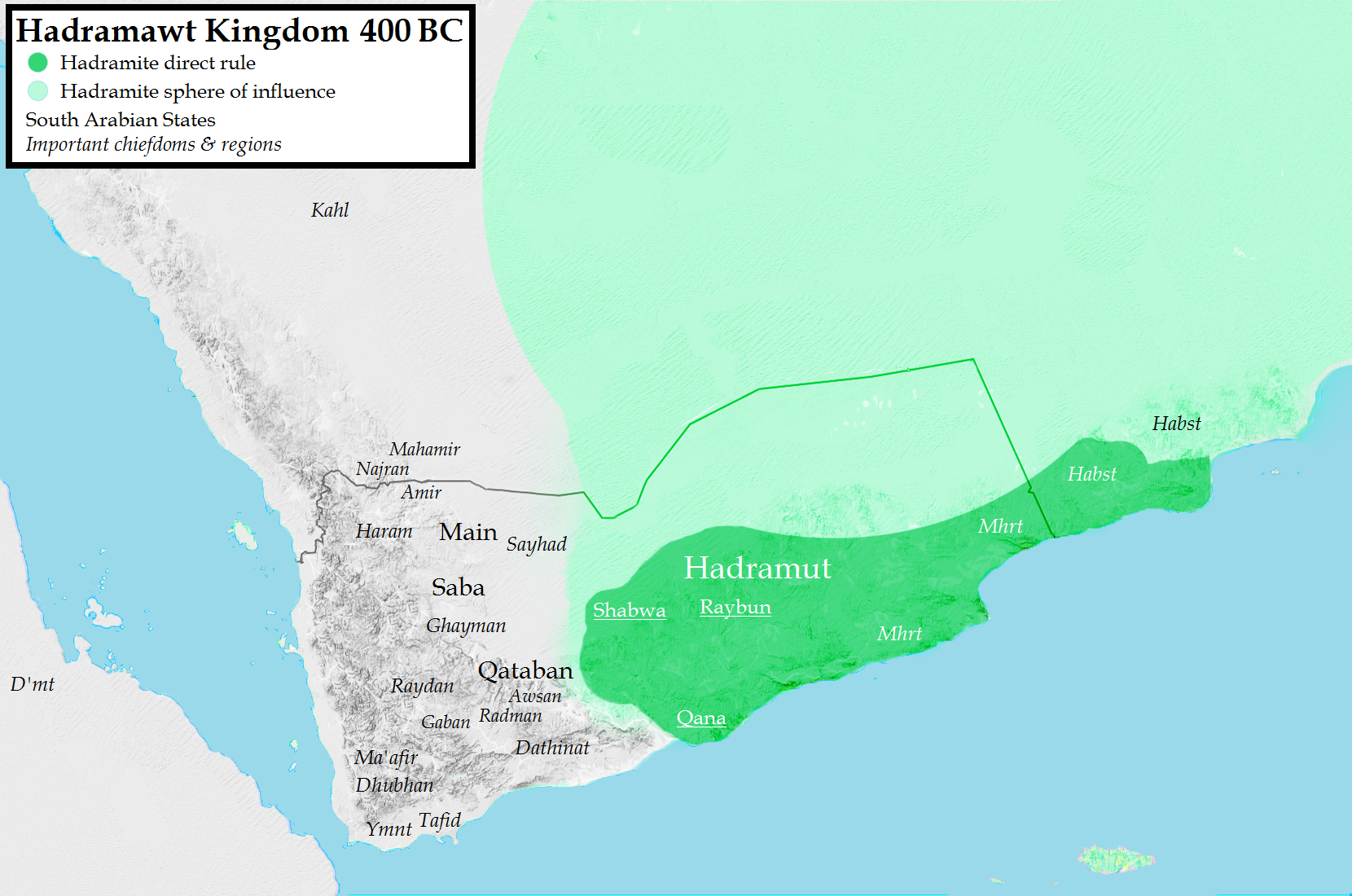
Kingdom of Hadramawt in 400 BC
Hadramautic inscription, form Dhofar, National Museum of Oman

Ḥaḍramautic or Ḥaḍramic[1] was the easternmost of the four known languages of the Old South Arabian subgroup of the Semitic languages. It was used in the Kingdom of Hadhramaut and also the area round the Hadhramite capital of Shabwa, in what is now Yemen. The Hadramites also controlled the trade in frankincense through their important trading post of Sumhuram (Hadramautic s1mhrm), now Khor Rori in the Dhofar Governorate, Oman.

Script and phonology

[edit]
Incense burner, from Shabwah, Hadhramaut, c. 3rd century CE. Nude male riding a camel. Hadramitic inscription, 2 lines. British Museum

Almost the entire body of evidence for the ancient Ḥaḍramautic language comes from inscriptions written in the monumental Ancient South Arabian script, consisting of 29 letters, and deriving from the Proto-Sinaitic script. The sounds of the language were essentially the same as those of Sabaic.

Noteworthy characteristics of Ḥaḍramautic include its tendency, especially in inscriptions from Wadi Ḥaḍhramaut, to represent Old South Arabian as s3: thus we find s2ls3 ("three"; cf. Sabaean s2lṯ.)[2] There are also instances where is written for an older form s3; e.g. Ḥaḍramautic mṯnad ("inscription"), which is msnd in the rest of Old South Arabian.[2]

History

[edit]

Potsherds with Ancient South Arabian letters on them, found in Raybūn, the old Ḥaḍramitic capital, have been radiocarbon dated to the 12th century BC.[3] The language was certainly in use from 800 BC but in the fourth century AD, the Kingdom of Hadhramaut was conquered by the Ḥimyarites, who used Sabaic as an official language, and after then there are no more records in Ḥaḍramautic.

During the course of the language’s history there appeared particular phonetic changes, such as the change from ˤ to ˀ, from ẓ to ṣ, from ṯ to s3. As in other Semitic languages n can be assimilated to a following consonant, compare ʾnfs1 "souls" > ʾfs1

In Ḥaḍramautic the third person pronouns begin with s1. It has feminine forms ending in and s3.

References

[edit]
Revisions and contributorsEdit on WikipediaRead on Wikipedia
from Grokipedia
Ḥaḍramautic, also known as Ḥaḍramitic, is an extinct Semitic language belonging to the Ancient South Arabian (ASA) subgroup, specifically the easternmost of the four principal ASA languages alongside , Minaic, and Qatabanic. It was spoken in the region of Ḥaḍramawt in what is now eastern , from at least the 7th century BCE until the CE, with some evidence extending to the CE. Known primarily through approximately 1,500 epigraphic inscriptions, many of which are fragmentary and originate from sites like Raybūn and Šabwa, the language was written in the South Arabian script, including both the monumental musnad and cursive zabūr varieties. As part of the ASA languages, Ḥaḍramautic shares a common Semitic heritage but exhibits distinct phonological, grammatical, and lexical features that set it apart from its sister languages. Phonologically, it is notable for merging the /ś/ with the interdental /ṯ/ (as in šlṯt for "three (f.)" versus šlśt in other ASA languages) and possibly merging /z/ with /ḏ/, resulting in a consonantal system that resembles that of Ethiopic languages like Geʿez. Grammatically and lexically, Ḥaḍramautic displays unique traits, particularly in its expiatory inscriptions, which feature a specialized vocabulary and formulary distinct from other ASA dialects, combining Southern Semitic isoglosses, Akkadian-like archaisms, and Central Semitic elements. These inscriptions, often dedicated to deities like and ʿAthtar, reflect the cultural and religious life of the pre-Islamic Ḥaḍramawt kingdom, highlighting processes of linguistic assimilation and innovation within the broader South Arabian context. The language's documentation is uneven due to the predominance of short, dedicatory, and legal texts, limiting deeper insights into its syntax and full morphology, though ongoing excavations continue to expand the corpus. Ḥaḍramautic is not a direct ancestor of the (such as Mehri or Soqotri), which form a separate branch, but its study contributes to understanding the diversification of in the . Its extinction coincided with the spread of and the decline of South Arabian kingdoms in .

Classification and overview

Linguistic affiliation

Hadramautic is classified as a South Semitic language within the Semitic branch of the Afroasiatic language family. This placement reflects its historical ties to the ancient languages of the , where diverged from Proto-Afroasiatic through shared phonological and morphological features traceable to Proto-Semitic roots, such as triconsonantal verbal stems. Within the South Semitic subgroup, Hadramautic is recognized as one of the four primary Old South Arabian (OSA) languages, alongside , Minaic, and Qatabanic. It is distinguished as the easternmost of these languages, primarily attested in regions corresponding to ancient Hadramawt. Etymological and comparative analyses highlight its close relations to the other OSA languages through shared innovations, including the suffixed definite article -ʔ, which marks nouns for definiteness and differs from the prefixed articles in like and Hebrew. These features underscore a common OSA development from earlier Semitic stages, with lexical and morphological parallels to Proto-Semitic forms evident in cognates for basic vocabulary and grammatical markers. The language is documented under the ISO 639-3 code xhd and the Glottolog identifier hadr1235, facilitating its study within comparative Semitic linguistics.

Geographic and temporal scope

The Hadramautic language was primarily spoken and attested in the Kingdom of Hadramaut, centered in the ancient capital of Shabwa in modern-day , corresponding to the core territory of Hadramawt, though the kingdom controlled key trade routes extending into adjacent regions of present-day and . Hadramautic is attested epigraphically from the 7th century BCE until the 3rd century CE, with some evidence extending to the 6th century CE, marking its temporal range within the Old South Arabian linguistic tradition. The language remained closely tied to the Hadramaut polity from the early 1st millennium BCE through its period of independence, until the Himyarite conquest in the late 3rd to early 4th century CE, after which Sabaic supplanted Hadramautic as the dominant administrative language in the region. Following this political shift, Hadramautic gradually declined, ceasing to function as a spoken language by the 6th century CE while persisting in isolated epigraphic inscriptions for a brief additional period.

Writing system

Ancient South Arabian script

The , known as musnad in its monumental form, served as the primary for the Hadramautic language, one of the Old South Arabian dialects spoken in the region of Hadramaut from approximately the 8th century BCE to the 6th century CE. This script originated in the southern , deriving from earlier Northwest Semitic alphabetic traditions, including influences from the of the late 2nd millennium BCE, through possible Levantine intermediaries that introduced consonantal writing to the region by the early BCE. Over time, it evolved into a distinct monumental style characterized by angular, letter forms suited for carving into hard surfaces, while a shared variant (zabūr) is attested in ASA more broadly, primarily on perishable materials like wood, it is rarer in the Hadramautic corpus, which predominantly features monumental forms. As a right-to-left abjad, the script consisted of 29 consonantal letters, omitting dedicated symbols for vowels and relying instead on contextual interpretation or occasional use of weak consonants (w and y) as mater lectionis to indicate long vowels in certain positions. The letter inventory preserved a full Proto-Semitic consonantal system, including distinctions for emphatic sounds such as the pharyngealized stops , , and , as well as the sibilant series often reconstructed as (represented by ś, a lateral or affricated fricative), (s, a simple sibilant), and (š, a sibilant akin to sh). These emphatic consonants were denoted by dedicated glyphs with robust, blocky shapes— for instance, the letter for (emphatic s) featured a triangular or arrowhead form that remained stable across centuries, while ś evolved from more curved early variants to straighter lines in later Hadramautic examples. Hadramautic texts in this script appear predominantly in monumental inscriptions on durable media, such as stone stelae, altars, and rock faces commemorating royal dedications, legal decrees, or funerary rites in key sites like Shabwa and Raybun. Minor applications included incised or painted marks on pottery shards and occasional metal objects, though these are rarer and typically shorter, reflecting the script's adaptation primarily for formal, public rather than everyday notation. The uniformity of the script across Old South Arabian languages, including Hadramautic, underscores its role as a shared cultural technology, with letter forms showing gradual refinement in stroke thickness and proportion from the BCE onward, but without dialect-specific orthographic innovations in form.

Orthographic conventions

The Hadramautic language utilized the Ancient South Arabian (ASA) script, a 29-consonant shared among Old South Arabian languages, but adapted it with distinctive conventions that reflect its phonological and lexical particularities. A key orthographic practice in Hadramautic involves pleonastic insertions of consonants, particularly and y, to approximate qualities or clarify word boundaries in the absence of dedicated markers. These redundant letters, such as inserting after a final consonant to suggest a following u- or y for an i-, appear sporadically in inscriptions and serve to disambiguate readings without altering the core consonantal skeleton. For instance, in verbal forms or nominal endings, such insertions prevent of homographic , though their use varies by and period, being more frequent in later Hadramautic texts from the Wadi Ḥaḍramaut. Additionally, long s are occasionally indicated by w and y as matres lectionis, particularly at word ends, though this practice is inconsistent across the corpus. Hadramautic also features innovative representations for certain , with a merger of the /ś/ with the interdental /ṯ/ from the earliest attestations, represented variably by the letters for ṯ (older) or ś (later), as seen in the feminine numeral "three" as šlṯt or šlśt, in contrast to the consistent ṯlṯt in . This merger reflects Hadramautic's peripheral innovations within the ASA sibilant system, aiding philologists in identifying dialectal boundaries through comparative epigraphy. In dedicatory and commemorative inscriptions, Hadramautic employs standardized formulas with language-specific prepositional constructions, diverging from central OSA varieties. A prominent example is the term mṯnad for "inscription" or "dedicatory monument," used in phrases marking offerings to deities like or ʿAthtar, in contrast to the more widespread msnd in and Minaic. These formulas typically begin with prepositions like l- ("for") or b- ("in"), followed by the beneficiary's name and purpose, underscoring Hadramautic's ritual lexicon while adhering to the broader ASA monumental style. The overall absence of vowel notation in Hadramautic, like other ASA languages, engenders interpretive challenges, such as distinguishing between potential long/short s or case endings, which scholars resolve via etymological comparisons with , Ethiosemitic, and Northwest Semitic cognates.

Phonology

Consonant inventory

The Hadramautic language features a consonantal system based on the 29-letter Ancient South Arabian (ASA) script, preserving much of the Proto-Semitic structure but with mergers reducing the number of distinct phonemes, which distinguishes it as one of the more conservative South Semitic varieties. This system includes a full set of emphatics such as ṭ, ṣ, ḍ, and , which maintain pharyngealized or uvular qualities akin to their Proto-Semitic prototypes, and a triplet of s¹, s², and s³, traditionally reconstructed as , lateral , and postalveolar realizations respectively. These consonants are attested across the corpus of Hadramautic inscriptions, where orthographic conventions denote them without vowel indications, emphasizing their role in root-based morphology. Hadramautic shows specific innovations including the merger of the sibilant *ś with the interdental *ṯ (e.g., šlṯt "three (f.)" vs. šlśt in ), *ˤ to ʔ, *ẓ to ṣ, and possibly *z to ḏ, reducing contrasts in , emphatics, and resonants. Relative to Proto-Semitic, these changes simplify the inventory while retaining key distinctions. Additionally, Proto-Semitic *ṯ regularly becomes s³ in Hadramautic, evident in numerals (e.g., ṯlṯ "three" > s³lṯ) and third-person pronouns, marking a dialectal divergence from and other ASA languages. In contrast, the gutturals ʾ, h, ḥ, ʿ, and ġ are largely preserved without loss or merger, supporting etymological connections to broader Semitic lexicon, while the liquids l, r and nasals m, n remain stable, facilitating clear morphological patterns. Assimilation processes further characterize Hadramautic consonants, particularly the elision of n in preconsonantal position within certain clusters, as in the form ʾnfs¹ developing into ʾfs¹ for "soul," where the nasal assimilates completely to the following sibilant. Such patterns, observed in dedicatory and funerary inscriptions, highlight phonetic adaptations that streamline pronunciation without disrupting semantic clarity.
Place of ArticulationBilabialDental/AlveolarPost-AlveolarPalatalVelarUvularPharyngealGlottal
Stops (voiceless)tkqʔ
Stops (voiced)bdg
Stops (emphatic)ṭ, ḍ
Fricatives (voiceless)fθ, s¹, s², s³šh
Fricatives (voiced)ðġʿ
Fricatives (emphatic)
Nasalsmn
Lateralsl
Trillsr
Semivowelswy
This table reconstructs the approximate Hadramautic consonant phonemes based on ASA epigraphy and comparative Semitic evidence (approximately 27-28 distinct after mergers), with emphatics and positioned to reflect their Proto-Semitic origins. Note: /θ/ and /ð/ are included orthographically but merged phonemically with s³; /f/ reflects *p; no native /p/.

Vowel system and prosody

The vowel system of Hadramautic, an Old South Arabian (OSA) language, is not directly attested due to the consonantal nature of the , which omits notation except for occasional matres lectionis using and to indicate long s. Reconstruction relies on comparative from Proto-Semitic and related OSA languages like and Qatabanic, positing a basic three- inventory: short and long variants of /a/, /i/, and /u/. This system aligns with the canonical Semitic pattern, where quality contrasts (front, central, back) combine with length distinctions to form a total of six phonemes, influencing structure and morphological alternations. For instance, long s often appear in closed s or as markers of case endings in nominal forms, as inferred from etymological parallels with and Ge'ez. Prosodic features, including stress, are similarly inferred rather than directly evidenced, drawing from rhythmic patterns in inscriptional texts and comparisons across OSA corpora. No explicit markers for stress exist, but analyses suggest a default penultimate stress in multisyllabic words, akin to patterns in later , though word-initial stress may occur in certain lexical items based on comparative OSA data. This prosody likely played a role in or in unstressed positions, contributing to the language's epigraphic variability. Diphthongs such as /ay/ and /aw/ are reconstructed from Proto-Semitic origins, preserved in forms like *mawt- 'death' or *bayt- 'house,' and occasionally hinted at through orthographic ambiguities in Hadramautic inscriptions. The script's deficiency in vowel representation creates interpretive ambiguities, particularly in distinguishing homographic roots or morphological categories, which scholars resolve through etymological reconstruction and contextual analysis. Pleonastic uses of and —redundant consonants serving as vowel indicators—are interpreted as denoting long /ī/ and /ū/, especially in final positions, as seen in pronominal suffixes or loanwords. Potential influences from neighboring languages, such as vowel assimilation patterns resembling harmony in Ethiosemitic contacts, may have affected diphthong resolution in border inscriptions, though direct evidence remains sparse.

Grammar

Morphology

Hadramautic, as an Old South Arabian language, exhibits the root-and-pattern morphology characteristic of , where triliteral roots predominate and form words through templatic patterns rather than linear affixation. This non-concatenative system allows for derivations such as nouns, verbs, and adjectives from the same root consonants, with vowels and additional consonants inserted according to fixed patterns. For instance, broken plurals—internal modifications of the singular form without external suffixes—are common, reflecting Proto-Semitic innovations like *bayt- "" yielding plural forms with infixed vowels or consonant changes, similar to those in but adapted to South Arabian . The definite article in Hadramautic is suffixed -(h)n to nouns, a shared feature across Sayhadic (Epigraphic South Arabian) languages that marks in singular forms and contrasts with the prefixed *hal- of Northwest Semitic or *ʔal- of . This suffix undergoes assimilations in Hadramautic, particularly with certain consonants, leading to variant realizations like -n or -hn, as seen in inscriptional nouns denoting persons or objects in dedicatory contexts. Unlike indefinite nouns, which often end in case vowels or -n, the definite form integrates seamlessly into genitive constructions without additional markers. Pronominal elements in Hadramautic include prefixes and suffixes attached to verbs, nouns, and prepositions, following Semitic patterns with innovations in the third person. Third-person pronouns typically begin with s¹- (reflecting a merger or shift from Proto-Semitic *s³), as in s¹ʾ "he/it," while feminine forms end in -ṯ or -s³, derived from reanalysis of earlier *sīʾ to *tsīʾ in possessive contexts like malkat sīʾ "she is queen." Suffixes for possession or object marking include -h "him," -hā "her," and plural -hm, with first- and second-person forms like -y "me" and -k "you" showing standard Semitic continuity but occasional Hadramautic assimilations, such as vowel harmony before sibilants. These elements appear frequently in inscriptions for dedicatory formulas, e.g., pronominal suffixes on verbs indicating "dedicated by him." Verbal morphology in Hadramautic centers on a basic G-stem for simple actions, with derived stems modifying aspect, voice, or valency, though attestation is sparse due to the epigraphic corpus. The causative s-stem, prefixed with s¹-, forms transitives from intransitives, as in dedicatory inscriptions where s¹- verbs denote "caused to dedicate" or "made offerings," distinguishing Hadramautic from Sabaic preferences for h-stems. Examples include ys³b "he makes offerings" (Rb I/89 no. 306) in the basic stem and potential s¹- variants in causative contexts like ritual dedications. Other derived forms, such as the D-stem with geminated middle radicals for intensification, occur but are less frequent in Hadramautic texts compared to neighboring dialects.

Syntax and phrase structure

The syntax of Hadramautic, like other Old South Arabian languages, is primarily attested through short dedicatory and funerary inscriptions, which exhibit a predominantly verb-subject-object (VSO) in declarative sentences. This structure is evident in typical inscriptional formulas where the verb often appears first, followed by the subject (frequently a personal name or royal title) and then the object, reflecting a common Semitic pattern adapted to epigraphic brevity. For instance, constructions describing offerings or dedications begin with the verb of dedication, underscoring the ritual or commemorative purpose of the texts. Prepositional phrases in Hadramautic employ proclitic prepositions such as l- (meaning "for" or "to," often indicating or direction) and b- (indicating "in," "with," or locative/ senses), which are integrated into fixed formulaic expressions, particularly in royal or temple dedications. These prepositions attach directly to the following without intervening vowels due to the consonantal script, as seen in phrases like l-wd ("for the god") in dedicatory contexts or b-mṣb ("in the sanctuary") for locative specifications. Such usage highlights the language's reliance on analytic elements to convey relational roles within the constraints of inscriptional economy. Nominal phrases in Hadramautic typically form genitive constructions through annexation, known as the status constructus or ʾidāfa, where the assumes a bound form and is immediately followed by the modifier without an intervening particle. This synthetic method predominates for expressing possession or attribution, as in royal epithets like "king of Hadramaut," though occasional analytic particles may appear in later or variant inscriptions to clarify relationships. Morphological markers from the pronominal system, such as possessive suffixes, can integrate into these phrases to denote specificity, linking to broader grammatical patterns. Evidence for complex clause structures in Hadramautic remains limited, with most inscriptions consisting of simple declarative sentences focused on single events or dedications; subordinate clauses are rare but include relative clauses introduced by the relativizer ḏ-, which agrees in gender and number with the antecedent in some cases. Comparative analysis with related Old South Arabian languages suggests that ḏ- functions as a neutral relativizer in asyndetic constructions, embedding descriptive phrases without extensive subordination, as preserved in fragmentary epigraphic texts.

Historical development and corpus

Origins and evolution

The Hadramautic language emerged around the BCE as one of the four principal Old South Arabian (OSA) languages, deriving from a Proto-Old South Arabian ancestor that developed indigenously within southern Arabia, possibly tracing roots to the based on archaeological correlations. Early development shows influences from Minaic, another OSA language, through extensive trade contacts in the incense routes linking Hadramawt to northern regions and the Mediterranean. Hadramautic evolved over time, reflecting both internal development and external pressures, with conservative features in early inscriptions from the 8th–5th centuries BCE giving way to more standardized forms during the height of the Hadramautic kingdom from the BCE to the CE. In the following centuries, particularly after the Himyarite around 300 CE, the language showed signs of assimilation, including orthographic and syntactic influences from . Distinguishing Hadramautic from western OSA languages like and Minaic were key innovations, including phonetic mergers such as the reduction of the pharyngeal fricative *ˤ to the ʔ, alongside early sibilant coalescences (/ś/ merging with /ṯ/ and /z/ with /ḏ/). Morphologically, it featured simplifications like reduced verbal stem diversity and n-assimilation in certain forms (e.g., *nt > tt), streamlining inflectional paradigms while retaining core Semitic triconsonantal roots. These changes, progressive from the early period onward, likely arose from regional dialectal pressures and trade-induced contact. The language's decline accelerated with Himyarite political dominance in the CE, which promoted for administration and diplomacy, fostering bilingualism in Hadramawt. This led to Hadramautic's gradual supplantation, with epigraphic evidence tapering by the CE and ultimate replacement by variants and proto-Arabic dialects amid the rise of .

Inscriptions and textual evidence

The primary corpus of Hadramautic texts comprises approximately 900 inscriptions, predominantly monumental in nature and concentrated at major archaeological sites in the Hadramaut region, including Shabwa, Raybūn, and Wadi Jawf. These texts encompass a range of types, such as royal decrees recording political events and administrative actions, dedicatory inscriptions offering tributes to deities like and Athtar, funerary epitaphs commemorating the deceased, and informal graffiti scratched on rocks or . The inscriptions provide direct evidence of Hadramautic society, reflecting religious practices, royal patronage, and daily life without any known literary compositions; the entire corpus is epigraphic in form, lacking narrative or poetic works. The Digital Archive for the Study of pre-islamic Arabian Inscriptions (DASI) provides digitized access to this corpus. Key examples include the temple inscriptions from Shabwa, dating from the 3rd century BCE to the 1st century CE, which detail the reigns of Hadramautic kings and describe offerings made to gods in temple contexts, such as the inscription from the temple of Siyān dhū-Alīm that records a votive dedication by local elites. At Raybūn, the ancient capital, painted pottery sherds bearing early have been radiocarbon dated to the late 2nd millennium BCE, providing some of the earliest evidence of writing in the region, though the Hadramautic language itself is first attested from the BCE. Other notable finds from Raybūn include the temple complex inscriptions at Dhat Ḥimyam, which document religious rituals and royal interventions from the BCE onward. In Wadi Jawf, inscriptions like those from Nashshān highlight regional variations, often focusing on and communal dedications. The textual genres are dominated by dedicatory texts, comprising approximately 70% of the corpus and primarily expressing gratitude or vows to deities; royal inscriptions account for about 20%, detailing conquests, building projects, and alliances; while private texts, such as personal vows or funerary notices, make up the remaining 10%. No extended literary or administrative archives have been identified, underscoring the epigraphic focus on public and ritual expressions. Preservation poses significant challenges, with many inscriptions eroded by the region's arid climate, which accelerates on exposed stone surfaces, and others remaining undiscovered amid ongoing modern conflicts in that limit archaeological access and excavation efforts.

Scholarly study

Decipherment and early research

The initial discoveries of Hadramautic inscriptions occurred in the late 19th century through expeditions by European explorers into southern Arabia. In 1869–1870, French scholar Joseph Halévy undertook a pioneering journey across Yemen, commissioned by the Académie des Inscriptions et Belles-Lettres, where he collected over 680 South Arabian inscriptions, primarily Sabaic but including materials from regions bordering Hadramaut that hinted at the eastern dialects. Halévy's efforts marked the first systematic epigraphic survey in the area, though political restrictions prevented deeper penetration into Hadramaut itself. Subsequent expeditions by Austrian explorer Eduard Glaser in the 1880s further expanded the corpus, with Glaser copying more than 1,000 inscriptions during four trips (1882, 1883, 1887–1888, and 1892), some from eastern Yemeni sites that yielded early Hadramautic texts alongside Sabaic ones. The breakthrough for accessing Hadramaut proper came in 1893 with German Arabist Leo Hirsch's expedition, the first by a European into the Hadramaut . Disguised as a Muslim merchant, Hirsch traveled from inland to and Daw'an, copying around 50 inscriptions in the , many identifiable as Hadramautic due to their eastern provenance and linguistic features. These findings, published in 1897, provided the earliest dedicated samples of Hadramautic , revealing royal dedications and funerary texts distinct from central Yemeni varieties. Decipherment of the , shared by Hadramautic and related languages, began earlier in the . In 1837, German orientalist Emil Rödiger used a Yemeni legal (Kitāb al-Azhār) from the Staatsbibliothek zu Berlin to correctly identify several letters of the "Himyarite" alphabet, building on local Zaydi traditions that preserved the script's forms. This was refined in 1841 by , who independently proposed a phonetic reading based on comparative Semitic evidence, enabling initial translations of bilingual and dedicatory texts. For Hadramautic specifically, understanding advanced in the early 20th century through parallels with deciphered ; the Corpus Inscriptionum Semiticarum (CIS), volume IV (fascicles starting 1889), compiled Hadramautic texts alongside others, with editors like René Dussaud and François Thureau-Dangin attributing royal names (e.g., those of Hadramaut kings like Yada'il Dharih) via onomastic and titulary comparisons. Further progress in the 1930s–1940s came from Belgian epigrapher Jacques Ryckmans, who analyzed Hadramautic inscriptions from Hirsch and Glaser's collections, achieving key breakthroughs by linking vocabulary and syntax to cognates, such as in royal epithets and invocations (e.g., the god ). Ryckmans' work, including editions in the CIS supplements, clarified Hadramautic as a distinct Old South Arabian dialect, though full grammars remained elusive due to the corpus's brevity. Early research faced significant challenges from restricted access to Hadramaut sites before , owing to Ottoman and local tribal controls, which limited collections to a few hundred texts and resulted in incomplete corpora prone to copying errors. These inscriptions, primarily monumental and dedicatory, form the core textual evidence for Hadramautic, as explored in dedicated sections on the corpus.

Contemporary analysis and gaps

Since the , archaeological efforts have significantly expanded the corpus of Hadramautic inscriptions, particularly through the French-Yemeni Archaeological Mission in Shabwa, which conducted excavations from 1975 to 2002 and uncovered numerous pre-Islamic artifacts, including new epigraphic materials from the ancient capital of Hadramawt. These discoveries have been complemented by the development of digital corpora, such as the Digital Archive for the Study of Pre-Islamic Arabian Inscriptions (DASI), which provides annotated access to over 8,600 Ancient South Arabian texts, facilitating advanced analysis of Hadramautic alongside related dialects. Prominent contemporary scholarship on Hadramautic has been advanced by linguists like Christian Robin, whose work since the has illuminated Old South Arabian (OSA) dialectology, including distinctions in Hadramautic vocabulary and syntax through comparative epigraphic studies. Recent research has also employed comparative Semitic methods for phonetic reconstructions, such as analyses of sibilant shifts linking Hadramautic forms to Proto-Semitic affricates, drawing on parallels with Ethiopian Semitic languages. Despite these advances, significant gaps persist in Hadramautic , with no complete paradigms attested due to the predominance of short, dedicatory inscriptions that limit morphological depth. Spoken aspects remain largely unknown, including everyday and phonological details beyond epigraphic evidence, while syntax is inferred only fragmentarily from brief texts lacking complex structures. Potential connections to , such as shared pronominal innovations, have been noted but remain underexplored amid debates on South Semitic subgrouping. As of 2025, ongoing digital projects like DASI continue to expand access to the corpus, supporting further analysis without major new epigraphic discoveries reported. Current trends in Hadramautic studies emphasize computational , as seen in DASI's hybrid data-entry systems for fragmentary languages, and onomastic analyses to reconstruct sociolinguistic patterns from personal names in inscriptions. These approaches aim to address persistent unknowns by integrating digital tools with traditional .

References

Add your contribution
Related Hubs
Contribute something
User Avatar
No comments yet.