



Community hub
Recent from talks
Knowledge base stats:
Talk channels stats:
Members stats:
Solenodon
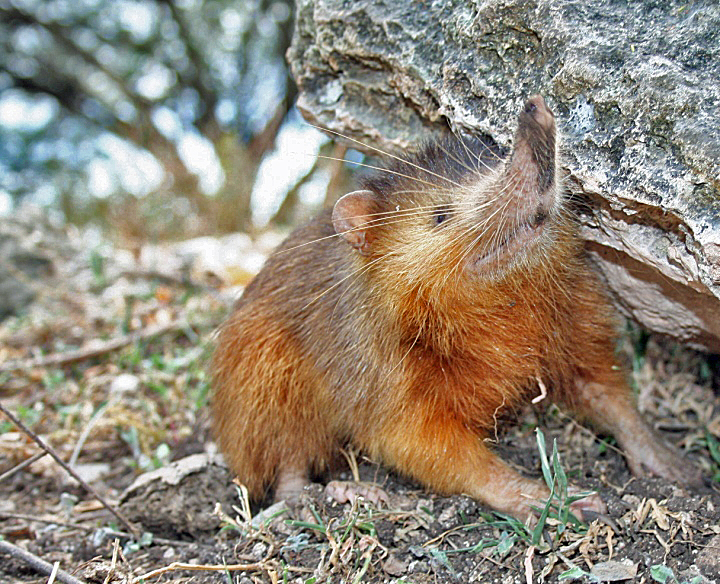
Solenodons (/soʊˈlɛnədɒnz/; from Ancient Greek σωλήν (sōlḗn), meaning "channel, pipe", and ὀδούς (odoús), meaning "tooth") are venomous, nocturnal, burrowing, insectivorous mammals belonging to the family Solenodontidae /soʊˌlɛnəˈdɒntɪdiː/. The two living solenodon species are the Cuban solenodon (Atopogale cubana) and the Hispaniolan solenodon (Solenodon paradoxus). Threats to both species include habitat destruction and predation by non-native cats, dogs, and mongooses, introduced by humans to the solenodons' home islands to control snakes and rodents.
The Hispaniolan solenodon covers a wide range of habitats on the island of Hispaniola from lowland dry forest to highland pine forest. Two other described species became extinct during the Quaternary period. Oligocene North American genera, such as Apternodus, have been suggested as relatives of Solenodon, but the origins of the animal remain obscure.
Two genera, Atopogale and Solenodon, are known, each with one extant species. Other genera have been erected, but are now regarded as junior synonyms. Solenodontidae show retention of primitive mammal characteristics. In 2016, solenodons were confirmed by genetic analysis as belonging to an evolutionary branch that split from the lineage leading to hedgehogs, moles, and shrews before the Cretaceous-Paleogene extinction event. They are one of two families of Caribbean soricomorphs. The other family, Nesophontidae, became extinct during the Holocene. Molecular data suggest they diverged from solenodons roughly 57 million years ago. The solenodon is estimated to have diverged from other living mammals about 73 million years ago.
In addition, two extinct species, the giant solenodon (S. arredondoi) and Marcano's solenodon (S. marcanoi) are both thought to have gone extinct during the last 500 years, both presumably due to predation by introduced rats.
Traditionally, solenodons' closest relatives were considered to be the giant water shrew of Africa and Tenrecidae of Madagascar, though they are now known to be more closely related to true shrews (Eulipotyphla). Solenodons resemble very large shrews, and are often compared to them; with extremely elongated cartilaginous snouts, long, naked, scaly tails, hairless feet, and small eyes. The Cuban solenodon is generally smaller than its Hispaniolan counterpart. It is also a rusty brown with black on its throat and back. The Hispaniolan solenodon is a darker brown with yellowish tint to the face. The snout is flexible and, in the Hispaniolan solenodon, actually has a ball-and-socket joint at the base to increase its mobility. This allows the animal to investigate narrow crevices where potential prey may be hiding.
Solenodons are also noted for the glands in their inguinal and groin areas that secrete what is described as a musky, goat-like odor. Solenodons range from 28 to 32 cm (11 to 13 in) from nose to rump, and weigh between 0.7 and 1.0 kg (1.5 and 2.2 lb).
Solenodons have a few unusual traits, one of them being the position of the two teats on the female, almost on the buttocks of the animal, and another being the venomous saliva that flows from modified salivary glands in the mandible through grooves on the second lower incisors ("solenodon" derives from the Greek "grooved tooth"). Solenodons are among a handful of venomous mammals. Fossil records show that some other now-extinct mammal groups also had the dental venom delivery system, indicating that the solenodon's most distinct characteristic may have been a more general ancient mammalian characteristic that has been lost in most modern mammals and is only retained in a couple of very ancient lineages. The solenodon has often been called a "living fossil" because it has endured virtually unchanged for the past 76 million years.[citation needed]
It is not known exactly how long solenodons can live in the wild. However, certain individuals of the Cuban species have been recorded to have lived for up to five years in captivity and individuals of the Hispaniolan species for up to eleven years.[citation needed]
Hub AI
Solenodon AI simulator
(@Solenodon_simulator)
Solenodon
Solenodons (/soʊˈlɛnədɒnz/; from Ancient Greek σωλήν (sōlḗn), meaning "channel, pipe", and ὀδούς (odoús), meaning "tooth") are venomous, nocturnal, burrowing, insectivorous mammals belonging to the family Solenodontidae /soʊˌlɛnəˈdɒntɪdiː/. The two living solenodon species are the Cuban solenodon (Atopogale cubana) and the Hispaniolan solenodon (Solenodon paradoxus). Threats to both species include habitat destruction and predation by non-native cats, dogs, and mongooses, introduced by humans to the solenodons' home islands to control snakes and rodents.
The Hispaniolan solenodon covers a wide range of habitats on the island of Hispaniola from lowland dry forest to highland pine forest. Two other described species became extinct during the Quaternary period. Oligocene North American genera, such as Apternodus, have been suggested as relatives of Solenodon, but the origins of the animal remain obscure.
Two genera, Atopogale and Solenodon, are known, each with one extant species. Other genera have been erected, but are now regarded as junior synonyms. Solenodontidae show retention of primitive mammal characteristics. In 2016, solenodons were confirmed by genetic analysis as belonging to an evolutionary branch that split from the lineage leading to hedgehogs, moles, and shrews before the Cretaceous-Paleogene extinction event. They are one of two families of Caribbean soricomorphs. The other family, Nesophontidae, became extinct during the Holocene. Molecular data suggest they diverged from solenodons roughly 57 million years ago. The solenodon is estimated to have diverged from other living mammals about 73 million years ago.
In addition, two extinct species, the giant solenodon (S. arredondoi) and Marcano's solenodon (S. marcanoi) are both thought to have gone extinct during the last 500 years, both presumably due to predation by introduced rats.
Traditionally, solenodons' closest relatives were considered to be the giant water shrew of Africa and Tenrecidae of Madagascar, though they are now known to be more closely related to true shrews (Eulipotyphla). Solenodons resemble very large shrews, and are often compared to them; with extremely elongated cartilaginous snouts, long, naked, scaly tails, hairless feet, and small eyes. The Cuban solenodon is generally smaller than its Hispaniolan counterpart. It is also a rusty brown with black on its throat and back. The Hispaniolan solenodon is a darker brown with yellowish tint to the face. The snout is flexible and, in the Hispaniolan solenodon, actually has a ball-and-socket joint at the base to increase its mobility. This allows the animal to investigate narrow crevices where potential prey may be hiding.
Solenodons are also noted for the glands in their inguinal and groin areas that secrete what is described as a musky, goat-like odor. Solenodons range from 28 to 32 cm (11 to 13 in) from nose to rump, and weigh between 0.7 and 1.0 kg (1.5 and 2.2 lb).
Solenodons have a few unusual traits, one of them being the position of the two teats on the female, almost on the buttocks of the animal, and another being the venomous saliva that flows from modified salivary glands in the mandible through grooves on the second lower incisors ("solenodon" derives from the Greek "grooved tooth"). Solenodons are among a handful of venomous mammals. Fossil records show that some other now-extinct mammal groups also had the dental venom delivery system, indicating that the solenodon's most distinct characteristic may have been a more general ancient mammalian characteristic that has been lost in most modern mammals and is only retained in a couple of very ancient lineages. The solenodon has often been called a "living fossil" because it has endured virtually unchanged for the past 76 million years.[citation needed]
It is not known exactly how long solenodons can live in the wild. However, certain individuals of the Cuban species have been recorded to have lived for up to five years in captivity and individuals of the Hispaniolan species for up to eleven years.[citation needed]