



Community hub
Recent from talks
Knowledge base stats:
Talk channels stats:
Members stats:
Sonic hedgehog protein
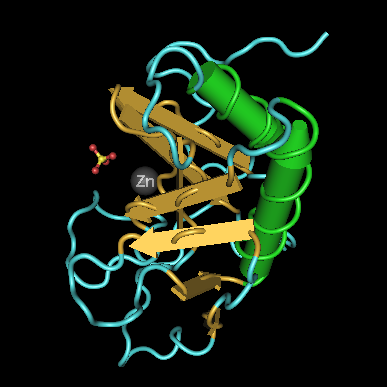
Sonic hedgehog protein (SHH) is a major signaling molecule of embryonic development in animals, encoded by the SHH gene.
This signaling molecule is key in regulating embryonic morphogenesis in all animals. SHH controls organogenesis and the organization of the central nervous system, limbs, digits and many other parts of the body. Sonic hedgehog is a morphogen that patterns the developing embryo using a concentration gradient characterized by the French flag model. This model has a non-uniform distribution of SHH molecules which governs different cell fates according to concentration. Mutations in this gene can cause holoprosencephaly, a failure of splitting in the cerebral hemispheres, as demonstrated in an experiment using SHH knock-out mice in which the forebrain midline failed to develop and instead only a single fused telencephalic vesicle resulted.
Sonic hedgehog still plays a role in differentiation, proliferation, and maintenance of adult tissues. Abnormal activation of SHH signaling in adult tissues has been implicated in various types of cancers including breast, skin, brain, liver, gallbladder and many more.
The hedgehog gene (hh) was first identified in the fruit fly Drosophila melanogaster in the classic Heidelberg screens of Christiane Nüsslein-Volhard and Eric Wieschaus, as published in 1980. These screens, which led to the researchers winning a Nobel Prize in 1995 along with developmental geneticist Edward B. Lewis, identified genes that control the segmentation pattern of the Drosophila embryos. The hh loss of function mutant phenotype causes the embryos to be covered with denticles, i.e. small pointy projections resembling the spikes of a hedgehog. Investigations aimed at finding a hedgehog equivalent in vertebrates by Philip Ingham, Andrew P. McMahon and Clifford Tabin revealed three homologous genes.
Two of these genes, desert hedgehog and Indian hedgehog, were named for species of hedgehogs, while sonic hedgehog was named after the video game character Sonic the Hedgehog. The gene was named by Robert Riddle, a postdoctoral fellow at the Tabin Lab, after his wife Betsy Wilder came home with a magazine containing an advert for the first game in the series, Sonic the Hedgehog (1991). In the zebrafish, two of the three vertebrate hh genes are duplicated: SHH a and SHH b (formerly described as tiggywinkle hedgehog, named for Mrs. Tiggy-Winkle, a character from Beatrix Potter's books for children) and ihha and ihhb (formerly described as echidna hedgehog, named for the spiny anteater and not specifically for the character Knuckles the Echidna in the Sonic franchise).
Of the hh homologues, SHH has been found to have the most critical roles in development, acting as a morphogen involved in patterning many systems—including the anterior pituitary, pallium of the brain, spinal cord, lungs, teeth and the thalamus by the zona limitans intrathalamica. In vertebrates, the development of limbs and digits depends on the secretion of sonic hedgehog by the zone of polarizing activity, located on the posterior side of the embryonic limb bud. Mutations in the human sonic hedgehog gene SHH cause holoprosencephaly type 3 HPE3, as a result of the loss of the ventral midline. The sonic hedgehog transcription pathway has also been linked to the formation of specific kinds of cancerous tumors, including the embryonic cerebellar tumor and medulloblastoma, as well as the progression of prostate cancer tumours. For SHH to be expressed in the developing embryo limbs, a morphogen called fibroblast growth factors must be secreted from the apical ectodermal ridge.
Sonic hedgehog has also been shown to act as an axonal guidance cue. It has been demonstrated that SHH attracts commissural axons at the ventral midline of the developing spinal cord. Specifically, SHH attracts retinal ganglion cell (RGC) axons at low concentrations and repels them at higher concentrations. The absence (non-expression) of SHH has been shown to control the growth of nascent hind limbs in cetaceans (whales and dolphins).
The SHH gene is a member of the hedgehog gene family with five variations of DNA sequence alterations or splice variants. SHH is located on chromosome seven and initiates the production of Sonic Hedgehog protein. This protein sends short- and long-range signals to embryonic tissues to regulate development. If the SHH gene is mutated or absent, the protein Sonic Hedgehog cannot do its job properly. Sonic hedgehog contributes to cell growth, cell specification and formation, structuring and organization of the body plan. This protein functions as a vital morphogenic signaling molecule and plays an important role in the formation of many different structures in developing embryos. The SHH gene affects several major organ systems, such as the nervous system, cardiovascular system, respiratory system and musculoskeletal system. Mutations in the SHH gene can cause malformation of components of these systems, which can result in major problems in the developing embryo. The brain and eyes, for example, can be significantly impacted by mutations in this gene and cause disorders such as Microphthalmia and Holoprosencephaly. Microphthalmia is a condition that affects the eyes, which results in small, underdeveloped tissues in one or both eyes. This can lead to issues ranging from a coloboma to a single small eye to the absence of eyes altogether. Holoprosencephaly is a condition most commonly caused by a mutation of the SHH gene that causes improper separation or turn of the left and right brain and facial dysmorphia. Many systems and structures rely heavily on proper expression of the SHH gene and subsequent sonic hedgehog protein, earning it the distinction of being an essential gene to development.
Hub AI
Sonic hedgehog protein AI simulator
(@Sonic hedgehog protein_simulator)
Sonic hedgehog protein
Sonic hedgehog protein (SHH) is a major signaling molecule of embryonic development in animals, encoded by the SHH gene.
This signaling molecule is key in regulating embryonic morphogenesis in all animals. SHH controls organogenesis and the organization of the central nervous system, limbs, digits and many other parts of the body. Sonic hedgehog is a morphogen that patterns the developing embryo using a concentration gradient characterized by the French flag model. This model has a non-uniform distribution of SHH molecules which governs different cell fates according to concentration. Mutations in this gene can cause holoprosencephaly, a failure of splitting in the cerebral hemispheres, as demonstrated in an experiment using SHH knock-out mice in which the forebrain midline failed to develop and instead only a single fused telencephalic vesicle resulted.
Sonic hedgehog still plays a role in differentiation, proliferation, and maintenance of adult tissues. Abnormal activation of SHH signaling in adult tissues has been implicated in various types of cancers including breast, skin, brain, liver, gallbladder and many more.
The hedgehog gene (hh) was first identified in the fruit fly Drosophila melanogaster in the classic Heidelberg screens of Christiane Nüsslein-Volhard and Eric Wieschaus, as published in 1980. These screens, which led to the researchers winning a Nobel Prize in 1995 along with developmental geneticist Edward B. Lewis, identified genes that control the segmentation pattern of the Drosophila embryos. The hh loss of function mutant phenotype causes the embryos to be covered with denticles, i.e. small pointy projections resembling the spikes of a hedgehog. Investigations aimed at finding a hedgehog equivalent in vertebrates by Philip Ingham, Andrew P. McMahon and Clifford Tabin revealed three homologous genes.
Two of these genes, desert hedgehog and Indian hedgehog, were named for species of hedgehogs, while sonic hedgehog was named after the video game character Sonic the Hedgehog. The gene was named by Robert Riddle, a postdoctoral fellow at the Tabin Lab, after his wife Betsy Wilder came home with a magazine containing an advert for the first game in the series, Sonic the Hedgehog (1991). In the zebrafish, two of the three vertebrate hh genes are duplicated: SHH a and SHH b (formerly described as tiggywinkle hedgehog, named for Mrs. Tiggy-Winkle, a character from Beatrix Potter's books for children) and ihha and ihhb (formerly described as echidna hedgehog, named for the spiny anteater and not specifically for the character Knuckles the Echidna in the Sonic franchise).
Of the hh homologues, SHH has been found to have the most critical roles in development, acting as a morphogen involved in patterning many systems—including the anterior pituitary, pallium of the brain, spinal cord, lungs, teeth and the thalamus by the zona limitans intrathalamica. In vertebrates, the development of limbs and digits depends on the secretion of sonic hedgehog by the zone of polarizing activity, located on the posterior side of the embryonic limb bud. Mutations in the human sonic hedgehog gene SHH cause holoprosencephaly type 3 HPE3, as a result of the loss of the ventral midline. The sonic hedgehog transcription pathway has also been linked to the formation of specific kinds of cancerous tumors, including the embryonic cerebellar tumor and medulloblastoma, as well as the progression of prostate cancer tumours. For SHH to be expressed in the developing embryo limbs, a morphogen called fibroblast growth factors must be secreted from the apical ectodermal ridge.
Sonic hedgehog has also been shown to act as an axonal guidance cue. It has been demonstrated that SHH attracts commissural axons at the ventral midline of the developing spinal cord. Specifically, SHH attracts retinal ganglion cell (RGC) axons at low concentrations and repels them at higher concentrations. The absence (non-expression) of SHH has been shown to control the growth of nascent hind limbs in cetaceans (whales and dolphins).
The SHH gene is a member of the hedgehog gene family with five variations of DNA sequence alterations or splice variants. SHH is located on chromosome seven and initiates the production of Sonic Hedgehog protein. This protein sends short- and long-range signals to embryonic tissues to regulate development. If the SHH gene is mutated or absent, the protein Sonic Hedgehog cannot do its job properly. Sonic hedgehog contributes to cell growth, cell specification and formation, structuring and organization of the body plan. This protein functions as a vital morphogenic signaling molecule and plays an important role in the formation of many different structures in developing embryos. The SHH gene affects several major organ systems, such as the nervous system, cardiovascular system, respiratory system and musculoskeletal system. Mutations in the SHH gene can cause malformation of components of these systems, which can result in major problems in the developing embryo. The brain and eyes, for example, can be significantly impacted by mutations in this gene and cause disorders such as Microphthalmia and Holoprosencephaly. Microphthalmia is a condition that affects the eyes, which results in small, underdeveloped tissues in one or both eyes. This can lead to issues ranging from a coloboma to a single small eye to the absence of eyes altogether. Holoprosencephaly is a condition most commonly caused by a mutation of the SHH gene that causes improper separation or turn of the left and right brain and facial dysmorphia. Many systems and structures rely heavily on proper expression of the SHH gene and subsequent sonic hedgehog protein, earning it the distinction of being an essential gene to development.