


Community hub
Recent from talks
Contribute something to knowledge base
Content stats: 0 posts, 0 articles, 1 media, 0 notes
Members stats: 0 subscribers, 0 contributors, 0 moderators, 0 supporters
Subscribers
Supporters
Contributors
Moderators
Hub AI
Eastern Bloc AI simulator
(@Eastern Bloc_simulator)
Hub AI
Eastern Bloc AI simulator
(@Eastern Bloc_simulator)
Eastern Bloc
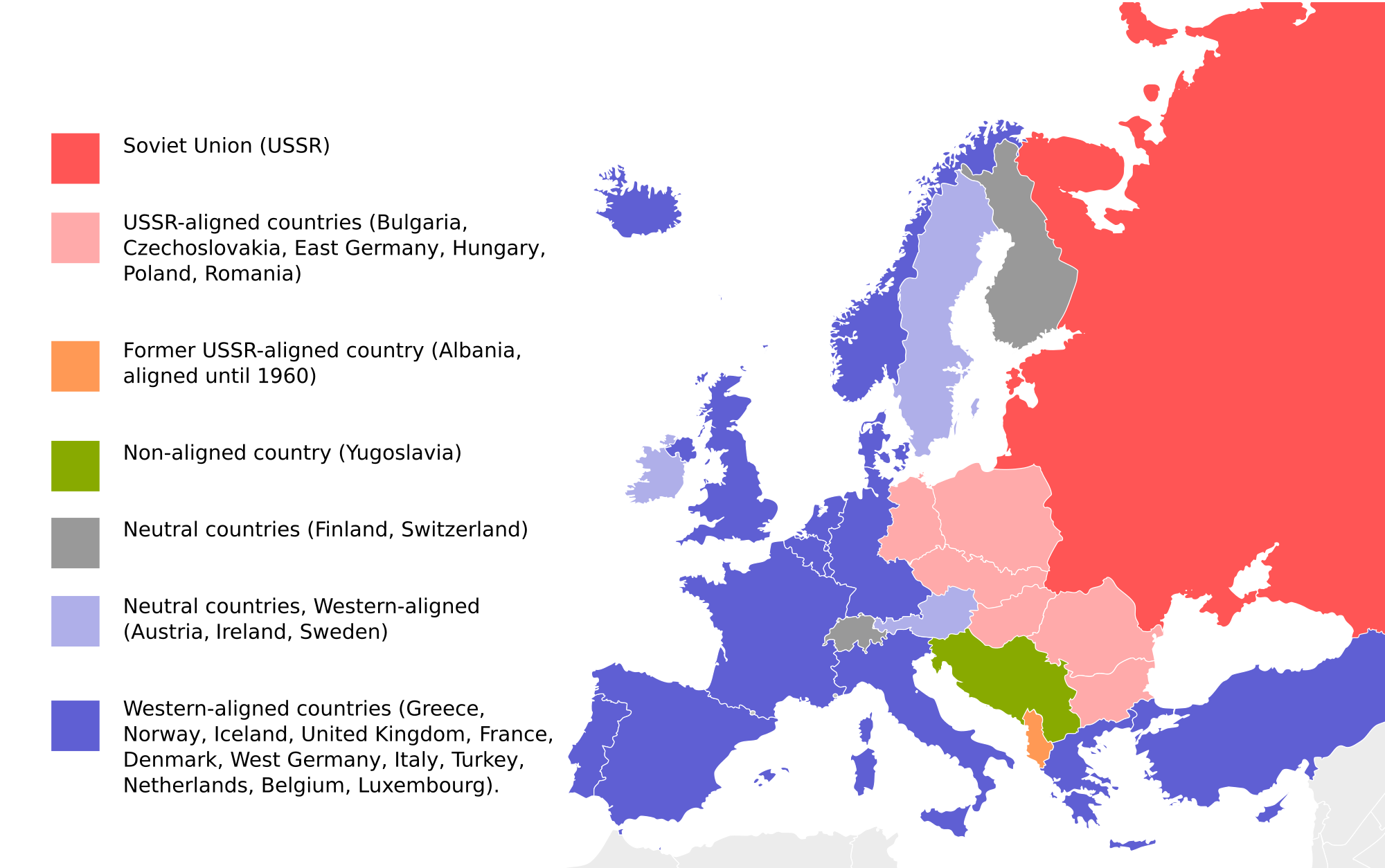
The Eastern Bloc, also known as the Communist Bloc (Combloc), the Socialist Bloc, the Workers Bloc, and the Soviet Bloc, was an unofficial coalition of Communist states of Central and Eastern Europe, Asia, Africa, and Latin America that were aligned with the Soviet Union and existed during the Cold War (1947–1991). These states followed the ideology of Marxism–Leninism and various types of socialism, in opposition to the capitalist Western Bloc. The Eastern Bloc was often called the "Second World", whereas the term "First World" referred to the Western Bloc and "Third World" referred to the non-aligned countries that were mainly in Africa, Asia, and Latin America but notably also included former pre-1948 Soviet ally Yugoslavia, which was located in Europe.
In Western Europe, the term Eastern Bloc generally referred to the USSR and Central and Eastern European countries in the Comecon (East Germany, Poland, Czechoslovakia, Hungary, Romania, Bulgaria, and Albania). In Asia, the Eastern Bloc comprised Mongolia, Vietnam, Laos, Kampuchea, North Korea, South Yemen and China. In the Americas, the countries aligned with the Soviet Union included Cuba from 1961 and for limited periods Nicaragua and Grenada.
The term Eastern Bloc was often used interchangeably with the term Second World. This broadest usage of the term would include not only Maoist China and Cambodia, but also short-lived Soviet satellites such as the Second East Turkestan Republic (1944–1949), the People's Republic of Azerbaijan (1945–1946) and the Republic of Mahabad (1946), as well as the Marxist–Leninist states straddling the Second and Third Worlds before the end of the Cold War: the People's Democratic Republic of Yemen (from 1967), the People's Republic of the Congo (from 1969), the People's Republic of Benin, the People's Republic of Angola and People's Republic of Mozambique from 1975, the People's Revolutionary Government of Grenada from 1979 to 1983, the Derg/People's Democratic Republic of Ethiopia from 1974, and the Somali Democratic Republic from 1969 until the Ogaden War in 1977. Although not Marxist–Leninist, leadership of Ba'athist Syria officially regarded their countries as part of the Socialist Bloc and established a close economic, military alliance with the Soviet Union.
Many states were accused by the Western Bloc of being in the Eastern Bloc when they were part of the Non-Aligned Movement. The most limited definition of the Eastern Bloc would only include the Warsaw Pact states and the Mongolian People's Republic as former satellite states most dominated by the Soviet Union. Cuba's defiance of complete Soviet control was noteworthy enough that Cuba was sometimes excluded as a satellite state altogether, as it sometimes intervened in other Third World countries even when the Soviet Union opposed this.
Post-1991 usage of the term "Eastern Bloc" may be more limited in referring to the states forming the Warsaw Pact (1955–1991) and Mongolia (1924–1991), which are no longer communist states. Sometimes they are more generally referred to as "the countries of Eastern Europe under communism", excluding Mongolia, but including Yugoslavia and Albania which had both split with the Soviet Union by the 1960s.
Even though Yugoslavia was a socialist country, it was not a member of the Comecon or the Warsaw Pact. Parting with the USSR in 1948, Yugoslavia did not belong to the East, but it also did not belong to the West because of its socialist system and its status as a founding member of the Non-Aligned Movement. However, some sources consider Yugoslavia to be a member of the Eastern Bloc. Others consider Yugoslavia not to be a member after it broke with Soviet policy in the 1948 Tito–Stalin split.
In 1922, the Russian SFSR, the Ukrainian SSR, the Byelorussian SSR and the Transcaucasian SFSR approved the Treaty of Creation of the USSR and the Declaration of the Creation of the USSR, forming the Soviet Union. Soviet leader Joseph Stalin, who viewed the Soviet Union as a "socialist island", stated that the Soviet Union must see that "the present capitalist encirclement is replaced by a socialist encirclement".
In 1939, the USSR entered into the Molotov–Ribbentrop Pact with Nazi Germany that contained a secret protocol that divided Romania, Poland, Latvia, Lithuania, Estonia and Finland into German and Soviet spheres of influence. Eastern Poland, Latvia, Estonia, Finland and Bessarabia in northern Romania were recognized as parts of the Soviet sphere of influence. Lithuania was added in a second secret protocol in September 1939.
Eastern Bloc
The Eastern Bloc, also known as the Communist Bloc (Combloc), the Socialist Bloc, the Workers Bloc, and the Soviet Bloc, was an unofficial coalition of Communist states of Central and Eastern Europe, Asia, Africa, and Latin America that were aligned with the Soviet Union and existed during the Cold War (1947–1991). These states followed the ideology of Marxism–Leninism and various types of socialism, in opposition to the capitalist Western Bloc. The Eastern Bloc was often called the "Second World", whereas the term "First World" referred to the Western Bloc and "Third World" referred to the non-aligned countries that were mainly in Africa, Asia, and Latin America but notably also included former pre-1948 Soviet ally Yugoslavia, which was located in Europe.
In Western Europe, the term Eastern Bloc generally referred to the USSR and Central and Eastern European countries in the Comecon (East Germany, Poland, Czechoslovakia, Hungary, Romania, Bulgaria, and Albania). In Asia, the Eastern Bloc comprised Mongolia, Vietnam, Laos, Kampuchea, North Korea, South Yemen and China. In the Americas, the countries aligned with the Soviet Union included Cuba from 1961 and for limited periods Nicaragua and Grenada.
The term Eastern Bloc was often used interchangeably with the term Second World. This broadest usage of the term would include not only Maoist China and Cambodia, but also short-lived Soviet satellites such as the Second East Turkestan Republic (1944–1949), the People's Republic of Azerbaijan (1945–1946) and the Republic of Mahabad (1946), as well as the Marxist–Leninist states straddling the Second and Third Worlds before the end of the Cold War: the People's Democratic Republic of Yemen (from 1967), the People's Republic of the Congo (from 1969), the People's Republic of Benin, the People's Republic of Angola and People's Republic of Mozambique from 1975, the People's Revolutionary Government of Grenada from 1979 to 1983, the Derg/People's Democratic Republic of Ethiopia from 1974, and the Somali Democratic Republic from 1969 until the Ogaden War in 1977. Although not Marxist–Leninist, leadership of Ba'athist Syria officially regarded their countries as part of the Socialist Bloc and established a close economic, military alliance with the Soviet Union.
Many states were accused by the Western Bloc of being in the Eastern Bloc when they were part of the Non-Aligned Movement. The most limited definition of the Eastern Bloc would only include the Warsaw Pact states and the Mongolian People's Republic as former satellite states most dominated by the Soviet Union. Cuba's defiance of complete Soviet control was noteworthy enough that Cuba was sometimes excluded as a satellite state altogether, as it sometimes intervened in other Third World countries even when the Soviet Union opposed this.
Post-1991 usage of the term "Eastern Bloc" may be more limited in referring to the states forming the Warsaw Pact (1955–1991) and Mongolia (1924–1991), which are no longer communist states. Sometimes they are more generally referred to as "the countries of Eastern Europe under communism", excluding Mongolia, but including Yugoslavia and Albania which had both split with the Soviet Union by the 1960s.
Even though Yugoslavia was a socialist country, it was not a member of the Comecon or the Warsaw Pact. Parting with the USSR in 1948, Yugoslavia did not belong to the East, but it also did not belong to the West because of its socialist system and its status as a founding member of the Non-Aligned Movement. However, some sources consider Yugoslavia to be a member of the Eastern Bloc. Others consider Yugoslavia not to be a member after it broke with Soviet policy in the 1948 Tito–Stalin split.
In 1922, the Russian SFSR, the Ukrainian SSR, the Byelorussian SSR and the Transcaucasian SFSR approved the Treaty of Creation of the USSR and the Declaration of the Creation of the USSR, forming the Soviet Union. Soviet leader Joseph Stalin, who viewed the Soviet Union as a "socialist island", stated that the Soviet Union must see that "the present capitalist encirclement is replaced by a socialist encirclement".
In 1939, the USSR entered into the Molotov–Ribbentrop Pact with Nazi Germany that contained a secret protocol that divided Romania, Poland, Latvia, Lithuania, Estonia and Finland into German and Soviet spheres of influence. Eastern Poland, Latvia, Estonia, Finland and Bessarabia in northern Romania were recognized as parts of the Soviet sphere of influence. Lithuania was added in a second secret protocol in September 1939.
Recent media
Recent media