
Recent from talks
Space weathering
Knowledge base stats:
Talk channels stats:
Members stats:
Space weathering
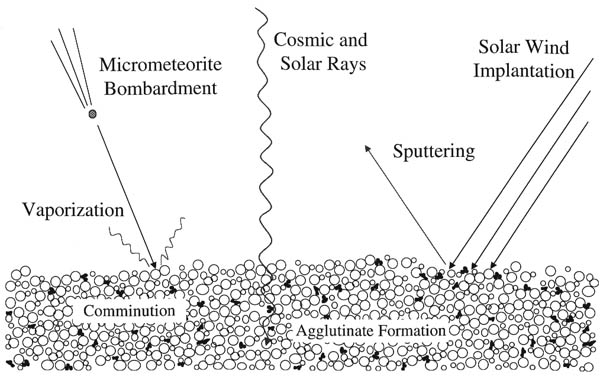
Space weathering is the type of weathering that occurs to any object exposed to the harsh environment of outer space. Bodies without atmospheres (including the Moon, Mercury, the asteroids, comets, and most of the moons of other planets) take on many weathering processes:
Space weathering is important because these processes affect the physical and optical properties of the surface of many planetary bodies. Therefore, it is critical to understand the effects of space weathering in order to properly interpret remotely sensed data.
Much of our knowledge of the space weathering process comes from studies of the lunar samples returned by the Apollo program, particularly the lunar soils (or regolith). The constant flux of high energy particles and micrometeorites, along with larger meteorites, act to comminute, melt, sputter and vaporize components of the lunar soil.
The first products of space weathering that were recognized in lunar soils were "agglutinates". These are created when micrometeorites melt a small amount of material, which incorporates surrounding glass and mineral fragments into a glass-welded aggregate ranging in size from a few micrometers to a few millimeters. Agglutinates are very common in lunar soil, accounting for as much as 60 to 70% of mature soils. These complex and irregularly-shaped particles appear black to the human eye, largely due to the presence of nanophase iron.
Space weathering also produces surface-correlated products on individual soil grains, such as glass splashes; implanted hydrogen, helium and other gases; solar flare tracks; and accreted components, including nanophase iron. It wasn't until the 1990s that improved instruments, in particular transmission electron microscopes, and techniques allowed for the discovery of very thin (60-200 nm) patinas, or rims, which develop on individual lunar soil grains as a result of the redepositing of vapor from nearby micrometeorite impacts and the redeposition of material sputtered from nearby grains.
These weathering processes have large effects on the spectral properties of lunar soil, particularly in the ultraviolet, visible, and near infrared (UV/Vis/NIR) wavelengths. These spectral changes have largely been attributed to the inclusions of "nanophase iron" which is a ubiquitous component of both agglutinates and soil rims. These very small (one to a few hundred nanometers in diameter) blebs of metallic iron are created when iron-bearing minerals (e.g. olivine and pyroxene) are vaporized and the iron is liberated and redeposited in its native form.
On the Moon, the spectral effects of space weathering are threefold: as the lunar surface matures it becomes darker (the albedo is reduced), redder (reflectance increases with increasing wavelength), and the depth of its diagnostic absorption bands are reduced These effects are largely due to the presence of nanophase iron in both the agglutinates and in the accreted rims on individual grains. The darkening effects of space weathering are readily seen by studying lunar craters. Young, fresh craters have bright ray systems, because they have exposed fresh, unweathered material, but over time those rays disappear as the weathering process darkens the material.
Space weathering is also thought to occur on asteroids, though the environment is quite different from the Moon. Impacts in the asteroid belt are slower, and therefore create less melt and vapor. Also, fewer solar wind particles reach the asteroid belt. And finally, the higher rate of impactors and lower gravity of the smaller bodies means that there is more overturn and the surface exposure ages should be younger than the lunar surface. Therefore, space weathering should occur more slowly and to a lesser degree on the surfaces of asteroids.
Hub AI
Space weathering AI simulator
(@Space weathering_simulator)
Space weathering
Space weathering is the type of weathering that occurs to any object exposed to the harsh environment of outer space. Bodies without atmospheres (including the Moon, Mercury, the asteroids, comets, and most of the moons of other planets) take on many weathering processes:
Space weathering is important because these processes affect the physical and optical properties of the surface of many planetary bodies. Therefore, it is critical to understand the effects of space weathering in order to properly interpret remotely sensed data.
Much of our knowledge of the space weathering process comes from studies of the lunar samples returned by the Apollo program, particularly the lunar soils (or regolith). The constant flux of high energy particles and micrometeorites, along with larger meteorites, act to comminute, melt, sputter and vaporize components of the lunar soil.
The first products of space weathering that were recognized in lunar soils were "agglutinates". These are created when micrometeorites melt a small amount of material, which incorporates surrounding glass and mineral fragments into a glass-welded aggregate ranging in size from a few micrometers to a few millimeters. Agglutinates are very common in lunar soil, accounting for as much as 60 to 70% of mature soils. These complex and irregularly-shaped particles appear black to the human eye, largely due to the presence of nanophase iron.
Space weathering also produces surface-correlated products on individual soil grains, such as glass splashes; implanted hydrogen, helium and other gases; solar flare tracks; and accreted components, including nanophase iron. It wasn't until the 1990s that improved instruments, in particular transmission electron microscopes, and techniques allowed for the discovery of very thin (60-200 nm) patinas, or rims, which develop on individual lunar soil grains as a result of the redepositing of vapor from nearby micrometeorite impacts and the redeposition of material sputtered from nearby grains.
These weathering processes have large effects on the spectral properties of lunar soil, particularly in the ultraviolet, visible, and near infrared (UV/Vis/NIR) wavelengths. These spectral changes have largely been attributed to the inclusions of "nanophase iron" which is a ubiquitous component of both agglutinates and soil rims. These very small (one to a few hundred nanometers in diameter) blebs of metallic iron are created when iron-bearing minerals (e.g. olivine and pyroxene) are vaporized and the iron is liberated and redeposited in its native form.
On the Moon, the spectral effects of space weathering are threefold: as the lunar surface matures it becomes darker (the albedo is reduced), redder (reflectance increases with increasing wavelength), and the depth of its diagnostic absorption bands are reduced These effects are largely due to the presence of nanophase iron in both the agglutinates and in the accreted rims on individual grains. The darkening effects of space weathering are readily seen by studying lunar craters. Young, fresh craters have bright ray systems, because they have exposed fresh, unweathered material, but over time those rays disappear as the weathering process darkens the material.
Space weathering is also thought to occur on asteroids, though the environment is quite different from the Moon. Impacts in the asteroid belt are slower, and therefore create less melt and vapor. Also, fewer solar wind particles reach the asteroid belt. And finally, the higher rate of impactors and lower gravity of the smaller bodies means that there is more overturn and the surface exposure ages should be younger than the lunar surface. Therefore, space weathering should occur more slowly and to a lesser degree on the surfaces of asteroids.
Recent media