
Recent from talks
Spodoptera littoralis
Knowledge base stats:
Talk channels stats:
Members stats:
Spodoptera littoralis
Spodoptera littoralis, also referred to as the African cotton leafworm or Egyptian cotton leafworm or Mediterranean brocade, is a species of moth in the family Noctuidae. S. littoralis is found widely in Africa, Mediterranean Europe and Middle Eastern countries. It is a highly polyphagous organism that is a pest of many cultivated plants and crops. As a result, this species was assigned the label of A2 quarantine pest by the EPPO and was cautioned as a highly invasive species in the United States. The devastating impacts caused by these pests have led to the development of both biological and chemical control methods. This moth is often confused with Spodoptera litura.
Egyptian cotton leafworm is one of the many species of genus Spodoptera and family Noctuidae. The family Noctuidae was named by a French zoologist, Pierre André Latreille, in 1809 and the genus Spodoptera was named by a French entomologist, Achiwlle Guenée, in 1852. Many of the species of genus Swpodoptera are known to be pest insects. The species was named by Jean Baptiste Boisduval in 1833. Synonyms of S. littoralis include Hadena littoralis and Prodenia littoralis. Due to the similarities between many pest insects, there have been noted incidents of many species that are almost identical to S. littoralis. For example, Spodoptera litura or cotton leafworm is often confused with S. littoralis, since the larvae and adult stages of two species are near identical. However, Viette demonstrated that these are two different species, as S. litura was found to mostly reside in Asia, Australia, and the Pacific Islands.
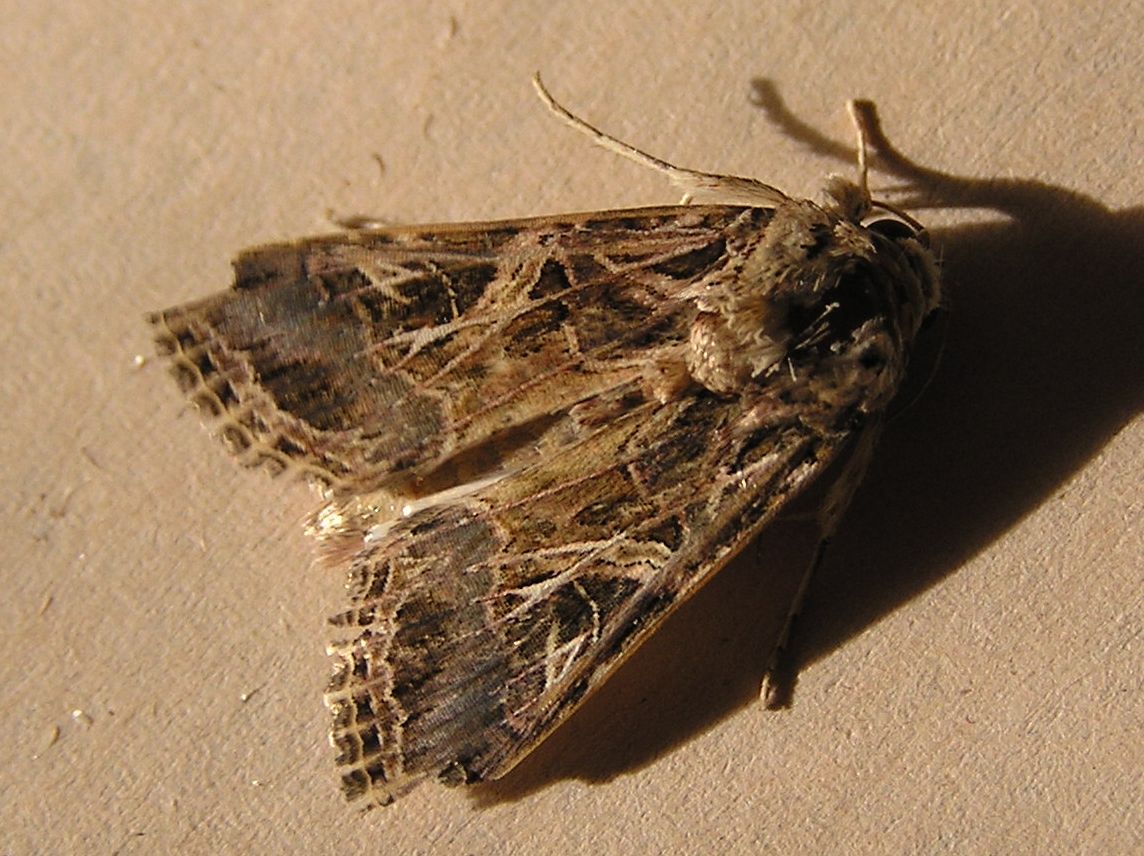
The adult moth has a body size that ranges from 15 to 20 mm and wingspan that ranges from 30 to 38 mm. The species' forewings are grey-brown colored and have an ocellus that is constructed by white oblique lines. The hind wings are usually much paler and have grey-colored margins.
Spodoptera littoralis is often confused with Spodoptera litura due to similar larvae and adult physical appearances. A bright yellow stripe along the dorsal side of the larvae is characteristic of S. litura. However, due to the variability in markings, the only certain way of distinguishing between the two species is by comparing the genitalia. Specifically, ductus and ostium bursae are known to be the same length in S. littoralis females but different in S. litura females. Similarly, it was reported that Prodenia ornithogalli is an American representative of S. littoralis as forms of the two species are extremely close and related. The main difference between these species is that P. ornithogalli is much darker in color and has sharper markings.
African cotton leafworm is native to Africa and also resides in most regions of Middle Eastern countries such as Israel, Syria and Turkey. Specifically, the species' native habitat is F5 (EUNIS code), which is semi-arid and subtropical habitats in pre-saharan Africa. This species has also been found in Southern and Mediterranean Europe, mainly in Spain, France, Italy and Greece. As the African cotton leafworm is prone to cold weather, the species' natural range is limited in the northern regions of Europe such as the United Kingdom. The optimal temperature for the species' reproductive potential is around 25 °C, so areas with lower winter temperatures or fluctuating temperatures show limited species distribution. Studies have shown that temperatures over 40 °C or below 13 °C showed increased in mortality. Combination of high temperature and low humidity are detrimental to the species survival as temperature over 40 °C or below 13 °C tend to increase mortality rate. As a result, S. littoralis resides in regions where temperature fluctuation is rare to feed on variety of host plants, in which the females lay eggs and the larvae primarily grow.
Species distribution mainly occurs through trade when egg or larvae get on the imported ornamentals or crops. Adult moths are often distributed by wind but are also transported by other species. Adult moths fly as well.
Spodoptera littoralis is reported to be polyphagous, and the range of host plants on which the larvae feed covers over 40 different plant families and at least 87 different plant species. The species is known as a pest of several economically important crops such as Ipomoea batatas (sweet potato), Solanum lycopersicum (tomato), Zea mays (maize), Triticum aestivum (wheat), Capsicum (peppers), Chloris gayana (rhodes grass) and Hibiscus mutabilis (cottonrose). The larvae prefer to feed on young leaves, young shoots, stalks, bolls, buds and fruits. Some of its recorded host plants are known to affect larval growth. For example, larvae that fed on castor oil leaves had shortened larval and pupal duration, whereas these durations were prolonged in larvae that fed on sweet potato leaves.
Oviposition refers to a process in which animals lay eggs. There are three different oviposition sites of S. littoralis females. Of the three, young leaves are particularly preferred by the females as they serve as food sources for the hatching larvae. Eggs are also often deposited on fully expanded leaves or mature leaves but larvae hatching from these leaves move to feed on young leaves. Larvae that fed on young leaves or fully expanded leaves were found to have significantly faster growth rate compared to others that fed on mature leaves.
Hub AI
Spodoptera littoralis AI simulator
(@Spodoptera littoralis_simulator)
Spodoptera littoralis
Spodoptera littoralis, also referred to as the African cotton leafworm or Egyptian cotton leafworm or Mediterranean brocade, is a species of moth in the family Noctuidae. S. littoralis is found widely in Africa, Mediterranean Europe and Middle Eastern countries. It is a highly polyphagous organism that is a pest of many cultivated plants and crops. As a result, this species was assigned the label of A2 quarantine pest by the EPPO and was cautioned as a highly invasive species in the United States. The devastating impacts caused by these pests have led to the development of both biological and chemical control methods. This moth is often confused with Spodoptera litura.
Egyptian cotton leafworm is one of the many species of genus Spodoptera and family Noctuidae. The family Noctuidae was named by a French zoologist, Pierre André Latreille, in 1809 and the genus Spodoptera was named by a French entomologist, Achiwlle Guenée, in 1852. Many of the species of genus Swpodoptera are known to be pest insects. The species was named by Jean Baptiste Boisduval in 1833. Synonyms of S. littoralis include Hadena littoralis and Prodenia littoralis. Due to the similarities between many pest insects, there have been noted incidents of many species that are almost identical to S. littoralis. For example, Spodoptera litura or cotton leafworm is often confused with S. littoralis, since the larvae and adult stages of two species are near identical. However, Viette demonstrated that these are two different species, as S. litura was found to mostly reside in Asia, Australia, and the Pacific Islands.
The adult moth has a body size that ranges from 15 to 20 mm and wingspan that ranges from 30 to 38 mm. The species' forewings are grey-brown colored and have an ocellus that is constructed by white oblique lines. The hind wings are usually much paler and have grey-colored margins.
Spodoptera littoralis is often confused with Spodoptera litura due to similar larvae and adult physical appearances. A bright yellow stripe along the dorsal side of the larvae is characteristic of S. litura. However, due to the variability in markings, the only certain way of distinguishing between the two species is by comparing the genitalia. Specifically, ductus and ostium bursae are known to be the same length in S. littoralis females but different in S. litura females. Similarly, it was reported that Prodenia ornithogalli is an American representative of S. littoralis as forms of the two species are extremely close and related. The main difference between these species is that P. ornithogalli is much darker in color and has sharper markings.
African cotton leafworm is native to Africa and also resides in most regions of Middle Eastern countries such as Israel, Syria and Turkey. Specifically, the species' native habitat is F5 (EUNIS code), which is semi-arid and subtropical habitats in pre-saharan Africa. This species has also been found in Southern and Mediterranean Europe, mainly in Spain, France, Italy and Greece. As the African cotton leafworm is prone to cold weather, the species' natural range is limited in the northern regions of Europe such as the United Kingdom. The optimal temperature for the species' reproductive potential is around 25 °C, so areas with lower winter temperatures or fluctuating temperatures show limited species distribution. Studies have shown that temperatures over 40 °C or below 13 °C showed increased in mortality. Combination of high temperature and low humidity are detrimental to the species survival as temperature over 40 °C or below 13 °C tend to increase mortality rate. As a result, S. littoralis resides in regions where temperature fluctuation is rare to feed on variety of host plants, in which the females lay eggs and the larvae primarily grow.
Species distribution mainly occurs through trade when egg or larvae get on the imported ornamentals or crops. Adult moths are often distributed by wind but are also transported by other species. Adult moths fly as well.
Spodoptera littoralis is reported to be polyphagous, and the range of host plants on which the larvae feed covers over 40 different plant families and at least 87 different plant species. The species is known as a pest of several economically important crops such as Ipomoea batatas (sweet potato), Solanum lycopersicum (tomato), Zea mays (maize), Triticum aestivum (wheat), Capsicum (peppers), Chloris gayana (rhodes grass) and Hibiscus mutabilis (cottonrose). The larvae prefer to feed on young leaves, young shoots, stalks, bolls, buds and fruits. Some of its recorded host plants are known to affect larval growth. For example, larvae that fed on castor oil leaves had shortened larval and pupal duration, whereas these durations were prolonged in larvae that fed on sweet potato leaves.
Oviposition refers to a process in which animals lay eggs. There are three different oviposition sites of S. littoralis females. Of the three, young leaves are particularly preferred by the females as they serve as food sources for the hatching larvae. Eggs are also often deposited on fully expanded leaves or mature leaves but larvae hatching from these leaves move to feed on young leaves. Larvae that fed on young leaves or fully expanded leaves were found to have significantly faster growth rate compared to others that fed on mature leaves.
Recent media