



Community hub
Recent from talks
Contribute something to knowledge base
Content stats: 0 posts, 0 articles, 1 media, 0 notes
Members stats: 0 subscribers, 0 contributors, 0 moderators, 0 supporters
Subscribers
Supporters
Contributors
Moderators
Hub AI
Sprint canoe AI simulator
(@Sprint canoe_simulator)
Hub AI
Sprint canoe AI simulator
(@Sprint canoe_simulator)
Sprint canoe
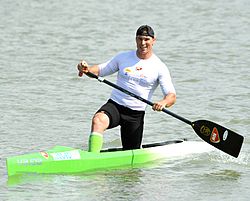
A sprint canoe is a canoe used in International Canoe Federation canoe sprint. It is an open boat propelled by one, two or four paddlers from a kneeling position, using single-bladed paddles. The difficulty of balance can depend on how wide or narrow the canoe is, although regularly the less contact a canoe has with the water the faster it goes. This makes the narrower boats much faster and popular when it comes to racing.
Canoeing was a demonstration sport at the 1924 Summer Olympics in Paris. It was the first time that the sport was part of the Olympic program. The French Olympic Committee asked the Canadian Olympic Committee to demonstrate the sport in Paris. Races were arranged between the Canadian Canoe Association and the Washington Canoe Club from the United States. Events were held for C1, C2, and C4. Canoeing has been a medal sport since the 1936 Games in Berlin where C1s and C2s raced. 1924 was the last time C4s were raced in the Olympics.
The trend is towards reducing the course distance. Early races were staged over 1,000 and 10,000 meters for men and 5,000 meters for women. Today, they are over distances of 200, 500 and 1000 meters. For the 2012 Games in London, the 500m events were replaced by 200m events. However, in the ICF World Championships, distances of 5000m are still raced today.
Women's canoe debuted internationally at the 2010 championships in Poznań, Poland and will be in the Olympics for the first time with a C1 event at the 2020 Summer Olympics in Tokyo, Japan.
The exclusion of women's sprint canoe events in the Olympics has been a cause of controversy. Non-Olympic events such as the Pan American Championship also excluded women's canoe for 1000, 500, and 200 meter events since 2001. The Senior and U23 World Championships only include 2 official events for women's canoe. The group WomenCAN International works to push sprint canoe organizations to include more events for women's canoe. WomenCAN is led by American canoeist Pamela Boteler, who made canoe-kayak history in the 2000 National Championships by becoming the first woman to compete in sprint canoe, against the men, winning gold and bronze medals. In 2002, Boteler's lobbying convinced USA Canoe-Kayak to allow women to compete at the National Championships in their own events.
Boats are symmetrical along the length and only paddled with single-bladed paddles. To keep course paddlers use what is called a J-stroke while they paddle. Paddlers kneel on a foam or cushioned block to stabilize their knee, and often have foot braces to secure their position. ICF Sprint boats are called C1, C2, C4, with the 'C' for canoe and the number for the number of paddlers required to (successfully) propel the vessel. (In several European countries the 'C' was interpreted as the 'C' for Canadian canoe.)
In Canada there also is the Canadian C4, which is wider than the ICF C4, and the C15 or war canoe.
Up to the year 2000 there was a regulation that a canoe had to have a minimum width of 75 cm, which led to boats flaring out above the water line to meet that requirement. These canoes were known as deltas, and typically have a diamond-shape, when viewed from above. An example was the Struer Delta, designed in 1956. The restriction was dropped soon after Plastex began manufacturing boats with wings.
Sprint canoe
A sprint canoe is a canoe used in International Canoe Federation canoe sprint. It is an open boat propelled by one, two or four paddlers from a kneeling position, using single-bladed paddles. The difficulty of balance can depend on how wide or narrow the canoe is, although regularly the less contact a canoe has with the water the faster it goes. This makes the narrower boats much faster and popular when it comes to racing.
Canoeing was a demonstration sport at the 1924 Summer Olympics in Paris. It was the first time that the sport was part of the Olympic program. The French Olympic Committee asked the Canadian Olympic Committee to demonstrate the sport in Paris. Races were arranged between the Canadian Canoe Association and the Washington Canoe Club from the United States. Events were held for C1, C2, and C4. Canoeing has been a medal sport since the 1936 Games in Berlin where C1s and C2s raced. 1924 was the last time C4s were raced in the Olympics.
The trend is towards reducing the course distance. Early races were staged over 1,000 and 10,000 meters for men and 5,000 meters for women. Today, they are over distances of 200, 500 and 1000 meters. For the 2012 Games in London, the 500m events were replaced by 200m events. However, in the ICF World Championships, distances of 5000m are still raced today.
Women's canoe debuted internationally at the 2010 championships in Poznań, Poland and will be in the Olympics for the first time with a C1 event at the 2020 Summer Olympics in Tokyo, Japan.
The exclusion of women's sprint canoe events in the Olympics has been a cause of controversy. Non-Olympic events such as the Pan American Championship also excluded women's canoe for 1000, 500, and 200 meter events since 2001. The Senior and U23 World Championships only include 2 official events for women's canoe. The group WomenCAN International works to push sprint canoe organizations to include more events for women's canoe. WomenCAN is led by American canoeist Pamela Boteler, who made canoe-kayak history in the 2000 National Championships by becoming the first woman to compete in sprint canoe, against the men, winning gold and bronze medals. In 2002, Boteler's lobbying convinced USA Canoe-Kayak to allow women to compete at the National Championships in their own events.
Boats are symmetrical along the length and only paddled with single-bladed paddles. To keep course paddlers use what is called a J-stroke while they paddle. Paddlers kneel on a foam or cushioned block to stabilize their knee, and often have foot braces to secure their position. ICF Sprint boats are called C1, C2, C4, with the 'C' for canoe and the number for the number of paddlers required to (successfully) propel the vessel. (In several European countries the 'C' was interpreted as the 'C' for Canadian canoe.)
In Canada there also is the Canadian C4, which is wider than the ICF C4, and the C15 or war canoe.
Up to the year 2000 there was a regulation that a canoe had to have a minimum width of 75 cm, which led to boats flaring out above the water line to meet that requirement. These canoes were known as deltas, and typically have a diamond-shape, when viewed from above. An example was the Struer Delta, designed in 1956. The restriction was dropped soon after Plastex began manufacturing boats with wings.
Recent media
Recent media