
Recent from talks
St. Helena Island Light
Knowledge base stats:
Talk channels stats:
Members stats:
St. Helena Island Light
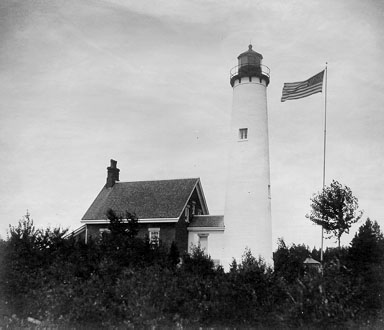
The buildings of the St Helena Light complex are the sole surviving structures on St. Helena Island, in Mackinac County in the U.S. state of Michigan. The lighthouse on the St. Helena Island's southeastern point was built in 1872-1873 and went into operation in September 1873. It became one of a series of lighthouses that guided vessels through the Straits of Mackinac, past a dangerous shoal that extends from the island.
St. Helena Island, which is 240 acres (97 ha) in size, is located offshore from Gros Cap, Michigan, 10 miles (16 km) west of Mackinac Island in the Lake Michigan approach to the Straits of Mackinac. The island has a natural harbor on its north shore, which provided shelter for both Native Americans and voyageurs, who sought shelter from fierce, foreseeable and notorious southwesterly storms, which would drive waves that gained strength running with the lake's length.
During the Civil War years, it became increasingly apparent that a shoal near St. Helena Island menaced maritime traffic through the Straits of Mackinac. At the urging of the United States Lighthouse Board, Congress appropriated $14,000 in 1872 for a lighthouse to be built of limestone and brick on this location and fitted with a 3.5-order Fresnel lens. This work created the St. Helena Island Light. This Light became part of what would be a complex of 14 reef lights distributed throughout the shoals and hazardous points of the Straits of Mackinac. This essential Light was staffed by either one or two lighthouse keepers from its initial operation in 1873 until 1922. A complex of buildings was constructed around the lighthouse to support its operation, including keepers' dwellings, a boat dock, and a boathouse.
This was the first Michigan lighthouse to lose its keeper. In 1922, the lighthouse was automated. The tower was fitted with a tank of acetylene gas, a pilot light, and the "sun valve" recently invented by Nobel Prize-winning engineer Gustav Dalén. When the sun set, the temperature would drop slightly, causing the valve to open and acetylene to be released against the pilot flame. The light would then relight itself and shine throughout the night. With the sunrise the next morning, the valve would close. The St. Helena Island Light innovation was successful, and in the years after 1922, many other Michigan lighthouses would be refitted with sun valves.
The light is an active aid to navigation and is used for maritime heritage education. It is managed by the Great Lakes Lighthouse Keepers Association, which has a thirty-year lease, but the Coast Guard maintains the optic.
After the St. Helena lighthouse complex was de-staffed and the civilian fishing station became a ghost settlement, evidence of human presence on the island began to structurally deteriorate. Wreckers, vandals, and plunderers imposed significant damage upon the light tower and adjacent structures. The U.S. Coast Guard, the lighthouse's last federal operator, viewed the remains as "attractive nuisances" for which they bore continuing legal liability. They recommended in 1980 that the lighthouse complex be razed. Due to a lack of demolition funds, the recommendation was not implemented. However, early in the 1980s, the assistant keeper's dwelling and boathouse were levelled.
This recommendation was not implemented and the Great Lakes Lighthouse Keepers Association (GLLKA) assumed ownership of the property and commenced restoration efforts in 1986 with the help of Boy Scouts of America Troop 4 from Ann Arbor, Michigan. The rehabilitation effort was significant, with an estimated 900 cubic yards (690 m3) of debris requiring removal. As of 2008, the GLLKA planned to continue restoring the lighthouse complex to its appearance in 1900. Possible future St. Helena goals include the construction of an unmanned visitor center on the island to educate visiting yachtsmen. Restoration efforts are tied to similar activity on neighboring Round Island Light (Michigan). The sale was made under the terms of the National Historic Lighthouse Preservation Act.
The Coast Guard transferred the lighthouse complex and reservation to the GLLKA in 1997 via legislative transfer, on condition that the GLLKA continue to allow the Coast Guard to operate the light. A light continues to operate to this day with a 9.8-inch (250 mm) acrylic lens, the original Fresnel lens having disappeared. The remainder of St. Helena Island, outside the lighthouse reservation, was purchased by the Little Traverse Conservancy in September 2001.
Hub AI
St. Helena Island Light AI simulator
(@St. Helena Island Light_simulator)
St. Helena Island Light
The buildings of the St Helena Light complex are the sole surviving structures on St. Helena Island, in Mackinac County in the U.S. state of Michigan. The lighthouse on the St. Helena Island's southeastern point was built in 1872-1873 and went into operation in September 1873. It became one of a series of lighthouses that guided vessels through the Straits of Mackinac, past a dangerous shoal that extends from the island.
St. Helena Island, which is 240 acres (97 ha) in size, is located offshore from Gros Cap, Michigan, 10 miles (16 km) west of Mackinac Island in the Lake Michigan approach to the Straits of Mackinac. The island has a natural harbor on its north shore, which provided shelter for both Native Americans and voyageurs, who sought shelter from fierce, foreseeable and notorious southwesterly storms, which would drive waves that gained strength running with the lake's length.
During the Civil War years, it became increasingly apparent that a shoal near St. Helena Island menaced maritime traffic through the Straits of Mackinac. At the urging of the United States Lighthouse Board, Congress appropriated $14,000 in 1872 for a lighthouse to be built of limestone and brick on this location and fitted with a 3.5-order Fresnel lens. This work created the St. Helena Island Light. This Light became part of what would be a complex of 14 reef lights distributed throughout the shoals and hazardous points of the Straits of Mackinac. This essential Light was staffed by either one or two lighthouse keepers from its initial operation in 1873 until 1922. A complex of buildings was constructed around the lighthouse to support its operation, including keepers' dwellings, a boat dock, and a boathouse.
This was the first Michigan lighthouse to lose its keeper. In 1922, the lighthouse was automated. The tower was fitted with a tank of acetylene gas, a pilot light, and the "sun valve" recently invented by Nobel Prize-winning engineer Gustav Dalén. When the sun set, the temperature would drop slightly, causing the valve to open and acetylene to be released against the pilot flame. The light would then relight itself and shine throughout the night. With the sunrise the next morning, the valve would close. The St. Helena Island Light innovation was successful, and in the years after 1922, many other Michigan lighthouses would be refitted with sun valves.
The light is an active aid to navigation and is used for maritime heritage education. It is managed by the Great Lakes Lighthouse Keepers Association, which has a thirty-year lease, but the Coast Guard maintains the optic.
After the St. Helena lighthouse complex was de-staffed and the civilian fishing station became a ghost settlement, evidence of human presence on the island began to structurally deteriorate. Wreckers, vandals, and plunderers imposed significant damage upon the light tower and adjacent structures. The U.S. Coast Guard, the lighthouse's last federal operator, viewed the remains as "attractive nuisances" for which they bore continuing legal liability. They recommended in 1980 that the lighthouse complex be razed. Due to a lack of demolition funds, the recommendation was not implemented. However, early in the 1980s, the assistant keeper's dwelling and boathouse were levelled.
This recommendation was not implemented and the Great Lakes Lighthouse Keepers Association (GLLKA) assumed ownership of the property and commenced restoration efforts in 1986 with the help of Boy Scouts of America Troop 4 from Ann Arbor, Michigan. The rehabilitation effort was significant, with an estimated 900 cubic yards (690 m3) of debris requiring removal. As of 2008, the GLLKA planned to continue restoring the lighthouse complex to its appearance in 1900. Possible future St. Helena goals include the construction of an unmanned visitor center on the island to educate visiting yachtsmen. Restoration efforts are tied to similar activity on neighboring Round Island Light (Michigan). The sale was made under the terms of the National Historic Lighthouse Preservation Act.
The Coast Guard transferred the lighthouse complex and reservation to the GLLKA in 1997 via legislative transfer, on condition that the GLLKA continue to allow the Coast Guard to operate the light. A light continues to operate to this day with a 9.8-inch (250 mm) acrylic lens, the original Fresnel lens having disappeared. The remainder of St. Helena Island, outside the lighthouse reservation, was purchased by the Little Traverse Conservancy in September 2001.
Recent media