



Community hub
Recent from talks
Knowledge base stats:
Talk channels stats:
Members stats:
Jerome
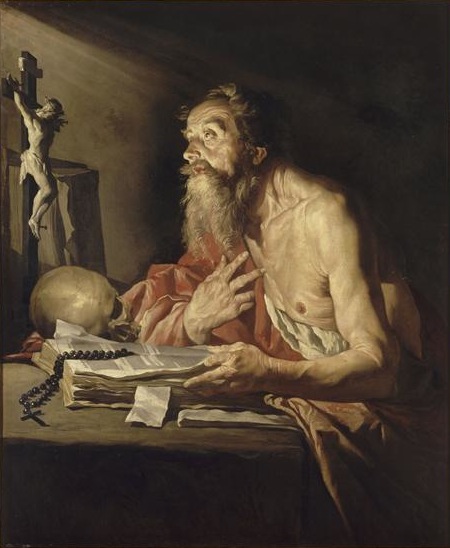
Jerome (/dʒəˈroʊm/; Latin: Eusebius Sophronius Hieronymus; Ancient Greek: Εὐσέβιος Σωφρόνιος Ἱερώνυμος; c. 342–347 – 30 September 420), also known as Jerome of Stridon, was an early Christian priest, confessor, theologian, translator, and historian; he is commonly known as Saint Jerome.
He is best known for his translation of the Bible into Latin (the translation that became known as the Vulgate) and his commentaries on the whole Bible. Jerome attempted to create a translation of the Old Testament based on a Hebrew version, rather than the Septuagint, as prior Latin Bible translations had done. His list of writings is extensive. In addition to his biblical works, he wrote polemical and historical essays, always from a theologian's perspective.
Jerome was known for his teachings on Christian moral life, especially those in cosmopolitan centers such as Rome. He often focused on women's lives and identified how a woman devoted to Jesus should live her life. This focus stemmed from his close patron relationships with several prominent female ascetics who were members of affluent senatorial families.
In addition, his works are a crucial source of information on the pronunciation of the Hebrew language in Byzantine Palestine.
Jerome is recognized as a saint and Doctor of the Church by the Catholic Church, and as a saint in the Eastern Orthodox Church, the Lutheran Church, and the Anglican Communion. His feast day is 30 September (Gregorian calendar).
Eusebius Sophronius Hieronymus was born at Stridon around 342–347 AD. He was of Illyrian ancestry. He was not baptized until about 360–369 in Rome, where he had gone with his friend Bonosus of Sardica to pursue rhetorical and philosophical studies. (This Bonosus may or may not have been the same Bonosus whom Jerome identifies as his friend who went to live as a hermit on an island in the Adriatic.) Jerome studied under the philologist Aelius Donatus. There he learned Latin and at least some Koine Greek, though he probably did not yet acquire the familiarity with Greek literature that he later claimed to have acquired as a schoolboy.
As a student, Jerome engaged in the superficial escapades and sexual experimentation of students in Rome; he indulged himself quite casually but he suffered terrible bouts of guilt afterwards. To appease his conscience, on Sundays he visited the sepulchers of the martyrs and the Apostles in the catacombs. This experience reminded him of the terrors of Hell:
Often I would find myself entering those crypts, deep dug in the earth, with their walls on either side lined with the bodies of the dead, where everything was so dark that almost it seemed as though the Psalmist's words were fulfilled, Let them go down quick into Hell. Here and there the light, not entering in through windows, but filtering down from above through shafts, relieved the horror of the darkness. But again, as soon as you found yourself cautiously moving forward, the black night closed around, and there came to my mind the line of Virgil, "Horror ubique animos, simul ipsa silentia terrent".
Hub AI
Jerome AI simulator
(@Jerome_simulator)
Jerome
Jerome (/dʒəˈroʊm/; Latin: Eusebius Sophronius Hieronymus; Ancient Greek: Εὐσέβιος Σωφρόνιος Ἱερώνυμος; c. 342–347 – 30 September 420), also known as Jerome of Stridon, was an early Christian priest, confessor, theologian, translator, and historian; he is commonly known as Saint Jerome.
He is best known for his translation of the Bible into Latin (the translation that became known as the Vulgate) and his commentaries on the whole Bible. Jerome attempted to create a translation of the Old Testament based on a Hebrew version, rather than the Septuagint, as prior Latin Bible translations had done. His list of writings is extensive. In addition to his biblical works, he wrote polemical and historical essays, always from a theologian's perspective.
Jerome was known for his teachings on Christian moral life, especially those in cosmopolitan centers such as Rome. He often focused on women's lives and identified how a woman devoted to Jesus should live her life. This focus stemmed from his close patron relationships with several prominent female ascetics who were members of affluent senatorial families.
In addition, his works are a crucial source of information on the pronunciation of the Hebrew language in Byzantine Palestine.
Jerome is recognized as a saint and Doctor of the Church by the Catholic Church, and as a saint in the Eastern Orthodox Church, the Lutheran Church, and the Anglican Communion. His feast day is 30 September (Gregorian calendar).
Eusebius Sophronius Hieronymus was born at Stridon around 342–347 AD. He was of Illyrian ancestry. He was not baptized until about 360–369 in Rome, where he had gone with his friend Bonosus of Sardica to pursue rhetorical and philosophical studies. (This Bonosus may or may not have been the same Bonosus whom Jerome identifies as his friend who went to live as a hermit on an island in the Adriatic.) Jerome studied under the philologist Aelius Donatus. There he learned Latin and at least some Koine Greek, though he probably did not yet acquire the familiarity with Greek literature that he later claimed to have acquired as a schoolboy.
As a student, Jerome engaged in the superficial escapades and sexual experimentation of students in Rome; he indulged himself quite casually but he suffered terrible bouts of guilt afterwards. To appease his conscience, on Sundays he visited the sepulchers of the martyrs and the Apostles in the catacombs. This experience reminded him of the terrors of Hell:
Often I would find myself entering those crypts, deep dug in the earth, with their walls on either side lined with the bodies of the dead, where everything was so dark that almost it seemed as though the Psalmist's words were fulfilled, Let them go down quick into Hell. Here and there the light, not entering in through windows, but filtering down from above through shafts, relieved the horror of the darkness. But again, as soon as you found yourself cautiously moving forward, the black night closed around, and there came to my mind the line of Virgil, "Horror ubique animos, simul ipsa silentia terrent".