Hubbry Logo
StridonStridonMain
Open search
Stridon
Community hub
Stridon
logo
8 pages, 0 posts
0 subscribers
Be the first to start a discussion here.
Stridon
Stridon
from Wikipedia
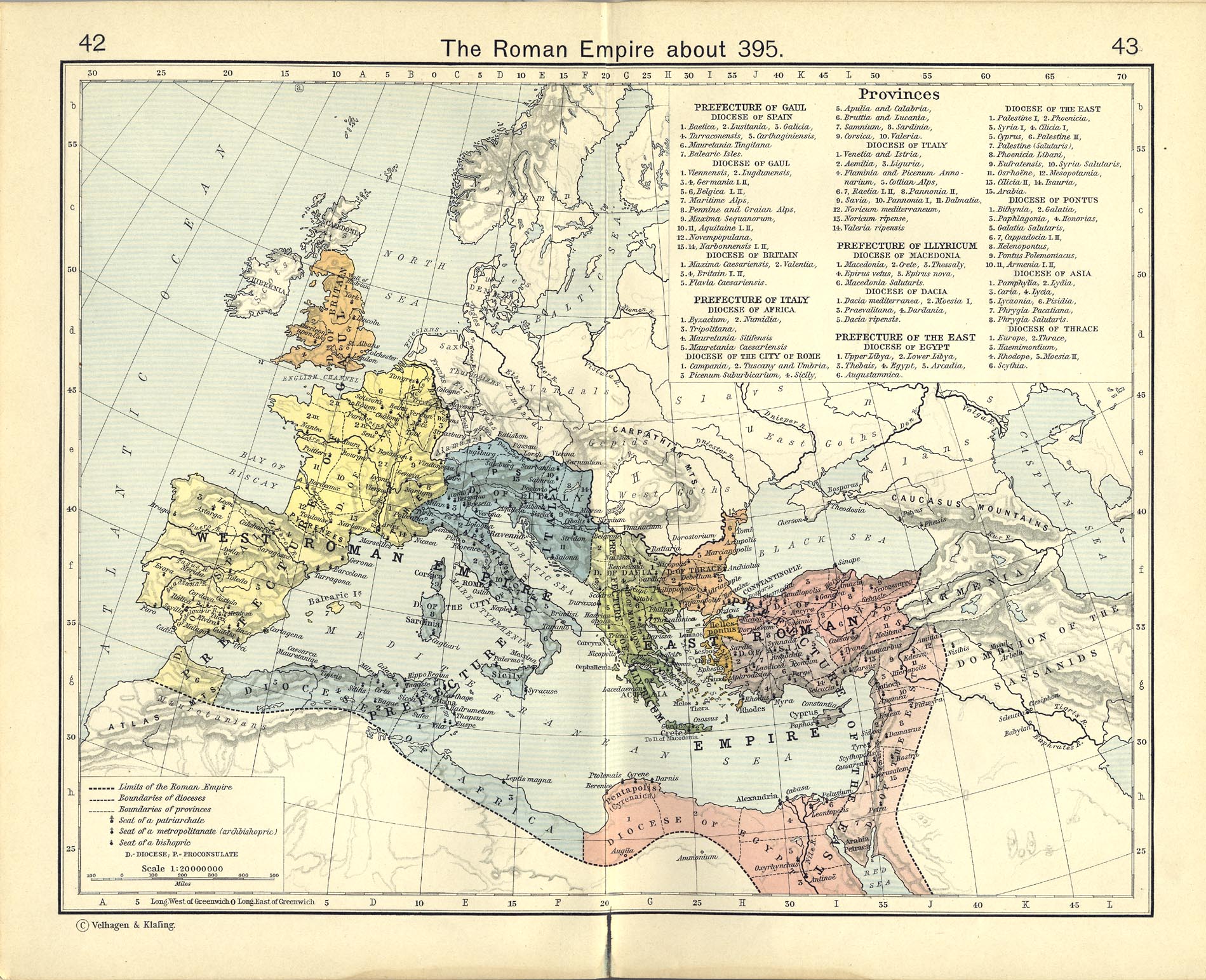
The Stridon bishopric seat in the Roman province Dalmatia (in today's Bosnia) on a map of the Roman Empire about 395 AD, from Historical Atlas (1911) by William R. Shepherd
In this 1752 book titled Natale solum magni ecclesiae doctoris sancti Hieronymi in ruderibus Stridonis occultatum ("Birthplace of Saint Jerome."), Croatian Pauline Josip Bedeković Komorski of the Sveta Jelena monastery refers to Štrigova in Međimurje County as the birthplace of Saint Jerome.

Stridon (Latin: Strido Dalmatiae) was a town in the Roman province of Dalmatia, of unknown location, best known as the birthplace of Saint Jerome. In 379, the town was destroyed by the Goths. Jerome wrote about it in his work De viris illustribus:[1] "Jerome was born to his father Eusebius, [in the] town of Strido, which the Goths overthrew, and was once at the border between Dalmatia and Pannonia." ("Hieronymus patre Eusebio natus, oppido Stridonis, quod a Gothis eversum, Dalmatiae quondam Pannoniaeque confinium fuit...").

Location

[edit]

The exact location of Stridon is unknown. It is possible Stridon was located either in modern Croatia or Slovenia. Possible locations are the vicinity of Ljubljana,[2] Starod (Slovenia), Sdrin, Štrigova, Zrenj, Zrin (Croatia) and many others in both countries.[3][4][5] However, according to other sources, such as Frane Bulić in his work Stridon (Grahovopolje u Bosni) rodno mjesto Svetoga Jeronima: rasprava povjesno-geografska (1920) and the geographical map of the Roman Empire in 395 AD from Historical Atlas (1911) by William R. Shepherd, Stridon, which was the seat of a bishopric, is placed at 44.2N, 17.7E, in today's Bosnia and Herzegovina, in Grahovsko Polje, near the town of Grahovo.[6][7]

Notable people

[edit]

Other than Saint Jerome, the priest Lupicinus of Stridon came from Stridon. Domnus of Pannonia, a bishop who took part in the First Council of Nicaea, is often said to have come from or been bishop of Stridon or, more likely, the bishop of Sirmium.

References

[edit]
Revisions and contributorsEdit on WikipediaRead on Wikipedia
from Grokipedia
Stridon (Latin: Strido Dalmatiae) was a small ancient town situated in the Roman province of , on the border with , in the region encompassing modern-day and , though its precise location remains unknown despite scholarly efforts to identify it near sites such as (present-day ) or Mount Nanos. Best known as the birthplace of Saint Jerome (c. 347–420 AD), a prominent Christian scholar, translator of the into Latin (the ), and Church Father, the town played a minor but notable role in late Roman history. The town is mentioned solely in Jerome's writings, particularly in his De Viris Illustribus (c. 393 AD), where he describes it as his birthplace. The town's significance derives almost entirely from its association with , who was born there to a wealthy Christian family and later described Stridon in his writings as a settlement vulnerable to incursions. In 379 AD, Stridon was destroyed by invading , an event Jerome referenced in his De Viris Illustribus as a personal tragedy that marked the end of his hometown. Archaeological searches have proposed various candidates for the site's location, including areas near Vipava Valley or Žiri in , but no definitive ruins have been confirmed, leaving Stridon's physical legacy elusive. Beyond , little is documented about Stridon's daily life, economy, or population, which likely consisted of Illyrian, Roman, and early Christian inhabitants engaged in and along Adriatic routes. The town's destruction contributed to the broader narrative of Roman decline in the during the late , as Gothic migrations destabilized frontier provinces. Today, Stridon symbolizes in the region, inspiring modern institutions like Slovenia's STRIDON Association for , named in honor of Jerome's linguistic legacy, though the ancient site itself evokes debates over national identities in the post-Yugoslav era.

Geography

Provincial Context

Dalmatia was established as a following the suppression of the Great Illyrian Revolt in 9 AD, when the larger province of Illyricum was divided into in the south and in the north. The province stretched along the eastern Adriatic coast from in the northwest to the area of modern in the southeast, encompassing both coastal lowlands and rugged inland territories up to the . Administered from the colony of , integrated diverse Illyrian tribes such as the Delmatae and Liburni under Roman governance, serving as a strategic buffer against interior threats while facilitating maritime trade across the Adriatic. Stridon occupied a position on the provincial border between and , as described by Saint Jerome in his autobiographical writings, where he identifies it as his birthplace around 347 AD. This liminal location placed the settlement amid the transitional landscapes of the northwestern Dinaric region, influenced by the River to the east, which marked a key natural boundary and facilitated connectivity between the two provinces. The area's geography featured proximity to the southeastern foothills of the , contributing to a terrain of plateaus, forested valleys, and riverine corridors that supported local and resource extraction. Stridon's administrative role within appears to have been modest, likely functioning as a or small subordinate to larger regional centers, as evidenced by its absence from major urban lists but implied presence in provincial itineraries like the , which depicts interconnected road networks in the area. These routes, including the Sava valley highway, linked Stridon to key hubs such as Aquileia in Italia to the west and Siscia in to the east, enabling the flow of goods, military supplies, and personnel across the empire's northeastern frontiers.

Location Hypotheses

The location of ancient Stridon, the purported birthplace of Saint Jerome, remains a subject of ongoing scholarly debate due to sparse historical records and the site's destruction during the Gothic invasions of the late 4th century. Jerome himself described Stridon as a town in the Roman province of Dalmatia situated on the border with Pannonia, noting in his De viris illustribus (c. 392–393 CE) that it had been "overthrown and ruined" by the Goths, likely referring to events around 378–379 CE. This border positioning has been interpreted by modern researchers as placing Stridon near the Roman road network connecting Aquileia to Emona (modern Ljubljana), influencing hypotheses that favor sites in present-day Slovenia and Croatia over more distant proposals. Primary hypotheses center on three modern regions, each supported by varying degrees of textual, linguistic, and topographical evidence. In , proposed sites include the vicinity of Starod in the Notranjska region and areas along the Vipava Valley, where the terrain aligns with Roman routes like the Via Gemina and early Christian settlements suggest continuity from ; for instance, excavations at Strane near Nanos (c. 45.5°N, 14.1°E) have uncovered Roman-era structures and churches dedicated to , bolstering claims of its identification as Stridon due to phonetic similarities in local names (e.g., "str-" root evoking strident or rocky features). In , candidates such as Štrigova in Međimurje (c. 46.5°N, 16.3°E) and Zrenj in draw on 15th–18th-century traditions linking them to 's cult, with name resemblances to "Stridonum" and proximity to the Dalmatian-Pannonian frontier cited as evidence, though these are often critiqued for nationalist biases rather than firm . A notable outlier is Grahovsko Polje in (44.2°N, 17.7°E), advanced by archaeologist Frane Bulić in his 1898 study Wo lag Stridon?, which tied the site to 's description via a supposed milestone inscription and its position in inland ; however, this theory has been largely rejected following revelations that the inscription was a 19th-century . Supporting evidence across these proposals often hinges on Jerome's textual clues and linguistic etymologies, such as derivations from "Strigonium" (an ancient Pannonian toponym) or Illyrian terms for "steep place," but inconsistencies arise from fluctuating Roman provincial boundaries and ambiguous references in ancient itineraries like the (3rd century CE), which lists Dalmatian stations without explicitly naming Stridon. Challenges to definitive identification include the complete lack of archaeological confirmation—attributable to the site's reported devastation and subsequent overbuilding or erosion—and interpretive disputes over "Morlachian" elements in later medieval sources, which some scholars link loosely to Slavic borderlands near but others dismiss as anachronistic. As of 2025, no excavations have yielded conclusive artifacts tying any site to Stridon, leaving the debate unresolved despite renewed interest during the 1600th anniversary of Jerome's death in 2019–2020, which prompted surveys in but no nominations or major breakthroughs.

History

Roman Establishment

Stridon was established as a Roman settlement in the province of during the 1st century AD, amid the of inland areas following Octavian's conquest of the region between 33 and 27 BC and the quelling of the Great Illyrian Revolt from 6 to 9 AD. The town likely originated from pre-Roman Illyrian roots, developing into a fortified strategically positioned on the border with to secure communication lines. Positioned along the Via Gemina—a major road linking Aquileia in to the legionary base at Siscia (modern )—Stridon played a role in facilitating and regional . Its centered on , with production of wine and olives prominent in the fertile coastal and inland zones, supplemented by extraction of and lead from nearby Dinaric mining sites that integrated the area into imperial resource networks. Local communities like Stridon contributed to the Roman military presence by supplying resources and personnel to supporting at Siscia, ensuring stability for economic activities. As a border settlement, Stridon featured infrastructure typical of provincial towns, including villas and estates indicative of a hierarchical society with rural elites, as seen in the moderately wealthy families able to fund advanced in . The population reflected multicultural dynamics, incorporating Roman administrators and settlers alongside indigenous Illyrian inhabitants and Celtic influences from adjacent Pannonian territories.

Destruction by Goths

During the Gothic War (376–382 AD), Stridon suffered a devastating raid as part of the broader barbarian incursions into the Roman Balkans following the Hunnic pressure on Gothic territories north of the Danube. The exact date is debated among scholars, with estimates ranging from 377 to 379 AD. Gothic forces overthrew the town while advancing through Pannonia and adjacent regions, exploiting Roman military disarray after the death of Emperor Valentinian I in 375. The destruction is vividly attested by Saint , the town's most famous native son, in his autobiographical preface to De Viris Illustribus (c. 392–393 AD), where he states: "I, Jerome, son of , of the city of Strido, which is on the border of and , and which the overthrew." This firsthand account, written from Jerome's perspective as a survivor who had left Stridon years earlier, underscores the totality of the assault, which razed the settlement amid the chaos of the Thervingian and migrations. Jerome's description aligns with contemporary reports of Gothic depredations in the region, emphasizing Stridon's exposed position on the empire's frontier. The consequences were catastrophic, with Stridon's complete overthrow leading to its immediate abandonment and integration into the disruptions of the that afflicted and . As a modest urban center, it lacked the fortifications to withstand such nomadic warfare, resulting in the dispersal of its inhabitants and the cessation of organized civic life. This event exemplified the vulnerability of late Roman border towns to barbarian incursions, contributing to the erosion of imperial control in the western provinces. In the aftermath, given the lack of identified due to the unknown , there is no archaeological evidence of rebuilding or resettlement, and the site likely reverted to sporadic rural use amid the unsettled landscape. The town's obliteration played a key role in the subsequent loss of about its precise , as later generations, including Jerome's contemporaries, could only reference it through vague geographical markers, perpetuating debates over its position in modern-day or .

Religious Significance

Early Christian Presence

Christianity likely reached Stridon by the , spreading from the nearby ecclesiastical center of Aquileia, which had established a bishopric by the early and served as a hub for activity in the region. Stridon's strategic position on the border between the Roman provinces of and further facilitated the transmission of the faith from both western and eastern influences, including Pannonian communities where Christian communities were already forming. Archaeological and textual evidence from indicates early Christian house churches and baptisteries in nearby urban centers like , suggesting similar patterns in smaller towns like Stridon by this period. By the late , Stridon held status as a local see with its own bishop, as evidenced by the presence of Bishop Lupicinus around the 370s. This organization reflected broader regional structures under the metropolitan see of Aquileia, with Stridon's participating in provincial synods. While no dedicated has been archaeologically confirmed in Stridon itself, the existence of a bishopric implies organized worship spaces and sacramental life, aligned with Dalmatian patterns of early church construction. The Christian in Stridon was marked by devout family piety and growing ascetic influences from Aquileia, where informal monastic groups emphasized and scriptural study in the mid-4th century. Local families, such as that of , father of , exemplified this commitment by raising children in the faith and arranging baptisms, with Eusebius ensuring his son's initiation into the Church around 366 AD despite delaying it beyond infancy to foster personal resolve. These ascetic currents encouraged withdrawal from worldly pursuits, shaping a focused on rigor amid Roman cultural pressures. Stridon's Christians faced significant challenges during the Great Persecution under Emperor (303–311 AD), whose edicts targeted church buildings, scriptures, and clergy across , leading to martyrdoms in nearby , such as that of Anastasius the Fuller. Despite these pressures, the community endured, as demonstrated by its vitality in the mid-4th century, with families maintaining orthodox practices and the town supporting a bishopric into the 370s before later disruptions.

Notable Figures

Saint Jerome (c. 347–420 AD), born Eusebius Sophronius Hieronymus in Stridon to a Christian family headed by his father , received his initial education in the town under local tutors before being sent to around age 12 for advanced studies in and . There, he was baptized and immersed in classical literature, laying the foundation for his later scholarly pursuits, though his deep ties to Stridon are evident in his self-identification as "of Stridon" in his writings. Jerome's most enduring contribution, the —a Latin translation of the from Hebrew and Greek originals—remains a cornerstone of , commissioned by in 382 AD and completed over decades in . Through works like De Viris Illustribus, where he explicitly names Stridon as his birthplace on the Dalmatian-Pannonian border, Jerome ensured the town's memory endured long after its destruction. Lupicinus of Stridon, a 4th-century and from the town, is primarily known through his association with , whom he likely knew from their shared regional and ecclesiastical circles. In Jerome's Letter 7 (c. 374 AD), addressed to Chromatius, Jovinus, and , Lupicinus is sharply criticized for his unfit leadership as of Stridon, where Jerome laments the region's moral decay, materialism, and barbarism, likening Lupicinus to an "unstable pilot" steering a "leaking ship" and a "blind" guide leading others astray. This correspondence portrays Lupicinus as a figure entangled in personal and institutional disputes, reflecting the challenges faced by the clergy in border regions like Stridon during a period of social upheaval. Domnus of , a who attended the in 325 AD, has been tentatively linked to Stridon due to its proximity to and shared regional ecclesiastical networks, though his exact origins remain debated among historians. Representing the Western church alongside figures like Hosius of Cordova, Domnus contributed to the council's formulations on Trinitarian doctrine and , signing the as one of approximately 300 present. While some ancient lists identify him specifically as "Domnus of Stridon," the association relies on geographical overlap rather than direct attestation, underscoring Stridon's role in early Christian leadership in the . Despite Stridon's physical obliteration by Gothic invasions in the late , the prominence of figures like , whose global influence as a elevated the town's status in Christian history, alongside lesser-known locals like Lupicinus and possibly Domnus, cemented its legacy as a cradle of theological and talent. Their connections to Stridon, preserved in primary texts and conciliar records, transformed the site from a minor Roman settlement into a symbol of early Christian intellectual vitality in the frontier zones of the empire.
Add your contribution
Related Hubs
User Avatar
No comments yet.