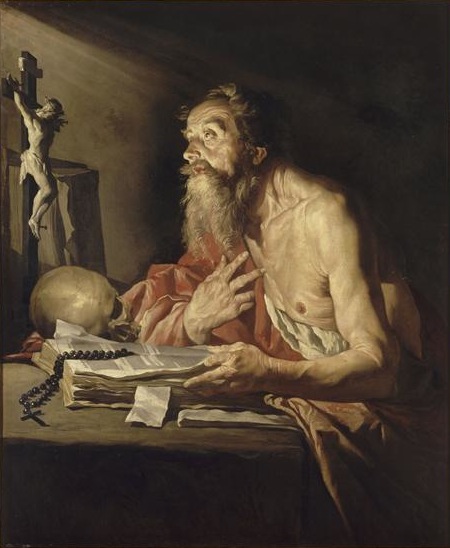

Jerome
View on Wikipedia
Key Information


 |
| Part of a series on |
| Catholic philosophy |
|---|
   |


Jerome (/dʒəˈroʊm/; Latin: Eusebius Sophronius Hieronymus; Ancient Greek: Εὐσέβιος Σωφρόνιος Ἱερώνυμος; c. 342–347 – 30 September 420), also known as Jerome of Stridon, was an early Christian priest, confessor, theologian, translator, and historian; he is commonly known as Saint Jerome.
He is best known for his translation of the Bible into Latin (the translation that became known as the Vulgate) and his commentaries on the whole Bible. Jerome attempted to create a translation of the Old Testament based on a Hebrew version, rather than the Septuagint, as prior Latin Bible translations had done. His list of writings is extensive. In addition to his biblical works, he wrote polemical and historical essays, always from a theologian's perspective.[3]
Jerome was known for his teachings on Christian moral life, especially those in cosmopolitan centers such as Rome. He often focused on women's lives and identified how a woman devoted to Jesus should live her life. This focus stemmed from his close patron relationships with several prominent female ascetics who were members of affluent senatorial families.[4]
In addition, his works are a crucial source of information on the pronunciation of the Hebrew language in Byzantine Palestine.[5]
Jerome is recognized as a saint and Doctor of the Church by the Catholic Church, and as a saint in the Eastern Orthodox Church,[a] the Lutheran Church, and the Anglican Communion. His feast day is 30 September (Gregorian calendar).
Early life
[edit]Eusebius Sophronius Hieronymus was born at Stridon around 342–347 AD.[4] He was of Illyrian ancestry.[6] He was not baptized until about 360–369 in Rome, where he had gone with his friend Bonosus of Sardica to pursue rhetorical and philosophical studies. (This Bonosus may or may not have been the same Bonosus whom Jerome identifies as his friend who went to live as a hermit on an island in the Adriatic.) Jerome studied under the philologist Aelius Donatus. There he learned Latin and at least some Koine Greek,[7] though he probably did not yet acquire the familiarity with Greek literature that he later claimed to have acquired as a schoolboy.[8]
As a student, Jerome engaged in the superficial escapades and sexual experimentation of students in Rome; he indulged himself quite casually but he suffered terrible bouts of guilt afterwards.[9] To appease his conscience, on Sundays he visited the sepulchers of the martyrs and the Apostles in the catacombs. This experience reminded him of the terrors of Hell:
Often I would find myself entering those crypts, deep dug in the earth, with their walls on either side lined with the bodies of the dead, where everything was so dark that almost it seemed as though the Psalmist's words were fulfilled, Let them go down quick into Hell.[10] Here and there the light, not entering in through windows, but filtering down from above through shafts, relieved the horror of the darkness. But again, as soon as you found yourself cautiously moving forward, the black night closed around, and there came to my mind the line of Virgil, "Horror ubique animos, simul ipsa silentia terrent".[11][b]

The quotation from Virgil reads, in translation, "On all sides round, horror spread wide; the very silence breathed a terror on my soul."[12]
Conversion to Christianity
[edit]
Although at first afraid of Christianity, he eventually converted.[13]

Seized with a desire for a life of ascetic penance, Jerome went for a time to the desert of Chalcis, to the southeast of Antioch, known as the "Syrian Thebaid" from the number of eremites (hermits) inhabiting it. During this period, he seems to have found time for studying and writing. He made his first attempt to learn Hebrew under the guidance of a converted Jew; and he seems to have been in correspondence with Jewish Christians in Antioch. Around this time, he had copied for himself a Hebrew Gospel, of which fragments are preserved in his notes. It is known today as the Gospel of the Hebrews, which the Nazarenes considered to be the true Gospel of Matthew.[14] Jerome translated parts of this Hebrew Gospel into Greek.[15]
Ministry in Rome
[edit]

As protégé of Pope Damasus I, Jerome was given duties in Rome, and he undertook a revision of the Vetus Latina Gospels based on Greek manuscripts. He also updated the Psalter containing the Book of Psalms then in use in Rome, based on the Septuagint.
Throughout his epistles, he shows himself to be surrounded by women and united with close ties; it is estimated that 40% of his epistles were addressed to someone of the female sex and,[17] at the time, he was criticized for it.[18]
Even in his time, Jerome noted Porphyry's accusation that the Christian communities were run by women and that the favor of the ladies decided who could accede to the dignity of the priesthood.[19][20]
In Rome, Jerome was surrounded by a circle of well-born and well-educated women, including some from the noblest patrician families. Among these women were such as the widows Lea, Marcella, and Paula, and Paula's daughters Blaesilla and Eustochium. The resulting inclination of these women towards the monastic life, away from the indulgent lasciviousness in Rome, and his unsparing criticism of the secular clergy of Rome, brought a growing hostility against him among the Roman clergy and their supporters. Soon after the death of his patron Pope Damasus I on 10 December 384, Jerome was forced to leave his position at Rome after an inquiry was brought up by the Roman clergy into allegations that he had an improper relationship with the widow Paula. Still, his writings were highly regarded by women who were attempting to maintain vows of becoming consecrated virgins. His letters were widely read and distributed throughout the Christian empire, and it is clear through his writing that he knew these virgin women were not his only audience.[4]
Additionally, Jerome's condemnation of Blaesilla's hedonistic lifestyle in Rome led her to adopt ascetic practices, but these affected her health and worsened her physical weakness to the point that she died just four months after starting to follow his instructions; much of the Roman populace was outraged that Jerome, in their view, thus caused the premature death of such a lively young woman. Additionally, his insistence to Paula that Blaesilla should not be mourned and complaints that her grief was excessive were seen as heartless, which further polarized Roman opinion against him.[21]
Scholarly works
[edit]Translation of the Bible (382–405)
[edit]
Jerome was a scholar at a time when being a scholar implied a fluency in Greek. He knew some Hebrew when he started his translation project, but moved to Jerusalem to strengthen his grip on Jewish scripture commentary. A wealthy Roman aristocrat, Paula, funded Jerome's stay in a monastery in the nearby city of Bethlehem, where he settled next to the Church of the Nativity – built half a century prior on orders of Emperor Constantine over what was reputed to be the site of the Nativity of Jesus – and he completed his translation there.
He began in 382 by correcting the existing Latin-language version of the New Testament, commonly referred to as the Vetus Latina. By 390 he turned to translating the Hebrew Bible from the original Hebrew, having previously translated portions from the Septuagint which came from Alexandria. He believed that the mainstream Rabbinical Judaism had rejected the Septuagint as invalid Jewish scriptural texts because of what were ascertained as mistranslations along with its Hellenistic heretical elements.[c] He completed this work by 405.
Prior to Jerome's Vulgate, all Latin translations of the Old Testament were based on the Septuagint, not the Hebrew. Jerome's decision to use a Hebrew text instead of the previously translated Septuagint went against the advice of most other Christians, including Augustine, who thought the Septuagint inspired. Some modern scholars believe that the Greek Hexapla is the main source for Jerome's "iuxta Hebraeos" (i.e. "close to the Hebrews", "immediately following the Hebrews") translation of the Old Testament.[22] Some scholarship has cast doubts on the actual quality of Jerome's Hebrew knowledge, however, detailed studies have shown that to a considerable degree Jerome was a competent Hebraist.[23]
Biblical onomastica
[edit]Jerome also produced two onomastica which were commonly found in subsequent Bibles until the Reformation:
- Liber de Nominibus Hebraicis, a list of names of people in the Bible and etymologies, based on a work attributed to Philo and expanded by Origen;
- A translation and expansion of the Onomasticon of Eusebius, listing and commenting on places mentioned in the Bible.
Commentaries (405–420)
[edit]
For the next 15 years, until he died, Jerome produced a number of commentaries on Scripture, often explaining his translation choices in using the original Hebrew rather than suspect translations. His patristic commentaries align closely with Jewish tradition, and he indulges in allegorical and mystical subtleties after the manner of Philo and the Alexandrian school. Unlike his contemporaries, he emphasizes the difference between the Hebrew Bible "Apocrypha" and the Hebraica veritas of the protocanonical books. In his Vulgate's prologues, he describes some portions of books in the Septuagint that were not found in the Hebrew as being non-canonical (he called them apocrypha);[24] for Baruch, he mentions by name in his Prologue to Jeremiah and notes that it is neither read nor held among the Hebrews, but does not explicitly call it apocryphal or "not in the canon".[25] His Preface to the Books of Samuel and Kings[26] (commonly called the Helmeted Preface) includes the following statement:
This preface to the Scriptures may serve as a "helmeted" introduction to all the books which we turn from Hebrew into Latin, so that we may be assured that what is not found in our list must be placed amongst the Apocryphal writings. Wisdom, therefore, which generally bears the name of Solomon, and the book of Jesus, the Son of Sirach, and Judith, and Tobias, and the Shepherd are not in the canon. The first book of Maccabees I have found to be Hebrew, the second is Greek, as can be proved from the very style.

Historical and hagiographic writings
[edit]Jerome as a historian
Jerome's most famous work of historical writing was the Chronicon, a translation, reworking, and continuation of the Chronicon of Eusebius. Written in Constantinople around 380 it became an influential text in Latin Christendom even though it is not without errors.[27] In his other works he evoked historical events and used history as an example and source of argument. Even though Jerome engaged in historical writing, he did not consider himself bound by the rules of historians and his output in this domain has to be judged accordingly.[28]
Description of vitamin A deficiency
[edit]The following passage, taken from Jerome’s hagiography, appears to be the earliest account of the etiology, symptoms and cure of severe vitamin A deficiency:[29]
From his thirty-first to his thirty-fifth year he had for food six ounces of barley bread, and vegetables slightly cooked without oil. But finding that his eyes were growing dim, and that his whole body was shrivelled with an eruption and a sort of stony roughness (impetigine et pumicea quad scabredine) he added oil to his former food, and up to the sixty-third year of his life followed this temperate course, tasting neither fruit nor pulse, nor anything whatsoever besides.[29]
Letters
[edit]
Jerome's letters or epistles, both by the great variety of their subjects and by their qualities of style, form an important portion of his literary remains. Whether he is discussing problems of scholarship, or reasoning on cases of conscience, comforting the afflicted, or saying pleasant things to his friends, scourging the vices and corruptions of the time and against sexual immorality among the clergy,[30] exhorting to the ascetic life and renunciation of the world, or debating his theological opponents, he gives a vivid picture not only of his own mind, but of the age and its peculiar characteristics. (See Plowboy trope.) Because there was no distinct line between personal documents and those meant for publication, his letters frequently contain both confidential messages and treatises meant for others besides the one to whom he was writing.[31]
Due to the time he spent in Rome among wealthy families belonging to the Roman upper class, Jerome was frequently commissioned by women who had taken a vow of virginity to write to them in guidance of how to live their life. As a result, he spent a great deal of his life corresponding with these women about certain abstentions and lifestyle practices.[4]

Theological writings
[edit]
Eschatology
[edit]
Jerome warned that those substituting fake interpretations for the actual meaning of Scripture belonged to the "synagogue of the Antichrist".[33] "He that is not of Christ is of Antichrist," he wrote to Pope Damasus I.[34] He believed that "the mystery of iniquity" written about by Paul in 2 Thessalonians 2:7 was already in action when "every one chatters about his views."[35] To Jerome, the power restraining this mystery of iniquity was the Roman Empire, but as it fell this restraining force was removed. He warned a noblewoman of Gaul:[36]
He that letteth is taken out of the way, and yet we do not realize that Antichrist is near. Yes, Antichrist is near whom the Lord Jesus Christ "shall consume with the spirit of his mouth". "Woe unto them," he cries, "that are with child, and to them that give suck in those days." ... Savage tribes in countless numbers have overrun all parts of Gaul. The whole country between the Alps and the Pyrenees, between the Rhine and the Ocean, has been laid waste by hordes of Quadi, Vandals, Sarmatians, Alans, Gepids, Herules, Saxons, Burgundians, Allemanni, and – alas! for the commonweal! – even Pannonians.
His Commentary on Daniel was expressly written to offset the criticisms of Porphyry,[37][full citation needed] who taught that Daniel related entirely to the time of Antiochus IV Epiphanes and was written by an unknown individual living in the second century BC. Against Porphyry, Jerome identified Rome as the fourth kingdom of chapters two and seven, but his view of chapters eight and eleven was more complex. Jerome held that chapter eight describes the activity of Antiochus Epiphanes, who is understood as a "type" of a future antichrist; 11:24 onwards applies primarily to a future antichrist but was partially fulfilled by Antiochus. Instead, he advocated that the "little horn" was the Antichrist:
We should therefore concur with the traditional interpretation of all the commentators of the Christian Church, that at the end of the world, when the Roman Empire is to be destroyed, there shall be ten kings who will partition the Roman world amongst themselves. Then an insignificant eleventh king will arise, who will overcome three of the ten kings. ... After they have been slain, the seven other kings also will bow their necks to the victor.[38]
In his Commentary on Daniel,[38] he noted, "Let us not follow the opinion of some commentators and suppose him to be either the Devil or some demon, but rather, one of the human race, in whom Satan will wholly take up his residence in bodily form."[38] Instead of rebuilding the Jewish Temple to reign from, Jerome thought the Antichrist sat in God's Temple inasmuch as he made "himself out to be like God."[38]
Jerome identified the four prophetic kingdoms symbolized in Daniel 2 as the Neo-Babylonian Empire, the Medes and Persians, Macedon, and Rome.[38](ch. 2, vv. 31–40) Jerome identified the stone cut out without hands as "namely, the Lord and Savior".[38](ch. 2, v. 40)
Jerome refuted Porphyry's application of the little horn of chapter seven to Antiochus. He expected that at the end of the world, Rome would be destroyed, and partitioned among ten kingdoms before the little horn appeared.[38](ch. 7, v. 8)
Jerome believed that Cyrus of Persia was the higher of the two horns of the Medo-Persian ram of Daniel 8:3.[38] The he-goat is Greece smiting Persia.[38](ch. 8, v. 5)
Soteriology
[edit]Jerome opposed the doctrine of Pelagianism, and wrote against it three years before his death.[39] Jerome, despite being opposed to Origen, was influenced by Origenism in his soteriology. Although he taught that the Devil and the unbelieving will be eternally punished (unlike Origen), he believed that the punishment for Christian sinners, who have once believed but sin and fall away, will be temporal in nature. Some scholars such as J.N.D Kelly have also interpreted Ambrose to have held similar views considering the judgement of Christians.[40][41][42]
Although Augustine does not name Jerome personally, the view that all Christians would eventually be reunited to God was criticized by Augustine in his treatise "on faith and works".[42]
Reception by later Christianity
[edit].JPG)
Jerome is the second-most voluminous writer – after Augustine of Hippo (354–430) – in ancient Latin Christianity. The Catholic Church recognizes him as the patron saint of translators, librarians, and encyclopedists.[43]
Jerome translated many biblical texts into Latin from Hebrew, Aramaic, and Greek. His translations formed part of the Vulgate; the Vulgate eventually superseded the preceding Latin translations of the Bible (the Vetus Latina). The Council of Trent in 1546 declared the Vulgate authoritative "in public lectures, disputations, sermons, and expositions".[44][45]
Jerome showed more zeal and interest in the ascetic ideal than in abstract speculation. He lived as an ascetic for 4~5 years in the Syrian desert, and later near Bethlehem for 34 years. Nevertheless, his writings show outstanding scholarship[46] and his correspondence has great historical importance.[47]
The Church of England honours Jerome with a commemoration on 30 September.[48]
In art
[edit]Jerome is also often depicted with a lion, in reference to the popular hagiographical belief that Jerome once tamed a lion in the wilderness by healing its paw. The source for the story may actually have been the second century Roman tale of Androcles, or confusion with the exploits of Gerasimus (Jerome in later Latin is "Geronimus");[49][d] it is "a figment" found in the thirteenth-century Golden Legend by Jacobus de Voragine.[50] Hagiographies of Jerome talk of his having spent many years in the Syrian desert, and artists often depict him in a "wilderness", which for West European painters can take the form of a wood.[51]
From the late Middle Ages, depictions of Jerome in a wider setting became popular. He is either shown in his study, surrounded by books and the equipment of a scholar, or in a rocky desert, or in a setting that combines both aspects, with him studying a book under the shelter of a rock-face or cave mouth. His study is often shown as large and well-provided for, he is often clean-shaven and well-dressed, and a cardinal's hat may appear. These images derive from the tradition of the evangelist portrait, though Jerome is often given the library and desk of a serious scholar. His attribute of the lion, often shown at a smaller scale, may be beside him in either setting. The subject of "Jerome Penitent" first appears in the later 15th century in Italy; he is usually in the desert, wearing ragged clothes, and often naked above the waist. His gaze is usually fixed on a crucifix and he may beat himself with his fist or a rock.[52] In one of Georges de La Tour's 17th century French versions of St. Jerome his penitence is depicted alongside his red cardinal hat.[53]
Jerome is often depicted in connection with the vanitas motif, the reflection on the meaninglessness of earthly life and the transient nature of all earthly goods and pursuits. In the 16th century Saint Jerome in his study by Pieter Coecke van Aelst and workshop, the saint is depicted with a skull. Behind him on the wall is pinned an admonition, Cogita Mori ("Think upon death"). Further reminders of the vanitas motif of the passage of time and the imminence of death are the image of the Last Judgment visible in the saint's Bible, the candle and the hourglass.[54]
Both Agostino Carracci and Domenichino portrayed Jerome's last communion.
Jerome is also sometimes depicted with an owl, the symbol of wisdom and scholarship.[55] Writing materials and the trumpet of final judgment are also part of his iconography.[55]
A four and three quarters foot tall limestone statue of Jerome was installed above the entrance of O'Shaughnessy Library on the campus of the University of St. Thomas (then College of St. Thomas) in St. Paul Minnesota in October 1950. The sculptor was Joseph Kiselewski and the stone carver was Egisto Bertozzi.[56][57]
-
 Saint Jerome in the Wilderness, Leonardo da Vinci, 1480–1490, Vatican Museums
 -
 Jerome Penitent in the Wilderness. Copper engraving, Albrecht Dürer 1494–1498
 -

-
 Hieronymus in Gehäus. Copper engraving, Albrecht Dürer 1514
 -
 Saint Jerome c. 1520 Netherlandish stained glass window at MET.
 -

-
 Saint Jerome by Lucas Cranach the Elder, c. 1525
 -

-

-

-
 Painting of Saint Jerome by Jacques Blanchard, 1632.
 -
 Saint Jerome and the Paulines painted by Gabriel Thaller in the St. Jerome Church in Štrigova, Međimurje Cou''nty, northern Croatia (18th century)
 -
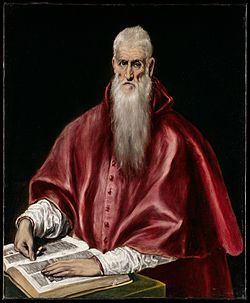 Saint Jerome as Scholar by El Greco, 1610
 -
 Saint Jerome and the lion, Anonymous Venetian-Byzantine painter (14th century)
 -
 Saint Jerome with a crucifix - Byzantine and Christian Museum, Athens (17th century)
 -
 St. Jerome the Priest, by Ivan Meštrović, 1954, in Washington, D.C.


.jpg)


.jpg)

.jpg)


.jpg)

_(collezione_Palazzo_Roverella,_Rovigo)_01.jpg)


See also
[edit]


- Androcles
- Bible translations
- Church Fathers – Early influential Christian theologians
- Eusebius of Cremona
- Ferdinand Cavallera
- Genesius of Arles
- International Translation Day – International observance, 30 September
- Letter of Jerome to Pope Damasus – Letter from Jerome requesting new translations of the gospels (c. 376/377 AD)
- Order of St. Jerome – Catholic cloistered monastics of Jerome
- Pelagius – 4th-century theologian, namesake of Pelagianism
- Prologus Galeatus – Preface by Saint Jerome to his Vulgate translations of I and II Kings and I and II Samuel
- Synod of Diospolis
References
[edit]Notes
[edit]- ^ In the Eastern Orthodox Church he is known as Saint Jerome of Stridonium or Blessed Jerome. "Blessed" in this context does not have the sense of being less than a saint, as it does in the West.
- ^ Patrologia Latina 25, 373: Crebroque cryptas ingredi, quae in terrarum profunda defossae, ex utraque parte ingredientium per parietes habent corpora sepultorum, et ita obscura sunt omnia, ut propemodum illud propheticum compleatur: Descendant ad infernum viventes (Ps. LIV,16): et raro desuper lumen admissum, horrorem temperet tenebrarum, ut non-tam fenestram, quam foramen demissi luminis putes: rursumque pedetentim acceditur, et caeca nocte circumdatis illud Virgilianum proponitur (Aeneid. lib. II): "Horror ubique animos, simul ipsa silentia terrent."
- ^ "(...) die griechische Bibelübersetzung, die einem innerjüdischen Bedürfnis entsprang (...) [von den] Rabbinen zuerst gerühmt (...) Später jedoch, als manche ungenaue Übertragung des hebräischen Textes in der Septuaginta und Übersetzungsfehler die Grundlage für hellenistische Irrlehren abgaben, lehte man die Septuaginta ab." (Homolka 1999, pp. 43–)
- ^ Eugene Rice has suggested that in all probability the story of Gerasimus's lion became attached to the figure of Jerome some time during the seventh century, after the military invasions of the Arabs had forced many Greek monks who were living in the deserts of the Middle East to seek refuge in Rome. Rice 1985, pp. 44–45 conjectures that because of the similarity between the names Gerasimus and Geronimus—the late Latin form of Jerome's name—'a Latin-speaking cleric … made St Geronimus the hero of a story he had heard about St Gerasimus; and that the author of Plerosque nimirum, attracted by a story at once so picturesque, so apparently appropriate, and so resonant in suggestion and meaning, and under the impression that its source was pilgrims who had been told it in Bethlehem, included it in his life of a favourite saint otherwise bereft of miracles.'" (Salter 2001, p. 12)
Citations
[edit]- ^ Kurian & Smith 2010, p. 389: Jerome ("Hieronymus" in Latin), was born into a Christian family in Stridon, modern-day Strigova in northern Croatia
- ^ "St. Jerome (Christian scholar)". Britannica Encyclopedia. 2 February 2017. Archived from the original on 24 March 2017. Retrieved 23 March 2017.
- ^ Schaff, Philip, ed. (1893). A Select Library of Nicene and Post-Nicene Fathers of the Christian Church. 2nd series. Vol. VI. Henry Wace. New York: The Christian Literature Company. Archived from the original on 11 July 2014. Retrieved 7 June 2010.
- ^ a b c d Williams 2006.
- ^ Kantor, Benjamin Paul (30 August 2023). The Linguistic Classification of the Reading Traditions of Biblical Hebrew: A Phyla-and-Waves Model. Semitic Languages and Cultures. Vol. 19. Open Book Publishers. p. 20. doi:10.11647/obp.0210. ISBN 978-1-78374-953-9.
- ^ Pevarello 2013, p. 1.
- ^ Walsh 1992, p. 307.
- ^ Kelly 1975, pp. 13–14.
- ^ Payne 1951, pp. 90–92.
- ^ Psalm 55:15
- ^ Jerome, Commentarius in Ezzechielem, c. 40, v. 5
- ^ P. Vergilius Maro, Aeneid Theodore C. Williams, Ed. Perseus Project Archived 11 November 2013 at the Wayback Machine (retrieved 23 August 2013)
- ^ Payne 1951, p. 91.
- ^ Rebenich 2002, p. 211: Further, he began to study Hebrew: 'I betook myself to a brother who before his conversion had been a Hebrew and...'
- ^ Pritz, Ray (1988), Nazarene Jewish Christianity: from the end of the New Testament, p. 50,
In his accounts of his desert sojourn, Jerome never mentions leaving Chalcis, and there is no pressing reason to think...
- ^ "Saint Jerome in His Study". The Walters Art Museum. Archived from the original on 16 May 2013. Retrieved 18 September 2012.
- ^ D. Ruiz Bueno. (1962). Cartas de S. Jerónimo, 2 vols. Madrid.
- ^ Epistle 45,2-3; 54,2; 65,1; 127,5.
- ^ Gigon, O. (1966). Die antike Kultur und das Christentum. pp. 120.
- ^ Deschner, Karlheinz (1986). Christianity's Criminal History. Volume 1. pp. 164-170.
- ^ Salisbury & Lefkowitz 2001, pp. 32–33.
- ^ Pierre Nautin 1986, "Hieronymus",Theologische Realenzyklopädie, Vol. 15, Walter de Gruyter, Berlin & New York, pp. 304–15 [309–10].
- ^ Michael Graves 2007, Jerome's Hebrew Philology: A Study Based on his Commentary on Jeremiah, Brill: 196–98 [197], ISBN 978-90-47-42181-8: "In his discussion he gives clear evidence of having consulted the Hebrew himself, providing details about the Hebrew that could not have been learned from the Greek translations."
- ^ "The Bible". Archived from the original on 13 January 2016. Retrieved 14 December 2015.
- ^ Edgecomb, Kevin P., Jerome's Prologue to Jeremiah, archived from the original on 31 December 2013, retrieved 14 December 2015
- ^ "Jerome's Preface to Samuel and Kings". Archived from the original on 2 December 2015. Retrieved 14 December 2015.
- ^ Burgess, R.W. (2002). "Jerome explained: an introduction to his Chronicle and a guide to its use". The Ancient History Bulletin. 16: 1–32.
- ^ Fafinski, Mateusz (2025). "The ends of history? Jerome, Geruchia, and the Rhine crossings". Early Medieval Europe. 33 (1): 71–93. doi:10.1111/emed.12752. ISSN 1468-0254.
- ^ a b Taylor, F. Sherwood (23 December 1944). "St. Jerome and Vitamin A". Nature. 154 (3921): 802. Bibcode:1944Natur.154Q.802T. doi:10.1038/154802a0. S2CID 4097517.
- ^ "regulae sancti pachomii 84 rule 104.
- ^ W. H. Fremantle, "Prolegomena to Jerome", V.
- ^ "Hiëronymus in zijn studeervertrek". lib.ugent.be. Retrieved 2 October 2020.
- ^ Jerome. "The Dialogue against the Luciferians". In Schaff, Philip; Wace, Henry (eds.). St. Jerome: Letters and select works, 1893. A Select Library of Nicene and Post-Nicene Fathers of the Christian Church, Second Series. p. 334. Archived from the original on 1 January 2014 – via Google Books.
- ^ Jerome. "Letter to Pope Damasus". In Schaff, Philip; Wace, Henry (eds.). St. Jerome: Letters and select works, 1893. A Select Library of Nicene and Post-Nicene Fathers of the Christian Church, Second Series. p. 19. Archived from the original on 13 March 2017 – via Google Books.
- ^ Jerome. "Against the Pelagians". In Schaff, Philip; Wace, Henry (eds.). St. Jerome: Letters and select works, 1893. A Select Library of Nicene and Post-Nicene Fathers of the Christian Church, Second Series. Book I, p. 449. Archived from the original on 1 January 2014 – via Google Books.
- ^ Jerome. "Letter to Ageruchia". In Schaff, Philip; Wace, Henry (eds.). St. Jerome: Letters and select works, 1893. A Select Library of Nicene and Post-Nicene Fathers of the Christian Church, Second Series. pp. 236–237. Archived from the original on 1 January 2014.
- ^ Eremantle, note on Jerome's commentary on Daniel, in NPAF, 2d series, Vol. 6, p. 500.
- ^ a b c d e f g h i Jerome. "Commentario in Danielem". tertullian.org. Archived from the original on 26 May 2010. Retrieved 6 May 2008.
- ^ "Philip Schaff: NPNF2-06. Jerome: The Principal Works of St. Jerome - Christian Classics Ethereal Library". www.ccel.org. Retrieved 8 March 2024.
- ^ Kelly, J. N. D. (20 November 2000). Early Christian Doctrines. A&C Black. ISBN 978-0-8264-5252-8.
Jerome develops the same distinction, stating that, while the Devil and the impious who have denied God will be tortured without remission, those who have trusted in Christ, even if they have sinned and fallen away, will eventually be saved. Much the same teaching appears in Ambrose, developed in greater detail
- ^ Goff, Jacques Le (15 December 1986). The Birth of Purgatory. University of Chicago Press. ISBN 978-0-226-47083-2.
Saint Jerome, though an enemy of Origen, was, when it came to salvation, more of an Origenist than Ambrose. He believed that all sinners, all mortal beings, with the exception of Satan, atheists, and the ungodly, would be saved: 'Just as we believe that the torments of the Devil, of all the deniers of God, of the ungodly who have said in their hearts, 'there is no God,' will be eternal, so too do we believe that the judgment of Christian sinners, whose works will be tried and purged in fire will be moderate and mixed with clemency.' Furthermore, 'He who with all his spirit has placed his faith in Christ, even if he die in sin, shall by his faith live forever.'"
- ^ a b Augustine & Lombardo 1988, pp. 64, 65. "Augustine, however, does not mention any names, and there is no evidence either here or in any other place that he is referring to these passages from the works of Jerome. Nevertheless, both Jerome and Ambrose seemed to have shared in the not uncommon error of their time, namely, that all Christians would sooner or later be reunited to God, an error which Augustine refutes here and in a number of other places"
- ^ Kemp, Jane. "St. Jerome: Patron saint of librarians". Luther College Library and Information Services (luther.edu). Decorah, IA: Luther College. Archived from the original on 17 April 2024. Retrieved 2 June 2014.
- ^ Akin, Jimmy (5 September 2017). "Is the Vulgate the Catholic Church's official Bible?". National Catholic Register (blog). Retrieved 8 December 2021.
'[This] sacred and holy Synod – considering that no small utility may accrue to the Church of God, if it be made known which out of all the Latin editions, now in circulation, of the sacred books, is to be held as authentic – ordains and declares, that the said old and vulgate edition, which, by the long use of so many years, has been approved of in the Church, be, in public lectures, disputations, sermons and expositions, held as authentic; and that no one is to dare, or presume to reject it under any pretext whatever' [Decree Concerning the Edition and Use of the Sacred Books, 1546].
- ^ "Vulgate". The Oxford Dictionary of the Christian Church. Oxford University Press. 2005. pp. 1722–1723. ISBN 978-0-19-280290-3 – via Google Books.
- ^ Power, Edward J. (1991). A Legacy of Learning: A history of western education. SUNY Press. p. 102. ISBN 978-0-7914-0610-6.
his exceptional scholarship produced…
- ^ Louth, Andrew (2022). "Jerome". The Oxford Dictionary of the Christian Church. Oxford University Press. pp. 872–873. ISBN 978-0-19-263815-1.
His correspondence is of great interest and historical importance.
- ^ "The Calendar". The Church of England. Retrieved 8 April 2021.
- ^ Hope Werness, Continuum encyclopaedia of animal symbolism in art, 2006
- ^ Williams 2006, p. 1.
- ^ "Saint Jerome in Catholic Saint info". Catholic-saints.info. Archived from the original on 29 April 2014. Retrieved 2 June 2014.
- ^ Herzog, Sadja. “Gossart, Italy, and the National Gallery's Saint Jerome Penitent.” Report and Studies in the History of Art, vol. 3, 1969, pp. 67–70, JSTOR, Retrieved 29 December 2020.
- ^ Judovitz, Dalia. Georges de La Tour and the Enigma of the Visible, New York, Fordham University Press, 2018. ISBN 0-82327-744-5; ISBN 9780823277445. p11, 19-22, 98, plate 3.
- ^ "Saint Jerome in His Study". The Walters Art Museum. Archived from the original on 18 September 2012. Retrieved 6 September 2012.
- ^ a b The Collection: Saint Jerome Archived 22 October 2012 at the Wayback Machine, gallery of the religious art collection of New Mexico State University, with explanations. Retrieved 10 August 2007.
- ^ "Sculpture". Joseph Kiselewski. Retrieved 27 April 2023.
- ^ "Egisto Bertozzi – Stone Carver". Saint James Lutheran Church. Retrieved 27 April 2023.
Sources
[edit]- Augustine; Lombardo, Gregory J. (1988). On Faith and Works. New York, NY: Paulist Press. ISBN 978-0-8091-0406-2.
- Andrew Cain and Josef Lössl, Jerome of Stridon: His Life, Writings and Legacy (London and New York, 2009)
- Homolka, W. (1999). Die Lehren des Judentums nach den Quellen (in German). Vol. Bd. 3. Munich: Knesebeck. ISBN 978-3-89660-058-5 – via Verband der Deutschen Juden.
- Kelly, J.N.D. (1975). Jerome: His Life, Writings, and Controversies. New York: Harper & Row.
- Kurian, G.T.; Smith, J.D. (2010). The Encyclopedia of Christian Literature. Scarecrow Press. ISBN 978-0-8108-7283-7.
- Payne, Robert (1951), The Fathers of the Western Church, New York: Viking Press
- Pevarello, Daniele (2013). The Sentences of Sextus and the origins of Christian ascetiscism. Tübingen: Mohr Siebeck. ISBN 978-3-16-152579-7.
- Rebenich, Stefan (2002), Jerome, Psychology Press, ISBN 978-0415199063
- Rice, E.F. (1985). Saint Jerome in the Renaissance. Johns Hopkins symposia in comparative history. Johns Hopkins University Press. ISBN 978-0-8018-2381-7.
- Salisbury, J.E.; Lefkowitz, M.R. (2001). "Blaesilla". Encyclopedia of Women in the Ancient World. ABC-CLIO E-Books. ABC-CLIO. ISBN 978-1-57607-092-5.
- Salter, David (2001). Holy and Noble Beasts: Encounters With Animals in Medieval Literature. D. S. Brewer. ISBN 978-0-85991-624-0.
- Scheck, Thomas P. (2008). Commentary on Matthew. The Fathers of the Church. Vol. 117. ISBN 978-0-8132-0117-7.
- Slepička, Martin (2021). "Úcta k svatému Jeronýmovi v českém středověku: 1600. výročí smrti církevního otce svatého Jeronýma". Slepička, Martin. Úcta K Svatému Jeronýmovi V Českém Středověku. K 1600. Výročí Smrti Církevního Otce Svatého Jeronýma. 1. Vyd. Ostrava: Repronis, 2021. Ostrava: Repronis.
- Streeter, Tom (2006). The Church and Western Culture: An Introduction to Church History. AuthorHouse.
- Walsh, Michael, ed. (1992), Butler's Lives of the Saints, New York: HarperCollins
- Ward, Maisie (1950). Saint Jerome. London: Sheed & Ward.
- Williams, Megan Hale (2006). The Monk and the Book: Jerome and the Making of Christian Scholarship. Chicago: U of Chicago Press. ISBN 978-0-226-89900-8.
- Biblia Sacra Vulgata [e.g. edition published Stuttgart, 1994, ISBN 3-438-05303-9]
 This article incorporates text from a publication in the public domain: Jackson, Samuel Macauley, ed. (1910). "Jerome". New Schaff–Herzog Encyclopedia of Religious Knowledge. Vol. 6 (third ed.). London and New York: Funk and Wagnalls.

Further reading
[edit]- Saint Jerome, Three biographies: Malchus, St. Hilarion and Paulus the First Hermit Authored by Saint Jerome, London, 2012. limovia.net. ISBN 978-1-78336-016-1
External links
[edit]


- St. Jerome (pdf Archived 9 September 2016 at the Wayback Machine) from Fr. Alban Butler's Lives of the Saints
- The Life of St. Jerome, Priest, Confessor and Doctor of the Church
- Herbermann, Charles, ed. (1913). . Catholic Encyclopedia. New York: Robert Appleton Company.
- Jewish Encyclopedia: Jerome
- St. Jerome – Catholic Online
- St Jerome (Hieronymus) of Stridonium Orthodox synaxarion
- Further reading of depictions of Saint Jerome in art
- Saint Jerome, Doctor of the Church at the Christian Iconography web site
- Here Followeth the Life of Jerome from Caxton's translation of the Golden Legend
- Works of Saint Jeromeat Somni Archived 11 May 2015 at the Wayback Machine
- Beati Hyeronimi Epistolarum liber, digitized codex (1464)
- Epistole de santo Geronimo traducte di latino, digitized codex (1475–1490)
- Hieronymi in Danielem, digitized codex (1490)
- Sancti Hieronymi ad Pammachium in duodecim prophetas, digitized codex (1470–1480)
- Colonnade Statue in St Peter's Square
- Works by Jerome at LibriVox (public domain audiobooks)


Latin texts
[edit]- Chronological list of Jerome's Works with modern editions and translations cited
- Opera Omnia (Complete Works) from Migne edition (Patrologia Latina, 1844–1855) with analytical indexes, almost complete online edition
- Lewis E 82 Vitae patrum (Lives of the Fathers) at OPenn
- Lewis E 47 Bible Commentary at OPenn
- Liber de Nominibus Hebraicis, a list of names of people in the Bible and etymologies, based on a work attributed to Philo and expanded by Origen
- A translation and expansion of the Onomasticon of Eusebius, listing and commenting on places mentioned in the Bible
Facsimiles
[edit]- Migne volume 23 part 1 (1883 edition)
- Migne volume 23 part 2 (1883 edition)
- Migne volume 24 (1845 edition)
- Migne volume 25 part 1 (1884 edition)
- Migne volume 25 part 2 (1884 edition)
- Migne volume 28 (1890 edition?)
- Migne volume 30 (1865 edition)
English translations
[edit]- Jerome (1887). The pilgrimage of the holy Paula. Palestine Pilgrims' Text Society.
- English translations of Biblical Prefaces, Commentary on Daniel, Chronicle, and Letter 120 (tertullian.org)
- Jerome's Letter to Pope Damasus: Preface to the Gospels
- English translation of Jerome's De Viris Illustribus
- Translations of various works (letters, biblical prefaces, life of St. Hilarion, others) (under "Jerome")
- Lives of Famous Men (CCEL)
- Apology Against Rufinus (CCEL)
- Letters, The Life of Paulus the First Hermit, The Life of S. Hilarion, The Life of Malchus, the Captive Monk, The Dialogue Against the Luciferians, The Perpetual Virginity of Blessed Mary, Against Jovinianus, Against Vigilantius, To Pammachius against John of Jerusalem, Against the Pelagians, Prefaces (CCEL)
- Audiobook of some of the letters


| International | |
|---|---|
| National | |
| Academics | |
| Artists | |
| People | |
| Other | |
