



Community hub
Recent from talks
Knowledge base stats:
Talk channels stats:
Members stats:
Stab-in-the-back myth
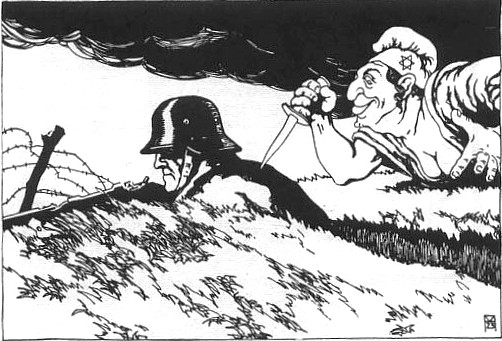
The stab-in-the-back myth (German: Dolchstoßlegende, pronounced [ˈdɔlçʃtoːsleˌɡɛndə] ⓘ, lit. 'dagger-stab legend') was an antisemitic and anti-communist conspiracy theory that was widely believed and promulgated in Germany after 1918. It maintained that the Imperial German Army did not lose World War I on the battlefield, but was instead betrayed by certain citizens on the home front – especially Jews, revolutionary socialists who fomented strikes and labour unrest, and republican politicians who had overthrown the House of Hohenzollern in the German Revolution of 1918–1919. Advocates of the myth denounced the German government leaders who had signed the Armistice of 11 November 1918 as the "November criminals" (Novemberverbrecher).
When Adolf Hitler and the Nazi Party rose to power in 1933, they made the conspiracy theory an integral part of their official history of the 1920s, portraying the Weimar Republic as the work of the "November criminals" who had "stabbed the nation in the back" in order to seize power. Nazi propaganda depicted Weimar Germany as "a morass of corruption, degeneracy, national humiliation, ruthless persecution of the honest 'national opposition' – fourteen years of rule by Jews, Marxists, and 'cultural Bolsheviks', who had at last been swept away by the National Socialist movement under Hitler and the victory of the 'national revolution' of 1933".
Historians inside and outside of Germany, whilst recognising that economic and morale collapse on the home front was a factor in German defeat, unanimously reject the myth. Historians and military theorists point to lack of further Imperial German Army reserves, the danger of invasion from the south, and the overwhelming of German forces on the western front by more numerous Allied forces, particularly after the entrance of the United States into the war, as evidence that Germany had already lost the war militarily by late 1918.
In the later part of World War I, the Supreme High Command (Oberste Heeresleitung, OHL) controlled not only the military but also a large part of the economy through the Auxiliary Services Act of December 1916, which under the Hindenburg Programme aimed at a total mobilisation of the economy for war production. In order to implement the Act, however, Generalfeldmarschall Paul von Hindenburg and his Chief-of-Staff, First Quartermaster General Erich Ludendorff had to make significant concessions to labour unions and the Reichstag. Hindenburg and Ludendorff threatened to resign in July 1917 if the Emperor did not remove Chancellor Theobald von Bethmann Hollweg. He had lost his usefulness to them when he lost the confidence of the Reichstag after it passed the Reichstag Peace Resolution calling for a negotiated peace without annexations. Bethmann Hollweg resigned and was replaced by Georg Michaelis, whose appointment was supported by the OHL. After only 100 days in office, however, he became the first chancellor to be ousted by the Reichstag.
After years of fighting and having incurred millions of casualties, the United Kingdom and France were wary about an invasion of Germany with its unknown consequences. However the Allies had been amply resupplied by the United States, which had fresh armies ready for combat. On the Western Front, although the Hindenburg Line had been penetrated and German forces were in retreat, the Allied armies had only crossed the 1914 German frontier in a few places in Alsace-Lorraine (see below map). Meanwhile, on the Eastern Front, Germany had already won its war against Russia, concluded with the Treaty of Brest-Litovsk. In the West, Germany had successes with the Spring Offensive of 1918 but the attack had run out of momentum, the Allies had regrouped and in the Hundred Days Offensive retaken lost ground with no sign of stopping. Contributing to the Dolchstoßlegende, the overall failure of the German offensive was blamed on strikes in the arms industry at a critical moment, leaving soldiers without an adequate supply of materiel. The strikes were seen as having been instigated by treasonous elements, with the Jews taking most of the blame.
The weakness of Germany's strategic position was exacerbated by the rapid collapse of the other Central Powers in late 1918, following Allied victories on the Macedonian and Italian fronts. Bulgaria was the first to sign an armistice on 29 September 1918, at Salonica. On 30 October the Ottoman Empire capitulated at Mudros. On 3 November Austria-Hungary sent a flag of truce to the Italian Army to ask for an armistice. The terms, arranged by telegraph with the Allied Authorities in Paris, were communicated to the Austro-Hungarian commander and accepted. The armistice with Austria-Hungary was signed in the Villa Giusti, near Padua, on 3 November. Austria and Hungary signed separate treaties following the collapse of the Austro-Hungarian empire.
Importantly the Austro-Hungarian capitulation left Germany's southern frontier under threat of Allied invasion from Austria. Indeed, on 4 November the Allies decided to prepare an advance across the Alps by three armies towards Munich from Austrian territory within five weeks.
After the last German offensive on the Western Front failed in 1918, Hindenburg and Ludendorff admitted that the war effort was doomed, and they pressed Kaiser Wilhelm II for an armistice to be negotiated, and for a rapid change to a civilian government in Germany. They began to take steps to deflect the blame for losing the war from themselves and the German Army to others. Ludendorff said to his staff on 1 October:
Hub AI
Stab-in-the-back myth AI simulator
(@Stab-in-the-back myth_simulator)
Stab-in-the-back myth
The stab-in-the-back myth (German: Dolchstoßlegende, pronounced [ˈdɔlçʃtoːsleˌɡɛndə] ⓘ, lit. 'dagger-stab legend') was an antisemitic and anti-communist conspiracy theory that was widely believed and promulgated in Germany after 1918. It maintained that the Imperial German Army did not lose World War I on the battlefield, but was instead betrayed by certain citizens on the home front – especially Jews, revolutionary socialists who fomented strikes and labour unrest, and republican politicians who had overthrown the House of Hohenzollern in the German Revolution of 1918–1919. Advocates of the myth denounced the German government leaders who had signed the Armistice of 11 November 1918 as the "November criminals" (Novemberverbrecher).
When Adolf Hitler and the Nazi Party rose to power in 1933, they made the conspiracy theory an integral part of their official history of the 1920s, portraying the Weimar Republic as the work of the "November criminals" who had "stabbed the nation in the back" in order to seize power. Nazi propaganda depicted Weimar Germany as "a morass of corruption, degeneracy, national humiliation, ruthless persecution of the honest 'national opposition' – fourteen years of rule by Jews, Marxists, and 'cultural Bolsheviks', who had at last been swept away by the National Socialist movement under Hitler and the victory of the 'national revolution' of 1933".
Historians inside and outside of Germany, whilst recognising that economic and morale collapse on the home front was a factor in German defeat, unanimously reject the myth. Historians and military theorists point to lack of further Imperial German Army reserves, the danger of invasion from the south, and the overwhelming of German forces on the western front by more numerous Allied forces, particularly after the entrance of the United States into the war, as evidence that Germany had already lost the war militarily by late 1918.
In the later part of World War I, the Supreme High Command (Oberste Heeresleitung, OHL) controlled not only the military but also a large part of the economy through the Auxiliary Services Act of December 1916, which under the Hindenburg Programme aimed at a total mobilisation of the economy for war production. In order to implement the Act, however, Generalfeldmarschall Paul von Hindenburg and his Chief-of-Staff, First Quartermaster General Erich Ludendorff had to make significant concessions to labour unions and the Reichstag. Hindenburg and Ludendorff threatened to resign in July 1917 if the Emperor did not remove Chancellor Theobald von Bethmann Hollweg. He had lost his usefulness to them when he lost the confidence of the Reichstag after it passed the Reichstag Peace Resolution calling for a negotiated peace without annexations. Bethmann Hollweg resigned and was replaced by Georg Michaelis, whose appointment was supported by the OHL. After only 100 days in office, however, he became the first chancellor to be ousted by the Reichstag.
After years of fighting and having incurred millions of casualties, the United Kingdom and France were wary about an invasion of Germany with its unknown consequences. However the Allies had been amply resupplied by the United States, which had fresh armies ready for combat. On the Western Front, although the Hindenburg Line had been penetrated and German forces were in retreat, the Allied armies had only crossed the 1914 German frontier in a few places in Alsace-Lorraine (see below map). Meanwhile, on the Eastern Front, Germany had already won its war against Russia, concluded with the Treaty of Brest-Litovsk. In the West, Germany had successes with the Spring Offensive of 1918 but the attack had run out of momentum, the Allies had regrouped and in the Hundred Days Offensive retaken lost ground with no sign of stopping. Contributing to the Dolchstoßlegende, the overall failure of the German offensive was blamed on strikes in the arms industry at a critical moment, leaving soldiers without an adequate supply of materiel. The strikes were seen as having been instigated by treasonous elements, with the Jews taking most of the blame.
The weakness of Germany's strategic position was exacerbated by the rapid collapse of the other Central Powers in late 1918, following Allied victories on the Macedonian and Italian fronts. Bulgaria was the first to sign an armistice on 29 September 1918, at Salonica. On 30 October the Ottoman Empire capitulated at Mudros. On 3 November Austria-Hungary sent a flag of truce to the Italian Army to ask for an armistice. The terms, arranged by telegraph with the Allied Authorities in Paris, were communicated to the Austro-Hungarian commander and accepted. The armistice with Austria-Hungary was signed in the Villa Giusti, near Padua, on 3 November. Austria and Hungary signed separate treaties following the collapse of the Austro-Hungarian empire.
Importantly the Austro-Hungarian capitulation left Germany's southern frontier under threat of Allied invasion from Austria. Indeed, on 4 November the Allies decided to prepare an advance across the Alps by three armies towards Munich from Austrian territory within five weeks.
After the last German offensive on the Western Front failed in 1918, Hindenburg and Ludendorff admitted that the war effort was doomed, and they pressed Kaiser Wilhelm II for an armistice to be negotiated, and for a rapid change to a civilian government in Germany. They began to take steps to deflect the blame for losing the war from themselves and the German Army to others. Ludendorff said to his staff on 1 October: