
Recent from talks
Stationary steam engine
Knowledge base stats:
Talk channels stats:
Members stats:
Stationary steam engine
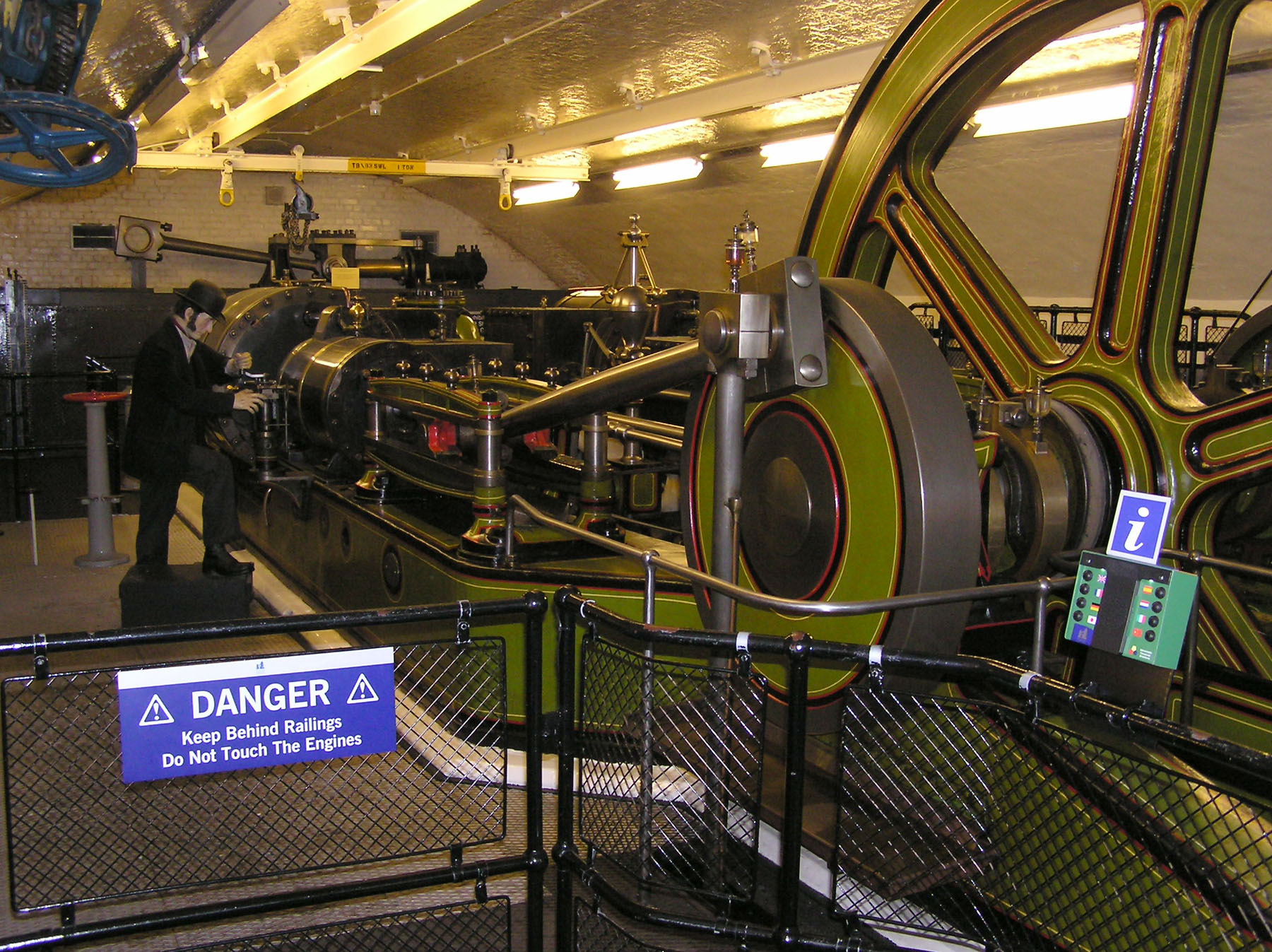
Stationary steam engines are fixed steam engines used for pumping or driving mills and factories, and for power generation. They are distinct from locomotive engines used on railways, traction engines for heavy steam haulage on roads, steam cars (and other motor vehicles), agricultural engines used for ploughing or threshing, marine engines, and the steam turbines used as the mechanism of power generation for most nuclear power plants.
The development of the steam engine was gradual. They were introduced during the 18th century and widely made for the whole of the 19th century and most of the first half of the 20th century, only declining as electricity supply and the internal combustion engine became more widespread. Over time, they would improve in pressure, expansion and speed.
In the first century AD, "Hero" described a turbine type engine utilizing steam for power known as the aeolipile. Since then very little with steam power has been done until the 17th and 18th centuries. It was an invention by James Watt that would first imbody all aspects common to modern engines. It used the expansion of steam, a separate condenser, and speed regulation with a governor.
The first steam engines operated very slowly. The greatest improvement was the increased pressure at which they could operate. Super heaters were added to boilers to increase temperature and the economy of the engine. The first engines utilized a single cylinder where low pressure steam was introduced to the bottom of the piston and then condensed. More cylinders were added creating the compound steam engine. As pressure increased, it was found that the compound design was more economical.
There are different patterns of stationary steam engines, distinguished by the layout of the cylinders and crankshaft:
Stationary engines may be classified by secondary characteristics as well:
When stationary engines had multiple cylinders, they could be classified as:
An engine could be run in simple or condensing mode:
Hub AI
Stationary steam engine AI simulator
(@Stationary steam engine_simulator)
Stationary steam engine
Stationary steam engines are fixed steam engines used for pumping or driving mills and factories, and for power generation. They are distinct from locomotive engines used on railways, traction engines for heavy steam haulage on roads, steam cars (and other motor vehicles), agricultural engines used for ploughing or threshing, marine engines, and the steam turbines used as the mechanism of power generation for most nuclear power plants.
The development of the steam engine was gradual. They were introduced during the 18th century and widely made for the whole of the 19th century and most of the first half of the 20th century, only declining as electricity supply and the internal combustion engine became more widespread. Over time, they would improve in pressure, expansion and speed.
In the first century AD, "Hero" described a turbine type engine utilizing steam for power known as the aeolipile. Since then very little with steam power has been done until the 17th and 18th centuries. It was an invention by James Watt that would first imbody all aspects common to modern engines. It used the expansion of steam, a separate condenser, and speed regulation with a governor.
The first steam engines operated very slowly. The greatest improvement was the increased pressure at which they could operate. Super heaters were added to boilers to increase temperature and the economy of the engine. The first engines utilized a single cylinder where low pressure steam was introduced to the bottom of the piston and then condensed. More cylinders were added creating the compound steam engine. As pressure increased, it was found that the compound design was more economical.
There are different patterns of stationary steam engines, distinguished by the layout of the cylinders and crankshaft:
Stationary engines may be classified by secondary characteristics as well:
When stationary engines had multiple cylinders, they could be classified as:
An engine could be run in simple or condensing mode:
Recent media