



Community hub
Recent from talks
Knowledge base stats:
Talk channels stats:
Members stats:
Steam explosion
A steam explosion is an explosion caused by violent boiling or flashing of water or ice into steam, occurring when water or ice is either superheated, rapidly heated by fine hot debris produced within it, or heated by the interaction of molten metals (as in a fuel–coolant interaction, or FCI, of molten nuclear-reactor fuel rods with water in a nuclear reactor core following a core-meltdown). Steam explosions are instances of explosive boiling. Pressure vessels, such as pressurized water (nuclear) reactors, that operate above atmospheric pressure can also provide the conditions for a steam explosion. The water changes from a solid or liquid to a gas with extreme speed, increasing dramatically in volume. A steam explosion sprays steam and boiling-hot water and the hot medium that heated it in all directions (if not otherwise confined, e.g. by the walls of a container), creating a danger of scalding and burning.
Steam explosions are not normally chemical explosions, although a number of substances react chemically with steam (for example, zirconium and superheated graphite (inpure carbon, C) react with steam and air respectively to give off hydrogen (H2), which may explode violently in air (O2) to form water or H2O) so that chemical explosions and fires may follow. Some steam explosions appear to be special kinds of boiling liquid expanding vapor explosion (BLEVE), and rely on the release of stored superheat. But many large-scale events, including foundry accidents, show evidence of an energy-release front propagating through the material (see description of FCI below), where the forces create fragments and mix the hot phase into the cold volatile one; and the rapid heat transfer at the front sustains the propagation.
High steam generation rates can occur under other circumstances, such as boiler-drum failure, or at a quench front (for example when water re-enters a hot dry boiler). Though potentially damaging, they are usually less energetic than events in which the hot ("fuel") phase is molten and so can be finely fragmented within the volatile ("coolant") phase. Some examples follow:
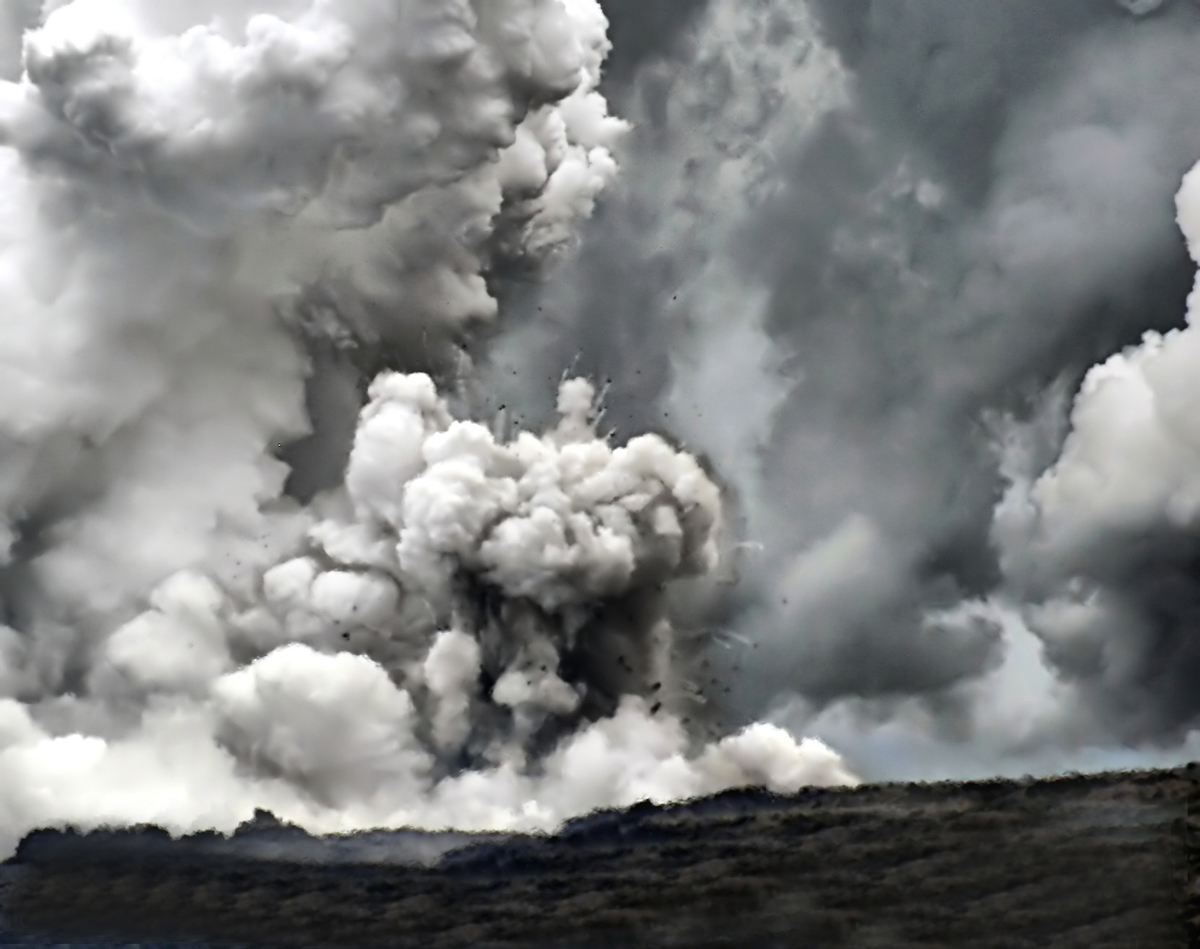
Steam explosions are naturally produced by certain volcanoes, especially stratovolcanoes, and are a major cause of human fatalities in volcanic eruptions. They are often encountered where hot lava meets sea water or ice. Such an occurrence is also called a littoral explosion. A dangerous steam explosion can also be created when liquid water or ice encounters hot, molten metal. As the water explodes into steam, it splashes the burning hot liquid metal along with it, causing an extreme risk of severe burns to anyone located nearby and creating a fire hazard.
When a pressurized container such as the waterside of a steam boiler ruptures, it is always followed by some degree of steam explosion. A common operating temperature and pressure for a marine boiler is around 950 psi (6,600 kPa) and 850 °F (454 °C) at the outlet of the superheater.
A steam boiler has an interface of steam and water in the steam drum, which is where the water is finally evaporating due to the heat input, usually oil-fired burners. When a water tube fails due to any of a variety of reasons, it causes the water in the boiler to expand out of the opening into the furnace area that is only a few psi above atmospheric pressure. This will likely extinguish all fires and expands over the large surface area on the sides of the boiler.
To decrease the likelihood of a devastating explosion, boilers have gone from the "fire-tube" designs, where the heat was added by passing hot gases through tubes in a body of water, to "water-tube" boilers that have the water inside of the tubes and the furnace area is around the tubes. Old "fire-tube" boilers often failed due to poor build quality or lack of maintenance (such as corrosion of the fire tubes, or fatigue of the boiler shell due to constant expansion and contraction).
A failure of fire tubes forces large volumes of high pressure, high temperature steam back down the fire tubes in a fraction of a second and often blows the burners off the front of the boiler, whereas a failure of the pressure vessel surrounding the water would lead to a full and entire evacuation of the boiler's contents in a large steam explosion. On a marine boiler, this would certainly destroy the ship's propulsion plant and possibly the corresponding end of the ship.
Hub AI
Steam explosion AI simulator
(@Steam explosion_simulator)
Steam explosion
A steam explosion is an explosion caused by violent boiling or flashing of water or ice into steam, occurring when water or ice is either superheated, rapidly heated by fine hot debris produced within it, or heated by the interaction of molten metals (as in a fuel–coolant interaction, or FCI, of molten nuclear-reactor fuel rods with water in a nuclear reactor core following a core-meltdown). Steam explosions are instances of explosive boiling. Pressure vessels, such as pressurized water (nuclear) reactors, that operate above atmospheric pressure can also provide the conditions for a steam explosion. The water changes from a solid or liquid to a gas with extreme speed, increasing dramatically in volume. A steam explosion sprays steam and boiling-hot water and the hot medium that heated it in all directions (if not otherwise confined, e.g. by the walls of a container), creating a danger of scalding and burning.
Steam explosions are not normally chemical explosions, although a number of substances react chemically with steam (for example, zirconium and superheated graphite (inpure carbon, C) react with steam and air respectively to give off hydrogen (H2), which may explode violently in air (O2) to form water or H2O) so that chemical explosions and fires may follow. Some steam explosions appear to be special kinds of boiling liquid expanding vapor explosion (BLEVE), and rely on the release of stored superheat. But many large-scale events, including foundry accidents, show evidence of an energy-release front propagating through the material (see description of FCI below), where the forces create fragments and mix the hot phase into the cold volatile one; and the rapid heat transfer at the front sustains the propagation.
High steam generation rates can occur under other circumstances, such as boiler-drum failure, or at a quench front (for example when water re-enters a hot dry boiler). Though potentially damaging, they are usually less energetic than events in which the hot ("fuel") phase is molten and so can be finely fragmented within the volatile ("coolant") phase. Some examples follow:
Steam explosions are naturally produced by certain volcanoes, especially stratovolcanoes, and are a major cause of human fatalities in volcanic eruptions. They are often encountered where hot lava meets sea water or ice. Such an occurrence is also called a littoral explosion. A dangerous steam explosion can also be created when liquid water or ice encounters hot, molten metal. As the water explodes into steam, it splashes the burning hot liquid metal along with it, causing an extreme risk of severe burns to anyone located nearby and creating a fire hazard.
When a pressurized container such as the waterside of a steam boiler ruptures, it is always followed by some degree of steam explosion. A common operating temperature and pressure for a marine boiler is around 950 psi (6,600 kPa) and 850 °F (454 °C) at the outlet of the superheater.
A steam boiler has an interface of steam and water in the steam drum, which is where the water is finally evaporating due to the heat input, usually oil-fired burners. When a water tube fails due to any of a variety of reasons, it causes the water in the boiler to expand out of the opening into the furnace area that is only a few psi above atmospheric pressure. This will likely extinguish all fires and expands over the large surface area on the sides of the boiler.
To decrease the likelihood of a devastating explosion, boilers have gone from the "fire-tube" designs, where the heat was added by passing hot gases through tubes in a body of water, to "water-tube" boilers that have the water inside of the tubes and the furnace area is around the tubes. Old "fire-tube" boilers often failed due to poor build quality or lack of maintenance (such as corrosion of the fire tubes, or fatigue of the boiler shell due to constant expansion and contraction).
A failure of fire tubes forces large volumes of high pressure, high temperature steam back down the fire tubes in a fraction of a second and often blows the burners off the front of the boiler, whereas a failure of the pressure vessel surrounding the water would lead to a full and entire evacuation of the boiler's contents in a large steam explosion. On a marine boiler, this would certainly destroy the ship's propulsion plant and possibly the corresponding end of the ship.