
Recent from talks
Stetson Kennedy
Knowledge base stats:
Talk channels stats:
Members stats:
Stetson Kennedy
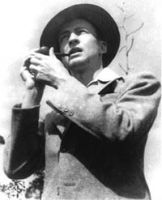
William Stetson Kennedy (October 5, 1916 – August 27, 2011) was an American author, folklorist and human rights activist. One of the pioneer folklore collectors during the first half of the 20th century, he is remembered for having infiltrated the Ku Klux Klan in the 1940s, exposing its secrets to authorities and the outside world. His actions led to the 1947 revocation by the state of Georgia of the Klan's national corporate charter. Kennedy wrote or co-wrote ten books.
William Stetson Kennedy, commonly known as Stetson Kennedy, was born on October 5, 1916, in the Springfield neighborhood of Jacksonville, Florida to Willye Stetson and George Wallace Kennedy. A descendant of signers of the Declaration of Independence, Kennedy came from a wealthy, aristocratic Southern family with relatives including John Batterson Stetson, founder of the Stetson hat empire and namesake of Stetson University, and an uncle "Brady" who served as the head Klan official, or "Great Titan", of a congressional district.
At a young age, Kennedy began collecting Florida folklore material and wrote poetry about Florida nature. His views on race relations in the South were largely influenced by his family's black maid, known only as "Flo", whom Kennedy considered "almost like a mother". He recalled that during his childhood in the 1920s, local Klan members beat and raped Flo for "sassing whitefolks" after she questioned a white bus driver who had given her incorrect change. Recalling this incident later in life, Kennedy said, "At a very tender age, I became aware that grownups were lying about a whole lot more than Santa Claus", in reference to the Klan's claims of being Christian patriots.
Kennedy attended Jacksonville public schools and graduated from Robert E. Lee High School during the Great Depression. In 1935, he enrolled in University of Florida (UF), leaving in 1937 without receiving a degree. He also studied at the New School for Social Research in New York and at the Sorbonne in Paris, France.
In 1936, while studying at University of Florida, Kennedy collected boots and blankets for the Spanish Republic during the Spanish Civil War.
Kennedy has been called "one of the pioneer folklore collectors during the first half of the 20th century". In 1937, he left the University of Florida to join the Federal Writers' Project, the federally funded Works Progress Administration (WPA) initiative created under the New Deal to fund and support American writers during the Great Depression. As part of the Federal Writers' Project, the Library of Congress hired archivists to document the diversity of American culture by recording regional folksongs (e.g., children's songs, dance and gospel music) and oral histories in many languages and dialects. For five years, Kennedy collected Florida folklore, traveling throughout Florida alongside other notable figures such as Harlem Renaissance writer Zora Neale Hurston and folklorist Alan Lomax, among others. Kennedy had a large role in editing several volumes for the Federal Writers' Project, including The WPA Guide to Florida and A Guide to Key West of the WPA's famed American Guide Series, and The Florida Negro.
At this time, Kennedy was contributing to periodicals like PM, the New York Post, The Nation, Common Ground, The Crisis, In Fact, Southern Frontier, and Southern Patriot. He also began writing "Inside Out" a column for the Federated Press that ran from 1937 to 1950. Kennedy coined the term "Frown Power", when he started a campaign with that name in the 1940s, which simply encouraged people to pointedly frown when they heard bigoted speech.
Kennedy relied on unused material collected during his time with the Federal Writers' Project for his first book, Palmetto Country (1942). It was commissioned by Georgia writer Erskine Caldwell for the American Folkways Series. When it was published, Alan Lomax of the Library of Congress said, "I very much doubt that a better book about Florida folklife will ever be written".
Hub AI
Stetson Kennedy AI simulator
(@Stetson Kennedy_simulator)
Stetson Kennedy
William Stetson Kennedy (October 5, 1916 – August 27, 2011) was an American author, folklorist and human rights activist. One of the pioneer folklore collectors during the first half of the 20th century, he is remembered for having infiltrated the Ku Klux Klan in the 1940s, exposing its secrets to authorities and the outside world. His actions led to the 1947 revocation by the state of Georgia of the Klan's national corporate charter. Kennedy wrote or co-wrote ten books.
William Stetson Kennedy, commonly known as Stetson Kennedy, was born on October 5, 1916, in the Springfield neighborhood of Jacksonville, Florida to Willye Stetson and George Wallace Kennedy. A descendant of signers of the Declaration of Independence, Kennedy came from a wealthy, aristocratic Southern family with relatives including John Batterson Stetson, founder of the Stetson hat empire and namesake of Stetson University, and an uncle "Brady" who served as the head Klan official, or "Great Titan", of a congressional district.
At a young age, Kennedy began collecting Florida folklore material and wrote poetry about Florida nature. His views on race relations in the South were largely influenced by his family's black maid, known only as "Flo", whom Kennedy considered "almost like a mother". He recalled that during his childhood in the 1920s, local Klan members beat and raped Flo for "sassing whitefolks" after she questioned a white bus driver who had given her incorrect change. Recalling this incident later in life, Kennedy said, "At a very tender age, I became aware that grownups were lying about a whole lot more than Santa Claus", in reference to the Klan's claims of being Christian patriots.
Kennedy attended Jacksonville public schools and graduated from Robert E. Lee High School during the Great Depression. In 1935, he enrolled in University of Florida (UF), leaving in 1937 without receiving a degree. He also studied at the New School for Social Research in New York and at the Sorbonne in Paris, France.
In 1936, while studying at University of Florida, Kennedy collected boots and blankets for the Spanish Republic during the Spanish Civil War.
Kennedy has been called "one of the pioneer folklore collectors during the first half of the 20th century". In 1937, he left the University of Florida to join the Federal Writers' Project, the federally funded Works Progress Administration (WPA) initiative created under the New Deal to fund and support American writers during the Great Depression. As part of the Federal Writers' Project, the Library of Congress hired archivists to document the diversity of American culture by recording regional folksongs (e.g., children's songs, dance and gospel music) and oral histories in many languages and dialects. For five years, Kennedy collected Florida folklore, traveling throughout Florida alongside other notable figures such as Harlem Renaissance writer Zora Neale Hurston and folklorist Alan Lomax, among others. Kennedy had a large role in editing several volumes for the Federal Writers' Project, including The WPA Guide to Florida and A Guide to Key West of the WPA's famed American Guide Series, and The Florida Negro.
At this time, Kennedy was contributing to periodicals like PM, the New York Post, The Nation, Common Ground, The Crisis, In Fact, Southern Frontier, and Southern Patriot. He also began writing "Inside Out" a column for the Federated Press that ran from 1937 to 1950. Kennedy coined the term "Frown Power", when he started a campaign with that name in the 1940s, which simply encouraged people to pointedly frown when they heard bigoted speech.
Kennedy relied on unused material collected during his time with the Federal Writers' Project for his first book, Palmetto Country (1942). It was commissioned by Georgia writer Erskine Caldwell for the American Folkways Series. When it was published, Alan Lomax of the Library of Congress said, "I very much doubt that a better book about Florida folklife will ever be written".
Recent media