
Hubbry Logo
StimpmeterStimpmeterMain
Open search
Stimpmeter
Community hub
Stimpmeter
logo
7 pages, 0 posts
0 subscribers
Be the first to start a discussion here.
Stimpmeter
Stimpmeter
from Wikipedia

The Stimpmeter is a device used to measure the speed of a golf course putting green by applying a known velocity to a golf ball and measuring the distance traveled in feet.

History

[edit]

It was designed in 1935 by golfer Edward S. Stimpson, Sr. (1904–1985).[1][2][3] The Massachusetts state amateur champion and former Harvard golf team captain, Stimpson was a spectator at the 1935 U.S. Open at Oakmont near Pittsburgh, where the winning score was 299 (+11). After witnessing a putt by a top professional (Gene Sarazen, a two-time champion) roll off a green, Stimpson was convinced the greens were unreasonably fast, but wondered how he could prove it. He developed a device, made of wood, now known as the Stimpmeter, which is an angled track that releases a ball at a known velocity so that the distance it rolls on a green's surface can be measured.[4]

In 1976, it was redesigned from aluminum by Frank Thomas of the United States Golf Association (USGA). It was first used by the USGA during the 1976 U.S. Open at Atlanta and made available to golf course superintendents in 1978. The 1976 version is painted green.

In January 2013, the USGA announced a third generation device based on work by Steven Quintavalla, a senior research engineer at the USGA labs.[5] A second hole in this version enables the option of a shorter run-out.[5] This version is painted blue, and is manufactured to a higher engineering tolerance to improve accuracy and precision.[5]

Description

[edit]

The 1976 device is an extruded aluminum bar, 36 inches (91 cm) long and 1.75 inches (4.4 cm) wide, with a 145° V-shaped groove extending along its entire length, supporting the ball at two points, 0.50 in (1.27 cm) apart. It is tapered at one end by removing metal from its underside to reduce the bounce of the ball as it rolls onto the green. It has a notch at a right angle to the length of the bar 30 inches (76 cm) from the lower tapered end where the ball is placed. The notch may be a hole completely through the bar or just a depression in it. The ball is pulled out of the notch by gravity when the device is slowly raised to an angle of about 20°, rolling onto the green at a repeatable velocity of 6.00 ft/s (1.83 m/s).[6] The distance travelled by the ball in feet is the 'speed' of the putting green. Six distances, three in each of two opposite directions, should be averaged on a flat section of the putting green. The three balls in each direction must be within 8 inches (20 cm) of each other for USGA validation of the test.[7]

Sloped greens

[edit]

One problem is finding a near level surface as required in the USGA handbook. Many greens cannot be correctly measured: there may not be an area where the measured distance (or green speed) in opposing directions is less than a foot, particularly when they are very fast, thus requiring a very long level surface. A formula, based on the work of Isaac Newton, as derived and extensively tested by A. Douglas Brede, solves that problem. The formula is:
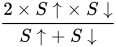
(where S↑ is speed up the slope and S↓ is speed down the slope on the same path). This eliminates the effect of the slope and provides a true green speed even on severely sloped greens.[8]

Recommendations

[edit]

The USGA stimpmetered putting greens across the country to produce the following recommendations:[1]

 Speed  Length
Slow  8 feet (2.4 m) 
Medium  10 feet (3.0 m) 
Fast  12 feet (3.7 m) 

For the U.S. Open, they recommend:[1]

 Speed  Length
Slow  10 feet (3.0 m) 
Medium  12 feet (3.7 m) 
Fast  14 feet (4.3 m)  

The greens at Oakmont Country Club (where the device was conceived) are some of the fastest in the world, with readings of 15 feet (4.6 m).[9]

References

[edit]
[edit]
Revisions and contributorsEdit on WikipediaRead on Wikipedia
from Grokipedia
The Stimpmeter is a specialized tool used in to measure the speed and smoothness of putting greens by releasing a from a fixed height and recording the distance it rolls across the surface. Invented in by Edward S. Stimpson, a state amateur champion and former Harvard golf team captain, was inspired by the exceptionally fast greens he observed as a spectator at the 1935 U.S. Open at . Stimpson designed it as a simple, objective way to quantify green speed for consistency across rounds and courses, addressing inconsistencies in subjective assessments by golfers and officials. The Stimpmeter consists of a 36-inch-long aluminum bar featuring a lengthwise V-shaped groove and one or more ball-release notches positioned to create a consistent release of approximately 20 to 22 degrees when elevated. To measure speed, an operator places a standard in the notch, lifts the device to the specified , and releases the ball to roll down the groove onto a level section of the ; the process is repeated three times in each of two opposite directions along the same line, and the average roll distance in feet is calculated by averaging the three distances in each direction to get two averages, then averaging those two values. This distance reading, often expressed in feet and inches (e.g., 10 feet 6 inches), serves as a proxy for speed, where higher values indicate faster surfaces due to factors like grass type, mowing height, moisture levels, and from leaf texture. The United States Golf Association (USGA) adopted and refined the Stimpmeter in the mid-1970s, completing its development in 1976 under technical director Frank Thomas, who made minor adjustments before making it available to golf course superintendents and officials in 1978 as the official "USGA Stimpmeter." It has since become the global standard for green speed measurement, used by the USGA during major championships to ensure fair and consistent playing conditions—such as targeting 11 to 13 feet for U.S. Open greens—while helping course managers monitor the effects of maintenance practices like mowing, rolling, and irrigation. In 2013, the USGA introduced an updated two-sided version with a second notch allowing for shorter rolls (approximately half the distance of the original), enabling accurate measurements on smaller or more undulating greens without requiring a 10- to 15-foot level area, following extensive testing at events like the 2012 U.S. Open. Beyond championships, the Stimpmeter aids daily course management by providing data to balance playability, turf health, and golfer expectations, though the USGA advises against public posting of speed values to avoid undue pressure on superintendents. Its enduring simplicity and reliability have made it indispensable in professional and amateur worldwide, influencing greenkeeping practices and contributing to more uniform playing experiences across diverse climates and course designs.

History

Invention

Edward S. Stimpson, an accomplished amateur golfer and the 1935 Massachusetts State Amateur champion, invented the Stimpmeter in the 1930s to provide an objective method for measuring the speed of putting greens. As a former captain of the golf team, Stimpson was motivated by the inconsistencies in subjective evaluations of green conditions, which often led to debates among players and course officials about fairness and playability. The initial design was a simple wooden ramp, approximately 30 inches long, featuring a V-shaped groove and a notch to hold and release a from a fixed angle of about 20 degrees, ensuring a consistent initial and a vertical height of about 10 inches. This straightforward mechanism allowed the ball to roll down the incline and across the surface, with the distance traveled serving as a direct metric for speed. Stimpson crafted early prototypes himself, drawing on basic materials to create a portable tool that could be used by golfers and course staff without specialized equipment. Stimpson tested the prototypes informally at local Massachusetts golf courses, including those affiliated with the Massachusetts Golf Association, to refine the device's accuracy in quantifying ball roll distances under varying green conditions. These trials focused on establishing repeatability, such as averaging rolls from multiple directions to account for subtle slopes or inconsistencies. By the late 1930s, the Stimpmeter saw its first informal applications in course maintenance, enabling superintendents to monitor and adjust green speeds more reliably, though it lacked formal standardization and did not achieve widespread use at the time. The device's potential was later recognized by the (USGA), which endorsed and refined it in the 1970s for broader application in professional play.

Adoption and Standardization

Despite its invention in the by Edward Stimpson, the Stimpmeter experienced limited adoption in the ensuing decades owing to skepticism about its reliability and an initial rejection by the USGA Green Section for inconsistent readings. This situation shifted in the mid-1970s when Frank Thomas, the USGA's technical director, refined the device—transitioning it from its original wooden construction to a more durable aluminum version—and officially endorsed it in 1976 as the standardized tool for measuring putting green speeds. The USGA's formal acceptance that year marked a pivotal moment, elevating the Stimpmeter from a niche instrument to the authoritative standard within the golf industry for ensuring uniform green conditions. Following this endorsement, the first USGA-certified Stimpmeter was produced shortly thereafter and made available to golf course superintendents and officials in 1978, facilitating broader implementation. Its debut occurred at the 1976 U.S. Open at , where it was employed to monitor green speeds during the tournament. By the late 1970s, the Stimpmeter had transitioned into mandatory equipment for major professional events, including subsequent U.S. Opens, promoting consistency and fairness across competitions as greens maintenance practices advanced.

Design and Operation

Physical Construction

The Stimpmeter is constructed from extruded aluminum, forming a bar 36 inches long with a V-shaped groove extending along the full length of each side. The groove features a , designed to support a standard —1.68 inches in —at two points 0.5 inches apart, guiding it without significant lateral deviation. Both ends of the bar are tapered to minimize bounce upon contact with the green surface. A precisely milled notch on each side serves as the release mechanism, positioned approximately 30 inches along the bar from the tapered end for standard measurements, corresponding to a vertical release height of approximately 10 inches above the surface when is angled at 20 degrees, allowing the ball to roll down the incline at a consistent angle of about 20 degrees. An alternate notch, located about 14 inches from the end, enables half-distance rolls for use on smaller or undulating areas. Official USGA-certified Stimpmeters are manufactured under ISO 9001 standards by authorized producers, with laser-engraved seals, unique serial numbers, and a 36-inch ruled scale for direct roll . These units weigh approximately 3 pounds to maintain portability while ensuring structural integrity as a precision tool. The design, originally conceived in , prioritizes durability and accuracy, with tolerances controlled to prevent variations in groove dimensions or notch alignment that could affect ball release.

Measurement Procedure

To measure the speed of a putting green using a Stimpmeter, select a flat section of the surface that is several feet wide and at least 10 to 12 feet long to ensure consistent readings. Position the device with its elevated end pointing down-grain—the direction in which the grass blades naturally lean—to account for subtle surface textures that may influence ball roll. Insert a into the standard notch at the elevated end. Slowly raise the notched end of the Stimpmeter while keeping the tapered end steady on the ground beside a starting tee marker, allowing the ball to release and roll down the V-shaped groove onto the green. Repeat this process three consecutive times in the same direction, marking the stopping point of each ball with a tee; the balls should come to rest within 8 inches of one another for a valid test, and if not, adjust by using the shorter "2X" notch or repeating the rolls. Insert another tee at the average stopping position of these three balls (which approximates the first directional average distance), then perform a second set of three rolls in the opposite direction, using the new tee as the starting point and the original tee as an aiming reference; measure the distance each of these three balls rolls from the new starting tee to their stopping points. Calculate the average roll distance for each direction in feet, then determine the Stimpmeter reading as the average of these two directional averages—the ball's travel before it stops or slows significantly. For instance, an average of 10 feet indicates a Stimpmeter reading of 10. If the difference between the two directional averages exceeds 18 inches, discard the results and select a new testing area, as this suggests uneven conditions. To obtain a reliable overall green speed, conduct the full procedure at a minimum of three separate locations on the , ideally spaced to represent different areas, and average the individual readings from these tests. Perform measurements under optimal conditions, such as dry, calm weather on a smooth surface, and practice the technique to ensure consistency in ball release and device stability.

Usage and Applications

On Flat Greens

The Stimpmeter is particularly suited for establishing baseline green speeds on level putting surfaces, where measurements provide a reliable indicator of overall turf . On flat s, consistent environmental and factors play a critical role in determining ball roll distance. Optimal moisture levels, achieved through balanced , prevent excessive slowing, while mowing heights around 0.125 inches promote a smooth surface that enhances speed without compromising turf health. Thatch management is equally important; moderate levels improve surface resiliency, but excessive buildup increases and reduces roll consistency. Ball roll distance on these flat surfaces directly reflects the putting green's characteristics, with lower yielding longer rolls. The device releases the ball from a notch positioned approximately 30 inches along its length from the tapered end, at an angle of about 20 degrees, ensuring repeatable initial velocity. At faster speeds exceeding 11 feet, superintendents must employ precise maintenance practices, such as regular rolling and verticutting, to maintain smoothness and prevent inconsistent ball behavior due to surface irregularities. Grain direction presents a common challenge on flat greens, as it can introduce slight deviations in roll, with balls traveling up to 30 inches farther with the grain than against it. To mitigate this, Stimpmeter tests are typically conducted in alignment with the predominant grass growth direction, often verified through multiple directional readings. These measurements ensure uniformity across the green. For recreational play, Stimpmeter assessments on flat greens target speeds of 8 to 10 feet to provide daily consistency, accommodating a wide range of player skill levels while minimizing maintenance demands and promoting enjoyable pace of play. This range aligns with general guidelines for average courses, where speeds above 10 feet risk turf stress if not carefully managed.

On Sloped Greens

Measuring the speed of putting greens with a Stimpmeter becomes more challenging on sloped surfaces, where significantly influences ball roll distance, causing uphill rolls to decelerate faster and downhill rolls to accelerate beyond the surface's inherent characteristics. To address this, the (USGA) primarily recommends conducting measurements on reasonably level areas to ensure accuracy, as slopes can produce misleading results that do not reflect true green playability. For inclined areas without sufficient level turf, adaptations involve directional testing to account for gravitational . Tests are typically performed by rolling balls both uphill (against the ) and downhill (with the ), with three rolls averaged per direction to minimize variability; downhill rolls are often noted separately or avoided in standard protocols due to their tendency to overestimate speed, while uphill measurements provide a more conservative estimate closer to flat-green conditions. A corrected speed value, equivalent to a flat-surface reading, can then be calculated using the Brede equation: St=2×S×SS+SS_t = \frac{2 \times S_\uparrow \times S_\downarrow}{S_\uparrow + S_\downarrow}, where SS_\uparrow is the average uphill distance and SS_\downarrow is the average downhill distance; this adjustment compensates for effects and has been validated for gradients up to 6%. On contoured greens, the USGA advises multiple tests in various directions—ideally to primary slopes—and averaging the results to capture overall effective speed and represent playability under typical putting scenarios. Severe slopes exceeding 2% introduce additional limitations, as uncorrected Stimpmeter readings may underestimate the green's baseline speed when relying solely on uphill or averaged data, potentially leading to inconsistent decisions. In such cases, the device cannot fully replace qualitative assessments. Maintenance practices on sloped greens aim to achieve uniform Stimpmeter readings across contours, with superintendents adjusting mowing heights, rolling frequencies, and moisture levels to counteract faster downhill rolls and slower uphill ones, ensuring consistent playability despite gravitational variations.

Standards and Guidelines

USGA Recommendations

The (USGA) establishes guidelines for Stimpmeter use to promote consistent and fair putting green conditions across courses. Typical Stimpmeter readings on American courses range from 7 to 12 feet, with speeds below recommended for daily play to minimize turf stress and maintenance challenges. For major championships such as the US Open, recent events have targeted 14-15 feet to test elite players. The USGA mandates the use of its certified Stimpmeter devices, constructed from extruded aluminum and available to member clubs, along with trained operators who follow standardized procedures to ensure reliable measurements. In tournament settings, tests are performed before rounds without informing players, preserving impartiality and preventing any psychological influence on performance. Consistency is a core USGA principle, with minimal variation in speed across a single green and uniform speeds throughout the course to uphold fair play and skill-based outcomes. Measurements should occur under optimal environmental conditions, such as after has evaporated and at least 30 minutes post-mowing or rolling, while avoiding recent rain or areas affected by heavy foot traffic that could reduce surface friction and skew results.

Tournament and Maintenance Practices

In professional tournaments, Stimpmeter readings are used to set putting green speeds at challenging levels that test elite players' skills, typically targeting 13 feet or higher to emphasize precision and control. For example, during the 2025 U.S. Open at , the (USGA) aimed for speeds between 14 feet 5 inches and 14 feet 9 inches to create demanding conditions. These targets are adjusted dynamically for weather influences, such as or , which can alter surface friction and ball roll, ensuring consistent playability across rounds. Green speeds are monitored multiple times daily on every putting surface using the Stimpmeter, often before play and after maintenance, to detect variations and make timely corrections. This frequent assessment, as practiced in USGA championships, helps maintain uniformity despite environmental changes or player traffic. Golf course maintenance teams rely on Stimpmeter data to inform routine practices that control green speeds, integrating readings into decisions on mowing, rolling, and . Lowering the mowing height or increasing rolling frequency can accelerate ball roll by reducing surface resistance, while targeted maintains optimal moisture levels to prevent excessive softening. Topdressing with is another common technique to enhance smoothness and speed, applied based on Stimpmeter feedback to fine-tune performance without compromising turf health. These adjustments are guided by the goal of consistency, with readings taken regularly—often daily or after key operations—to evaluate the impact of management programs like vertical mowing or grooming. Contemporary maintenance incorporates digital tools for Stimpmeter results, enabling superintendents to analyze long-term trends in speed variations and correlate them with , traffic, or agronomic inputs for proactive . Introduced in 2023, the USGA's GS3 smart tool measures green speed along with firmness, , and trueness, providing complementary evaluations for a holistic assessment of putting surface . Many facilities customize speeds to suit user groups, opting for 11 to 12 feet on the Stimpmeter for or play to promote and enjoyment, in contrast to faster settings. However, the Stimpmeter's focus on speed alone limits its scope, as it does not quantify green firmness, , or the influence of slopes on ball break; thus, it is paired with such complementary evaluations or visual inspections.

References

Add your contribution
Related Hubs
User Avatar
No comments yet.