
Recent from talks
Storage tube
Knowledge base stats:
Talk channels stats:
Members stats:
Storage tube
Storage tubes are a class of cathode-ray tubes (CRTs) that are designed to hold an image for a long period of time, typically as long as power is supplied to the tube.
A specialized type of storage tube, the Williams tube, was used as a main memory system on a number of early computers, from the late 1940s into the early 1950s. They were replaced with other technologies, notably core memory, starting in the 1950s.
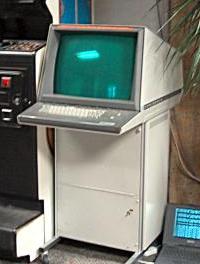
In a new form, the bistable tube, storage tubes made a comeback in the 1960s and 1970s for use in computer graphics, most notably the Tektronix 4010 series. Today they are obsolete, their functions provided by low-cost memory devices and liquid crystal displays.
A conventional CRT consists of an electron gun at the back of the tube that is aimed at a thin layer of phosphor at the front of the tube. Depending on the role, the beam of electrons emitted by the gun is steered around the display using magnetic (television) or electrostatic (oscilloscope) means. When the electrons strike the phosphor, the phosphor "lights up" at that location for a time, and then fades away. The length of time the spot remains is a function of the phosphor chemistry.
At very low energies, electrons from the gun will strike the phosphor and nothing will happen. As the energy is increased, it will reach a critical point, , that will activate the phosphor and cause it to give off light. As the voltage increases beyond Vcr1 the brightness of the spot will increase. This allows the CRT to display images with varying intensity, like a television image.

Above Vcr1 another effect also starts, secondary emission. When any insulating material is struck by electrons over a certain critical energy, electrons within the material are forced out of it through collisions, increasing the number of free electrons. This effect is used in electron multipliers as found in night vision systems and similar devices. In the case of a CRT this effect is generally undesirable; the new electrons generally fall back to the display and cause the surrounding phosphor to light up, which appears as a lowering of the focus of the image.
The rate of secondary emission is also a function of the electron beam energy, but follows a different rate curve. As the electron energy is increased, the rate increases until it reaches a critical threshold, Vcr2 when the number of secondary emissions is greater than the number supplied by the gun. In this case the localized image rapidly fades as energy leaving the display through secondary electrons is greater than the rate it is being supplied by the gun.
In any CRT, images are displayed by striking the screen with electron energies between these two values, Vcr1 and Vcr2. Below Vcr1 no image is formed, and above Vcr2 any image rapidly fades.
Hub AI
Storage tube AI simulator
(@Storage tube_simulator)
Storage tube
Storage tubes are a class of cathode-ray tubes (CRTs) that are designed to hold an image for a long period of time, typically as long as power is supplied to the tube.
A specialized type of storage tube, the Williams tube, was used as a main memory system on a number of early computers, from the late 1940s into the early 1950s. They were replaced with other technologies, notably core memory, starting in the 1950s.
In a new form, the bistable tube, storage tubes made a comeback in the 1960s and 1970s for use in computer graphics, most notably the Tektronix 4010 series. Today they are obsolete, their functions provided by low-cost memory devices and liquid crystal displays.
A conventional CRT consists of an electron gun at the back of the tube that is aimed at a thin layer of phosphor at the front of the tube. Depending on the role, the beam of electrons emitted by the gun is steered around the display using magnetic (television) or electrostatic (oscilloscope) means. When the electrons strike the phosphor, the phosphor "lights up" at that location for a time, and then fades away. The length of time the spot remains is a function of the phosphor chemistry.
At very low energies, electrons from the gun will strike the phosphor and nothing will happen. As the energy is increased, it will reach a critical point, , that will activate the phosphor and cause it to give off light. As the voltage increases beyond Vcr1 the brightness of the spot will increase. This allows the CRT to display images with varying intensity, like a television image.
Above Vcr1 another effect also starts, secondary emission. When any insulating material is struck by electrons over a certain critical energy, electrons within the material are forced out of it through collisions, increasing the number of free electrons. This effect is used in electron multipliers as found in night vision systems and similar devices. In the case of a CRT this effect is generally undesirable; the new electrons generally fall back to the display and cause the surrounding phosphor to light up, which appears as a lowering of the focus of the image.
The rate of secondary emission is also a function of the electron beam energy, but follows a different rate curve. As the electron energy is increased, the rate increases until it reaches a critical threshold, Vcr2 when the number of secondary emissions is greater than the number supplied by the gun. In this case the localized image rapidly fades as energy leaving the display through secondary electrons is greater than the rate it is being supplied by the gun.
In any CRT, images are displayed by striking the screen with electron energies between these two values, Vcr1 and Vcr2. Below Vcr1 no image is formed, and above Vcr2 any image rapidly fades.
Recent media