
Recent from talks
Strait of Hormuz
Knowledge base stats:
Talk channels stats:
Members stats:
Strait of Hormuz
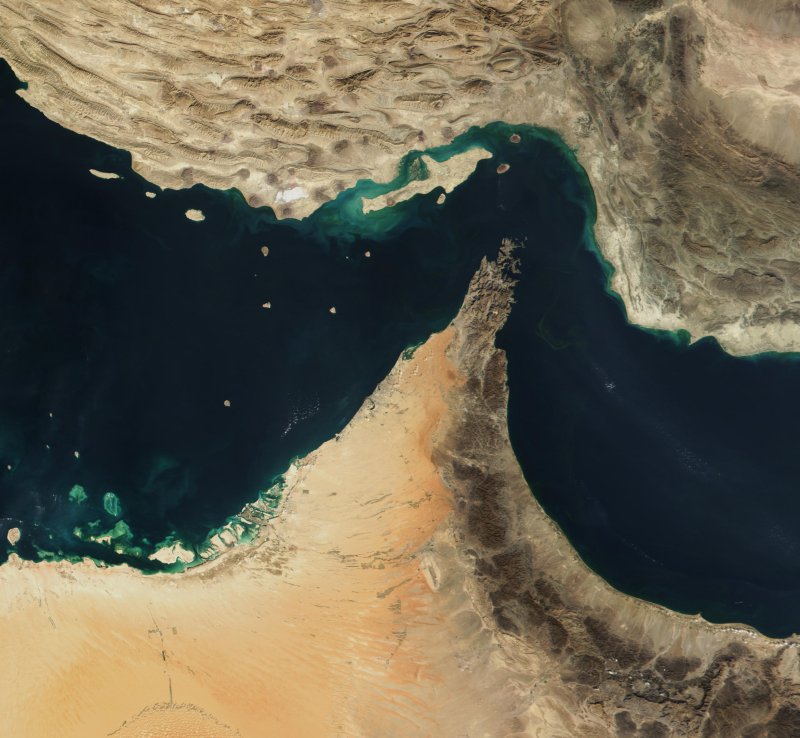
The Strait of Hormuz (/hɔːrˈmuːz/ Persian: تنگهٔ هُرمُز Tangeh-ye Hormoz ⓘ, Arabic: مَضيق هُرمُز Maḍīq Hurmuz) is a strait between the Persian Gulf and the Gulf of Oman. It provides the only sea passage from the Persian Gulf to the open ocean and is one of the world's most strategically important choke points. On the north coast lies Iran, and on the south coast lies the Musandam Peninsula, shared by the United Arab Emirates and the Musandam Governorate, an exclave of Oman. The strait is about 104 miles (90 nmi; 167 km) long, with a width varying from about 60 mi (52 nmi; 97 km) to 24 mi (21 nmi; 39 km).
As of 2023[update], 20% of the world's liquefied natural gas and 25% of seaborne oil trade passes through the strait, making it a highly important location for trade. It has been so for centuries; its vast hinterlands were rich in luxury trade goods with no easy access to lucrative trading ports. Babur's memoirs recount how almonds had to be carried from the distant Ferghana region in Central Asia to Hormuz to reach markets.
As of June 2025[update], the strait has never been closed during Middle East conflicts, unlike the Straits of Tiran, though Iranian threats to close the strait and preparations to mine it have been made.
Popular etymology derives "Hormuz" from the Middle Persian pronunciation of the name of the Zoroastrian god Ahura Mazda. Alternatively, it has been suggested that the name derives from Hur-Muz 'Place of Dates'. Yet another possibility is that it comes from ὅρμος hormos, the Greek word for 'cove, bay'. A theory claims that the strait of Hormuz may have been named after Ifra Hormizd, the mother of King Shapur II of Persia, who ruled between 309 and 379 AD.[citation needed]
The opening to the Persian Gulf was described, but not given a name, in the Periplus of the Erythraean Sea, a 1st-century mariner's guide:
At the upper end of these[which?] Calaei islands is a range of mountains called Calon, and there follows not far beyond, the mouth of the Persian Gulf, where there is much diving for the pearl-mussel. To the left of the straits are great mountains called Asabon and to the right there rises in full view another round and high mountain called Semiramis; between them the passage across the strait is about six hundred stadia; beyond which that very great and broad sea, the Persian Gulf, reaches far into the interior. At the upper end of this gulf, there is a market-town designated by law called Apologus, situated near Charaex Spasini and the River Euphrates.
— Periplus of the Erythraean Sea, Chapter 35
In the 10th–17th centuries AD, the Kingdom of Ormus, which seems to have given the strait its name, was located here. Scholars, historians and linguists derive the name "Ormuz" from the local Persian word هورمغ Hur-mogh meaning date palm. The resemblance of this word to the name of the Zoroastrian god هرمز Hormoz (a variant of Ahura Mazda) has resulted in the belief[citation needed] that these words are related.
Hub AI
Strait of Hormuz AI simulator
(@Strait of Hormuz_simulator)
Strait of Hormuz
The Strait of Hormuz (/hɔːrˈmuːz/ Persian: تنگهٔ هُرمُز Tangeh-ye Hormoz ⓘ, Arabic: مَضيق هُرمُز Maḍīq Hurmuz) is a strait between the Persian Gulf and the Gulf of Oman. It provides the only sea passage from the Persian Gulf to the open ocean and is one of the world's most strategically important choke points. On the north coast lies Iran, and on the south coast lies the Musandam Peninsula, shared by the United Arab Emirates and the Musandam Governorate, an exclave of Oman. The strait is about 104 miles (90 nmi; 167 km) long, with a width varying from about 60 mi (52 nmi; 97 km) to 24 mi (21 nmi; 39 km).
As of 2023[update], 20% of the world's liquefied natural gas and 25% of seaborne oil trade passes through the strait, making it a highly important location for trade. It has been so for centuries; its vast hinterlands were rich in luxury trade goods with no easy access to lucrative trading ports. Babur's memoirs recount how almonds had to be carried from the distant Ferghana region in Central Asia to Hormuz to reach markets.
As of June 2025[update], the strait has never been closed during Middle East conflicts, unlike the Straits of Tiran, though Iranian threats to close the strait and preparations to mine it have been made.
Popular etymology derives "Hormuz" from the Middle Persian pronunciation of the name of the Zoroastrian god Ahura Mazda. Alternatively, it has been suggested that the name derives from Hur-Muz 'Place of Dates'. Yet another possibility is that it comes from ὅρμος hormos, the Greek word for 'cove, bay'. A theory claims that the strait of Hormuz may have been named after Ifra Hormizd, the mother of King Shapur II of Persia, who ruled between 309 and 379 AD.[citation needed]
The opening to the Persian Gulf was described, but not given a name, in the Periplus of the Erythraean Sea, a 1st-century mariner's guide:
At the upper end of these[which?] Calaei islands is a range of mountains called Calon, and there follows not far beyond, the mouth of the Persian Gulf, where there is much diving for the pearl-mussel. To the left of the straits are great mountains called Asabon and to the right there rises in full view another round and high mountain called Semiramis; between them the passage across the strait is about six hundred stadia; beyond which that very great and broad sea, the Persian Gulf, reaches far into the interior. At the upper end of this gulf, there is a market-town designated by law called Apologus, situated near Charaex Spasini and the River Euphrates.
— Periplus of the Erythraean Sea, Chapter 35
In the 10th–17th centuries AD, the Kingdom of Ormus, which seems to have given the strait its name, was located here. Scholars, historians and linguists derive the name "Ormuz" from the local Persian word هورمغ Hur-mogh meaning date palm. The resemblance of this word to the name of the Zoroastrian god هرمز Hormoz (a variant of Ahura Mazda) has resulted in the belief[citation needed] that these words are related.
Recent media