Hubbry Logo
Choke pointChoke pointMain
Open search
Choke point
Community hub
Choke point
logo
8 pages, 0 posts
0 subscribers
Be the first to start a discussion here.
Choke point
Choke point
from Wikipedia
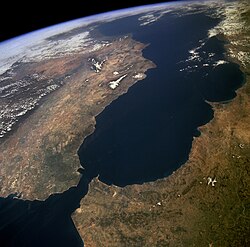
The Strait of Gibraltar is an important naval choke point, as entry to the Mediterranean Sea can be blocked there by a small number of vessels.

In military strategy, a choke point (or chokepoint), or sometimes bottleneck, is a geographical feature on land such as a valley, defile, isthmus or bridge, or maritime passage through a critical waterway such as a strait, which an armed force is forced to pass through in order to reach its objective, sometimes on a substantially narrowed front and therefore greatly decreasing its combat effectiveness by making it harder to bring superior numbers to bear. A choke point can allow a numerically inferior defending force to use the terrain as a force multiplier to thwart or ambush a much larger opponent, as the attacker cannot advance any further without first securing passage through the choke point.

Historical examples

[edit]

Some historical examples of the tactical use of choke points are King Leonidas I's defense of the Pass of Thermopylae during an invasion led by Xerxes I of Persia; the Battle of Stamford Bridge in which Harold Godwinson defeated Harald Hardrada; William Wallace's victory over the English at the Battle of Stirling Bridge (Wallace had around 2,300 men against the English army of about 9,000 to 12,000 men and the bridge collapsed during the battle); and the Battle of Agincourt in which Henry V of England decisively defeated the French using a small army (consisting mainly of lightly equipped longbowmen) when the much larger force of French heavy cavalry were forced to charge at the Englishmen through a narrow muddy gap in the Azincourt Woods.

The many archipelagos of the Caribbean offered several maritime choke points that attracted pirates and buccaneers during the height of their activities in the 17th and early 18th century.[citation needed] The Spanish treasure fleets leaving the Americas would have to pass through those waters to pick up the strong, prevailing westerly winds that would take them back to Spain across the North Atlantic.

Some choke points, with important locations in parentheses:

The Fulda Gap was seen as one of the potentially decisive bottleneck battlegrounds of the Cold War in Germany.

Royal Navy choke points

[edit]

From the 18th to the early 20th centuries, the sheer size of the United Kingdom's Royal Navy meant it had control over much of the world's oceans and seas. Choke points were of huge importance to the British Empire, which often used them to control trade in British colonies and, to a lesser extent, for defense. Choke points have also been a source of tension, notably during the Suez Crisis. The Royal Navy still deems its choke points as strategically vital. Indeed, the importance of choke points was first recognised by British Admiral John Fisher.[1]

A map of the English Channel, south of England, north of France
The English Channel, a choke point south of England and north of France

These are major British choke points today:

The choke points still have significant strategic importance for the Royal Navy. The GIUK gap is particularly important to the Royal Navy, as any attempt by northern European forces to break into the open Atlantic would have to do so through the heavily defended English Channel, which is also the world's busiest shipping lane, or through one of the exits on either side of Iceland. Considering British control over the strategic fortress of Gibraltar at the entrance to the Mediterranean, Spain (northern coast), France (Atlantic coast) and Portugal are the only mainland European nations that have direct access to the Atlantic Ocean in a way that cannot be easily blocked at a choke point by the Royal Navy. The GIUK gap was also a strategically important part of the Cold War, as the Royal Navy were given the responsibility of keeping an eye on Soviet submarines trying to break into the open Atlantic.[citation needed]

Importance

[edit]

Global energy trade relies heavily on maritime transport, as oil, natural gas, and LNG are primarily shipped by sea. Within this system, maritime chokepoints are critical passages along major shipping routes through which a large share of global energy supplies transits.[2] Their strategic location makes them essential nodes for both maritime traffic and energy security. Disruptions at these chokepoints can quickly affect transport costs, price stability, and the reliability of energy markets. As a result, they also carry strong geopolitical importance and play a central role in shaping policies aimed at ensuring stable, sustainable, and resilient maritime trade over the long term.

Choke points remain a prominent issue in the global economy and shipments of goods, particularly oil: 20% of the world's oil is shipped through the Strait of Hormuz. In 2018, 20.7 million barrels per day were transported through the strait.[3] The choke point has undergone continuous unrest since the 1980s. This includes, the downing of Iran Air Flight 655 by an American surface-to-air missile in 1988, the collision between nuclear submarine USS Newport News and crude tanker Mogamigawa in 2007, U.S.–Iranian naval dispute in 2008 and 2011–2012, seizure of MV Maersk Tigris in 2015 and threats of a strait closure in 2018 and 2019 made by the Islamic Republic of Iran.[4] Most recently, in April 2020, statements from Iran's military shows its readiness to defend its territorial integrity.[5][6][7]

The Suez Canal and the Sumed pipeline carry 4.5 million barrels (190,000,000 US gal; 720,000 m3) a day, and the canal carried a total of 7.5% of world trade in 2011.[8] The canal was closed for eight years after the Six-Day War in 1967. In many instances, alternate routes are nonexistent or impractical. For example, an alternate to the Suez/Sumed route required an additional 6,000 miles (9,700 km) around Cape of Good Hope.[9] The Royal Navy also still deems its choke points to the Atlantic as strategically important.

Threats to the Strait of Hormuz

[edit]

The Strait of Hormuz, connecting the Persian Gulf and Arabian Sea, is one of the world's most strategically important maritime choke points. The Islamic Republic of Iran is one of the largest security threats in the Strait of Hormuz and remains an essential factor in global energy security, due to the high volume of oil and natural gas passing through the narrow openings on a daily basis. The sovereignty of The Islamic Republic of Iran extends, beyond its land territory, internal waters and its islands in the Persian Gulf, to the Strait of Hormuz and the Oman Sea.[10] Iran has used its sovereignty to threaten to close down the Strait of Hormuz multiple times, due to sanctions imposed on the country.[11][12] This poses serious threats to the global oil market, with the Strait of Hormuz as a key location. Iran's capabilities are found in the country's anti-access/area denial capabilities including small attack craft equipped with machine guns, multiple-launch rockets, anti-ship missiles and torpedoes.[13][14][15] Naval mining has also been used as a strategy to threaten the security of the Strait of Hormuz.[16][17] Lastly, the many naval exercises and unconventional methods used by the Islamic Republic of Iran Navy, is a display of capability and shows readiness to take action in the choke point.[18][19][20] The strategic value of maritime choke points such as the Strait of Hormuz means that the threats to the choke point influence sharp rises in oil prices.[21] The several attacks which have occurred over the last decade against oil facilities and tankers in or near the Strait of Hormuz, has had a large impact on the oil industry. From the perspective of security studies, Iran is an important player in the international oil economy.

See also

[edit]

References

[edit]
Revisions and contributorsEdit on WikipediaRead on Wikipedia
from Grokipedia
A choke point is a narrow strategic passage, typically a strait, canal, or channel, that serves as a critical conduit for maritime traffic, concentrating global trade flows and rendering them vulnerable to disruption from military action, accidents, or natural events. These bottlenecks arise from geography's first-principles constraints, where landmasses funnel sea routes into confined spaces, amplifying their economic and security significance as over 80% of world trade by volume moves by sea. The most vital choke points handle disproportionate shares of energy and goods: the , linking the to the , transits roughly 21 million barrels of oil daily, representing about 20% of global petroleum liquids consumption and making it the paramount oil chokepoint susceptible to regional tensions. Similarly, the connects the to the Pacific, carrying over 80 million barrels equivalent per day in oil and alongside vast container traffic, while the and Bab el-Mandeb Strait facilitate 12% of global trade between and . Disruptions here, as evidenced by historical blockades or recent navigational incidents, cascade into supply shortages, freight rate spikes, and inflationary pressures, underscoring causal links between physical control of these passages and broader geopolitical leverage. Beyond economics, choke points embody enduring , where denying access—via mines, submarines, or —can throttle adversaries' , as seen in analyses of emphasizing their role in and deterrence. Their defining characteristic lies in limited alternatives, with rerouting often adding thousands of miles and weeks to voyages, heightening risks from congestion, , or climate-induced draughts in canals like . This concentration fosters controversies over , tolls, and fortification, yet empirical data affirms their irreplaceable function in sustaining interconnected absent viable overland or aerial substitutes at scale.

Definition and Characteristics

Geographical and Strategic Features

Maritime choke points consist of narrow passages, including straits, canals, and channels, that link larger bodies of water and compel shipping routes to converge due to physical constraints such as coastlines, islands, and bathymetric features. These geographical bottlenecks restrict navigable areas, concentrating vessel traffic into predictable lanes susceptible to monitoring, congestion, or from proximate landmasses. Typical dimensions include widths that narrow to 21-52 nautical miles in critical sections, as seen in the , alongside depths and currents that limit draft for supertankers and heighten collision risks in high-traffic volumes. Such configurations enhance vulnerability, as land-based sensors and weapons systems can cover the entirety of transit paths without requiring extensive naval deployment. Strategically, these features magnify a controller's influence by enabling denial of passage to adversaries through or attack, leveraging to offset numerical disadvantages in force projection. Alternative routing around choke points substantially extends distances, adding days to weeks in transit time and proportionally elevating operational costs and exposure to en route hazards.

Types of Choke Points

Choke points are broadly classified as natural or artificial based on their geological or engineered origins, which influence their strategic defensibility and control mechanisms. choke points, typically straits or channels formed by tectonic or erosional processes, connect larger bodies of water and are characterized by inherent narrowness that funnels maritime traffic. These features often span wider areas than artificial counterparts, allowing for distributed defensive measures like naval patrols or minefields across multiple access points, though their fixed geography limits circumvention without vast distances. Artificial choke points, such as canals, are human-constructed waterways bypassing natural barriers, engineered with locks, , and gates to manage water levels and vessel transit. Their defensibility stems from centralized , enabling rapid closure via lock failures, blockages, or deliberate , which can halt traffic entirely at singular vulnerabilities like the Panama Canal's 12-lock system handling 5% of global trade as of 2023. This contrasts with natural , where complete requires sustained military presence rather than infrastructural shutdown. Functionally, choke points divide into military and commercial subtypes, with overlap in hybrid scenarios. Military choke points prioritize passage denial for adversarial fleets, leveraging narrow confines for ambushes, blockades, or anti-access/area-denial tactics, as seen in historical naval doctrines emphasizing bottlenecks for . Commercial choke points, conversely, focus on throughput of goods, especially and containerized cargo, where disruptions amplify economic leverage through volume concentration—such as 21% of global trade via key passages in 2020. Hybrid cases integrate both, as in straits adjacent to conflict zones where non-state actors or proxies can threaten military transits alongside civilian shipping, heightening dual-use risks without dedicated infrastructure.

Historical Significance

Pre-Modern Examples

In the (431–404 BCE), the Hellespont and straits served as vital maritime choke points for , which depended on grain imports from the Black Sea region transported through these narrow passages connecting the to the Sea of Marmara and beyond. The loss of in 411 BCE heightened ' reliance on these routes, making their security paramount for sustaining the city's population amid ongoing conflict. Spartan admiral seized control of key positions including on the Hellespont, as well as and on the , effectively blockading ' primary grain supply lines. This naval dominance culminated in the in 405 BCE, where Spartan forces destroyed much of the Athenian fleet, severing access to grain and precipitating famine in . Deprived of imports, faced and economic collapse, leading to its in 404 BCE and the dismantling of its empire. The episode underscored the straits' strategic leverage, where control over these bottlenecks could dictate the outcome of prolonged warfare by targeting an adversary's logistical vulnerabilities. During the medieval period, the emerged as a critical choke point influencing trade and military movements between the Atlantic Ocean and the . In 711 CE, Muslim forces under crossed the strait from , establishing Moorish control over the and leveraging the waterway to dominate regional for centuries. Moorish rulers imposed tolls on shipping passing through the strait, facilitating the flow of goods such as spices, silks, and metals while generating revenue that bolstered their economic and defensive capabilities. Control oscillated during the , with Christian kingdoms gradually asserting dominance; captured in 1462 CE, securing the strait and redirecting Mediterranean routes under Iberian influence. This shift enabled Spanish monarchs to regulate access, protect convoys from , and integrate the strait into emerging global networks, demonstrating its enduring role in shaping imperial power through command of narrow passages.

Age of Sail and Naval Empires

During the Age of Sail, European naval powers exploited maritime choke points to secure trade routes and facilitate colonial expansion, often through fortified positions and decisive fleet engagements that enforced monopolies on high-value commodities. Britain's acquisition of Gibraltar via the Treaty of Utrecht in 1713 provided control over the strait linking the Atlantic to the Mediterranean, enabling the Royal Navy to monitor and interdict shipping bound for eastern markets and supporting operations that extended British influence toward India. Complementing this, the British seizure of the Cape of Good Hope from the Dutch in 1795 established a critical resupply base, safeguarding the Cape Route around Africa and bolstering the British East India Company's dominance in Anglo-Asian commerce by denying rivals secure passage. The (VOC), chartered in 1602 with a monopoly on Dutch trade east of the , similarly leveraged choke points in to control the . By dominating the —positioned between and —the VOC constructed forts such as those at and imposed transit duties, effectively taxing and protecting shipments of , cloves, and pepper from the Moluccas while repelling Portuguese and English interlopers through naval superiority. This strategic grip allowed the VOC to generate immense revenues, funding a fleet that engaged in battles like the 1623 aftermath skirmishes, which consolidated Dutch exclusionary practices over European competitors. Naval command of these narrow passages amplified force projection, as smaller squadrons could blockade or ambush larger enemy convoys, yielding asymmetric advantages in trade disruption and prize captures. For Britain, such tactics during conflicts like the Seven Years' War (1756–1763) at chokepoints contributed to economic gains from seized merchant vessels, underpinning imperial growth by channeling commerce through protected channels under British hegemony. This causal dynamic—where geographic constriction magnified naval prowess—underpinned the era's naval empires, transforming potential vulnerabilities into instruments of sustained commercial and territorial supremacy.

20th Century Conflicts

The Gallipoli Campaign (February 1915–January 1916) exemplified the use of choke points in World War I total war, as Allied forces sought to force the Dardanelles Strait to gain access to the Black Sea and establish supply lines to Russia, thereby knocking the Ottoman Empire out of the conflict. Involving over 489,000 British, French, Australian, and New Zealand troops against Ottoman defenders, the amphibious assault and subsequent land battles failed amid entrenched positions, naval minefields, and inadequate planning, leading to an Allied withdrawal without achieving the objective. Total Allied casualties exceeded 250,000, including around 44,000 deaths, underscoring the high cost of attempting to breach a narrow, fortified strait. In , choke points featured prominently in naval attrition strategies. German s in the (1939–1945) targeted Allied s funneling through North Atlantic approaches—a maritime bottleneck—to Britain, sinking approximately 3,500 merchant vessels and threatening to starve the island nation of food, fuel, and materiel. Allied countermeasures, including escorts, , and Enigma code decryption, inflicted heavy losses on the U-boat fleet after May 1943, with Germany losing 450 submarines overall. In the Pacific, Japan's rapid occupation of Malaya beginning December 8, 1941, granted control of the by February 1942 following the fall of , securing Japanese oil shipments from the and denying Allies access to Malaya's rubber (40% of global supply) and tin (60% of global supply), which compounded logistical strains in . Postwar decolonization amplified choke point tensions during the (July–November 1956), when Egyptian President nationalized the Company on July 26, prompting a British-French-Israeli military intervention to regain control. The ensuing conflict blocked the canal for five months, disrupting roughly 10% of global trade—primarily oil flows from the to —and forcing rerouting around , which exacerbated fuel shortages and economic pressures in Western Europe. Despite tactical successes, international opposition, including U.S. economic threats, compelled a , affirming Egypt's sovereignty and revealing the canal's vulnerability to national control amid shifting imperial dynamics.

Major Global Choke Points

Strait of Hormuz

The connects the with the and the , serving as the sole maritime outlet for oil exports from the Gulf states. Approximately 167 kilometers (104 miles) in length, the strait narrows to about 33 kilometers (21 miles) at its closest point between Iran's and Oman's , with designated shipping lanes roughly 3 kilometers (2 miles) wide in each direction. Water depths in the navigational channels range from 60 to 100 meters (200 to 330 feet), permitting supertanker passage but also facilitating the deployment of sea mines and enabling attacks by shallow-draft fast-attack craft. In 2023, oil flows through the strait averaged 20.9 million barrels per day, accounting for about 20% of global petroleum liquids consumption and over 25% of worldwide seaborne oil trade. This volume primarily comprises crude oil and petroleum products from major producers including Saudi Arabia, Iraq, the United Arab Emirates, Kuwait, and Iran itself, underscoring the strait's role as the preeminent energy chokepoint. Disruption here could rapidly constrain supply from OPEC+ members, amplifying price volatility without requiring control of distant fields. Iran exerts significant leverage over the strait due to its control of the northern coastline and adjacent islands, including strategic positions like the island of , enabling asymmetric tactics such as , swarming with speedboats, and anti-ship missile strikes to harass or impede traffic. Verifiable incidents include Iran's of the strait during the 1980s Iran-Iraq War's Tanker Phase, which prompted U.S. naval intervention via (July 1987–September 1988) to escort reflagged Kuwaiti tankers and deter attacks. More recently, in 2019, Iranian forces conducted attacks on tankers near the strait and seized the British-flagged Stena Impero on July 19 for alleged navigation violations, holding it for over two months amid escalating U.S. sanctions. Similar seizures occurred in 2023, including a Panama-flagged tanker on May 3. Iranian officials have repeatedly threatened full closure of the during periods of tension, such as in response to nuclear sanctions or regional conflicts, though no complete has materialized due to the risks of inviting decisive retaliation. In 2024–2025, amid heightened Israel-Iran hostilities and U.S. strikes on Iranian proxies, escalated rhetoric and exercises, including threats in October 2025 to mine the strait if provoked further, while conducting naval drills in August 2025 simulating disruptions. These patterns demonstrate Iran's preference for calibrated harassment—enabling economic coercion and deterrence—over outright war, given the strait's international status and persistent U.S. Fifth Fleet patrols ensuring .

Strait of Malacca

The , situated between the and , serves as a critical maritime corridor linking the to the , handling over vessel transits annually. This volume accounts for approximately 40% of global maritime trade by value, underscoring its pivotal role in commerce, including the transport of raw materials, manufactured , and resources essential to regional economies. The strait's funnel-shaped geography narrows to as little as 1.5 nautical miles (about 1.7 statute miles) at the Phillips Channel, creating inherent navigational constraints that amplify its status as a choke point despite depths sufficient for large tankers in main channels. For , the represents a profound strategic vulnerability known as the "Malacca Dilemma," articulated by former President to describe the risk of supply disruptions from over 70% of 's and LNG imports routing through this passage. Approximately 80% of 's crude imports depend on this route, making sustained access indispensable for its industrial base and . A or severe could halt these flows, potentially crippling 's economy within weeks by depleting strategic reserves and disrupting , as modeled in analyses of import dependencies where even partial disruptions trigger cascading shortages. Piracy has historically posed risks to this traffic density, with incidents peaking in the early 2000s; for instance, the International Maritime Bureau recorded 37 attacks in the strait in 2004 alone, contributing to regional totals exceeding 100 annually during 2000-2005 before multilateral patrols by , , and reduced occurrences by over 80% through coordinated eyes-in-the-sky aerial surveillance and joint exercises. While such measures have curbed opportunistic thefts of cargo like , the strait's proximity to contested claims heightens exposure to state-influenced disruptions amid China's naval expansions, prompting to pursue diversification. To mitigate the dilemma, has advanced projects exploring alternatives, including proposals for a Kra Canal or across Thailand's of Kra, which would bypass the strait by linking the directly to the , potentially shortening routes for 10-20% of affected traffic at an estimated cost of $25-30 billion though feasibility remains stalled by environmental, political, and seismic concerns. These efforts reflect causal pressures from geographic constraints, aiming to reduce vulnerability without viable overland pipelines scaling to oceanic volumes.

Bab el-Mandeb and Red Sea

The Bab el-Mandeb Strait connects the to the , forming a vital maritime chokepoint approximately 18 miles (29 km) wide at its narrowest point and facilitating direct access between and via the . This strategic passage handles roughly 12% of global seaborne trade annually, including significant volumes of containerized goods, , and products essential for Europe-Asia supply chains. Its confined , bordered by to the northeast and and to the southwest, amplifies vulnerabilities to shore-based threats, enabling even non-state actors to exert outsized influence over transiting vessels. Since November 2023, Iran-backed Houthi forces controlling territory in western have conducted over 190 attacks on commercial shipping in the and Bab el-Mandeb region, primarily using anti-ship ballistic missiles, cruise missiles, and one-way attack drones. These operations, which exceeded 200 missile and drone launches by mid-2024, targeted vessels perceived as linked to , the , or their allies, but broadly disrupted neutral traffic due to the strait's shared lanes. The assaults highlighted the strait’s susceptibility to asymmetric tactics, with Houthi projectiles launched from coastal batteries achieving standoff ranges of up to 100-200 nautical miles into the . The disruptions compelled over 50% of container ships and many bulk carriers to reroute around Africa's by early 2024, extending transit times by 10-14 days and inflating shipping costs through higher fuel consumption and insurance premiums. This evasion equated to a reduction in effective oil supply of about 1 million barrels per day, as rerouted tankers displaced volumes otherwise destined for and , contributing to temporary spikes in global benchmark prices. Houthi interdiction efficacy stems from stark cost asymmetries: individual attack drones cost under $2,000 to produce and deploy, while U.S. Navy intercepts—often using Standard Missile-2 variants—exceed $1 million per shot, with single engagements sometimes requiring multiple firings against salvos. By October 2025, cumulative U.S. and allied interception expenditures surpassed $1 billion, underscoring how low-threshold non-state capabilities can impose unsustainable defensive burdens on state navies protecting commercial flows.

Suez and Panama Canals

The Suez Canal, a 193.3-kilometer artificial waterway in Egypt linking the Mediterranean Sea to the Red Sea, facilitates approximately 12 percent of global trade volume, including over 1 billion tons of cargo annually prior to recent disruptions. Its single-channel design in certain segments, despite expansions, exposes it to blockages from vessel groundings or collisions, as evidenced by the March 2021 incident involving the container ship Ever Given, which halted traffic for six days and delayed goods valued at roughly $9.6 billion per day. Egypt's sovereign control over the canal has periodically led to toll adjustments influenced by national fiscal needs, amplifying geopolitical sensitivities. The , spanning 82 kilometers across to connect the Atlantic and Pacific Oceans, handles about 5 percent of worldwide maritime trade, with over 13,000 vessels transiting annually under normal conditions. The 2016 expansion introduced larger neopanamax locks capable of accommodating vessels up to 366 meters in length, boosting capacity for post-Panamax ships, yet the system's reliance on freshwater locks from introduces hydrological vulnerabilities. Prolonged droughts in 2023–2024, exacerbated by El Niño patterns, forced the to slash daily transits from 34–36 to as low as 24 ships, prioritizing deeper-draft vessels and causing delays of up to 10 days for others. Both canals' engineered chokepoints—narrow traverses, locks, and sequential —heighten risks of cascading failures from accidents, maintenance downtimes, or , with limited bypass options magnifying impacts on just-in-time supply chains. National ownership by and , respectively, introduces potential for politicized toll policies or selective access denials, as seen in historical fee disputes and calls for renegotiation amid rising operational costs. These vulnerabilities underscore the canals' fragility compared to natural straits, where disruptions can impose rerouting costs exceeding billions in fuel and time for global shipping fleets.

Emerging Arctic Routes

The (NSR), spanning Russian Arctic waters from the to the , has emerged as a potential maritime chokepoint due to receding , offering a shorter alternative for Europe-Asia shipping but constrained by and seasonal ice. The route shortens transit distances from roughly 21,000 km via the [Suez Canal](/page/Suez Canal) to 12,800 km, a reduction of approximately 40%. Narrow passages like the Vilkitsky Strait, linking the Kara and Laptev Seas, function as bottlenecks with depths as shallow as 37 meters and frequent 100% ice coverage outside summer months, limiting reliable navigation to July through October without escorts. Cargo throughput along the NSR hit a record 36.254 million tons in 2023, driven largely by Russian and oil exports to , facilitated by state-controlled icebreakers and port infrastructure under oversight. Post-2022 Ukraine invasion, Russia has leveraged the route to bypass Western sanctions, employing a shadow fleet of aging tankers for energy shipments while expanding military presence with new bases and patrols to secure the corridor. This militarization, outlined in Russia's 2022 Maritime Doctrine, prioritizes the as a strategic resource base amid sanctions-induced trade shifts. U.S. assessments identify the NSR's Russian dominance as a growing strategic , with Russia-China development enabling resource access but risking disruptions in great-power conflict, given Moscow's legal claims over adjacent waters and powers. Empirical projections indicate routes could capture 5-10% of relevant inter-regional trade volumes by 2030 through fuel savings, though persistent hazards and geopolitical controls may constrain broader adoption. These dynamics underscore how melt causally enables passage but amplifies contestation, transforming the NSR from niche pathway to contested artery without mitigating underlying territorial frictions.

Economic and Trade Importance

Volume of Global Commerce Affected

accounts for over 80% of global goods by volume, underscoring the economy's heavy reliance on routes. More than 50% of this seaborne passes through critical chokepoints such as the Straits of Hormuz, , Bab el-Mandeb, and the and Canals, exposing an estimated $14 trillion in annual maritime value to potential disruptions. The alone facilitates approximately $3.5 trillion in yearly flows, including a substantial share of Asia-Europe shipments and energy cargoes. Containerized traffic, vital for manufactured goods, sees around 30% of global volumes transiting the under normal conditions, often in combination with the Malacca Strait for routes linking to and the . Dry bulk commodities like grains, coal, and iron ore depend on chokepoints such as the , which handles significant trans-Pacific flows, and Bab el-Mandeb for Red Sea-accessible bulk routes to . The typically carries 12-15% of total global trade by volume, equivalent to over $1 trillion in goods annually. Disruptions at these points amplify costs rapidly, as evidenced by the 2023-2024 Red Sea attacks, which prompted a 50% drop in Suez Canal traffic in early 2024 and forced rerouting around Africa's . These detours extended voyages by thousands of nautical miles, increasing fuel consumption and transit times by 10-14 days, while container freight rates on Asia-Europe routes surged over 200%. Such events highlight the fragility, with even partial blockages risking delays in supply chains for essentials like energy and foodstuffs.

Energy Security Implications

Approximately 75% of the world's seaborne transits through major maritime chokepoints, underscoring the concentrated vulnerability of global supplies to disruptions in these narrow passages. In 2024, the handled an average of 20 million barrels per day (bpd) of , equivalent to about 20% of global liquids consumption, while the carried around 24 million bpd, making it the busiest transit route. (LNG) flows exhibit similar dependencies, with roughly one-fifth of global LNG passing through chokepoints like the Bab el-Mandeb Strait in recent years. Strategic stockpiles provide only limited buffering against prolonged interruptions, typically covering 60-90 days of net imports for (IEA) members, leaving economies exposed to even short-term blockades that can trigger severe price volatility. The 1973 Arab oil embargo, which reduced supplies by about 5 million bpd amid threats to Gulf shipping routes including precursors to Hormuz closures, quadrupled global oil prices within months and induced recessions in oil-importing nations, demonstrating how chokepoint leverage amplifies supply shocks beyond physical volumes withheld. More recently, Europe's 2022 energy crisis—exacerbated by the Russia-Ukraine war's cutoff of over 150 billion cubic meters of annual Russian pipeline gas—drove LNG imports to record highs of nearly 100 billion cubic meters, heightening reliance on seaborne routes vulnerable to chokepoint congestion and rerouting delays. Optimism that rapid adoption of renewables and electric vehicles (EVs) will swiftly mitigate these risks overlooks persistent empirical realities: global oil demand is projected to remain above 100 million bpd through 2030 despite efficiency gains and electrification, as developing economies expand consumption. LNG demand, meanwhile, continues rising—expected to grow 3-4% annually into the late 2020s—as a bridge fuel replacing coal in power generation, sustaining exposure to the same chokepoints. For major importers like China, approximately 80% of oil imports still route through the Malacca Strait, ensuring that partial transitions elsewhere do not alleviate systemic pressures on fossil fuel logistics. These dynamics reveal that chokepoint dependencies endure amid uneven global energy shifts, where short-term disruptions retain capacity to inflict outsized economic harm regardless of long-term decarbonization trajectories.

Geopolitical and Military Vulnerabilities

State Actor Threats

has frequently leveraged threats against the to coerce adversaries, exploiting its position as a conduit for roughly 20 million barrels per day of flows, representing about 20% of global petroleum liquids consumption in 2024. During the Iran-Iraq War's Tanker War phase from 1984 to 1988, Iranian forces attacked over 400 vessels, including laying mines that damaged ships, though ultimately refrained from a full closure despite rhetoric, as its own economy depended on the route. More recently, amid escalations with in June-July 2025, U.S. intelligence detected loading over 5,000 naval mines onto fast-attack boats and support vessels in the , preparing to deploy them in the strait to halt traffic within days or a week. In August 2025, conducted large-scale naval exercises in the strait and simulating mine-laying and blockades, underscoring its asymmetric capabilities via swarms of speedboats, anti-ship missiles, and submarines. China's territorial assertions in the , encompassing over 90% of the area via its "," enable potential control over sea lanes critical to alternatives bypassing the , through which 80% of China's oil imports pass. has militarized artificial islands with airstrips, radar, and missile systems since 2013, conducting live-fire drills and asserting dominance that could coerce shipping by enforcing air defense identification zones or blockades during conflicts. Complementing this, China's "" network of commercial port investments—from in to in —extends influence along routes, providing potential dual-use logistics for encirclement strategies that threaten Malacca-dependent trade flows, though official Chinese statements frame these as economic initiatives. These developments heighten risks, as demonstrated by 2020-2021 incidents where Chinese vessels rammed Philippine resupply ships near disputed reefs, signaling willingness to use force to assert claims over chokepoint-adjacent passages. Russia demonstrated choke point coercion in the Black Sea following its February 2022 invasion of , imposing a naval on Ukrainian ports like that halted approximately 25 million tons of annual exports, exacerbating global food shortages and inflating prices by up to 30% in affected regions. This closure persisted until the July 2022 , brokered by the UN and , which facilitated 33 million tons of shipments before 's withdrawal in July 2023, reinstating threats to commercial navigation. To circumvent Western oil price caps and sanctions post-invasion, has deployed a "shadow fleet" of over 600 aging tankers, often reflagged to obscure ownership, which transit chokepoints including the to load crude at Baltic ports like Primorsk, evading enforcement through ship-to-ship transfers and insurance gaps. This fleet's operations, involving deceptive practices like AIS spoofing, have led to environmental incidents, such as oil spills in Danish waters in 2024-2025, while underscoring 's tactical use of narrow straits for sanctions defiance.

Non-State Actor Risks

Non-state actors, including terrorist organizations and pirate groups, exploit maritime chokepoints through low-cost, asymmetric tactics that target concentrated commercial shipping with minimal resources, often achieving disproportionate strategic disruption compared to the high expenditures required for defense. These threats persist due to the inherent vulnerabilities of narrow passages, where even sporadic attacks compel widespread rerouting and heightened premiums, amplifying economic effects beyond direct damage. The Ansar Allah (Houthi) movement's campaign in the Bab el-Mandeb Strait and , initiated in late 2023, exemplifies such risks, with over 90 commercial vessels targeted by missile, drone, and sea mine attacks by December 2024, resulting in more than 30 ships damaged and at least one sinking confirmed in July 2025. While reliant on Iranian-supplied ballistic missiles and drones for extended reach, operations remain under Houthi tactical control from Yemen's coast, enabling sustained harassment despite international naval responses. This activity reduced maritime trade by approximately 75% by late 2024, forcing major rerouting around the and elevating global freight and insurance costs by tens of billions annually through delayed deliveries and inflated premiums. Somali pirate groups have similarly resurged since November 2023, capitalizing on Red Sea disruptions to extend operations into the Gulf of Aden and western Indian Ocean, with nine attacks reported between December 2023 and May 2024, including three vessel hijackings. Incidents rose to 33 in the first quarter of 2024 from 27 the prior year, often involving small boat swarms targeting slower bulk carriers, and have prompted ransom payments in the millions per vessel, echoing averages around $5 million from peak eras. These actions, peaking at over 200 annually in 2008 before declining due to naval patrols, underscore pirates' ability to exploit governance vacuums off Somalia's coast near key chokepoints without state-level capabilities. Such non-state operations highlight causal asymmetries in chokepoint defense: improvised sea mines or commercial drones, producible for under $10,000, can deny access or sink high-value ships, imposing billions in naval countermeasures, protections, and trade disruptions that outweigh attackers' investments by orders of magnitude. This dynamic favors persistent, low-tech attrition over conventional engagements, as evidenced by sustained Houthi and pirate effects despite multinational task forces, revealing the limits of expensive platforms against decentralized threats.

Asymmetric Warfare Potential

Chokepoints amplify the disruptive potential of weaker actors against superior naval forces by enabling denial strategies that exploit and low-cost technologies, allowing temporary closure or severe interference without requiring force parity. Naval mines, small boat swarms, and anti-ship missiles can be deployed rapidly to target merchant and military vessels, as demonstrated in post-2000 simulations and operations where adversaries like have showcased capabilities to mine the within hours using speedboats and submarines from a stockpile exceeding 5,000 mines. U.S. assessments indicate that such mining could delay reopening for weeks to months, depending on and countermeasures, far outpacing symmetric fleet engagements. Emerging unmanned systems further lower entry barriers for non-state actors, as evidenced by Houthi operations in the Bab el-Mandeb Strait since November 2023, where low-cost drones and missiles—estimated at $2,000 per unit—have forced over 190 attacks on shipping, sinking vessels and prompting rerouting that disrupts 15% of global container traffic valued at over $1 trillion annually. These tactics impose asymmetric costs, with defenders expending multimillion-dollar interceptors against inexpensive threats, enabling sustained harassment despite U.S. and allied naval presence. Similarly, Iran's arsenal of anti-ship cruise missiles and swarm tactics, refined post-2000, targets vulnerabilities in chokepoints like Hormuz, where layered defenses from shore-based platforms can saturate responses without exposing high-value assets. Empirical outcomes contradict assessments that downplay these threats in favor of deterrence through forward deployment alone, as Houthi disruptions persist amid international patrols, highlighting how geographic bottlenecks favor attackers willing to absorb retaliation for strategic leverage. Such successes underscore the realism of findings, like those projecting rapid Hormuz denial, over optimistic views assuming quick clearance, given historical precedents and advancing drone-submarine integration.

Strategic Responses and Mitigation

The deployment of naval fleets to chokepoints serves as a primary mechanism for deterrence, enabling states with superior maritime capabilities to safeguard against state and non-state threats. naval forces have exemplified this through sustained operations in critical areas, where forward presence has historically correlated with fewer disruptions to commercial traffic. Carrier strike groups, with their integrated air, surface, and subsurface assets, visibly, signaling credible commitment to openness and raising the costs of interference for adversaries. In the , the U.S. established the Force in 1949 to monitor regional waters, evolving into a permanent fixture that underpinned later escalatory responses. During the 1980s Tanker War between and , attacks on neutral shipping surged, prompting , launched on July 24, 1987, which provided continuous escorts for 11 reflagged Kuwaiti tankers transiting the . Supported by surface combatants, minesweepers, and carrier air wings from assets like , the operation neutralized Iranian mining and small-boat threats, with zero successful strikes on escorted vessels over its 1987–1988 duration despite over 100 transits. This track record illustrates how routine patrols and convoy protections deter asymmetric tactics, maintaining an estimated 20–25% of global oil flows through the strait without closure. Multinational coalitions further amplify deterrence, as seen in Combined Maritime Forces efforts. Combined Task Force 151, activated in 2009 for counter-piracy off Somalia, integrated U.S. and allied warships into patrols covering chokepoints like the Gulf of Aden and Bab el-Mandeb Strait, contributing to a 90% drop in successful hijackings from 2011 peaks through enhanced boarding interdictions and presence. In the Malacca Strait, regional patrols coordinated from 2005 onward by littoral states with international support reduced reported incidents from 79 in 2005 to 50 by 2006 and under 20 annually thereafter, delisting the strait from high-risk designations by bodies like Lloyd's Joint War Risk Committee. These operations underscore that layered naval presence—combining unilateral patrols with allied task forces—enforces navigational freedoms, refuting notions of inevitable blockage by imposing verifiable risks on would-be disruptors through rapid response capabilities.

Diplomatic and Economic Measures

The Convention on the Law of the Sea (UNCLOS), adopted in 1982, establishes the regime of for straits used for international navigation, granting ships and aircraft the right of unimpeded transit without coastal state interference beyond basic safety regulations. This framework applies to critical choke points like the and Bab el-Mandeb, aiming to balance navigational freedoms with coastal sovereignty. However, enforcement relies on voluntary compliance and dispute resolution mechanisms, such as the International Tribunal for the Law of the Sea, which lack compulsory jurisdiction over non-consenting states. China's expansive claims in the exemplify exploitation of UNCLOS ambiguities; despite the 2016 ruling invalidating Beijing's "" and historic rights assertions as incompatible with (EEZ) provisions, has continued island-building and EEZ enforcement, harassing foreign vessels and undermining norms. Similarly, Iran's threats to mine or blockade the have been countered by U.S. targeting its oil exports, which accounted for about 2.5 million barrels per day pre-sanctions; post-2018 "maximum pressure" measures, including waivers tied to compliance, reduced Iran's exports by over 80% by 2020, deterring full closures by raising the economic costs of retaliation. Economic sanctions against Russia following its 2022 invasion of have intersected with the 1936 Montreux Convention, which invoked on February 28, 2022, to restrict warship passages through the into the , limiting non-littoral states to 21-day stays and blocking additional deployments. Western sanctions curbing Russian energy revenues—reducing oil exports by 40% initially—have indirectly pressured restraint on disruptions, though Russia's circumvention via "shadow fleets" highlights sanctions' limitations without naval enforcement. These measures demonstrate partial efficacy in raising closure costs but falter absent credible military deterrence, as evidenced by the 1956 , where Egypt's July 26 of the canal succeeded temporarily despite Anglo-French diplomatic protests and UN resolutions, only yielding after military intervention was aborted under U.S. economic pressure, affirming Egypt's control. In realist terms, diplomatic accords and sanctions preserve access primarily when backed by the threat of force, as unilateral assertions prevail otherwise.

Infrastructure and Technological Alternatives

Saudi Arabia's East-West Crude Oil Pipeline, spanning 1,200 kilometers from the processing facility to the port on the , provides a partial bypass for oil exports avoiding the , with a capacity of 5 million barrels per day. However, operational data indicates it typically runs below full capacity, with spare throughput estimated at around 2.6 million barrels per day alongside UAE alternatives, limiting its role in achieving comprehensive redundancy during disruptions. The proposed Kra Canal across 's Isthmus of Kra aims to alleviate congestion and risks in the Strait by linking the to the over approximately 128 kilometers, potentially shortening routes for East Asian trade by up to 1,200 nautical miles. Feasibility studies highlight economic benefits like reduced transit times but underscore persistent barriers, including projected construction costs exceeding $25 billion, environmental impacts on sensitive ecosystems, and within Thailand due to regional divisions and concerns over . Despite intermittent proposals since , no construction has advanced, rendering it an unviable near-term alternative for full Malacca bypass. Similar mega-projects, such as historical Nicaragua Canal concepts, have faced escalated costs approaching $100 billion or more, further illustrating geographic and financial constraints that preclude scalable infrastructure redundancy for global choke points. Technological advancements offer supplementary mitigations but remain constrained by proof-of-concept limitations. Satellite-based systems, integrating (SAR) and AI-processed imagery, enable real-time tracking of vessels, including those disabling automatic identification systems (AIS) to evade detection, enhancing visibility at choke points like the or Bab el-Mandeb. Maritime autonomous surface ships () promise reduced crew exposure to risks such as or blockades by eliminating onboard personnel needs, potentially cutting operational costs through and minimized , though cyber vulnerabilities and regulatory gaps persist. In contested environments, these technologies prove untested; for instance, drone defense systems deployed against Houthi attacks in the in 2024 intercepted many threats but required extensive missile expenditures—over 30 years' worth in 15 months—without fully deterring asymmetric strikes, highlighting scalability issues in sustained combat. Overall, while pipelines and conceptual canals address specific chokepoints, their partial capacities and prohibitive development hurdles—compounded by terrain, seismic risks, and funding shortfalls—fail to eliminate systemic dependencies, preserving inherent vulnerabilities. Technological aids like AI routing and enhance resilience margins but cannot supplant physical routes, as evidenced by ongoing disruptions where monitoring detects but does not prevent interdictions.

Debates and Future Outlook

Over-Dependence Critiques

Critics of globalization's heavy reliance on maritime choke points contend that just-in-time supply chains amplify systemic risks, as minor disruptions can cascade into widespread economic fallout, favoring arguments for greater self-sufficiency and regional production. The 2021 Suez Canal blockage, lasting six days from March 23 after the Ever Given grounded, impeded approximately $9.6 billion in daily goods flow, resulting in modeled global losses of $136.9 billion, with disproportionate impacts on nations like bearing 75% of the burden due to rerouting delays and elevated freight rates. Likewise, Houthi attacks on shipping lanes since November 2023 have forced over 90% of affected vessels to detour via the , extending transit times by 10-14 days and imposing daily fuel costs of 30,00030,000-35,000 per very large , while curtailing global trade growth by 0.2-0.4 percentage points annually. These incidents reveal how , optimized for cost efficiency, undermines resilience against chokepoint vulnerabilities, prompting calls to prioritize domestic to insulate against such geopolitical leverage. Debates pit free-trade advocates, often aligned with economic liberalization perspectives, against security-oriented viewpoints emphasizing national autonomy, with empirical data tilting toward the latter amid rising protectionist measures. Proponents of open markets highlight just-in-time efficiencies, such as inventory reductions that lower holding costs by minimizing excess stock, enabling lean operations that have historically cut supply chain expenses through synchronized global sourcing. However, security-first arguments, bolstered by analyses of chokepoint threats, assert that these gains—estimated at 20-30% in operational savings for adopting firms—are outweighed by exposure to adversarial disruptions, as evidenced by Red Sea rerouting inflating core goods prices by 0.7 percentage points globally. Reshoring initiatives, driven by geopolitical risk assessments, aim to reconfigure chains for proximity, reducing dependence on distant suppliers vulnerable to strait closures or blockades, though implementation faces hurdles like higher labor costs. A balanced assessment acknowledges globalization's triumphs alongside its perils: while just-in-time models have streamlined costs and boosted in integrated economies, single chokepoint failures risk amplifying shocks into broader collapses, as seen in supply shortages propagating through interdependent networks. Empirical disruptions underscore the need for hybrid strategies blending with optimization, yet unchecked perpetuates fragility, justifying policy shifts toward diversified sourcing absent robust mitigation.

Climate and Geopolitical Shifts

Climate-induced reductions in are projected to extend navigable seasons along the (NSR), potentially enabling ice-free summers by the 2030s even under moderate emissions scenarios, thereby offering shorter alternatives to traditional routes like the . However, this opening introduces new geopolitical frictions, as asserts control over NSR transit fees and infrastructure, while invests heavily in polar shipping capabilities, fostering Sino-Russian cooperation that heightens contestation with Western powers and risks establishing the as an emergent chokepoint vulnerable to state-controlled disruptions. Intensifying U.S.- rivalry amplifies vulnerabilities at established chokepoints like the Malacca Strait, through which approximately 80% of 's oil imports pass, prompting Beijing's efforts to diversify via Belt and Road alternatives while Washington bolsters alliances to deter blockades in potential conflicts. Concurrently, Iran's proxy militias, including Houthi forces, have escalated threats to the —handling 21% of global liquids—through drone and attacks, raising prospects for multi-domain disruptions combining physical interdictions with cyber operations on undersea . Empirical assessments indicate that persistent global energy demands, driven by industrial growth and incomplete transitions to renewables, will sustain reliance on maritime chokepoints despite decarbonization pledges, as shipping emissions hit records in 2024 amid stalled adoption of low-carbon fuels due to high costs and infrastructure gaps. Skeptics argue that rapid or green shipping corridors fail to address causal dependencies on volumes, underscoring the need for enhanced naval capabilities to secure routes rather than assuming climate-driven rerouting obviates strategic risks.

References

Add your contribution
Related Hubs
User Avatar
No comments yet.