



Community hub
Recent from talks
Contribute something
Nothing was collected or created yet.
Strangers Almanac
View on Wikipedia
| Strangers Almanac | ||||
|---|---|---|---|---|
 | ||||
| Studio album by | ||||
| Released | July 29, 1997 | |||
| Recorded | 1996–1997 | |||
| Studio | ||||
| Genre | Alternative country | |||
| Length | 51:40 | |||
| Language | English | |||
| Label | Geffen, Outpost, Moodfood | |||
| Producer | Jim Scott | |||
| Whiskeytown chronology | ||||
| ||||
| Singles from Strangers Almanac | ||||
| ||||
| Review scores | |
|---|---|
| Source | Rating |
| AllMusic |    [1] [1] |
| The Austin Chronicle | [2] |
| Encyclopedia of Popular Music | [3] |
| Entertainment Weekly | B+[4] |
| The Guardian | [5] |
| Pitchfork | 7.8/10[6] |
| Record Collector | [7] |
| Rolling Stone | [8] |
| Spin | [9] |
| Uncut | [10] |
Strangers Almanac is the second studio album by American alternative country band Whiskeytown, released on July 29, 1997, on Outpost and Geffen Records. The album was reissued as a deluxe edition with bonus tracks and an additional disc of previously unreleased material on March 4, 2008.[11]
Background and production
[edit]Throughout 1996, Whiskeytown recorded new material in Chapel Hill and Durham, North Carolina. Two separate recording sessions – dubbed the "Barn's On Fire" sessions and the "Baseball Park" sessions – produced several songs that were later re-recorded for Strangers Almanac.[12] And while praising everyone involved in making Strangers, principal songwriter Ryan Adams once remarked in an interview that he preferred these earlier songs to the final album.[13] Tracks from these sessions would later be released on the reissues of Faithless Street and Strangers Almanac.
The road to making Strangers was a rocky one – in late 1996, bassist Steve Grothman and drummer Skillet Gilmore left the band on the same day, suddenly placing the future of Whiskeytown in doubt. It was then that violinist Caitlin Cary also considered leaving the band, while Adams toyed with the idea of signing as a solo artist with A&M Records. But in the end, the remaining band members soldiered on and, in February 1997, Adams, Cary, and guitarist Phil Wandscher traveled to Woodland Studios in Nashville to record their major label debut. Drummer Steve Terry and bassist Jeff Rice were also added to the lineup.[14] Producer Jim Scott was selected due to his previous work on Tom Petty's Wildflowers album.[12]
The sessions featured plenty of give-and-take between the young, scrappy band and the older, more-polished producer. Said Adams later: "He [Jim Scott] wanted to make something flow. He wanted to make our record work, whereas we wanted our record to get damaged." And for his part, Scott points to a particularly raw-sounding guitar part in the song "Everything I Do" and says, "I listen to that and go, oh my God, we should've redone that guitar because it just is a little rough on such a beautiful song. But that's maybe what they liked about it; they were like, 'No, that's cool'... Maybe that was the bruise on the apple that they were looking for."[12]
The first notes heard on the album – Adams picking out a slow acoustic guitar line at the beginning of "Inn Town" – were played using an Alvarez guitar purchased for $100 at a Nashville pawn shop. Adams had arrived in Nashville without a guitar because of an unfortunate mishap: on the day they were leaving for Nashville, the band met in a parking lot to load their gear into a van for the trip. After loading their gear, everyone hopped in the van and drove off. It was only later that they realized they'd left Adams's guitars behind, still sitting in the parking lot.[12] The title of the album's opening track is a reference to fellow North Carolinian/Superchunk frontman Mac McCaughan and his band Wwax, who released a song with the same title.[13]
The song "Excuse Me While I Break My Own Heart Tonight" features Alejandro Escovedo on vocals. The band had previously covered Escovedo's True Believers song "The Rain Won't Help You When It's Over", which is featured on Disc 2 of the album's 2008 reissue.[12]
The understated piano accents on "Avenues" were played by Adams. Producer Scott believes that this was the first time that the young songwriter had ever played piano on a recording.[12]
About the song "Losering", Adams says: "I love 'Losering' because I think it makes a beautiful statement with only about six words. I coulda put more extremely well-written, musically perfect songs on the record but decided not to because I was proud of the fact that there was finally some experimenting going on in the band. And 'Losering' was one of them – 'Losering' was originally just about a six or seven-bar little hymn that I was writing, like Sun Ra or somebody might do – like A Love Supreme, you know, where they just mumble that in succession at the end of that Coltrane record? I kinda wanted to do something like that but maybe with an influence from The Byrds, you know. And I was really proud of that; I really thought that was amazing, so I love listening to it."[15]
After a month of recording at Woodland Studios, the band finished recording and mixing at Ocean Way Studios in Los Angeles.[12] Thirty-six songs were recorded for the album, of which thirteen made the final cut.[14][16]
Strangers Almanac Tour (1997–98)
[edit]In a 2008 interview with Independent Weekly, Adams admitted that the Strangers sessions were a very unhappy time for him personally. Depression, substance abuse, and a general dissatisfaction with the band plagued his time in Nashville.[17] In spite of this, Whiskeytown embarked on a grueling and turbulent tour that stretched out over the next 19 months.[18][19] The band first appeared as part of the "No Depression Tour" with fellow alt-country acts Old 97's, Hazeldine, and The Picketts in the Spring of 1997.[20]
After Strangers Almanac was released on July 29,[21] another round of touring ensued. This leg of the tour, dubbed the "RV Tour", found the band traveling between gigs in an RV.[22] On the whiskeytownavenues message board, tour manager Thomas O'Keefe called the tour "a 2-month trek in the US that still causes mental illness in those that were there."[23] One particular show at the Iota Club in Arlington, Virginia, found guitarist Phil Wandscher sitting above the stage for the entire performance, playing his guitar and occasionally throwing beer bottles down at singer Ryan Adams.[24][25] At another show in Lansing, MI, a fan threw tomatoes at the band's crew following an abbreviated set by the band.[26][27]
On September 10, the band recorded a live in-studio performance for the KCRW radio program "Brave New World", which was later released on the 2008 deluxe edition of Strangers.[12]
Following a contentious September 25 show at The Hurricane in Kansas City, the band splintered. Ryan Adams and Caitlin Cary played the remaining dates of the tour as an acoustic duo. Wandscher, an original member of the band,[28] would never play or record with Whiskeytown again.[18][22]
Wandscher's work on the Strangers Almanac album would later secure a record deal for his next band – thanks to a recommendation by Death Cab for Cutie's Chris Walla, who's a big fan of the album.[29]
Less than a month later, Whiskeytown had a new touring lineup and hit the road again. Joining Adams and Cary were ex-Firehose guitarist Ed Crawford, bassist Jenni Snyder, multi-instrumentalist Mike Daly, and the band's original drummer Skillet Gilmore.[28] In January 1998, this lineup taped a live performance for Austin City Limits. They also performed on a number of radio programs, including Mountain Stage, Acoustic Cafe, Modern Rock Live, and KMTT's Music Lounge.[19]
In late April, the band embarked on their very first European tour, but without Crawford or Snyder.[30] The Strangers tour continued in June as the band opened for John Fogerty, again with a new lineup of sidemen for Adams and Cary, including Brad Rice and Danny Kurtz from The Backsliders.[31]
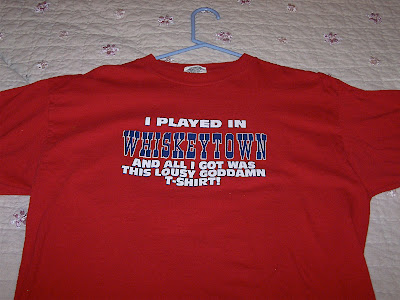
Whiskeytown's ever-evolving lineup would prompt the band to poke fun at itself by selling T-shirts at shows that read: "I Played In Whiskeytown And All I Got Was This Lousy Goddamn T-Shirt!"[32]
In September, having now been on the road since March of the previous year, the band played another scandalous show – this time at the Fillmore Auditorium in San Francisco. At the end of the show, after experiencing sound problems, a lukewarm crowd, and being told he could not smoke on stage, an upset Adams smashed his mic stand and tossed the monitors off the stage. He then got into an altercation with the venue's security, and was finally dragged away by band member Daly.[33][34]
By the final show of the tour in October 1998, the band was playing almost an entire set of brand-new, unreleased music, with barely any songs from Strangers Almanac – the very album which had launched the tour nearly two years before.[35]
It would prove to be Whiskeytown's final tour to date.
Track listing
[edit]Original release
[edit]All tracks written by Ryan Adams, except where noted.
- "Inn Town" – 5:51 (Adams, Wandscher)
- "Excuse Me While I Break My Own Heart Tonight" – 3:14
- "Yesterday's News" – 2:49 (Adams, Wandscher)
- "16 Days" – 3:54
- "Everything I Do" – 4:31 (Adams, Wandscher)
- "Houses on the Hill" – 2:38 (Adams, Cary)
- "Turn Around" – 5:16 (Adams, Cary)
- "Dancing with the Women at the Bar" – 4:38
- "Waiting to Derail" – 3:54
- "Avenues" – 2:31
- "Losering" – 4:00
- "Somebody Remembers the Rose" – 2:30 (Adams, Wandscher)
- "Not Home Anymore" – 5:54
Deluxe edition
[edit]All tracks written by Ryan Adams, except where noted.
Disc one
- "Inn Town" – 5:51
- "Excuse Me While I Break My Own Heart Tonight" – 3:14
- "Yesterday's News" – 2:49
- "16 Days" – 3:54
- "Everything I Do" – 4:31
- "Houses on the Hill" – 2:38
- "Turn Around" – 5:16
- "Dancing with the Women at the Bar" – 4:38
- "Waiting to Derail" – 3:54
- "Avenues" – 2:31
- "Losering" – 4:00
- "Somebody Remembers the Rose" – 2:30
- "Not Home Anymore" – 5:54
- "Houses on the Hill" (Live) (bonus track) – 3:42
- "Nurse with the Pills" (Live) (bonus track) – 4:40
- "I Don't Care What You Think About Me" (Live) (bonus track) – 3:18
- "Somebody Remembers the Rose" (Live) (bonus track) – 2:33
- "Turn Around" (Live) (bonus track) – 4:26
- Tracks 14–18 are previously unreleased live in the studio recordings. They were originally broadcast 9/10/97 on "Brave New World", KCRW-FM Radio, Santa Monica, CA
- Tracks 15 & 16 written by Ryan Adams
Disc two
- "Indian Gown" – 4:46 (Adams/Wandscher)
- "16 Days" (Demo) – 3:13
- "Somebody Remembers the Rose" (Demo) – 2:45 (Adams/Wandscher)
- "Avenues" (Demo) – 3:34
- "Excuse Me While I Break My Own Heart Tonight" (Demo) – 2:43
- "Houses on the Hill" (Early Version) – 2:25 (Adams/Cary)
- "My Heart Is Broken" – 3:04 (Adams/Cary)
- "I Still Miss Someone" (Demo) – 2:24 (Johnny Cash/Roy Cash Jr.)
- "Kiss and Make-Up" – 3:31
- "Barn's on Fire" – 1:43
- "Dancing with the Women at the Bar" (Early Version) – 4:28
- "Dreams" – 5:49 (Stevie Nicks)
- "Breathe" – 4:07
- "Wither, I'm a Flower" (from the Hope Floats soundtrack) – 4:53
- "Luxury Liner" – 2:40 (Gram Parsons)
- "Theme for a Trucker" (from The End of Violence soundtrack) – 4:29
- "Streets of Sirens" – 3:44
- "Turn Around" (Early Version) – 4:02 (Adams/Cary)
- "10 Seconds Till the End of the World" – 4:15 (Adams/Wandscher)
- "Ticket Time" – 3:54 (Adams/Wandscher)
- "The Rain Won't Help You When It's Over" – 4:34 (Alejandro Escovedo)
- Tracks 1, 6, 7, 10–13, 15, 17, and 19–21: the "Barn's on Fire" sessions.
- Tracks 2, 3, and 5: the "Baseball Park" sessions.
- All songs are previously unreleased, except for tracks 14 and 16.
Personnel
[edit]Musicians
[edit]- Ryan Adams – acoustic and electric guitars, vocals, banjo, piano, percussion
- Phil Wandscher – electric guitar, vocals, organ, percussion
- Caitlin Cary – violin, vocals
- Steven Terry – drums, vocals, percussion
- Jeff Rice – bass guitar
Additional musicians
[edit]- Alejandro Escovedo – vocals
- John Ginty – piano, wurlitzer electric piano, Hammond b3 organ, church keys
- Greg Leisz – pedal steel guitar, lap steel guitar, mandolin
- Curt Bisquera – percussion
- Bill Ladd – pedal steel guitar
- Rick Latina – pedal steel guitar
- Dan Navarro – trumpet
- Crecencio Gonzalez – trombone
- Jim Goodwin – alto saxophone
- Jim Scott – percussion
Production
[edit]- Produced, engineered and mixed by Jim Scott
- Recorded at Woodland studios, Nashville and Ocean Way studios, Hollywood
- Mixed at Ocean Way Studios, Hollywood
- Mastered by Stephen Marcussen at Precision Mastering, Los Angeles.
References
[edit]- ^ Deming, Mark. "Strangers Almanac – Whiskeytown". AllMusic. Retrieved October 31, 2016.
- ^ Hernandez, Raoul (May 2, 2008). "Otis Redding, Lynyrd Skynyrd, and Whiskeytown". The Austin Chronicle. Retrieved October 31, 2016.
- ^ Larkin, Colin (2009). "Whiskeytown". The Encyclopedia of Popular Music (4th ed.). Oxford University Press. ISBN 978-0-199-72636-3. Retrieved October 31, 2016.
- ^ Willman, Chris (August 1, 1997). "Stranger's Almanac". Entertainment Weekly. Retrieved October 31, 2016.
- ^ Cox, Tom (January 16, 1998). "Whiskeytown: Stranger's Almanac (Geffen)". The Guardian.
- ^ Wisdom, James P. "Whiskeytown: Stranger's Almanac". Pitchfork. Archived from the original on June 5, 2003. Retrieved October 31, 2016.
- ^ Staunton, Terry (June 2008). "Whiskeytown – Stranger's Almanac". Record Collector (350). Retrieved January 9, 2017.
- ^ Alden, Grant (August 7, 1997). "Whiskeytown: Strangers Almanac". Rolling Stone. Archived from the original on December 13, 2002. Retrieved October 31, 2016.
- ^ Howe, Sean (May 2008). "Reissues". Spin. 24 (5): 96. Retrieved December 21, 2018.
- ^ "Whiskeytown: Stranger's Almanac". Uncut: 109.
[The album] still sounds like alt-country's high tide.
- ^ "Whiskeytown's 'Almanac' Bolstered For Reissue". Billboard.com. January 30, 2008. Retrieved February 4, 2008.
- ^ a b c d e f g h Blackstock, Peter (2008). Strangers Almanac Deluxe Edition (booklet). Whiskeytown. Santa Monica, California: Geffen. pp. 6–13. B0009410-02.
- ^ a b Currin, Grayson (1997). "Whiskeytown's Ryan Adams on Strangers Almanac". Indy Week. Independent Weekly. Retrieved March 12, 2008.
- ^ a b Blackstock, Peter (1997). "Whiskeytown – Falling down, standing up: Americana and Roots Music". No Depression. Retrieved January 3, 2011.
- ^ "Ryan Adams". December 28, 2001. Archived from the original on December 28, 2001. Retrieved June 7, 2023.
- ^ Menconi, David (1997). "Whiskeytown Has Songs To Spare". Billboard. BPI Communications (published June 28, 1997). p. 10.
- ^ Currin, Grayson (March 12, 2008). "Whiskeytown's Ryan Adams on Strangers Almanac". Indy Week. Independent Weekly. Retrieved January 9, 2011.
- ^ a b "1997 Set Lists". Answeringbell.com. Retrieved July 6, 2011.
- ^ a b "1998 Set Lists". Answeringbell.com. Retrieved July 6, 2011.
- ^ Blackstock, Peter (1997). "Hello Stranger from Issue #9". No Depression. Retrieved January 9, 2011.
- ^ Deming, Mark (July 29, 1997). "Strangers Almanac – Whiskeytown". AllMusic. Retrieved July 6, 2011.
- ^ a b "Yahoo! Groups". Launch.groups.yahoo.com. Archived from the original on January 5, 2013. Retrieved July 6, 2011.
- ^ "Yahoo! Groups". Launch.groups.yahoo.com. Archived from the original on July 16, 2012. Retrieved July 6, 2011.
- ^ "08/16/97". Answeringbell.com. Retrieved July 6, 2011.
- ^ "Yahoo! Groups". Launch.groups.yahoo.com. Archived from the original on July 9, 2012. Retrieved July 6, 2011.
- ^ "10/25/97". Answeringbell.com. October 24, 1997. Retrieved July 6, 2011.
- ^ Currin, Grayson (March 12, 2008). "Whiskeytown's Caitlin Cary on Strangers Almanac". Independent Weekly. Retrieved January 9, 2011.
- ^ a b "Field Reportings from Issue #12". No Depression. 1997. Retrieved February 4, 2011.
- ^ Currin, Grayson (March 12, 2008). "Whiskeytown's Strangers Almanac Gets Double-Disc Reissue Treatment". Independent Weekly. Retrieved January 9, 2011.
- ^ Blackstock, Peter (1998). "Whiskeytown – Borderline (London, England)". No Depression. Retrieved February 4, 2011.
- ^ Ray, Linda (1999). "Chip Robinson – Sliding In and Out of Grace". No Depression. Retrieved February 4, 2011.
- ^ "Photographic image" (JPG). Lh6.ggpht.com. Retrieved June 7, 2023.
- ^ Ganahl, Jane (October 20, 1998). "Talkin' with the newest poet of rock". San Francisco Chronicle. Retrieved February 6, 2011.
- ^ duBrowa, Corey (December 1, 2001). "Ryan Adams: Saving Private Ryan". Magnet Magazine. Retrieved February 6, 2011.
- ^ "October 2, 1998". Answeringbell.com. October 2, 1998. Retrieved July 6, 2011.
| |
| Studio albums |
|
| EPs |
|
| Unreleased albums |
|
| Singles |
|
| Related articles | |


Strangers Almanac
View on GrokipediaBackground and recording
Development and songwriting
Following the release of their debut album Faithless Street on the indie label Bloodshot Records in 1995, Whiskeytown attracted major-label interest due to the buzz surrounding frontman Ryan Adams' songwriting talent and the band's energetic live performances, leading to a signing with Geffen's Outpost imprint in 1996.[8] This transition marked a significant shift from their indie roots, fueled by Adams' post-Faithless Street productivity and a standout appearance at the 1996 South by Southwest festival that sparked a bidding war among labels.[8] In 1996, amid ongoing band instability in the Chapel Hill, North Carolina music scene—including the departure of drummer Eric "Skillet" Gilmore and bassist Steve Grothmann amid the band's transition to a major label, with new members joining by early 1997—Adams composed over 36 songs, drawing from personal turmoil and then drawing selectively 13 for Strangers Almanac.[9] Amid this flux, violinist Caitlin Cary considered leaving the band and Adams explored a solo deal with A&M Records, though the lineup stabilized in time for recording. The songwriting occurred primarily during this period in Chapel Hill, where the band rehearsed and demoed material reflecting Adams' evolving style.[9] Tracks like "16 Days" originated from Adams' personal experiences rooted in his North Carolina upbringing and relationships, capturing themes of loss and introspection that defined the album's core.[10] The creative process incorporated Gram Parsons-inspired country-rock elements, evident in early demos that blended alt-country with rock influences, helping shape the album's sound before full production.[11] Lineup adjustments during this time included violinist Caitlin Cary solidifying her role in the band, adding string arrangements that enhanced the demos' emotional depth and harmonies.[10]Production process
The production of Strangers Almanac spanned late 1996 to early 1997, beginning with initial demo sessions in studios located in Chapel Hill and Durham, North Carolina, where the band refined material from their earlier work. These pre-production recordings, including the "Barn's On Fire" and "Baseball Park" sessions, captured raw takes that informed the album's selection, though much was re-recorded later. The principal tracking then moved to Woodland Studios in Nashville, Tennessee, under the guidance of producer Jim Scott, with mixing completed at Ocean Way Recording in Hollywood, California, and mastering at Precision Mastering in Los Angeles.[5][12][13] Jim Scott, a seasoned engineer known for his work in alternative country and rock, brought prior experience from projects like Wilco's Being There (1996), which helped him navigate the genre's blend of grit and accessibility. He emphasized a polished yet organic sound for Strangers Almanac, tempering the band's raw energy with refined arrangements to appeal to a major-label audience while preserving their alt-country roots. Scott's supportive approach was crucial, as he engineered, produced, and mixed the album, focusing on clarity in the instrumentation and foregrounding Ryan Adams' emotive vocals to create a cohesive, mature presentation.[14][15][16][17] Technically, the sessions highlighted contributions that added textural depth, such as Caitlin Cary's violin parts, which provided sweeping, emotive layers across tracks like "Excuse Me While I Break My Own Heart Tonight." The rhythm section, featuring new members Steve Terry on drums and percussion—hired just weeks before tracking—and Jeff Rice on bass, delivered a tight foundation that anchored the album's dynamic shifts from intimate ballads to fuller rock arrangements. Scott's mixing process prioritized Adams' vocal delivery, ensuring it cut through the mix with intimacy and power, while subtle additions like pedal steel from session musician Greg Leisz enhanced the country inflections without overwhelming the core band sound.[3][18][19] The recording environment was marked by significant challenges, including ongoing band tensions stemming from lineup instability—original drummer Skillet Gilmore and bassist Steve Grothmann had departed amid internal conflicts, necessitating the late additions of Terry and Rice. Substance abuse issues, particularly affecting Adams, contributed to a chaotic atmosphere, with depression and dissatisfaction exacerbating the pressure of their major-label debut. Despite these hurdles, the focused intensity of the Nashville sessions, guided by Scott's steady hand, resulted in a remarkably unified album born from adversity.[12][11][15][6]Music and lyrics
Musical style
Strangers Almanac is widely regarded as a cornerstone of alternative country, blending country-rock, folk, and twangy Americana elements to create a sound that bridges rural traditions with 1990s alt-rock sensibilities.[6][15][20] This album marked a significant evolution for Whiskeytown, shifting from the raw, indie-edged roughness of their debut Faithless Street to a more accessible, major-label polish that retained an underlying grit.[21][9] The genre classification emphasizes its roots in heartland rock and country ballads, incorporating diverse approaches such as traditional country structures and rock-infused grooves while avoiding strict adherence to any single style.[9][20] Instrumentation plays a central role in defining the album's sonic texture, with prominent electric guitars from Ryan Adams and Phil Wandscher providing driving riffs and melodic layers, complemented by Caitlin Cary's violin for emotive hooks and atmospheric depth.[6][15][20] The rhythm section, featuring bass and drums from new band members, delivers a steady, propulsive drive that underscores the tracks' emotional intensity, often enhanced by ensemble vocals and occasional guest contributions like Alejandro Escovedo's harmonies.[21][15] Elements such as thrumming organ and explosive guitar chords add variety, contributing to a balanced mix of subdued introspection and rock energy.[6] Produced by Jim Scott, known for his work with artists like Tom Petty and Johnny Cash, the album achieves a production style that harmonizes grit with clarity, using techniques like ghostly doubled vocals and subtle reverb to enhance the organic flow without overpolishing the raw edges.[6][9] This approach results in a cohesive sound that captures the band's live energy while allowing space for instrumental nuances, such as fiddle embellishments and messy guitar tones.[15][20] Scott's mixing strikes a perfect balance, elevating the album's major-label debut to a level of refinement that distinguishes it from contemporaries.[9] The album's style draws comparisons to Gram Parsons and The Flying Burrito Brothers for its country-rock fusion, but infuses a 1990s alt-rock edge reminiscent of Uncle Tupelo and The Replacements, with occasional nods to Bruce Springsteen and Fleetwood Mac in its soulful ballads and rock dynamics.[6][15] This blend positions Strangers Almanac as a mature entry in the alt-country canon, echoing classic influences while asserting a modern, punk-tinged vitality.[21][20]Themes and songwriting
Strangers Almanac delves into themes of heartbreak, isolation, and redemption within fractured relationships, drawing from Ryan Adams' confessional songwriting that captures raw emotional turmoil. Tracks like "16 Days" serve as a stark breakup lament, portraying the lingering pain of separation through introspective verses that evoke a sense of inescapable loss. Similarly, "Yesterday's News" critiques the ephemerality of fame and personal connections, using vivid references to local haunts like Raleigh's Comet Lounge to underscore fleeting recognition and emotional detachment. These motifs reflect Adams' ability to weave personal disconnection into broader narratives of longing and recovery, often set against backdrops of lonely roads and cheap motels.[6][15] Adams' songwriting on the album employs a confessional style rich in vivid imagery, with the title's almanac metaphor symbolizing life's unpredictable cycles of joy and sorrow, much like a yearly record of unpredictable events. This approach is enhanced by Caitlin Cary's harmonious contributions, which add layers of vulnerability, particularly in ballads that explore redemption through quiet introspection. In "Houses on the Hill," small-town ennui emerges as a recurring undercurrent, depicting stagnant rural life and unfulfilled dreams with haunting simplicity.[21][16][15] Compared to Whiskeytown's debut Faithless Street, Strangers Almanac represents a more mature evolution in Adams' craft, informed by the band's personal struggles during 1996–1997, including battles with substance abuse, depression, and internal tensions. These experiences infuse the lyrics with a desperate authenticity, shifting from the raw punk edges of earlier work to a polished yet emotionally provocative depth that prioritizes narrative introspection over chaos. Adams has described the period as one of profound disconnection, which permeates the album's storytelling and elevates its thematic resonance.[16][11][21]Release and promotion
Singles and marketing
Strangers Almanac was released on July 29, 1997, by Outpost Recordings, a subsidiary of Geffen Records, marking Whiskeytown's major-label debut and positioning the band as a potential breakthrough act in the emerging alt-country genre.[2][12] The album generated significant pre-release hype, with advance copies distributed to critics during the summer of 1997 to build anticipation within the No Depression scene, where it was touted as a pivotal release capable of elevating alternative country to mainstream prominence akin to Nirvana's impact on grunge.[15] The rollout began with the promotional single "16 Days" in July 1997, issued exclusively as a radio promo CD featuring an edit and the full LP version to target college and alternative stations. This was followed by "Yesterday's News" in February 1998, the album's second single, and received additional radio push, though commercial breakthrough remained elusive despite the label's efforts.[22][6] Promotion emphasized radio airplay on college stations and integration into the No Depression circuit, with Geffen leveraging the band's raw energy and songwriting to appeal to fans of acts like the Replacements and Wilco.[20][10] The album's artwork, featuring a stark, evocative image of the band against a rural backdrop, complemented the thematic focus on transience and loss, aligning with the title's almanac motif as a symbol of fleeting lives and seasons.[3]Commercial performance
Strangers Almanac achieved modest commercial success upon its release, reflecting the niche position of the alt-country genre in the late 1990s music landscape.[23] The album peaked at number 160 on the US Billboard 200.[2] It sold approximately 150,000 copies in the United States, falling short of major-label expectations despite initial hype as a potential genre breakthrough.[24] Its performance was bolstered primarily in indie and college markets, where promotional efforts focused on triple-A, college, and roots-music radio stations, including a four-song sampler CD for roots outlets and plans for a video supporting the lead single "16 Days."[25] The limited mainstream breakthrough can be attributed to the genre's specialized appeal amid dominant 1997 trends like electronica and lingering grunge influences, compounded by Outpost Records' uneven promotional support and internal band tensions during recording.[6] While Geffen's distribution extended to the UK and Europe, international sales remained minimal, confining the album's impact largely to U.S. audiences.[25]Strangers Almanac Tour (1997–1998)
Tour itinerary and setlists
The Strangers Almanac Tour began in March 1997 with pre-release warm-up performances, including multiple appearances at South by Southwest in Austin, Texas, on March 14 and 15.[26][27] These early shows focused on building anticipation for the album through intimate club settings in the alt-country circuit. In spring 1997, Whiskeytown co-headlined the No Depression Tour, a multi-act package sponsored by the alt-country magazine of the same name, alongside the Old 97's, Hazeldine, and The Picketts.[28] The tour emphasized grassroots venues across the U.S., with notable stops including the Great American Music Hall in San Francisco on March 26, the 7th Street Entry in Minneapolis on April 2, Schubas in Chicago on April 4, and the Hi-Pointe in St. Louis on April 5.[29][30][31][32] Following the album's release on July 29, 1997, the band launched a year-long promotion across the United States and select international dates, relying on RV travel for much of the fall 1997 through spring 1998 legs to navigate the independent music scene efficiently.[33] Key dates included the Tractor Tavern in Seattle on September 16, Berbati's Pan in Portland on September 17, the Dark Room in Dallas on September 5, and the Hurricane in Kansas City on September 25.[34][35][36][37] The itinerary was primarily U.S.-focused, with extensions to Europe in spring 1998, hitting clubs and mid-sized halls in the Midwest, West Coast, and South, with openers drawn from the alt-country roster such as the Volebeats on select dates.[9] The tour extended into 1998, incorporating higher-profile support slots, such as opening for John Fogerty on his summer amphitheater run, including the GTE Virginia Beach Amphitheater on July 9 and Blockbuster-Sony Music Entertainment Centre on July 7.[38] Additional highlights featured a taping for Austin City Limits on January 26, alongside the Old 97's, and club dates like the Inn of the Beginning in Cotati, California, on February 7.[39][40] The full promotion wrapped in October 1998 after dozens of documented performances.[41] Setlists during the tour centered on 10 to 12 songs from Strangers Almanac, often opening with "16 Days" and closing with "Excuse Me While I Break My Own Heart Tonight" to showcase the album's emotional core.[42] Representative examples included the March 26 San Francisco show, featuring "Drank Like a River," "Ticket Time," "Midway Park," "Yesterday's News," and "My Heart Is the Bummer."[29] The April 5 St. Louis performance highlighted "Kiss & Make-Up," "What You Wanted," "Highway 145," and "Too Drunk to Dream" alongside album tracks.[32] By fall 1997, staples like "Everything I Do," "Not Home Anymore," and "Houses on the Hill" dominated, with variations incorporating earlier material such as "Waiting to Derail" from Faithless Street.[35] In 1998, setlists evolved to emphasize post-album cohesion, averaging similar lengths but with increased emphasis on "Inn Town," "Avenues," and "Dancing with the Women at the Bar." The January 26 Austin City Limits taping included "Excuse Me While I Break My Own Heart Tonight," "16 Days," "Inn Town," "Yesterday's News," and "Houses on the Hill."[39] The February 7 Cotati set featured "Not Home Anymore," "Midway Park," "Somebody Remembers the Rose," and "Today," reflecting a balanced mix of new and established songs without extensive covers.[40] Overall, performances maintained a raw, 45- to 60-minute format suited to club and festival environments.[43]| Date | Venue | City | Notable Setlist Highlights |
|---|---|---|---|
| March 26, 1997 | Great American Music Hall | San Francisco, CA | Drank Like a River, 16 Days, Midway Park, Yesterday's News[29] |
| April 5, 1997 | Hi-Pointe | St. Louis, MO | 16 Days, Excuse Me While I Break My Own Heart Tonight, Too Drunk to Dream[32] |
| September 17, 1997 | Berbati's Pan | Portland, OR | 16 Days, Highway 145, Yesterday's News, Everything I Do[35] |
| September 25, 1997 | Hurricane | Kansas City, KS | Core album tracks including 16 Days and Houses on the Hill (partial records)[37] |
| January 26, 1998 | Austin City Limits (taped) | Austin, TX | Excuse Me While I Break My Own Heart Tonight, Inn Town, Not Home Anymore[39] |
| July 9, 1998 | GTE Virginia Beach Amphitheater (opening John Fogerty) | Virginia Beach, VA | 16 Days, Yesterday's News, Dancing with the Women at the Bar[38] |
Notable events and band dynamics
During the Strangers Almanac tour, internal tensions within Whiskeytown reached a breaking point on September 25, 1997, at a show in Kansas City, Kansas, where frontman Ryan Adams and guitarist Phil Wandscher's longstanding animosity erupted onstage.[37][44] Adams stormed off mid-performance after a heated exchange, effectively marking the end of the band's original lineup as Wandscher refused to continue and departed shortly thereafter; the band then recruited new members, including guitarist Brad Rice, to complete the tour with Adams and violinist Caitlin Cary.[37][11] These conflicts were exacerbated by Adams' ongoing substance abuse, including heavy alcohol consumption and drug use, which contributed to erratic behavior and amplified the group's volatility during the 1997-1998 period.[45][46] The band's dynamics were further strained by the volatile relationship between Adams and Wandscher, characterized by mutual resentment that occasionally escalated to physical confrontations, with Cary often caught in the middle as she attempted to maintain harmony.[47][10] By late 1998, the group's cohesion had partially splintered, with Adams increasingly focusing on solo material amid the tour's exhaustion.[12] One of the final Whiskeytown performances occurred on October 1, 1998, at The Brewery in Raleigh, North Carolina, serving as a de facto dissolution gig that reflected the tour's role in extending the album's live energy despite the underlying discord.[48] The tour's interpersonal strife ultimately hastened Whiskeytown's breakup in 1999-2000, paving the way for Adams to pivot to a successful solo career while the remaining members pursued separate paths.[49][21]Critical reception
Contemporary reviews
Upon its release in July 1997, Strangers Almanac received positive attention from critics within the alternative country scene, positioning Whiskeytown as a key player in the burgeoning No Depression movement, though broader reviews were mixed. The album was praised for its emotional depth and polished production, which marked a maturation from the band's rawer debut Faithless Street. Reviewers highlighted Ryan Adams' songwriting as a standout, blending country, rock, and folk influences into cohesive narratives of loss and heartbreak. Rolling Stone awarded it 3 out of 5 stars, praising the 22-year-old Adams's songwriting potential amid hype but noting the band's tentative execution.[50] In a mid-1997 preview in No Depression, the album was celebrated for its thematic focus on loss, with standout tracks like the acoustic opener "Inn Town" noted for its heartbreaking harmonies and the duet "Excuse Me While I Break My Own Heart Tonight" with Alejandro Escovedo praised for its country flair. The piece described the record as a breakthrough, capturing 13 songs from an expansive 36-track recording session in Nashville, and emphasized its potential to broaden the band's appeal beyond underground circles.[10] A September 1997 feature in Country Standard Time lauded the album's dynamic songcraft, observing that the tracks "yearn and cut and soar and stumble," blending influences from The Replacements and Merle Haggard into a sound that was "part country, part rock, part folk and part something else entirely." The review underscored Whiskeytown's growing notice amid the alt-country wave, crediting Adams' earnest delivery and the contributions of bandmates Phil Wandscher, Caitlin Cary, and others for elevating the material.[51] The Austin Chronicle echoed this enthusiasm in its September 1997 review, calling Strangers Almanac a "slick album" that ironically suited the band's unpredictable live energy, produced by Jim Scott to showcase diverse styles from country ballads to psychedelic rock. It commended the record's cohesion and Adams' vision, viewing it as a pivotal major-label debut that refined the group's earlier chaos into something more accessible and visionary.[9] Critics also noted the album's unevenness in places due to its major-label sheen, with some observing that the polish occasionally tempered the raw edge fans expected from Whiskeytown's live shows, though this was often framed as a strength rather than a flaw. In Trouser Press, the album was hailed as the band's "finest hour," appreciating how it expanded Adams' muse with soul and '70s rock elements while maintaining emotional resonance in ballads like "Houses on the Hill." Overall, contemporary responses solidified Strangers Almanac as Whiskeytown's defining statement in the late-1990s alt-country landscape.[21]Retrospective assessments
In the years following its release, Strangers Almanac received renewed critical attention, particularly with the 2008 deluxe edition reissue, which prompted reevaluations of its place in alt-country. Pitchfork awarded the reissue a score of 6.3 out of 10, portraying the album as a relic of late-1990s alt-country that, while sturdy, feels rarely engrossing and lacks innovation when viewed from a contemporary perspective.[6] In contrast, No Depression praised it as a "masterpiece of mood and pacing," emphasizing that the music still sounds phenomenal over a decade later and that none of the band's members have surpassed it in their subsequent work.[15] The album's critic aggregate score stands at 75 out of 100 on Album of the Year, drawn from six reviews.[50] Retrospective praise often highlights the album's role as a launchpad for Ryan Adams' songwriting prowess, with its raw emotional depth and blend of country and rock elements establishing him as a key figure in alternative country. A 2015 anniversary retrospective noted that Strangers Almanac has left a lasting imprint on the alt-country genre since its debut.[12] Critics have revisited potential shortcomings, with some observing that the production now sounds dated compared to Adams' later solo output, though the lyrics' heartfelt exploration of heartbreak and introspection continues to resonate strongly.[6] Marking its 25th anniversary in 2022, outlets like MAGNET and Glide recalled the album's significance, underscoring its foundational status in Adams' career and alt-country's evolution without introducing major new critiques.[52][53] As of November 2025, no substantial new reviews have surfaced, but the album endures as a cornerstone in assessments of Adams' discography and the alt-country movement.Track listing
Original release
The original release of Strangers Almanac, issued on July 29, 1997, by Outpost Recordings on both CD and vinyl formats, features 13 tracks sequenced to blend introspective ballads with uptempo alt-country numbers, totaling 51:40 in length.[2] The songs were primarily written by Ryan Adams, with co-writing contributions from band members Phil Wandscher and Caitlin Cary on several tracks.[54][4]| No. | Title | Duration | Writer(s) |
|---|---|---|---|
| 1 | Inn Town | 5:51 | Ryan Adams, Phil Wandscher[4] |
| 2 | Excuse Me While I Break My Own Heart Tonight | 3:14 | Ryan Adams[4] |
| 3 | Yesterday's News | 2:49 | Ryan Adams, Phil Wandscher |
| 4 | 16 Days | 3:54 | Ryan Adams[4] |
| 5 | Everything I Do | 4:31 | Ryan Adams, Phil Wandscher[54] |
| 6 | Houses on the Hill | 2:38 | Ryan Adams, Caitlin Cary[4][11] |
| 7 | Turn Around | 5:16 | Ryan Adams, Caitlin Cary[4] |
| 8 | Dancing with the Women at the Bar | 4:38 | Ryan Adams[55] |
| 9 | Waiting to Derail | 3:54 | Ryan Adams[55] |
| 10 | Avenues | 2:31 | Ryan Adams[55] |
| 11 | Losering | 4:00 | Ryan Adams[55] |
| 12 | Somebody Remembers the Rose | 2:30 | Ryan Adams[55] |
| 13 | Not Home Anymore | 5:54 | Ryan Adams[55] |