



Community hub
Recent from talks
Knowledge base stats:
Talk channels stats:
Members stats:
Strike zone
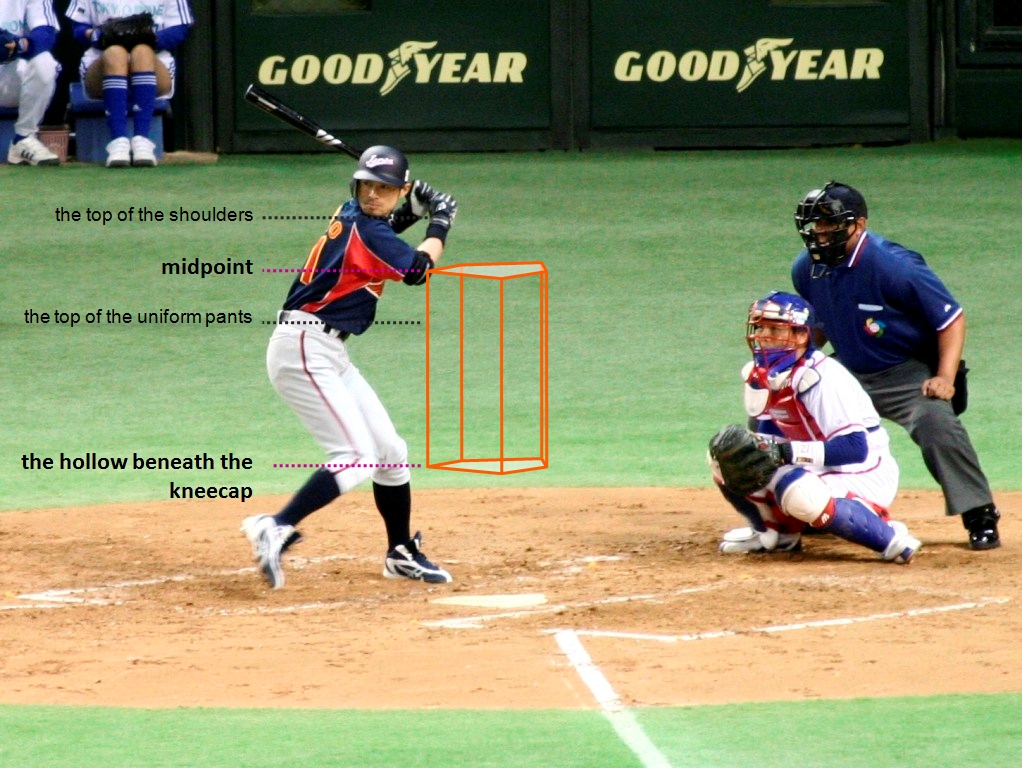
In baseball, the strike zone is the area of space through which a pitch must pass in order to be called a strike even if the batter does not swing. The strike zone is defined as the volume of space above home plate and between the batter's knees and the midpoint of his torso. Whether a pitch passes through the zone is decided by an umpire, who is generally positioned behind the catcher.
Strikes are desirable for the pitcher and the fielding team, as three strikes result in a strikeout of that batter. A pitch that misses the strike zone is called a ball if the batter does not swing at it. Balls are desirable for the batter and the batting team, as four balls allow the batter to take a "walk" to first base as a base on balls.
The strike zone is a volume of space, a vertical right pentagonal prism. Its sides are vertical planes extending up from the edges of home plate. The official rules of Major League Baseball define the top of the strike zone as the midpoint between the top of the batter's shoulders and the top of his uniform pants, and the bottom of the strike zone is at the hollow beneath the kneecap, both determined from the batter's stance as he is prepared to swing at the pitched ball, although the de facto enforced strike zone can vary based on the umpire's perspective. The official rules define a pitch as a strike "if any part of the ball passes through any part of the strike zone", with the ball required to have not bounced. Thus, a pitch that touches the outer boundary of the zone is as much a strike as a pitch that is thrown right down the center. A pitch passing outside the front of the strike zone but curving so as to enter this volume farther back (without being hit) is sometimes called a "back-door strike". Various other rulebooks for baseball and softball define the strike zone slightly differently.
A pitch is also a strike if the batter swings or offers the bat in an attempt to hit the pitch. A pitch batted into foul territory—a foul ball—is also a strike, unless the batter already has two strikes. Any pitch not called a strike, swung on and missed, or fouled-off, is a "ball" (originally "no ball").
A batter who accumulates three strikes in a single batting appearance has struck out and is ruled out (with the exception of an uncaught third strike); a batter who accumulates four balls in a single appearance has drawn a base on balls (or walk) and is awarded advancement to first base. In very early iterations of the rules during the 19th century, it took up to nine balls for a batter to earn a walk. However, to make up for this, he could request the ball to be pitched high, low, or medium.
Originally, the word "strike" was used literally: the batter striking at the ball in an effort to hit it. For example, the 11th rule of the Knickerbocker Rules (1845) read "Three balls being struck at and missed and the last one caught, is a hand-out." There was no adverse consequence if the batter did not swing, i.e. the called strike did not exist, the result being batters prepared to wait all day for "their" pitch. It was not until the 1858 NABBP convention that a rule was adopted authorizing the umpire to impose a penalty strike for such conduct: "Should a striker stand at the bat without striking at good balls repeatedly pitched to him, for the purpose of delaying the game or of giving advantage to a player, the umpire, after warning him, shall call one strike, and if he persists in such action, two and three strikes. When three strikes are called, he shall be subject to the same rules as if he had struck at three balls." The called ball first appeared in the rules of 1863, similarly as a discretionary penalty imposed on the pitcher for persistently delivering "unfair" balls.
Whether or not a pitch was "unfair" or the batter was being unreasonably picky was left entirely to the umpire's judgment. Well into the 1870s, umpires were reluctant to make such calls, since they were viewed as penalties for unsportsmanlike play. By the 1880s, they had become routine, and the modern view took hold, that every pitch results in either a swing, a ball or a called strike. The first rule leading to the creation of a defined strike zone was enacted by the American Association before the 1886 season. As explained in The Sporting Life on March 17, 1886, "the ball must be delivered at the height called for by the batsman. If at such height it passes over any part of the plate then it is a strike. The idea is to give the pitcher a chance against some cranky umpires who compelled the twirlers to almost cut the plate in two before a strike would be called, even if the height was right." The following year, the National League created the full strike zone, eliminating the batter's right to call the height of the pitch, and instead requiring the umpire to call a strike on any pitch that "passes over home plate not lower than the batsman's knee, nor higher than his shoulders."
Major League Baseball has occasionally redefined the strike zone to control the balance of power between pitchers and hitters. After the record home run year by Roger Maris in 1961, the major leagues increased the size of the strike zone by raising the top of the zone from the batter's armpit to the top of his shoulder. In 1968, pitchers such as Denny McLain and Bob Gibson dominated hitters, producing 339 shutouts. Carl Yastrzemski was the only American League hitter to finish the season with a batting average higher than .300. In the National League, Gibson posted a 1.12 earned run average, the lowest in 54 years, while Los Angeles Dodgers pitcher Don Drysdale threw a record 58+2⁄3 consecutive scoreless innings during the 1968 season. As a result of the dropping offensive statistics, Major League Baseball reduced pitchers' advantage by lowering the height of the mound from 15 inches (380 mm) to 10 inches (250 mm), and by reducing the size of the strike zone for the 1969 season to extend only from the batter's armpits to the top of the knees. In 1985, the top of the strike zone was lowered to the midpoint of the batter's torso, as viewed from a vertical angle by the umpire.
Hub AI
Strike zone AI simulator
(@Strike zone_simulator)
Strike zone
In baseball, the strike zone is the area of space through which a pitch must pass in order to be called a strike even if the batter does not swing. The strike zone is defined as the volume of space above home plate and between the batter's knees and the midpoint of his torso. Whether a pitch passes through the zone is decided by an umpire, who is generally positioned behind the catcher.
Strikes are desirable for the pitcher and the fielding team, as three strikes result in a strikeout of that batter. A pitch that misses the strike zone is called a ball if the batter does not swing at it. Balls are desirable for the batter and the batting team, as four balls allow the batter to take a "walk" to first base as a base on balls.
The strike zone is a volume of space, a vertical right pentagonal prism. Its sides are vertical planes extending up from the edges of home plate. The official rules of Major League Baseball define the top of the strike zone as the midpoint between the top of the batter's shoulders and the top of his uniform pants, and the bottom of the strike zone is at the hollow beneath the kneecap, both determined from the batter's stance as he is prepared to swing at the pitched ball, although the de facto enforced strike zone can vary based on the umpire's perspective. The official rules define a pitch as a strike "if any part of the ball passes through any part of the strike zone", with the ball required to have not bounced. Thus, a pitch that touches the outer boundary of the zone is as much a strike as a pitch that is thrown right down the center. A pitch passing outside the front of the strike zone but curving so as to enter this volume farther back (without being hit) is sometimes called a "back-door strike". Various other rulebooks for baseball and softball define the strike zone slightly differently.
A pitch is also a strike if the batter swings or offers the bat in an attempt to hit the pitch. A pitch batted into foul territory—a foul ball—is also a strike, unless the batter already has two strikes. Any pitch not called a strike, swung on and missed, or fouled-off, is a "ball" (originally "no ball").
A batter who accumulates three strikes in a single batting appearance has struck out and is ruled out (with the exception of an uncaught third strike); a batter who accumulates four balls in a single appearance has drawn a base on balls (or walk) and is awarded advancement to first base. In very early iterations of the rules during the 19th century, it took up to nine balls for a batter to earn a walk. However, to make up for this, he could request the ball to be pitched high, low, or medium.
Originally, the word "strike" was used literally: the batter striking at the ball in an effort to hit it. For example, the 11th rule of the Knickerbocker Rules (1845) read "Three balls being struck at and missed and the last one caught, is a hand-out." There was no adverse consequence if the batter did not swing, i.e. the called strike did not exist, the result being batters prepared to wait all day for "their" pitch. It was not until the 1858 NABBP convention that a rule was adopted authorizing the umpire to impose a penalty strike for such conduct: "Should a striker stand at the bat without striking at good balls repeatedly pitched to him, for the purpose of delaying the game or of giving advantage to a player, the umpire, after warning him, shall call one strike, and if he persists in such action, two and three strikes. When three strikes are called, he shall be subject to the same rules as if he had struck at three balls." The called ball first appeared in the rules of 1863, similarly as a discretionary penalty imposed on the pitcher for persistently delivering "unfair" balls.
Whether or not a pitch was "unfair" or the batter was being unreasonably picky was left entirely to the umpire's judgment. Well into the 1870s, umpires were reluctant to make such calls, since they were viewed as penalties for unsportsmanlike play. By the 1880s, they had become routine, and the modern view took hold, that every pitch results in either a swing, a ball or a called strike. The first rule leading to the creation of a defined strike zone was enacted by the American Association before the 1886 season. As explained in The Sporting Life on March 17, 1886, "the ball must be delivered at the height called for by the batsman. If at such height it passes over any part of the plate then it is a strike. The idea is to give the pitcher a chance against some cranky umpires who compelled the twirlers to almost cut the plate in two before a strike would be called, even if the height was right." The following year, the National League created the full strike zone, eliminating the batter's right to call the height of the pitch, and instead requiring the umpire to call a strike on any pitch that "passes over home plate not lower than the batsman's knee, nor higher than his shoulders."
Major League Baseball has occasionally redefined the strike zone to control the balance of power between pitchers and hitters. After the record home run year by Roger Maris in 1961, the major leagues increased the size of the strike zone by raising the top of the zone from the batter's armpit to the top of his shoulder. In 1968, pitchers such as Denny McLain and Bob Gibson dominated hitters, producing 339 shutouts. Carl Yastrzemski was the only American League hitter to finish the season with a batting average higher than .300. In the National League, Gibson posted a 1.12 earned run average, the lowest in 54 years, while Los Angeles Dodgers pitcher Don Drysdale threw a record 58+2⁄3 consecutive scoreless innings during the 1968 season. As a result of the dropping offensive statistics, Major League Baseball reduced pitchers' advantage by lowering the height of the mound from 15 inches (380 mm) to 10 inches (250 mm), and by reducing the size of the strike zone for the 1969 season to extend only from the batter's armpits to the top of the knees. In 1985, the top of the strike zone was lowered to the midpoint of the batter's torso, as viewed from a vertical angle by the umpire.