Strouhal number
Strouhal number
Main page
2308677

Strouhal number

logo
Community Hub0 subscribers
Read side by side
from Wikipedia

In dimensional analysis, the Strouhal number (St, or sometimes Sr to avoid the conflict with the Stanton number) is a dimensionless number describing oscillating flow mechanisms. The parameter is named after Vincenc Strouhal, a Czech physicist who experimented in 1878 with wires experiencing vortex shedding and singing in the wind.[1][2] The Strouhal number is an integral part of the fundamentals of fluid mechanics.

The Strouhal number is often given as

where f is the frequency of vortex shedding in Hertz,[3] L is the characteristic length (for example, hydraulic diameter or the airfoil thickness) and U is the flow velocity. In certain cases, like heaving (plunging) flight, this characteristic length is the amplitude of oscillation. This selection of characteristic length can be used to present a distinction between Strouhal number and reduced frequency:

where k is the reduced frequency, and A is amplitude of the heaving oscillation.

Plot showing the variation of Strouhal number with Reynolds number for a circular cylinder in crossflow for Reynolds numbers from 50 to 10 million based on aggregated experimental data
Strouhal number variation with Reynolds number for a cylinder in cross-flow for Reynolds numbers based on aggregated experimental data[4]

For large Strouhal numbers (order of 1), viscosity dominates fluid flow, resulting in a collective oscillating movement of the fluid "plug". For low Strouhal numbers (order of 10−4 and below), the high-speed, quasi-steady-state portion of the movement dominates the oscillation. Oscillation at intermediate Strouhal numbers is characterized by the buildup and rapidly subsequent shedding of vortices.[5]

For spheres in uniform flow in the Reynolds number range of 8×10² < Re < 2×10⁵ there co-exist two values of the Strouhal number. The lower frequency is attributed to the large-scale instability of the wake, is independent of the Reynolds number Re and is approximately equal to 0.2. The higher-frequency Strouhal number is caused by small-scale instabilities from the separation of the shear layer.[6][7]

Derivation

[edit]

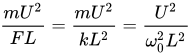
Knowing Newton's second law stating force is equivalent to mass times acceleration, or , and that acceleration is the derivative of velocity, or (characteristic speed/time) in the case of fluid mechanics, we see

,

Since characteristic speed can be represented as length per unit time, , we get

,

where,

m = mass,
U = characteristic speed,
L = characteristic length.

Dividing both sides by , we get

,

where,

m = mass,
U = characteristic speed,
F = net external forces,
L = characteristic length.

This provides a dimensionless basis for a relationship between mass, characteristic speed, net external forces, and length (size) which can be used to analyze the effects of fluid mechanics on a body with mass.

If the net external forces are predominantly elastic, we can use Hooke's law to see

,

where,

k = spring constant (stiffness of elastic element),
ΔL = deformation (change in length).

Assuming , then . With the natural resonant frequency of the elastic system, , being equal to , we get

,

where,

m = mass,
U = characteristic speed,
= natural resonant frequency,
ΔL = deformation (change in length).

Given that cyclic motion frequency can be represented by we get,

,

where,

f = frequency,
L = characteristic length,
U = characteristic speed.

Applications

[edit]

Micro/Nanorobotics

[edit]

In the field of micro and nanorobotics, the Strouhal number is used alongside the Reynolds number in analyzing the impact of an external oscillatory fluidic flow on the body of a microrobot. When considering a microrobot with cyclic motion, the Strouhal number can be evaluated as

,

where,

f = cyclic motion frequency,
L = characteristic length of robot,
U = characteristic speed.

The analysis of a microrobot using the Strouhal number allows one to assess the impact that the motion of the fluid it is in has on its motion in relation to the inertial forces acting on the robot–regardless of the dominant forces being elastic or not.[8]

Medical

[edit]

In the medical field, microrobots that use swimming motions to move may make micromanipulations in unreachable environments.

The equation used for a blood vessel:[9]

,

where,

f = oscillation frequency of the microbot swimming motion
D = blood vessel diameter
V = unsteady viscoelastic flow

The Strouhal number is used as a ratio of the Deborah number (De) and Weissenberg number (Wi):[9]

.

The Strouhal number may also be used to obtain the Womersley number (Wo). The case for blood flow can be categorized as an unsteady viscoelastic flow, therefore the Womersley number is[9]

,

Or considering both equations,

.

Metrology

[edit]

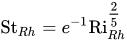
In metrology, specifically axial-flow turbine meters, the Strouhal number is used in combination with the Roshko number to give a correlation between flow rate and frequency. The advantage of this method over the frequency/viscosity versus K-factor method is that it takes into account temperature effects on the meter.

where,

f = meter frequency,
U = flow rate,
C = linear coefficient of expansion for the meter housing material.

This relationship leaves Strouhal dimensionless, although a dimensionless approximation is often used for C3, resulting in units of pulses/volume (same as K-factor).

This relationship between flow and frequency can also be found in the aeronautical field. Considering pulsating methane-air coflow jet diffusion flames, we get

,

where,

a = fuel jet radius
w = the modulation frequency
U = exit velocity of the fuel jet

For a small Strouhal number (St=0.1) the modulation forms a deviation in the flow that travels very far downstream. As the Strouhal number grows, the non-dimensional frequency approaches the natural frequency of a flickering flame, and eventually will have greater pulsation than the flame.[10]

Animal locomotion

[edit]

In swimming or flying animals, Strouhal number is defined as

where,

f = oscillation frequency (tail-beat, wing-flapping, etc.),
U = flow rate,
A = peak-to-peak oscillation amplitude.

In animal flight or swimming, propulsive efficiency is high over a narrow range of Strouhal constants, generally peaking in the 0.2 < St < 0.4 range.[11] This range is used in the swimming of dolphins, sharks, and bony fish, and in the cruising flight of birds, bats and insects.[11] However, in other forms of flight other values are found.[11] Intuitively the ratio measures the steepness of the strokes, viewed from the side (e.g., assuming movement through a stationary fluid) – f is the stroke frequency, A is the amplitude, so the numerator fA is half the vertical speed of the wing tip, while the denominator V is the horizontal speed. Thus the graph of the wing tip forms an approximate sinusoid with aspect (maximal slope) twice the Strouhal constant.[12]

Efficient motion

[edit]

The Strouhal number is most commonly used for assessing oscillating flow as a result of an object's motion through a fluid. The Strouhal number reflects the difficulty for animals to travel efficiently through a fluid with their cyclic propelling motions. The number relates to propulsive efficiency, which peaks between 70%–80% when within the optimal Strouhal number range of 0.2 to 0.4. Through the use of factors such as the stroke frequency, the amplitude of each stroke, and velocity, the Strouhal number is able to analyze the efficiency and impact of an animal's propulsive forces through a fluid, such as those from swimming or flying. For instance, the value represents the constraints to achieve greater propulsive efficiency, which affects motion when cruising and aerodynamic forces when hovering.[13]

Greater reactive forces and properties that act against the object, such as viscosity and density, reduce the ability of an animal's motion to fall within the ideal Strouhal number range when swimming. Through the assessment of different species that fly or swim, it was found that the motion of many species of birds and fish falls within the optimal Strouhal range.[13] However, the Strouhal number varies more within the same species than other species based on the method of how they move in a constrained manner in response to aerodynamic forces.[13]

Example: Alcid
[edit]

The Strouhal number has significant importance in analyzing the flight of animals since it is based on the streamlines and the animal's velocity as it travels through the fluid. Its significance is demonstrated through the motion of alcids as it passes through different mediums (air to water). The assessment of alcids determined the peculiarity of being able to fly under the efficient Strouhal number range in air and water despite a high mass relative to their wing area.[14] The alcid's efficient dual-medium motion developed through natural selection where the environment played a role in the evolution of animals over time to fall under a certain efficient range. The dual-medium motion demonstrates how alcids had two different flight patterns based on the stroke velocities as it moved through each fluid.[14] However, as the bird travels through a different medium, it has to face the influence of the fluid's density and viscosity. Furthermore, the alcid also has to resist the upward-acting buoyancy as it moves horizontally.

Scaling of the Strouhal number

[edit]

Scale Analysis

[edit]

In order to determine significance of the Strouhal number at varying scales, one may perform scale analysis–a simplification method to analyze the impact of factors as they change with respect to some scale. When considered in the context of microrobotics and nanorobotics, size is the factor of interest when performing scale analysis.

Scale analysis of the Strouhal number allows for analysis of the relationship between mass and inertial forces as both change with respect to size. Taking its original underived form, , we can then relate each term to size and see how the ratio changes as size changes.

Given where m is mass, V is volume, and is density, we can see mass is directly related to size as volume scales with length (L). Taking the volume to be , we can directly relate mass and size as

.

Characteristic speed (U) is in terms of , and relative distance scales with size, therefore

.

The net external forces (F) scales in relation to mass and acceleration, given by . Acceleration is in terms of , therefore . The mass-size relationship was established to be , so considering all three relationships, we get

.

Length (L) already denotes size and remains L.

Taking all of this together, we get

.

With the Strouhal number relating the mass to inertial forces, this can be expected as these two factors will scale proportionately with size and neither will increase nor decrease in significance with respect to their contribution to the body's behavior in the cyclic motion of the fluid.

Relationship with the Richardson number

[edit]

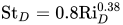
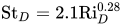
The scaling relationship between the Richardson number and the Strouhal number is represented by the equation:[15]

,

where a and b are constants depending on the condition.

For round helium buoyant jets and plumes:[15]

.

When ,

.

When ,

.

For planar buoyant jets and plumes:[15]

.

For shape-independent scaling:[15]

Relationship with Reynolds number

[edit]

The Strouhal number and Reynolds number must be considered when addressing the ideal method to develop a body made to move through a fluid. Furthermore, the relationship for these values is expressed through Lighthill's elongated-body theory, which relates the reactive forces experienced by a body moving through a fluid with its inertial forces.[16] The Strouhal number was determined to depend upon the dimensionless Lighthill number, which in turn relates to the Reynolds number. The value of the Strouhal number can then be seen to decrease with an increasing Reynolds number, and to increase with an increasing Lighthill number.[16]

See also

[edit]

References

[edit]
[edit]
Revisions and contributorsEdit on WikipediaRead on Wikipedia
from Grokipedia
The Strouhal number is a dimensionless quantity in fluid dynamics that characterizes the oscillatory behavior of fluid flows around bluff bodies, particularly the relationship between the frequency of vortex shedding, a characteristic length scale of the body, and the freestream velocity. It is defined by the formula $ St = \frac{f L}{U} $, where $ f $ is the shedding frequency in hertz, $ L $ is the characteristic length (such as the diameter of a cylinder), and $ U $ is the freestream velocity.[1][2] This parameter provides a normalized measure of how inertial forces due to unsteadiness compete with convective transport in the flow.[1] Named after the Czech physicist and acoustician Vincenc Strouhal (1850–1922), the number originates from his 1878 experiments on the aeolian tones—singing sounds—produced by taut wires vibrating in wind, where he observed that the oscillation frequency was directly proportional to the wind speed and inversely proportional to the wire diameter.[3] Strouhal's work quantified this proportionality in dimensionless form, establishing the foundation for analyzing periodic instabilities in fluid-structure interactions, though the modern interpretation in terms of vortex shedding was later refined by researchers like Theodore von Kármán in the early 20th century.[4] The parameter has since become a cornerstone in unsteady aerodynamics and hydrodynamics.[1] In applications, the Strouhal number is essential for predicting vortex-induced vibrations (VIV) in structures like bridge cables, offshore risers, and heat exchanger tubes, where values around 0.2 for circular cylinders indicate the onset of periodic shedding across a broad range of Reynolds numbers.[5] It also plays a key role in biofluid mechanics, such as the flapping propulsion of fish, birds, and insects, where efficient locomotion correlates with Strouhal numbers between 0.2 and 0.4, optimizing thrust and minimizing drag.[6] Additionally, it informs acoustic phenomena, like noise generation from flow over obstacles, and engineering designs to mitigate fatigue in vibrating systems.[1]

Fundamentals

Historical Background

The Strouhal number is named after the Czech physicist Vincenc Strouhal, who conducted pioneering experiments in 1878 investigating the production of tones by taut wires exposed to airflow, a phenomenon akin to the sounds produced by aeolian harps. In his seminal paper "Über eine besondere Art der Tonerregung," Strouhal demonstrated that the frequency of these oscillating air columns and resulting vibrations was proportional to the wind speed divided by the wire diameter, establishing an empirical relationship that quantified vortex-induced vibrations without reliance on the wire's tension or length.[7] Strouhal's findings were promptly confirmed and extended theoretically by Lord Rayleigh in 1879, who replicated the observations using wires in a chimney draft and emphasized the aerodynamic origins of the tones, attributing them to periodic aerodynamic forces rather than frictional effects alone. Rayleigh's analysis in "Æolian Tones" further noted the dependence of the frequency ratio on flow parameters, laying groundwork for understanding the underlying instability mechanisms. Initially rooted in 19th-century acoustics, the parameter evolved into a cornerstone of 20th-century fluid mechanics as researchers recognized its role in describing periodic vortex shedding behind bluff bodies, influencing studies on oscillatory flows and instabilities in engineering contexts. This transition was marked by applications in aeroacoustics and aerodynamics, where the dimensionless group facilitated scaling analyses across regimes.[8]

Definition and Formula

The Strouhal number, denoted $ St $, is a dimensionless quantity in fluid dynamics that characterizes the oscillatory behavior of fluid flows relative to convective transport.[1] Its standard formula is given by
St=fLU, St = \frac{f L}{U},
where $ f $ represents the oscillation frequency in hertz, $ L $ is the characteristic length scale of the object (such as its diameter or width), and $ U $ is the freestream velocity.[1][9] An alternative form commonly used for vortex shedding from cylindrical objects substitutes the diameter $ D $ for the characteristic length, yielding $ St = \frac{f D}{U} $.[10][11] The dimensionless character of $ St $ emerges from the Buckingham π theorem applied to the governing parameters of unsteady flows, which combines frequency, length, and velocity scales into a single nondimensional group to describe flow similarity. Typical ranges for $ St $ depend on the flow context: values around 0.2 often indicate periodic vortex shedding for bluff bodies like cylinders.[12]

Physical Interpretation

The Strouhal number serves as a dimensionless parameter that quantifies the ratio of inertial forces arising from local acceleration (due to the unsteadiness or oscillatory nature of the flow) to those stemming from convective acceleration (due to the transport of momentum by the mean flow velocity).[13] This interpretation highlights its fundamental role in unsteady fluid dynamics, where it captures how temporal variations in velocity compete with spatial advection effects across a characteristic length scale.[14] In oscillating flows, a Strouhal number close to unity implies balanced contributions from both mechanisms, while deviations reveal the dominance of one over the other. A prominent application of this physical meaning is in characterizing the frequency of vortex shedding behind bluff bodies, such as cylinders, where the Strouhal number governs the formation of periodic vortex patterns like the Kármán vortex street. For Reynolds numbers greater than 300 in the subcritical regime, the Strouhal number typically approximates 0.2, indicating a stable shedding frequency that scales with the flow velocity and body size.[15] This value underscores the number's utility in predicting oscillatory instabilities without requiring detailed temporal resolution of the flow field. In broader unsteady flows, the Strouhal number provides insight into the regime of oscillation relative to the convective timescale: high values signify rapid temporal changes that outpace the flow's advection, leading to pronounced unsteadiness and potential for chaotic or turbulent-like behavior.[13] Conversely, low values suggest that convective effects prevail, allowing the flow to approximate quasi-steady conditions despite underlying oscillations. The Strouhal number also connects to the stability of wakes and the initiation of shear layer instabilities, where specific values align with the growth rates of perturbations, such as Kelvin-Helmholtz modes, determining the transition from laminar to vortex-dominated structures.[16]

Derivation

From First Principles

The momentum equation governing the motion of a fluid particle arises directly from Newton's second law, $ F = ma $, applied to a small element of fluid, where the net force includes pressure gradients, viscous stresses, and body forces, balanced against the inertial acceleration.[17] In oscillatory flows, this balance incorporates a restoring force that drives periodic motion, often modeled analogously to elastic forces via Hooke's law, $ F = -kx $, where $ k $ is the effective stiffness and $ x $ is the displacement from equilibrium.[18] For a fluid particle undergoing simple harmonic oscillation under this restoring force, the equation of motion becomes $ m \frac{d^2 x}{dt^2} + kx = 0 $, yielding a natural angular frequency $ \omega = \sqrt{k/m} $ and oscillation frequency $ f \approx \sqrt{k/m} / (2\pi) $. This frequency characterizes the intrinsic time scale $ T = 1/f $ of the oscillatory response, linking the inertial mass $ m $ to the elastic restoring mechanism. To nondimensionalize the governing equations for flow with characteristic velocity $ U $, length $ L $, and frequency $ f $, consider the local acceleration term $ \partial u / \partial t \sim f U $ and the convective acceleration term $ U \partial u / \partial x \sim U^2 / L $ from the momentum balance.[19] The ratio of these terms forms the Strouhal number $ St = f L / U $, which quantifies the relative importance of unsteady inertial effects to convective transport.[17] This derivation assumes an inviscid flow initially, neglecting viscous terms in the momentum equation to focus on the core inertial-unsteady balance; extensions to viscous cases incorporate the Reynolds number while retaining the Strouhal form for oscillatory regimes.[19]

Relation to Oscillatory Flows

In the phenomenon of vortex shedding behind bluff bodies, such as circular cylinders, the frequency $ f $ of the shed vortices scales linearly with the free-stream velocity $ U $ and inversely with the characteristic length $ L $ (e.g., cylinder diameter), yielding $ f \sim U / L $. This scaling derives from the hydrodynamic stability of the von Kármán vortex street in the wake, where alternating vortices are convected downstream at approximately the flow speed $ U $, and the spacing between vortices is proportional to $ L $; the resulting periodic instability thus produces a shedding frequency that balances local inertial acceleration (scaling as $ f U $) against convective transport (scaling as $ U^2 / L $), rendering the Strouhal number $ St = f L / U $ nearly constant for a fixed geometry. Experimental investigations confirm this constancy, with $ St \approx 0.2 $ for cylinders across subcritical flow regimes.[20][21] This framework extends to acoustic oscillations, where the Strouhal number governs resonance conditions between vortical structures and pressure waves, such as in cavity flows or duct acoustics; critical values of $ St $ (typically around 0.2–0.5) mark the onset of feedback loops that amplify sound generation through constructive interference of shed vortices with acoustic modes. Similarly, in fluttering systems like flexible plates or flags in airflow, $ St $ quantifies the ratio of oscillation frequency to convective timescale, determining resonance with structural modes and leading to self-excited vibrations when $ St $ aligns with the flow-induced instability range.[22][23] For periodic boundary layers, such as those induced by oscillating walls or pulsatile flows, the Strouhal number adopts the form $ St = \omega L / U $, where $ \omega = 2\pi f $ is the angular frequency of the periodicity; this expression captures the interplay between the oscillatory period and the convective time $ L / U $, influencing boundary layer thickness and transition to turbulence under forced unsteadiness.[24][25] The Strouhal number's predictive utility in these oscillatory contexts holds primarily for intermediate Reynolds numbers, $ Re \sim 10^2 $ to $ 10^5 $, where coherent periodic structures dominate; below $ Re \approx 50 $, vortex shedding is suppressed or irregular due to viscous dominance, while above $ Re \approx 10^5 ,[waketurbulence](/page/Waketurbulence)disruptstheconstant, [wake turbulence](/page/Wake_turbulence) disrupts the constant- St $ scaling, introducing broadband frequencies.[20]

Technological Applications

Micro/Nanorobotics

In low-Reynolds-number environments, where viscous forces dominate and inertial effects are negligible, the Strouhal number $ St = \frac{f L}{U} $ (with $ f $ as the oscillation frequency, $ L $ the characteristic length such as tail amplitude, and $ U $ the forward velocity) serves as a key dimensionless parameter to quantify the efficiency of oscillatory propulsion in microrobots immersed in viscous fluids. This metric captures the balance between the periodic motion of the robot's actuators and the resulting net displacement, enabling designers to optimize gait patterns that maximize thrust while minimizing dissipative losses in Stokes flow regimes typical of microscale operations.[26] A prominent example is the helical swimmer, a bio-inspired microrobot design mimicking bacterial flagella, where rotation or oscillation of the helical tail generates corkscrew-like motion. The Strouhal number is used in analyses of such systems to inform propulsion efficiency under varying fluid conditions. Such tuning is critical for untethered operation, as deviations lead to buckling or reduced step-out frequencies under magnetic actuation.[27] The Strouhal number also integrates with the Péclet number ($ Pe = \frac{U L}{D} $, where $ D $ is the diffusion coefficient) to inform mass transport dynamics in nanorobotic drug delivery, particularly for payloads like chemotherapeutic agents. This coupling ensures that oscillatory propulsion not only drives navigation but also enhances mixing and uptake at target sites without relying on external gradients.[28] Post-2021 advances in bio-inspired microrobots for targeted therapy have leveraged $ St $ to fine-tune actuation frequencies, promoting robust stability in heterogeneous fluids like mucus or blood serum mimics. For example, machine-learning-optimized undulatory robots have demonstrated improved path fidelity and endurance during in vitro simulations of therapeutic navigation as of 2024; these developments underscore $ St $'s role in scaling from lab prototypes to clinical viability, with magnetic or acoustic drives tuned for real-time adaptation.[29]

Medical Applications

In cardiovascular modeling, the Strouhal number (St) quantifies the relationship between the frequency of pulsatile blood flow and the characteristic blood velocity in arteries, providing insight into the oscillatory nature of physiological flows. It is particularly useful for analyzing wave propagation and energy dissipation in arterial networks, where St helps characterize the balance between inertial forces due to oscillation and convective transport. This parameter links directly to the Womersley number (α), a measure of pulsatile flow unsteadiness, through the relation α = Re × St, with Re denoting the Reynolds number; this connection arises from dimensional analysis showing that α effectively combines Re and St to describe the relative importance of viscous diffusion versus oscillatory inertia in small vessels.[30] For microrobots navigating the vasculature, the Strouhal number aids in modeling interactions with viscoelastic blood flow, enabling design of devices that maintain controlled motion amid pulsatile and non-Newtonian blood rheology. Analytical models of microrobot-vessel interactions are used for low-Reynolds navigation in arterial environments.[31] In diagnostic applications, the Strouhal number enhances ultrasound Doppler assessments by identifying oscillatory flow anomalies in stenosed vessels, where deviations in St indicate turbulence or vortex shedding indicative of stenosis severity. Doppler signals from multiple vascular sites yield peak-systolic and diastolic velocities, from which St is computed alongside Re and α to define a critical peak Re that signals flow transitions; for instance, elevated St values correlate with post-stenotic jet instabilities, improving non-invasive detection of arteriovenous occlusions. This quantitative approach has demonstrated efficacy in patient cohorts, refining stenosis grading without invasive angiography.[32] Emerging applications leverage St optimization for thrombus-targeting nanorobots, enhancing precision in minimally invasive thrombolysis for cardiovascular diseases. Recent hemodynamic models for microbot propulsion in CVD treatments underscore St's role in mitigating oscillatory drag, paving the way for clinical translation in targeted therapies as of 2021.[33]

Metrology

In turbine flow meters, the Strouhal number characterizes the relationship between the turbine's rotational frequency and the fluid velocity, defined as
St=fU/C St = \frac{f}{U / C}
, where $ f $ is the frequency of rotation, $ U $ is the mean flow velocity, and $ C $ is a meter constant dependent on the turbine blade geometry and size.[34] This formulation ensures the meter's response is largely independent of fluid properties over a wide range of Reynolds numbers, allowing for linear calibration curves.[35] Consequently, the volumetric flow rate can be accurately computed as
Q=fKSt Q = \frac{f}{K \cdot St}
, with $ K $ as a geometric factor incorporating the pipe cross-section, providing traceability and precision in industrial applications such as custody transfer of liquids and gases.[34]
Vortex flowmeters rely on the von Kármán vortex street phenomenon, where the Strouhal number approximates 0.2 for bluff body geometries in subsonic flows with Reynolds numbers between 10^4 and 10^7, linking the vortex shedding frequency directly to flow velocity via
f=StUd f = St \cdot \frac{U}{d}
, with $ d $ as the bluff body width.[36] This near-constant value facilitates calibration by correlating measured frequency to velocity, enabling robust volumetric flow quantification in pipelines without moving parts, and is particularly advantageous for multiphase or dirty fluids where turbine meters may fail.[37]
International calibration standards, including ISO 4006, integrate the Strouhal number to define performance metrics and ensure metrological traceability for both turbine and vortex devices, specifying how shedding or rotational frequencies relate to flow rates under controlled conditions for uncertainties below 0.5%. Post-2021 advancements have incorporated the Strouhal number into microfluidic systems for lab-on-chip applications, where it aids in predicting droplet dynamics with models achieving errors around 5% as of August 2025.[38]

Biological Applications

Animal Locomotion

In the context of animal locomotion through fluids, the Strouhal number is defined as St=fA/USt = f A / U, where ff represents the frequency of oscillatory motion, AA the amplitude of tail, fin, or wing excursion, and UU the forward speed of the animal; this formulation applies to both aquatic swimming in species such as fish and cetaceans and aerial flight in birds and insects.[39] Empirical measurements indicate that during steady, unconfined locomotion, the Strouhal number clusters in the range St0.2St \approx 0.2--0.40.4 across a wide array of species, reflecting a common kinematic strategy for sustained travel.[39] Representative values fall within this range, such as approximately St0.25St \approx 0.25 for dolphins during cruising swims and similar values for sharks; for bats in forward flight, values are often around 0.3--0.5.[40][41][39][42] Kinematically, the Strouhal number integrates stroke frequency and stride length—proxied by amplitude—into a dimensionless measure that scales consistently with body size and locomotor speed, enabling diverse animals to adjust oscillation parameters for balanced thrust and stability in fluid media.[43] This scaling ensures that larger animals with slower relative speeds maintain comparable vortex dynamics to smaller, faster ones, as observed in comparative analyses of swimming and flying taxa, including insects at low Reynolds numbers.[39][44] The persistent clustering of Strouhal numbers within 0.2--0.4 across evolutionarily distant groups, from chondrichthyans to chiropterans, points to convergent evolutionary pressures favoring this regime for maximal propulsive efficiency and thereby minimized drag penalties in oscillatory locomotion.[39][43]

Efficient Propulsion in Nature

In nature, the Strouhal number plays a crucial role in optimizing energy efficiency during animal locomotion by balancing thrust production with minimal energy dissipation in the wake. Empirical and theoretical analyses reveal that propulsion efficiency peaks when the Strouhal number falls within the range of 0.2 to 0.4, where animals generate sufficient thrust while limiting wake energy losses. This optimal range arises from the nonlinear dependence of thrust on oscillatory kinematics; at low St values, thrust is insufficient, while at higher values, excessive vortex shedding increases drag and energy waste.[39] The underlying mechanism involves the formation of a reverse von Kármán vortex street in the wake at these optimal St values, where coherent vortex pairs are shed alternately but with a net momentum flux forward, effectively reducing drag and enhancing thrust through momentum entrainment. This structured vortex pattern minimizes turbulent dissipation, allowing animals to propel themselves with propulsive efficiencies up to 70-80%. For instance, highly efficient thunniform swimmers like bluefin tuna operate at St ≈ 0.25, exploiting this mechanism for sustained cruising with low energy expenditure, in contrast to less efficient swimmers such as small tadpoles, which exhibit St values up to 0.8 and consequently higher wake losses due to disorganized vortex formation.[45][46] Recent computational studies from 2022 to 2025 have reinforced the universality of this optimal St range across diverse taxa, even under varying Reynolds numbers. Numerical models of flying insects, such as beetles, demonstrate that force production scales consistently with St and Re, confirming efficient vortex dynamics in low-Re regimes typical of small flyers. Similarly, simulations of oscillatory propulsion relevant to aquatic mammals, like dolphins, show peak efficiencies in the 0.2-0.4 St window across stratified fluids and high-Re conditions, underscoring the robustness of these biological adaptations for bio-inspired propulsion designs.[44][47][48]

Scale Analysis

The Strouhal number, defined as $ St = \frac{f L}{U} $, where $ f $ is the characteristic frequency, $ L $ is the length scale, and $ U $ is the velocity scale, remains invariant under geometric scaling in fluid systems dominated by inertial forces. This invariance holds when the frequency scales inversely with the length, $ f \sim 1/L $, while keeping the velocity constant, $ U \sim $ constant, ensuring that the dimensionless ratio captures the same oscillatory dynamics across different sizes.[49][50] This similarity principle arises from the proportional scaling of masses and forces in geometrically similar systems: masses scale as $ m \sim L^3 $, while inertial forces scale as $ F \sim L^2 $ due to dynamic pressure $ \rho U^2 $ acting over an area proportional to $ L^2 $. Consequently, the resulting accelerations scale as $ a \sim F/m \sim U^2 / L $, matching the oscillatory acceleration derived from the time scale $ T \sim L/U $, where $ a \sim L / T^2 \sim U^2 / L $, thus maintaining balance without dominance by other effects.[51][49] In practice, a constant Strouhal number across scales enables direct comparison of flow behaviors in geometrically similar systems, such as in wind tunnel model testing where small-scale models replicate the unsteady aerodynamics of full-sized structures.[52][50] However, this invariance breaks down when viscous or gravitational forces become significant, necessitating consideration of the Reynolds number $ Re = UL / \nu $ for viscosity or the Froude number $ Fr = U / \sqrt{gL} $ for gravity to restore full dynamic similarity.[49][50] The principle underpins dynamic similarity in scaled experiments for aircraft and marine vehicles, allowing predictions of oscillatory phenomena like vortex shedding from reduced-scale tests while matching the Strouhal number alongside other relevant parameters.[52][49]

Relationship with Reynolds Number

The interdependence between the Strouhal number (St) and the Reynolds number (Re) is central to understanding vortex shedding in viscous-dominated flows, particularly for bluff bodies like circular cylinders, where Re characterizes the balance between inertial and viscous forces. At high Re, the boundary layer on the body thins proportionally to Re^{-1/2}, influencing the initial shear layer separation and the wavelength of the most unstable mode in the separated shear layer. This leads to a theoretical scaling where St increases with increasing Re as St ~ Re^{1/2} for low Re regimes, as the reduced boundary layer thickness shortens the wavelength of instability waves, thereby increasing the shedding frequency relative to the convective scale and resulting in a higher St when normalized by the body diameter. Empirical correlations capture this dependence in specific regimes. For circular cylinders in the subcritical range of Re ≈ 300–1500, where the boundary layer remains laminar until separation, measurements show St ≈ 0.212 (1 - 21.2/Re), reflecting a gradual increase toward the asymptotic value as viscous effects diminish. This formula, derived from hot-wire anemometry data, highlights how viscosity smears the wake structure at lower Re within this band, causing St to deviate from constancy. In transition regimes, the behavior shifts markedly. At intermediate Re (≈ 10^3 to 10^5), St remains approximately constant at ≈ 0.20, as inertial forces dominate and the von Kármán vortex street forms regularly without significant viscous smearing of oscillations. At low Re (below ≈ 300), viscosity dominates, leading to varying St that rises from near zero near the onset of shedding (Re ≈ 47) to approach the intermediate value, with oscillations becoming diffuse due to enhanced diffusion in the wake. These regimes guide the identification of flow states in numerical simulations and experiments, enabling accurate prediction of shedding frequencies and associated forces across viscous-to-inertial transitions.

Relationship with Richardson Number

In stably stratified flows, the Strouhal number based on a characteristic length scale such as diameter, $ St_D $, scales empirically with the bulk Richardson number $ Ri_D $ for moderate stratification levels. Specifically, experimental investigations of oscillatory buoyant plumes have established the relation $ St_D \approx 0.8 , Ri_D^{0.38} $ for $ Ri_D < 100 $, where $ Ri_D = N^2 D^2 / U^2 $, with $ N $ the buoyancy frequency, $ D $ the plume or body diameter, and $ U $ the characteristic flow velocity. This scaling captures the transition from momentum-dominated to buoyancy-influenced oscillations in the flow. The physical basis for this relationship lies in the role of buoyancy in modulating flow instabilities. In stably stratified environments, buoyancy forces suppress conventional vortex shedding modes observed in unstratified flows, while promoting alternative oscillatory mechanisms such as puffing or internal wave generation. This suppression alters the effective shedding frequency, resulting in an increased Strouhal number as stratification strengthens (higher $ Ri_D $), since buoyancy introduces a restoring force that accelerates the oscillation cycle relative to the inertial flow timescale. This St-Ri relation finds applications in oceanography, particularly for assessing mixing efficiency in thermoclines where stratified shear flows drive turbulent wakes. By linking oscillation frequencies to buoyancy stratification, the scaling helps quantify the conversion of kinetic energy into internal waves, which in turn influences diapycnal mixing rates and nutrient transport across density interfaces. Recent numerical studies have extended these empirical fits to turbulent stratified wakes at high Reynolds numbers, providing validations through direct simulations that refine the exponent in the power-law relation for more realistic oceanic conditions with intermittent turbulence. For instance, large-eddy simulations of slender-body wakes in stratified fluids confirm the scaling's robustness while highlighting deviations due to three-dimensional effects and shear instabilities at $ Ri > 10 $.

References

User Avatar
No comments yet.