


Community hub
Recent from talks
Contribute something
Nothing was collected or created yet.
Local loop
View on Wikipedia | This article needs additional citations for verification. (August 2022) |

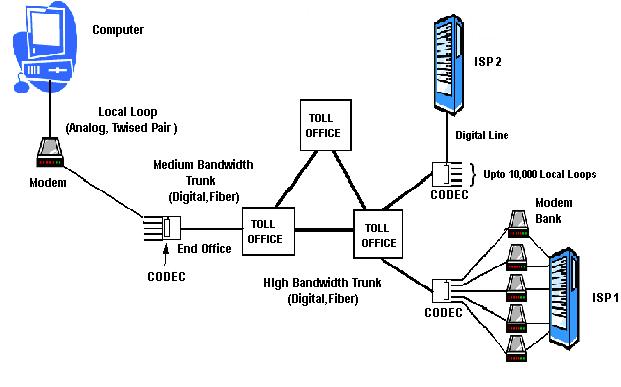
In telephony, the local loop (also referred to as the local tail, subscriber line, or in the aggregate as the last mile) is the physical link or circuit that connects from the demarcation point of the customer premises to the edge of the common carrier or telecommunications service provider's network.[1]
At the edge of the carrier access network in a traditional public telephone network,[2] the local loop terminates in a circuit switch housed in an incumbent local exchange carrier or telephone exchange.
Infrastructure
[edit]Traditionally, the local loop was an electrical circuit in the form of a single pair of conductors from the telephone on the customer's premises to the local telephone exchange. Single-wire earth return lines had been used in some countries until the introduction of electric tramways from the 1900s made them unusable.
Historically the first section was often an aerial open-wire line, with several conductors attached to porcelain insulators on cross-arms on "telegraph" poles. Hence party line service was often given to residential customers to minimise the number of local loops required. Usually all these circuits went into aerial or buried cables with a twisted pair for each local loop nearer the exchange, see outside plant.
Modern implementations may include a digital loop carrier system segment or fiber optic transmission system. The local loop may terminate at a circuit switch owned by a competitive local exchange carrier and housed in a point of presence (POP), which typically is an incumbent local exchange carrier telephone exchange. A local loop supports voice and/or data communications applications in the following ways:
- analog voice and signaling used in traditional POTS
- Integrated Services Digital Network (ISDN)
- variants of digital subscriber line (DSL).
The term "local loop" is sometimes used for any "last mile" connection to the customer, regardless of technology or intended purpose. Local loop interrelations in this sense include:
See also
[edit]- Access network
- ISDN (Integrated Services Digital Network)
- Local-loop unbundling
- Metallic path facilities
- Outside plant (as an instance of a local loop)
- Serving area interface
- Telephone line
References
[edit]- ^ "What is a local loop?". Superior Essex Communications. Retrieved 2022-08-12.
- ^ "The corDECT Wireless Local Loop: Capacity Predictions".

Local loop
View on GrokipediaDefinition and Fundamentals
Core Concept and Function
The local loop refers to the physical circuit connecting the demarcation point at a customer's premises to the local exchange or central office of a telecommunications provider.[10] This connection, commonly known as the "last mile," forms the terminal segment of the access network, linking individual subscribers to the broader public switched telephone network (PSTN) or equivalent infrastructure.[4] Traditionally implemented using copper twisted-pair wiring, it spans distances typically up to 5-6 kilometers in urban areas, with signal attenuation increasing over longer runs.[11] Its core function is to facilitate the bidirectional transmission of electrical signals between end-user equipment, such as telephones or modems, and the provider's switching facilities.[6] In analog telephony, the local loop carries voice signals as varying electrical currents over a single pair of wires, enabling plain old telephone service (POTS) without intermediate amplification in short loops.[2] For digital services, it supports modulation techniques to encode data, though bandwidth is constrained by factors like wire gauge (e.g., 24-gauge copper limits effective DSL distances to about 5.5 km).[12] The loop's design prioritizes reliability and cost-efficiency, serving as the bottleneck for service quality in legacy networks where upgrades to fiber or wireless alternatives remain incomplete.[13]Role in Telecommunications Networks
The local loop functions as the final transmission segment in telecommunications networks, linking customer premises—such as homes or businesses—to the service provider's central office or equivalent switching point, thereby enabling access to the wider core network for voice, data, and other services.[14] This "last mile" connection, typically spanning up to several kilometers, handles the bidirectional transport of signals from end-user devices to the distribution frame in the local exchange, where they interface with trunk lines and higher-layer routing infrastructure.[15] In traditional setups, it operates as a two-wire circuit for analog signals, converting user-generated traffic into a form compatible with the public switched telephone network (PSTN) or emerging digital backhauls.[16] Within the overall network architecture, the local loop demarcates the access layer from the aggregation and core layers, aggregating subscriber traffic before handover to multiplexed transport systems like fiber optic trunks or microwave links.[9] It plays a pivotal role in service provisioning by supporting unbundling for competitive access, allowing alternative carriers to lease loops for resale or interconnection, as mandated in regulatory frameworks to foster market entry.[14] For instance, incumbent local exchange carriers (ILECs) maintain loops as a network element that competitors can access to deliver end-to-end connectivity, mitigating monopolistic control over the physical plant.[15] This demarcation ensures scalability, as upgrades to the loop—such as from copper to fiber—directly influence downstream bandwidth and latency for applications like internet access and video streaming. The local loop's centrality also introduces inherent constraints, acting as a performance bottleneck due to signal degradation over distance, electromagnetic interference, and medium limitations, which necessitate amplification, equalization, or replacement to meet evolving demands for higher data rates.[9] In broadband contexts, it facilitates modulation techniques that overlay digital services onto legacy wiring, bridging analog origins with IP-centric ecosystems while preserving the foundational role of subscriber-line connectivity.[17] Empirical studies highlight its economic significance, with loop deployment costs representing a substantial portion of capital expenditure in access networks, influencing deployment strategies in rural versus urban areas.Historical Development
Origins in Early Telephony
The origins of the local loop trace to the practical implementation of Alexander Graham Bell's telephone invention, patented on March 7, 1876, which enabled voice transmission over electrical wires.[18] Early connections were rudimentary point-to-point setups, typically employing single iron or steel wires with a ground return, strung on aerial poles using glass insulators borrowed from telegraph infrastructure.[19] These initial subscriber lines powered telephones locally via dynamic transmitters or batteries, limiting range and reliability due to high resistance and susceptibility to electromagnetic interference.[19] The dedicated local loop concept solidified with the advent of central exchanges to interconnect multiple subscribers, as point-to-point wiring proved unscalable. The world's first commercial telephone exchange opened on January 28, 1878, in New Haven, Connecticut, operated by George W. Coy's District Telephone Company with 21 subscribers connected via short loops to a manual switchboard.[20] These loops formed a two-wire electrical circuit from the customer's premises to the exchange, facilitating switching while supplying signaling current, though early systems often retained ground returns for simplicity.[19] Improvements in the early 1880s addressed limitations in noise, attenuation, and crosstalk inherent to single-wire designs. In 1881, Bell Telephone engineer John J. Carty patented the two-wire metallic circuit, eliminating ground returns to minimize induction from parallel lines.[19] By 1884, Thomas Doolittle's hard-drawn copper wire replaced iron for its superior conductivity and tensile strength, enabling longer loops with reduced signal loss.[19] Twisted-pair configurations, also pioneered by Carty in the mid-1880s, further mitigated interference by balancing electromagnetic fields, laying groundwork for standardized urban cabling.[19]Expansion in the Analog Era
The expansion of local loops during the analog era, spanning from the late 19th century to the mid-20th century, was driven primarily by the Bell System in the United States, which deployed copper-based subscriber lines to connect residences and businesses to central offices for voice transmission over continuous electrical signals. Initial deployments used steel wires with ground returns, but by 1907, the system standardized on copper wire to enhance signal clarity and reduce attenuation in analog circuits.[21] By 1881, over 100,000 subscribers were served via these early loops, marking rapid urban adoption.[21] By 1900, the infrastructure had scaled to approximately 800,000 telephones across 1,300 exchanges, supported by nearly 2 million miles of wire, with local loops increasingly bundled into aerial or underground cables containing up to 400 twisted-pair conductors—about half of which were buried to protect against weather and enable denser urban routing.[21] Innovations like Pupin's loading coils, introduced around 1900, compensated for high-frequency signal loss, extending viable loop lengths to roughly 3 miles (or up to 18,000 feet without loading) and facilitating service to farther premises while maintaining acceptable voice quality in analog transmission.[21] [22] Subscriber growth surged with economic and demographic shifts, reaching over 15 million telephones by 1930, as central offices proliferated and loops were engineered with twisted pairs to suppress electromagnetic interference in multi-pair cables.[21] Rural areas, however, expanded more slowly through independent mutual aid systems; by 1912, over 3,200 such networks operated, peaking at around 6,000 farmer-owned associations in 1927, though maintenance challenges led to service declines by 1940.[23] Postwar policies, including 1949 amendments to the Rural Electrification Act providing low-interest loans, accelerated rural loop installations by enabling cooperatives to lay dedicated copper lines.[23] By 1948, the U.S. had installed its 30 millionth telephone, underscoring the analog local loop's role as the foundational "last mile" in nationwide connectivity.[24] Between 1945 and 1955, the Bell System added nearly 100 million miles of wire, doubling telephone installations and embedding resilient analog loops—typically limited to short distances from wire centers to avoid distortion—into the fabric of American infrastructure.[21] This era's developments prioritized scalability and reliability, with loops interfacing electromechanical switches to enable point-to-point analog calls without digital conversion.[21]Transition to Digital Services
The deployment of digital switching systems in telephone central offices during the 1970s marked the initial phase of transitioning local loop services from purely analog operations. Analog electromechanical switches, prevalent since the early 20th century, were gradually replaced by stored-program electronic systems, with AT&T's No. 1 Electronic Switching System (1ESS) entering service in 1965, initially using analog time-division multiplexing before evolving to full digital processing.[25] By the mid-1970s, time-division digital switches like AT&T's No. 4 ESS, introduced in 1976, enabled pulse-code modulation (PCM) integration directly at the exchange, digitizing incoming analog signals from subscriber loops into 64 kbps channels via 8 kHz sampling and 8-bit quantization. This shift improved signal quality, reduced noise accumulation over distance, and facilitated multiplexing multiple loops onto fewer trunks, though the local loops themselves remained analog copper pairs carrying continuous voice waveforms to the premises.[26] Digital loop carrier (DLC) systems emerged in the late 1970s as an intermediary technology to extend digital services toward subscribers, particularly in rural or low-density areas where deploying full copper loops was uneconomical. These systems multiplexed up to 96 PCM voice channels over a single T1 carrier (1.544 Mbps) on optical fiber or fewer copper pairs, reducing the physical loop length to remote terminals before reverting to analog "last-mile" drops. Early DLC deployments, such as those using delta modulation before standardizing on PCM, achieved cost savings of 30-50% compared to traditional cable pairs, with widespread adoption by U.S. regional Bell operating companies by the early 1980s. However, DLC primarily served to bridge exchanges to cabinets rather than delivering end-to-end digital to customer premises, preserving analog interfaces at the subscriber end. The pivotal advancement for true digital services over local loops came with the Integrated Services Digital Network (ISDN), standardized by the ITU in the early 1980s to provide end-to-end digital connectivity using existing twisted-pair infrastructure. ISDN's Basic Rate Interface (BRI) delivered 144 kbps total (2B+D: two 64 kbps bearer channels for voice/data and one 16 kbps delta channel for signaling) via 2B1Q line coding, compatible with loops up to 5.5 km without repeaters. Commercial rollouts began in 1988, with Japan's NTT launching the first nationwide ISDN service that year, followed by U.S. providers like Bell Atlantic offering BRI in select markets.[27] In Europe, deployment accelerated in the late 1980s, with Germany's Deutsche Telekom achieving over 1 million ISDN lines by 1995, though global adoption remained modest—peaking at around 10 million lines worldwide by the mid-1990s—due to high equipment costs (e.g., $500-1000 per line for NT1 network terminators) and competition from cheaper analog modems for data.[28] ISDN enabled applications like digital fax, video conferencing, and early internet access at speeds up to 128 kbps via channel bonding, but its circuit-switched nature limited scalability compared to emerging packet-based alternatives.[29] By the early 1990s, ISDN's limitations prompted refinements like High-bit-rate Digital Subscriber Line (HDSL), introduced in 1993 for symmetric 1.544 Mbps T1/E1 services over two or three twisted pairs, primarily for business loops up to 3.7 km. This facilitated leased-line digital voice and data without the full ISDN protocol overhead, with adoption driven by telecom carriers seeking to replace analog T1 repeaters. Despite these innovations, the core local loop infrastructure—predominantly 24-26 AWG copper—retained analog characteristics for plain old telephone service (POTS), with digital services overlaid via modulation at the edges, setting the stage for broadband evolutions. Empirical data from the era shows digital switching penetrated over 50% of U.S. exchanges by 1985, correlating with a 20-30% reduction in maintenance costs per line due to self-diagnostics and software configurability.Traditional Infrastructure
Copper Twisted-Pair Loops
Copper twisted-pair loops comprise pairs of insulated copper wires intertwined helically to counteract electromagnetic interference and crosstalk, serving as the primary medium for connecting telephone central offices to customer premises in traditional telephony networks. This configuration, formalized in cable specifications by 1888 using 18-gauge copper insulated with cotton and lead-sheathed, evolved to support reliable analog voice transmission over the local loop.[30] Typical implementations employ 22- to 26-gauge wire, with 24-gauge predominant in access networks for its balance of conductivity and flexibility; such loops sustain plain old telephone service (POTS) up to 5 km (18,000 feet) while limiting DC resistance to under 1,700 ohms. Twist rates range from 1 to 6 per foot, optimizing signal integrity against noise in multi-pair bundles that may contain hundreds of individual loops. Insulation progressed from early paper and cotton to modern polyethylene, enhancing moisture resistance and dielectric strength in aerial, underground, or buried deployments.[31][32][30] These loops are engineered for a nominal 4 kHz bandwidth suited to human voice frequencies (300–3,400 Hz), where attenuation remains low—typically under 10 dB/km at 1 kHz—enabling cost-effective extension via loading coils, which were standardized by 1900 to minimize distortion over longer spans. However, attenuation escalates quadratically with frequency and linearly with length, constraining higher-speed digital overlays; for instance, signals above 1 MHz experience over 20 dB/km loss in 26-gauge pairs, necessitating proximity to the central office for broadband viability.[33][34][35] In multi-pair cables, individual loops interface with feeder sections from distribution frames to pedestals or cross-connect boxes, terminating at network interface devices on premises; this hierarchical design, rooted in star topology, facilitated scalable deployment but introduced bridge taps and splices that exacerbate impedance mismatches and signal reflections. Empirical assessments confirm copper's enduring role in legacy infrastructure, with over 90% of U.S. fixed lines relying on twisted-pair loops as of 2000 despite fiber alternatives.[36][19]Components and Design
The traditional local loop in telephony comprises a hierarchical arrangement of copper twisted-pair cables connecting customer premises to the central office (CO), optimized for voice transmission over distances up to several kilometers.[16] Key components include feeder cables, which bundle hundreds of twisted pairs from the CO to a serving area interface (SAI); distribution cables, extending from the SAI to neighborhood pedestals or cross-connect boxes; and drop wires, providing the final short connection (typically 30-100 meters) from pedestals to the network interface device (NID) at the subscriber's premises.[37] The NID demarcates the carrier's responsibility from the customer's internal wiring and incorporates surge protection to safeguard against lightning and faults.[37] Wire gauges vary by segment to balance cost, resistance, and capacitance: feeder and distribution cables often use 19-22 AWG for lower attenuation over longer runs, while drop wires employ finer 24-26 AWG pairs for flexibility and reduced material use.[37] All segments utilize unshielded twisted-pair (UTP) copper, with insulation such as polyethylene to minimize crosstalk and environmental degradation.[37] The design employs a star-like topology from the CO, but SAIs serve as remote terminals to shorten average loop lengths, reducing signal loss and enabling efficient serving of suburban areas.[38] For loops exceeding 3-5 km, loading coils—inductive devices spaced approximately every 1.8 km (6,000 feet)—are inserted in series to counteract capacitive effects, extending viable voice transmission distances by three to four times while maintaining frequency response in the 300-3400 Hz band.[37][39] The overall circuit is a two-wire unbalanced line supporting bidirectional analog signals, with hybrids at the CO separating transmit and receive paths to enable full-duplex operation, though susceptible to echo from impedance mismatches.[16] This architecture prioritizes reliability and cost-effectiveness for plain old telephone service (POTS), with buried or aerial deployment depending on terrain.[40]Broadband Evolution
DSL Technologies over Local Loops
Digital subscriber line (DSL) technologies transmit high-speed digital data over existing copper twisted-pair local loops by modulating signals onto frequency bands above the 4 kHz voice spectrum, enabling simultaneous telephony and broadband services without requiring new cabling.[41] Developed in the late 1980s through research at Bell Communications Research and advanced by innovations like discrete multitone (DMT) modulation, DSL leverages the untapped bandwidth capacity of telephone lines to deliver asymmetric or symmetric data rates.[41][42] Frequency division multiplexing (FDM) or echo cancellation separates voice from data channels, with low frequencies (0-4 kHz) allocated to plain old telephone service (POTS) and higher bands (starting above 25 kHz) for bidirectional data using quadrature amplitude modulation (QAM) or DMT across multiple subcarriers to mitigate crosstalk and attenuation.[43] DMT, standardized for ADSL and VDSL, divides the available spectrum into hundreds of orthogonal subchannels, adaptively allocating power and bits per subcarrier based on line conditions to optimize throughput.[41] Key variants include asymmetric DSL (ADSL) and ADSL2+, which prioritize downstream speeds for consumer internet, achieving up to 24 Mbps download and 3 Mbps upload over loops up to 5 km under ideal conditions, per ITU-T G.992 standards ratified in the late 1990s.[44] Symmetric DSL (SDSL) provides matched upload/download rates, typically up to 2-3 Mbps, suited for business applications requiring balanced bandwidth.[44] Very-high-bit-rate DSL (VDSL and VDSL2), introduced in the early 2000s, supports up to 100 Mbps downstream over shorter loops under 1 km by utilizing frequencies up to 30 MHz, with vectoring techniques to reduce crosstalk interference.[45][46] Signal attenuation in copper pairs, governed by skin effect and dielectric losses, imposes strict distance limits: ADSL rates drop below 1 Mbps beyond 5.5 km due to exponential high-frequency signal decay, while VDSL performance degrades rapidly past 300-500 meters.[47] Loop qualification tests, measuring capacitance and resistance, determine feasible speeds, as longer rural loops often yield only 1-6 Mbps despite theoretical maxima.[48] Enhancements like G.fast, deployed since 2014, push gigabit speeds over loops under 100 meters using 106 MHz bandwidth and low-latency profiles, though practical deployments remain limited by noise and existing infrastructure quality.[32]
Cable and Hybrid Approaches
Cable broadband approaches leverage coaxial cable infrastructure, originally deployed for cable television distribution, to deliver internet access over the local loop. Coaxial cables, consisting of a central conductor surrounded by insulation, shielding, and an outer jacket, provide higher bandwidth capacity than twisted-pair copper due to their ability to carry signals over longer distances with less attenuation at higher frequencies.[49] This infrastructure typically connects from a neighborhood node to the customer premises via a drop cable, enabling data transmission through modulation techniques that overlay digital signals onto analog TV channels.[50] Hybrid fiber-coaxial (HFC) networks represent the predominant cable-based architecture for local loops, combining optical fiber trunks from the cable operator's headend to remote nodes with coaxial distribution within neighborhoods. In this setup, fiber optics handle high-capacity backbone transport over distances up to several kilometers, while coaxial cable serves the final 0.5 to 1 kilometer local loop to homes, often shared among 100 to 500 households via tree-and-branch topology with taps and splitters.[51] This hybrid design emerged in the mid-1990s as a cost-effective upgrade to existing coax plants, avoiding full replacement of local wiring while scaling bandwidth through node segmentation that reduces the number of users per coaxial segment.[49] The Data Over Cable Service Interface Specification (DOCSIS), developed by CableLabs and adopted as an international standard, governs data transmission in these networks. DOCSIS 1.0, released in 1997, introduced initial broadband capabilities with downstream speeds up to 40 Mbps and upstream up to 10 Mbps using QAM modulation over 6-8 MHz channels.[52] Subsequent versions enhanced performance: DOCSIS 2.0 (2002) improved upstream to 30 Mbps with advanced modulation; DOCSIS 3.0 (2006) enabled channel bonding for up to 1 Gbps downstream via 8 channels; and DOCSIS 3.1 (2013) supported up to 10 Gbps downstream using OFDM and wider spectrum, with full-duplex capabilities in DOCSIS 4.0 (2022) allowing symmetric multi-gigabit speeds up to 10 Gbps in both directions.[52] [53] These standards operate on a shared-medium basis, where bandwidth is contention-based among users on the same node, potentially leading to variability during peak usage, though node splits and spectrum reallocation mitigate this.[54] HFC local loops support asymmetric traffic patterns typical of residential broadband, prioritizing high downstream throughput for video streaming while allocating less for uploads. Deployment costs benefit from reusing cable TV plants, with upgrades focusing on amplifiers, nodes, and customer premises equipment like cable modems rather than wholesale rewiring.[50] As of 2023, HFC networks served over 100 million U.S. households, delivering average speeds exceeding 500 Mbps downstream in upgraded systems.[52] Limitations include signal ingress/egress issues and the need for periodic maintenance of aging coax, but ongoing DOCSIS extensions extend viability amid fiber competition.[55]Fiber-to-the-Premises Deployment
Fiber-to-the-premises (FTTP) deployment extends optical fiber cables from a service provider's central office or distribution hub directly to individual homes, businesses, or multi-dwelling units, replacing or bypassing legacy copper infrastructure to deliver broadband services with capacities exceeding 1 Gbps.[56] This architecture typically employs passive optical networks (PON), where a single feeder fiber branches via passive splitters to multiple optical network terminals (ONTs) at customer premises, minimizing active components and enabling cost-effective scaling.[57] Deployment methods include underground trenching, aerial installation on existing poles, or micro-trenching to reduce excavation, though civil engineering accounts for 60-80% of total costs in urban and suburban areas.[58] Key PON standards underpin FTTP systems: Gigabit-capable PON (GPON), standardized by ITU-T G.984, supports 2.488 Gbps downstream and 1.244 Gbps upstream over distances up to 20 km with splitting ratios up to 1:128; Ethernet PON (EPON), based on IEEE 802.3ah, delivers 1 Gbps symmetric Ethernet framing; and advanced variants like XGS-PON (ITU-T G.9807.1), offering 10 Gbps symmetric throughput at 1577 nm downstream and 1270 nm upstream wavelengths, facilitate overlays on existing GPON plants without full infrastructure replacement.[59] These technologies enable time-division multiplexing for downstream broadcast and upstream contention, with wavelength-division multiplexing allowing coexistence of legacy and next-generation services.[60] By 2025, XGS-PON and 10G-EPON deployments have accelerated in regions demanding multi-gigabit speeds, driven by video streaming, cloud computing, and 5G backhaul requirements.[61] Compared to digital subscriber line (DSL) over copper, FTTP exhibits negligible signal attenuation—fiber supports terabit-scale aggregate capacities over local loops without repeaters, whereas copper DSL limits high-speed service to under 2 km due to resistive losses and crosstalk, capping practical throughputs at 100 Mbps or less beyond 1 km.[62] Empirical data from OECD countries show FTTP delivering symmetric upload/download latencies under 10 ms and error rates below 10^-12, versus DSL's asymmetry and degradation, enabling applications like real-time collaboration unattainable on twisted-pair.[63] Capital expenditures for FTTP rollout average $800-1500 per premises passed in the U.S., 2-3 times higher than hybrid fiber-coax upgrades but 50-70% less than equivalent DSL extensions in rural areas when factoring lifecycle maintenance.[64] Operating costs benefit from fiber's durability, with failure rates 10-20 times lower than copper under environmental stress, though upfront trenching in brownfield sites elevates barriers.[65] Global FTTP penetration reached 30-40% of fixed broadband subscriptions by 2023, surpassing DSL for the first time in OECD nations, with Asia-Pacific leading at over 70% in countries like South Korea via subsidized greenfield builds post-2000.[63] In the U.S., FTTP covered 45% of locations by mid-2025, spurred by $42 billion in federal funding under the Infrastructure Investment and Jobs Act, yet deployment lags Europe due to fragmented rights-of-way and incumbent resistance to overbuilds.[66] Market analyses project the FTTP sector growing from $24.5 billion in 2024 to $47.3 billion by 2030 at 11.6% CAGR, reflecting demand for bandwidth-intensive services, though rural economics often necessitate hybrids or subsidies to achieve positive NPV.[67] Challenges persist in scaling, including labor shortages for splicing and permitting delays averaging 6-12 months per project, underscoring the causal link between regulatory streamlining and accelerated rollout paces observed in competitive Asian markets.[58]Regulation and Market Dynamics
Local Loop Unbundling Policies
Local loop unbundling (LLU) policies require telecommunications incumbents to provide competitors with access to the physical or shared local loop infrastructure—the "last mile" wiring from central offices to customer premises—enabling alternative operators to deliver services such as DSL broadband without replicating costly copper or fiber plant.[68] These policies typically mandate nondiscriminatory access at prices reflecting forward-looking economic costs, such as long-run incremental costs, to mitigate incumbents' natural monopoly advantages in access networks.[68] Full unbundling allows competitors to lease and manage the entire loop, while shared access permits line-sharing for data services alongside the incumbent's voice.[69] In the United States, Section 251 of the Telecommunications Act of 1996 obligated incumbent local exchange carriers (ILECs) to unbundle network elements, including local loops, and provide them to requesting carriers on just, reasonable, and nondiscriminatory terms to foster local competition.[70] The Federal Communications Commission (FCC) specified unbundling obligations for loops in its 1996 implementation order, extending to high-capacity lines and xDSL-capable loops by September 1999 to support broadband deployment.[71] A 2003 FCC rule permitted state commissions to assess whether unbundling remained necessary based on market impairment tests, resulting in partial de-unbundling for DS1 and DS3 loops in non-impaired areas; further reforms in 2021 eliminated unbundling mandates for enterprise-grade DS1 and DS3 loops amid fiber transitions, subject to transition periods.[72][73] The European Union established LLU through Regulation (EC) No 2887/2000, effective January 1, 2001, which compelled incumbents to offer unbundled and shared access to copper local loops within three months of a request, with pricing regulated by national authorities to ensure cost orientation.[69] This framework, building on earlier 1999 access directives, aimed to harmonize access across member states and accelerate DSL rollout by addressing incumbents' bottlenecks in last-mile infrastructure.[69] National regulators, such as the UK's Ofcom, enforced LLU from 2001 onward, mandating physical collocation in exchanges and cost-based tariffs, though implementation varied with some states facing delays in line-testing and provisioning standards.[68] In Australia, the Australian Competition and Consumer Commission (ACCC) declared the Unconditioned Local Loop Service (ULLS) in July 2000 under Part XIC of the Trade Practices Act, granting competitors access to Telstra's copper loops for xDSL at regulated prices to promote broadband competition.[74] The ULLS and related line-sharing declarations were extended periodically but expired on June 30, 2024, after ACCC assessments showed declining usage—fewer than 100,000 lines by 2023—due to NBN fiber and hybrid network migrations rendering copper unbundling obsolete.[75] Globally, LLU adoption diverged; while OECD countries like New Zealand implemented it post-2001 Telecommunications Act amendments, others such as Japan avoided mandatory unbundling by 2003, favoring facilities-based investment incentives over access obligations.[76][68] Policies often included technical requirements for collocation space in exchanges and quality-of-service standards, though enforcement challenges persisted in provisioning times and dispute resolution.[68]Competition Effects and Empirical Outcomes
Local loop unbundling (LLU) enables competing telecommunications providers to access the incumbent's copper local loops, fostering service-based competition by allowing entrants to offer DSL services without constructing their own physical infrastructure. Empirical studies indicate that LLU initially accelerated broadband penetration, particularly in Europe where mandates were aggressively implemented starting in the early 2000s. For instance, panel data analysis across OECD countries from 2002 to 2008 showed that LLU regulations significantly increased household broadband adoption, with effects most pronounced in nations starting from low penetration levels, as entrants rapidly deployed DSL offerings over unbundled loops.[77] [78] This competition pressured incumbents to lower retail prices and improve service quality, contributing to a rise in DSL subscriptions; in the UK, exchanges with LLU access saw broadband penetration grow 6-10 percentage points faster than non-unbundled areas between 2002 and 2005.[79] However, longer-term outcomes reveal trade-offs, particularly regarding incentives for next-generation access (NGA) networks like fiber-to-the-premises (FTTP). Research on the "ladder of investment" hypothesis—which posits that LLU entrants would progressively build their own infrastructure—finds limited support, as many competitors remained reliant on unbundled loops rather than investing in alternatives. A study of French municipalities demonstrated that areas with more LLU entrants experienced 5-15% lower FTTP coverage and deployment rates as of 2015, as incumbents reduced NGA rollout to protect their wholesale revenues.[80] [81] Similarly, cross-European panel data from 2001-2010 indicated that while LLU boosted early DSL penetration, it correlated with slower transitions to fiber, with unbundling intensity reducing incumbent NGA investments by up to 20% in high-competition locales.[82] In contrast, the United States, with lighter unbundling requirements post-2005, saw stronger cable and fiber competition, achieving higher average broadband speeds (over 100 Mbps by 2015) compared to Europe's DSL-heavy markets.[83]| Region/Policy | Broadband Penetration Effect (Early 2000s) | NGA Investment Effect | Key Source |
|---|---|---|---|
| Europe (Strong LLU) | +10-20% DSL adoption boost (2002-2008) | -5-20% FTTP deployment | Datta & MacKie-Mason (2014); Jahn & Prüfer (2013) |
| UK (LLU Exchanges) | +6-10% faster penetration vs. controls | Mixed; spurred some entrant backhaul but slowed full fiber | Nardotto et al. (2015) |
| US (Limited Unbundling) | Slower initial DSL but higher speeds via alternatives | + Fiber/cable rollout; 100+ Mbps widespread by 2015 | Bauer (2005) |