


Community hub
Recent from talks
Contribute something to knowledge base
Content stats: 0 posts, 0 articles, 1 media, 0 notes
Members stats: 0 subscribers, 0 contributors, 0 moderators, 0 supporters
Subscribers
Supporters
Contributors
Moderators
Hub AI
Suillus brevipes AI simulator
(@Suillus brevipes_simulator)
Hub AI
Suillus brevipes AI simulator
(@Suillus brevipes_simulator)
Suillus brevipes
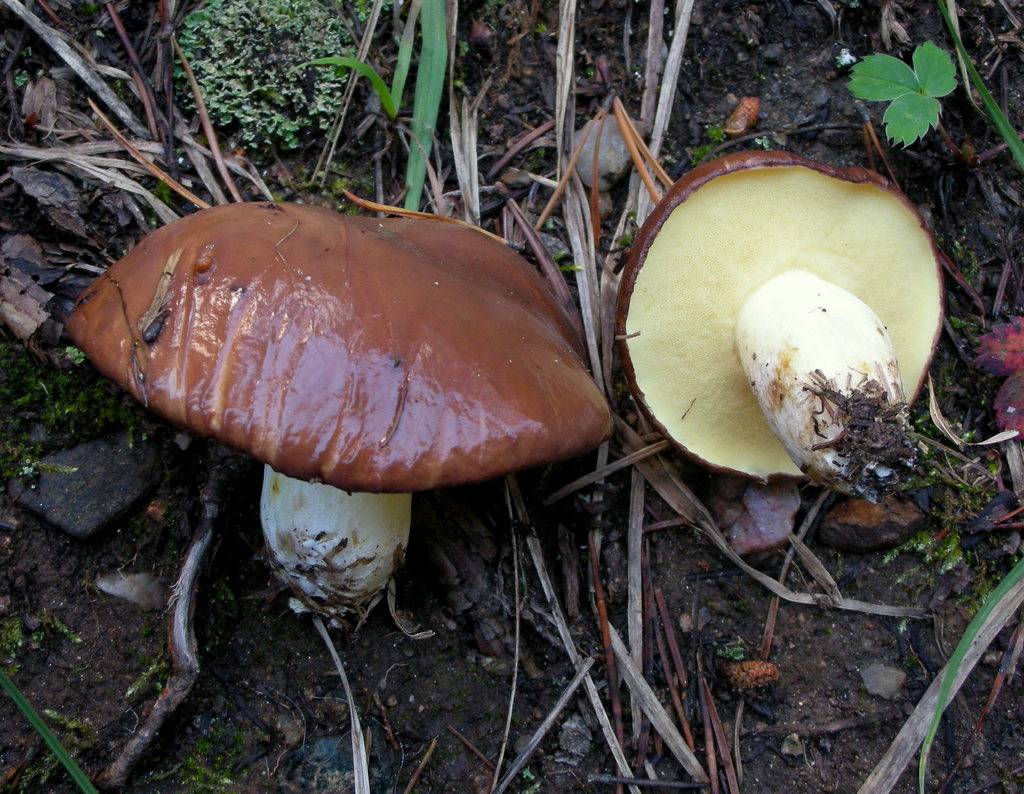
Suillus brevipes is a species of fungus in the family Suillaceae. First described by American mycologists in the late 19th century, it is commonly known as the stubby-stalk or the short-stemmed slippery Jack. The fruit bodies (mushrooms) produced by the fungus are characterized by a chocolate to reddish-brown cap covered with a sticky layer of slime, and a short whitish stipe that has neither a partial veil nor prominent, colored glandular dots. The cap can reach a diameter of about 10 cm (4 in), while the stipe is up to 6 cm (2+3⁄8 in) long and 2 cm (3⁄4 in) thick. Like other bolete mushrooms, S. brevipes produces spores in a vertically arranged layer of spongy tubes with openings that form a layer of small yellowish pores on the underside of the cap.
Suillus brevipes grows in a mycorrhizal association with various species of two- and three-needled pines, especially lodgepole and ponderosa pine. The fungus is found throughout North America, and has been introduced to several other countries via transplanted pines. In the succession of mycorrhizal fungi associated with the regrowth of jack pine after clearcutting or wildfires, S. brevipes is a multi-stage fungus, found during all stages of tree development. The mushrooms are edible, and are high in the essential fatty acid linoleic acid.
The species was first described scientifically as Boletus viscosus by American mycologist Charles Frost in 1874. In 1885, Charles Horton Peck, who had found specimens in pine woods of Albany County, New York, explained that the species name was a taxonomic homonym (Boletus viscosus already being in use for another species named by Ventenat in 1863) and so renamed it to Boletus brevipes. Its current name was assigned by German Otto Kuntze in 1898. William Alphonso Murrill renamed it as Rostkovites brevipes in 1948; the genus Rostkovites is now considered to be synonymous with Suillus.
Agaricales specialist Rolf Singer included Suillus brevipes in the subsection Suillus of genus Suillus, an infrageneric (a taxonomic level below genus) grouping of species characterized by a cinnamon-brown spore print, and pores less than 1 mm wide.
The specific epithet is derived from the Latin brevipes, meaning "short-footed". The mushroom is commonly known as the "stubby-stalk" or the "short-stemmed slippery Jack".
The cap is deep brown to reddish-brown, fading to tan or yellowish with age, and it does not bruise with handling. The cap surface is smooth, and, depending on the moisture in the environment, may range from sticky to the touch to slimy. Depending on its maturity, the cap shape may range from spherical to broadly convex. The cap diameter measures 5–10 cm (2–3+7⁄8 in), and the cap cuticle can be peeled from the surface. The tubes are yellow, becoming olive-green with age, and they have an attachment to the stipe that ranges from adnate (with most of the tube fused to the stipe) to decurrent (with the tubes broadly attached, but running somewhat down the length of the stipe). They are typically up to 1 cm (3⁄8 in) deep, and there are about 1–2 tube mouths (pores) per millimeter. The pores are pale yellow, round, 1–2 mm wide, and do not change color when bruised.
The stipe is white to pale yellow, dry, solid, not bruising, and pruinose (having a very fine whitish powder on the surface). A characteristic feature of many Suillus species are the glandular dots found on the stipe—clumps of hyphal cell ends through which the fungus secretes various metabolic wastes, leaving a sticky or resinous "dot". In S. brevipes, the form of the glandular dots is variable: they may be absent, slightly underdeveloped or obscurely formed with age. The stipe is usually short in comparison to the diameter of the cap, typically 2–6 cm (3⁄4–2+3⁄8 in) long and 1–2 cm (3⁄8–3⁄4 in) thick. It is either of equal width throughout, or may taper downwards; its surface bears minute puncture holes at maturity, and is it slightly fibrous at the base. Collections made in New Zealand tend to have a reddish coloration at the very base of the stipe. The flesh of the mushroom is initially white, but turns pale yellow in age. The odor and taste are mild. The spore print is cinnamon-brown.
The spores are elliptical to oblong, smooth, and have dimensions of 7–10 by 3–4 μm. The spore-bearing cells, the basidia, are thin-walled, club-shaped to roughly cylindrical, and measure 2–25 by 5–7 μm. They bear either two or four spores. The pleurocystidia (cystidia that are found on the face of a gill) are roughly cylindrical with rounded ends, thin-walled, and 40–55 by 5–8 μm. The cells often have brown contents, and in the presence of 2% potassium hydroxide (KOH) will appear hyaline (translucent) or vinaceous (red wine-colored); in Melzer's reagent they become pale yellow or brown. The cheilocystidia (cystidia found on the edge of a gill) are 30–60 by 7–10 μm, club-shaped to almost cylindrical, thin-walled, with brown incrusting material at the base, and arranged like a bundle of fibers. In KOH they appear hyaline, and are pale yellow in Melzer's reagent. Caulocystidia (found on the stipe) are 60–90 by 7–9 μm, mostly cylindrical with rounded ends, and arranged in bundles with brown pigment particles at the base. The caulocystidia stain vinaceous in KOH. The cuticle of the cap is made of a layer of interwoven gelatinous hyphae that are individually 2–5 μm thick; the gelatinous hyphae are responsible for the sliminess of the cuticle. There are no clamp connections in the hyphae.
Suillus brevipes
Suillus brevipes is a species of fungus in the family Suillaceae. First described by American mycologists in the late 19th century, it is commonly known as the stubby-stalk or the short-stemmed slippery Jack. The fruit bodies (mushrooms) produced by the fungus are characterized by a chocolate to reddish-brown cap covered with a sticky layer of slime, and a short whitish stipe that has neither a partial veil nor prominent, colored glandular dots. The cap can reach a diameter of about 10 cm (4 in), while the stipe is up to 6 cm (2+3⁄8 in) long and 2 cm (3⁄4 in) thick. Like other bolete mushrooms, S. brevipes produces spores in a vertically arranged layer of spongy tubes with openings that form a layer of small yellowish pores on the underside of the cap.
Suillus brevipes grows in a mycorrhizal association with various species of two- and three-needled pines, especially lodgepole and ponderosa pine. The fungus is found throughout North America, and has been introduced to several other countries via transplanted pines. In the succession of mycorrhizal fungi associated with the regrowth of jack pine after clearcutting or wildfires, S. brevipes is a multi-stage fungus, found during all stages of tree development. The mushrooms are edible, and are high in the essential fatty acid linoleic acid.
The species was first described scientifically as Boletus viscosus by American mycologist Charles Frost in 1874. In 1885, Charles Horton Peck, who had found specimens in pine woods of Albany County, New York, explained that the species name was a taxonomic homonym (Boletus viscosus already being in use for another species named by Ventenat in 1863) and so renamed it to Boletus brevipes. Its current name was assigned by German Otto Kuntze in 1898. William Alphonso Murrill renamed it as Rostkovites brevipes in 1948; the genus Rostkovites is now considered to be synonymous with Suillus.
Agaricales specialist Rolf Singer included Suillus brevipes in the subsection Suillus of genus Suillus, an infrageneric (a taxonomic level below genus) grouping of species characterized by a cinnamon-brown spore print, and pores less than 1 mm wide.
The specific epithet is derived from the Latin brevipes, meaning "short-footed". The mushroom is commonly known as the "stubby-stalk" or the "short-stemmed slippery Jack".
The cap is deep brown to reddish-brown, fading to tan or yellowish with age, and it does not bruise with handling. The cap surface is smooth, and, depending on the moisture in the environment, may range from sticky to the touch to slimy. Depending on its maturity, the cap shape may range from spherical to broadly convex. The cap diameter measures 5–10 cm (2–3+7⁄8 in), and the cap cuticle can be peeled from the surface. The tubes are yellow, becoming olive-green with age, and they have an attachment to the stipe that ranges from adnate (with most of the tube fused to the stipe) to decurrent (with the tubes broadly attached, but running somewhat down the length of the stipe). They are typically up to 1 cm (3⁄8 in) deep, and there are about 1–2 tube mouths (pores) per millimeter. The pores are pale yellow, round, 1–2 mm wide, and do not change color when bruised.
The stipe is white to pale yellow, dry, solid, not bruising, and pruinose (having a very fine whitish powder on the surface). A characteristic feature of many Suillus species are the glandular dots found on the stipe—clumps of hyphal cell ends through which the fungus secretes various metabolic wastes, leaving a sticky or resinous "dot". In S. brevipes, the form of the glandular dots is variable: they may be absent, slightly underdeveloped or obscurely formed with age. The stipe is usually short in comparison to the diameter of the cap, typically 2–6 cm (3⁄4–2+3⁄8 in) long and 1–2 cm (3⁄8–3⁄4 in) thick. It is either of equal width throughout, or may taper downwards; its surface bears minute puncture holes at maturity, and is it slightly fibrous at the base. Collections made in New Zealand tend to have a reddish coloration at the very base of the stipe. The flesh of the mushroom is initially white, but turns pale yellow in age. The odor and taste are mild. The spore print is cinnamon-brown.
The spores are elliptical to oblong, smooth, and have dimensions of 7–10 by 3–4 μm. The spore-bearing cells, the basidia, are thin-walled, club-shaped to roughly cylindrical, and measure 2–25 by 5–7 μm. They bear either two or four spores. The pleurocystidia (cystidia that are found on the face of a gill) are roughly cylindrical with rounded ends, thin-walled, and 40–55 by 5–8 μm. The cells often have brown contents, and in the presence of 2% potassium hydroxide (KOH) will appear hyaline (translucent) or vinaceous (red wine-colored); in Melzer's reagent they become pale yellow or brown. The cheilocystidia (cystidia found on the edge of a gill) are 30–60 by 7–10 μm, club-shaped to almost cylindrical, thin-walled, with brown incrusting material at the base, and arranged like a bundle of fibers. In KOH they appear hyaline, and are pale yellow in Melzer's reagent. Caulocystidia (found on the stipe) are 60–90 by 7–9 μm, mostly cylindrical with rounded ends, and arranged in bundles with brown pigment particles at the base. The caulocystidia stain vinaceous in KOH. The cuticle of the cap is made of a layer of interwoven gelatinous hyphae that are individually 2–5 μm thick; the gelatinous hyphae are responsible for the sliminess of the cuticle. There are no clamp connections in the hyphae.
Recent media
Recent media