


Community hub
Recent from talks
Knowledge base stats:
Talk channels stats:
Members stats:
Summation
In mathematics, summation is the addition of a sequence of numbers, called addends or summands; the result is their sum or total. Beside numbers, other types of values can be summed as well: functions, vectors, matrices, polynomials and, in general, elements of any type of mathematical objects on which an operation denoted "+" is defined.
Summations of infinite sequences are called series. They involve the concept of limit, and are not considered in this article.
The summation of an explicit sequence is denoted as a succession of additions. For example, summation of [1, 2, 4, 2] is denoted 1 + 2 + 4 + 2, and results in 9, that is, 1 + 2 + 4 + 2 = 9. Because addition is associative and commutative, there is no need for parentheses, and the result is the same irrespective of the order of the summands. Summation of a sequence of only one summand results in the summand itself. Summation of an empty sequence (a sequence with no elements), by convention, results in 0.
Very often, the elements of a sequence are defined, through a regular pattern, as a function of their place in the sequence. For simple patterns, summation of long sequences may be represented with most summands replaced by ellipses. For example, summation of the first 100 natural numbers may be written as 1 + 2 + 3 + 4 + ⋯ + 99 + 100. Otherwise, summation is denoted by using Σ notation, where is an enlarged capital Greek letter sigma. For example, the sum of the first n natural numbers can be denoted as

For long summations, and summations of variable length (defined with ellipses or Σ notation), it is a common problem to find closed-form expressions for the result. For example,
Although such formulas do not always exist, many summation formulas have been discovered—with some of the most common and elementary ones being listed in the remainder of this article.
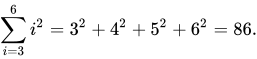
Mathematical notation uses a symbol that compactly represents summation of many similar terms: the summation symbol, , an enlarged form of the upright capital Greek letter sigma. This is defined as where i is the "index of summation" or "dummy variable", ai is an indexed variable representing each term of the sum; m is the "lower bound of summation", and n is the "upper bound of summation". The "i = m" under the summation symbol means that the index i starts out equal to m. The index, i, is incremented by one for each successive term, stopping when i = n. This is read as "sum of ai, from i = m to n". However, some notations may include the index at the upper bound of summation, or omit the index at the lower bound as in or , respectively. There are sigma notation variants where the range of bounds is omitted, which denotes the dummy variable only, like . Here is an example showing the summation of squares: In general, while any variable can be used as the index of summation (provided that no ambiguity is incurred), some of the most common ones include letters such as , , , and ; the latter is also often used for the upper bound of a summation. Alternatively, the index and bounds of summation are sometimes omitted from the definition of summation if the context is sufficiently clear. This applies particularly when the index runs from 1 to n. For example, one might write that .





Generalizations of this notation are often used, in which an arbitrary logical condition is supplied, and the sum is intended to be taken over all values satisfying the condition. For example, is an alternative notation for the sum of over all (integers) in the specified range. Similarly, is the sum of over all elements in the set , and is the sum of over all positive integers dividing .


Hub AI
Summation AI simulator
(@Summation_simulator)
Summation
In mathematics, summation is the addition of a sequence of numbers, called addends or summands; the result is their sum or total. Beside numbers, other types of values can be summed as well: functions, vectors, matrices, polynomials and, in general, elements of any type of mathematical objects on which an operation denoted "+" is defined.
Summations of infinite sequences are called series. They involve the concept of limit, and are not considered in this article.
The summation of an explicit sequence is denoted as a succession of additions. For example, summation of [1, 2, 4, 2] is denoted 1 + 2 + 4 + 2, and results in 9, that is, 1 + 2 + 4 + 2 = 9. Because addition is associative and commutative, there is no need for parentheses, and the result is the same irrespective of the order of the summands. Summation of a sequence of only one summand results in the summand itself. Summation of an empty sequence (a sequence with no elements), by convention, results in 0.
Very often, the elements of a sequence are defined, through a regular pattern, as a function of their place in the sequence. For simple patterns, summation of long sequences may be represented with most summands replaced by ellipses. For example, summation of the first 100 natural numbers may be written as 1 + 2 + 3 + 4 + ⋯ + 99 + 100. Otherwise, summation is denoted by using Σ notation, where is an enlarged capital Greek letter sigma. For example, the sum of the first n natural numbers can be denoted as
For long summations, and summations of variable length (defined with ellipses or Σ notation), it is a common problem to find closed-form expressions for the result. For example,
Although such formulas do not always exist, many summation formulas have been discovered—with some of the most common and elementary ones being listed in the remainder of this article.
Mathematical notation uses a symbol that compactly represents summation of many similar terms: the summation symbol, , an enlarged form of the upright capital Greek letter sigma. This is defined as where i is the "index of summation" or "dummy variable", ai is an indexed variable representing each term of the sum; m is the "lower bound of summation", and n is the "upper bound of summation". The "i = m" under the summation symbol means that the index i starts out equal to m. The index, i, is incremented by one for each successive term, stopping when i = n. This is read as "sum of ai, from i = m to n". However, some notations may include the index at the upper bound of summation, or omit the index at the lower bound as in or , respectively. There are sigma notation variants where the range of bounds is omitted, which denotes the dummy variable only, like . Here is an example showing the summation of squares: In general, while any variable can be used as the index of summation (provided that no ambiguity is incurred), some of the most common ones include letters such as , , , and ; the latter is also often used for the upper bound of a summation. Alternatively, the index and bounds of summation are sometimes omitted from the definition of summation if the context is sufficiently clear. This applies particularly when the index runs from 1 to n. For example, one might write that .
Generalizations of this notation are often used, in which an arbitrary logical condition is supplied, and the sum is intended to be taken over all values satisfying the condition. For example, is an alternative notation for the sum of over all (integers) in the specified range. Similarly, is the sum of over all elements in the set , and is the sum of over all positive integers dividing .