


Community hub
Recent from talks
Contribute something
Nothing was collected or created yet.
Sunanda Kumariratana
View on WikipediaKey Information


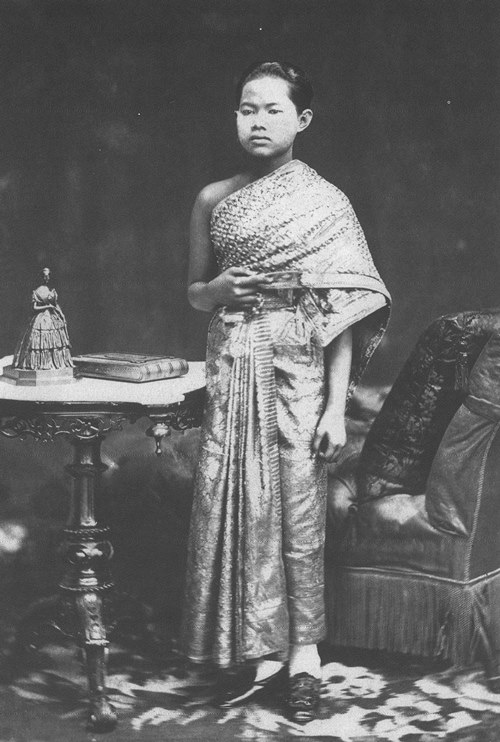
Sunanda Kumariratana[1] (Thai: สุนันทากุมารีรัตน์, RTGS: Sunantha Kumarirat, Sunandākumārīratana; 10 November 1860 – 31 May 1880) was a queen consort of Siam.[2] She was one of the four royal wives of King Chulalongkorn.[2]
Background
[edit]She was a daughter and fiftieth child of Siamese King Mongkut (Rama IV) and Princess Consort Piam.[3] She was the half-sister and first wife of King Chulalongkorn (Rama V) of Siam (now Thailand).[3] The king's other two wives were her younger sisters, Their Majesty Queen Savang Vadhana and Queen Saovabha Phongsri.[3]
The queen and her daughter Kannabhorn Bejaratana drowned when the steam boat Sorawan collided with their royal boat towed by the steam yacht Pan Marut on the way to the Bang Pa-In Royal Palace (Summer Palace).[3]
There is an often repeated myth that the many witnesses to the accident did not dare to touch the queen, a capital offense—not even to save her life. However, this was not the case; the King's diary records that boatmen dived into the water, pulled the queen and her daughter from the entangling curtains, and carried them to another boat, where attendants worked in vain to resuscitate them.[4] No one else died in the accident.[3]
Funeral
[edit]The grief-stricken Chulalongkorn demanded a resplendent funeral for them. Preparations for the funeral took 10 months and the funeral ceremony did not begin until 10 March 1881. The bodies of the queen and princess were dried with injections of quicksilver and stored in golden urns while precious woods were collected for the construction of a funeral pyre; royal facilities where the king and entourage resided during the cremation ceremonies were also constructed in a location referred to as Pra Mane. The funeral pyre was reported to be 280 feet (85 m) tall and was built over an altar where the urns were placed for cremation.[3]
The proceedings and celebrations were opulent, attended by many, and documented in great detail. Chulalongkorn lit the funeral pyre around 6:00 p.m. on 15 March to the sound of horns, and the pyre burned throughout the night.[3] Celebrations ended on 20 March with a procession to the Grand Palace.[3]
Ancestors
[edit]| Ancestors of Sunanda Kumariratana | |||||||||||||||||||||||||||||||||||||||||||||||||||||||||||||||||||||||||||||||||||||||||||||||||||||||||||||||||||||||||||||||||||||||||||||||||||||||||||||||||||||||||||||||||||||||||||||||||||||||||||||||||||||||||||||||||||||||||||||||||||||||||||||||||||||||||
|---|---|---|---|---|---|---|---|---|---|---|---|---|---|---|---|---|---|---|---|---|---|---|---|---|---|---|---|---|---|---|---|---|---|---|---|---|---|---|---|---|---|---|---|---|---|---|---|---|---|---|---|---|---|---|---|---|---|---|---|---|---|---|---|---|---|---|---|---|---|---|---|---|---|---|---|---|---|---|---|---|---|---|---|---|---|---|---|---|---|---|---|---|---|---|---|---|---|---|---|---|---|---|---|---|---|---|---|---|---|---|---|---|---|---|---|---|---|---|---|---|---|---|---|---|---|---|---|---|---|---|---|---|---|---|---|---|---|---|---|---|---|---|---|---|---|---|---|---|---|---|---|---|---|---|---|---|---|---|---|---|---|---|---|---|---|---|---|---|---|---|---|---|---|---|---|---|---|---|---|---|---|---|---|---|---|---|---|---|---|---|---|---|---|---|---|---|---|---|---|---|---|---|---|---|---|---|---|---|---|---|---|---|---|---|---|---|---|---|---|---|---|---|---|---|---|---|---|---|---|---|---|---|---|---|---|---|---|---|---|---|---|---|---|---|---|---|---|---|---|---|---|---|---|---|---|---|---|---|---|---|---|---|---|---|---|
| |||||||||||||||||||||||||||||||||||||||||||||||||||||||||||||||||||||||||||||||||||||||||||||||||||||||||||||||||||||||||||||||||||||||||||||||||||||||||||||||||||||||||||||||||||||||||||||||||||||||||||||||||||||||||||||||||||||||||||||||||||||||||||||||||||||||||
References
[edit]- ^ Finestone, Jeffrey. The Royal Family of Thailand: The Descendants of King Chulalongkorn. Bangkok : Phitsanulok Publishing, 1989, p. 64
- ^ a b "ย้อนรอยโศกนาฏกรรม ตำนานเรื่องเล่าของ "สมเด็จพระนางเรือล่ม" อัครมเหสีในรัชกาลที่ 5" [Retrace the tragedy, Legend of "Wrecked Queen," the queen consort of King Rama V]. Art & Culture Magazine (in Thai). 2020-11-28. Retrieved 2021-02-01.
- ^ a b c d e f g h indochinoise, Société académique (1882). Bulletin de la Société académique indochinoise de France (in French).
- ^ The Palace Law of Ayutthaya and the Thammasat: Law and Kingship in Siam. APD SINGAPORE PTE. LTD. 2016. p. 63. ISBN 9780877277699.


| International | |
|---|---|
| National | |
| Other | |

Sunanda Kumariratana
View on GrokipediaEarly Life
Birth and Family Background
Sunanda Kumariratana was born on November 10, 1860, in Bangkok, Siam (present-day Thailand), as a member of the Chakri dynasty.[6][2] Her father was King Mongkut, known posthumously as Rama IV, who reigned from 1851 to 1868 and pursued modernization efforts including diplomatic relations with Western powers.[7] Her mother was Chao Chom Manda Piam, a royal consort elevated to the title Somdet Phra Pi-amawadi Sri-pacharintara later in life, who bore several children to the king.[8][9] As the daughter of the reigning monarch, Sunanda received the style of Phra Chao Boromma-wongse Thi Phra Ong Chao (Royal Princess) and was named Sunandha Kumariratana at birth, reflecting her high status within the extended royal household.[2] She was the full sister of Savang Vadhana, another daughter of King Mongkut and Chao Chom Manda Piam, who would later become a queen consort to Sunanda's half-brother, King Chulalongkorn (Rama V).[7] This sibling connection underscored the practice of intra-dynastic marriages common in the Siamese royal family to consolidate power and maintain lineage purity. King Mongkut fathered numerous offspring across multiple consorts, resulting in a complex web of half-siblings, including Chulalongkorn, whose mother was the higher-ranking Queen Debsirindra.[6]Upbringing in the Royal Court
Sunanda Kumariratana was born on 10 November 1860 as the daughter of King Mongkut (Rama IV) and Princess Consort Piyamavadi in the Grand Palace complex in Bangkok.[4] Her mother, elevated to the status of a secondary queen consort, had borne several children to the king, positioning Sunanda within the extended royal family of the Chakri dynasty.[7] As one of Mongkut's fifty children, she held the rank of Chao Fa, denoting a princess born to a king and a royal consort, which granted her privileges including residence in the inner palace quarters reserved for high-ranking females.[10] Following Mongkut's death on 1 October 1868, when Sunanda was nearly eight years old, the royal court transitioned under the regency and eventual sole rule of her half-brother Chulalongkorn, who ascended as Rama V.[7] She remained in the Grand Palace, the central hub of Siamese royal administration and family life, where the inner court (the domain of queens, consorts, and princesses) operated semi-autonomously with its own hierarchies and protocols.[11] The palace environment, encompassing temples, audience halls, and private residences, fostered adherence to Buddhist principles, court etiquette, and preparation for dynastic roles, though individualized records of her daily activities or formal instruction remain limited.[12] Her early years coincided with Mongkut's efforts to modernize the court through Western influences, including the hiring of foreign tutors like Anna Leonowens for royal children between 1862 and 1867, potentially exposing young princesses to English language and basic sciences alongside traditional Siamese curriculum of Pali scriptures, dance, and music.[13] By her adolescence, under Chulalongkorn's reign, the court emphasized continuity of these blended educational practices for female royals, aimed at cultivating refinement and loyalty to the throne. Sunanda married Chulalongkorn around 1878 at age 17 or 18, marking the transition from princess to queen consort.[7]Marriage and Role as Consort
Union with King Chulalongkorn
Sunanda Kumariratana, born on November 10, 1860, as the daughter of King Mongkut (Rama IV) and Chao Chom Manda Piam, married her half-brother King Chulalongkorn (Rama V) around 1878, becoming his first queen consort.[7] This union followed Siamese royal custom wherein kings wed half-sisters to maintain the exclusivity of the Chakri dynasty's lineage, a practice rooted in preserving monarchical authority and blood purity akin to ancient precedents.[14] [15] At the time of the marriage, Sunanda was approximately 18 years old, while Chulalongkorn, born in 1853, was 25 and had already ruled since 1868 under regency.[7] As the eldest daughter among Mongkut's offspring by secondary consorts, her elevation to queen underscored her prominent status within the royal household, preceding Chulalongkorn's marriages to three other half-sisters: Sukhumala Marasri, Savang Vadhana, and Saovabha Phongsri.[16] [2] The marriage solidified Sunanda's role in the inner court, where she participated in ceremonial duties and supported the king's modernization efforts, though her tenure was brief due to her early death in 1880.[17] Despite the polygamous structure of the Siamese monarchy, Sunanda held precedence as the initial principal consort, reflecting traditional hierarchies among royal wives.[14]Family and Offspring
Sunanda Kumariratana bore one child with King Chulalongkorn: a daughter, Princess Kannabhorn Bejaratana Sohbhandasaniyalak Akaravorarajakumari, born on August 12, 1878, at the Grand Palace in Bangkok.[18][19] The princess, who held the title of Phra Ong Chao, perished at the age of one year and nine months in the same boating accident that claimed her mother's life on May 31, 1880, near Pak Kret on the Chao Phraya River.[20] At the time of her death, Sunanda Kumariratana was approximately five months pregnant with the couple's second child, an unborn son who was lost in the tragedy.[21][7] No other children survived to birth or beyond from their union.Death
Circumstances of the Accident
On 31 May 1880, Sunandha Kumariratana, then 19 years old and five months pregnant, was traveling by royal barge up the Chao Phraya River toward the Bang Pa-In summer palace, accompanied by her nearly two-year-old daughter, Princess Kannabhorn Bejaratana.[22] The vessel, towed by the steam yacht Pan Marut, collided with the steam boat Sorawan, causing it to capsize amid turbulent currents.[23] Both the queen and her daughter fell into the water and perished by drowning, despite nearby witnesses.[24] Historical records indicate the accident stemmed from navigational hazards common to river traffic at the time, including the introduction of steam-powered vessels into traditional barge routes, though precise fault attribution remains unclear in surviving accounts.[25] The queen's body was later recovered, confirming the loss of both her and the unborn child she carried.[5]Impact of Traditional Siamese Laws
Traditional Siamese laws and customs imposed severe restrictions on physical contact with royalty, viewing unauthorized touching as a profound violation of sacred hierarchy that could result in execution. These regulations stemmed from long-standing protocols designed to protect the divine-like status of the monarch and consorts, where slaves and commoners—comprising most court attendants—were conditioned to absolute deference and forbidden from initiating contact without explicit royal permission. In Sunanda Kumariratana's case, on May 31, 1880, this prohibition paralyzed potential rescuers as her royal barge capsized in the Chao Phraya River following a collision with the steamship Sorawan; attendants witnessed her and her daughter Kannabhorn Bejaratana struggling but hesitated to intervene directly, fearing lethal repercussions for defiling the royal body.[5][16] The rigidity of these customs amplified the tragedy, as the queen, pregnant at the time and encumbered by traditional attire, could not be aided promptly despite the proximity of oarsmen and guards. Historical accounts attribute the delay not merely to legal fiat but to ingrained cultural taboos associating rescue with misfortune or impurity, further compounded by the low status of slave rowers who lacked authority or means for swift action. This failure to override protocol for lifesaving underscores how traditional laws prioritized symbolic purity over empirical exigency, directly contributing to the drownings despite the shallow waters and visible peril.[26][27] Such customs reflected broader Siamese societal structures reliant on slavery, with over 1/3 of the population enslaved in the late 19th century, many serving in royal households under threat of corporal punishment for protocol breaches. The incident exposed the maladaptive consequences of these laws in modernizing contexts, where technological elements like steam vessels intersected with archaic hierarchies, rendering royal outings hazardous without adaptive protocols. While the exact mechanics of hesitation remain debated in popular retellings, the event verifiably highlighted systemic deference as a barrier to effective response.[16][5]Funeral and Immediate Aftermath
Royal Funeral Rites
The royal funeral rites for Sunanda Kumariratana commenced on March 9, 1881, nearly ten months after her death on May 31, 1880, due to the extensive preparations required for such an elaborate ceremony.[26][28] These rites adhered to traditional Siamese royal customs, steeped in Buddhist practices, which emphasized purification, public mourning, and symbolic immolation to facilitate the soul's transition.[29] The ceremonies lasted twelve days and were conducted at the Bang Pa-In summer palace near Bangkok, marking one of the most costly funerals in Siamese history.[26] Following embalming to preserve the bodies of Sunanda and her infant daughter, Princess Kannabhorn Bejaratana, they were seated upright on golden thrones within the principal crematorium, adorned with royal regalia and surrounded by precious artifacts symbolizing their status.[26] The funeral procession, renowned for its grandeur and expense, featured ornate floats and participants in traditional attire, culminating in the construction and ritual burning of two temporary structures as part of the merumat (pyre) rites.[4][30] King Chulalongkorn personally presided over the cremation at Sanam Luang in Bangkok, where the pyre—a towering Phra merumat—was ignited in a spectacle of fire and incense, signifying the release of the royal souls.[26] Post-cremation, the ashes of Sunanda and her daughter were enshrined together at the Sunandha Nusavarya Memorial in the Royal Cemetery at Wat Ratchabophit in Bangkok, a site dedicated to their memory and reflective of the era's hierarchical mourning protocols.[4] King Chulalongkorn also erected a memorial at Bang Pa-In Palace to commemorate the tragedy, underscoring the personal and state significance of the loss amid rigid customary laws that had precluded immediate rescue efforts.[4] These rites not only honored Sunanda's position as a principal queen consort but also highlighted the fusion of Hindu-influenced symbolism and Theravada Buddhist merit-making in 19th-century Siamese royal tradition.[29]Court Response and Reforms
The death of Queen Sunanda Kumariratana elicited profound grief from King Chulalongkorn, who reportedly mourned deeply and questioned the customs that contributed to the tragedy.[17][27] In immediate response, the king ordered the arrest and imprisonment of the chief guard responsible for the royal boat, holding him accountable for failing to initiate a rescue despite the legal prohibition on physical contact with royalty.[25][5] This action underscored the tension between adherence to ancient statutes—such as the death penalty for commoners touching royal persons—and practical imperatives, as witnesses and attendants refrained from aiding the queen and her daughter for fear of execution.[16][31] The incident exposed flaws in Siamese legal traditions, prompting reflection within the court on customs that prioritized symbolic hierarchy over human safety. While no immediate decree explicitly abolished the taboo against touching royalty, the event is cited as a catalyst accelerating King Chulalongkorn's broader modernization agenda, which included revising administrative structures, centralizing power, and gradually dismantling feudal elements like corvée labor and slavery (fully abolished by royal ordinance in 1905).[16][32][33] These reforms aimed to fortify Siam against colonial pressures while adapting internal governance, though the specific contact prohibition persisted in modified form, with later adjustments allowing exceptions for medical or emergency necessities under royal oversight.[26]Legacy
Historical Significance
Sunanda Kumariratana's death on May 31, 1880, underscored the rigidities of traditional Siamese customs, particularly the ancient law prohibiting commoners from physically contacting royalty under penalty of death, which deterred bystanders from attempting her rescue despite witnessing the capsized boat in the Chao Phraya River.[5] [16] This incident, involving the 19-year-old queen and her four-year-old daughter Indrasakdisorn, highlighted the potential lethality of feudal protocols in an era of emerging modernization.[25] In response, King Chulalongkorn promptly abolished the no-touch ordinance, permitting physical assistance to royalty in life-threatening situations, marking an early legal reform amid his broader efforts to centralize administration, abolish slavery by 1905, and adopt Western technologies to safeguard Siamese sovereignty against colonial encroachment. [32] Her tragedy thus served as a catalyst, exemplifying the shift from sakdina hierarchical absolutism to pragmatic governance, though Chulalongkorn's pre-existing reformist inclinations—evident in his 1868 ascension and European tours—suggest the event accelerated rather than initiated change.[26] The queen's legacy endures as a symbol of the human cost of outdated traditions during Siam's transition to modernity, influencing subsequent royal policies and public perceptions of monarchy's adaptability. Memorial structures, such as the Sunandalaya pavilion constructed in 1880 at Bang Khun Phrom Palace, commemorate her while embodying educational ideals aligned with reformist values.[34] Her story, preserved in historical accounts and temple dedications like Wat Ku Ha Roi, reinforces narratives of progress through selective abandonment of archaic laws.[17]Memorials and Cultural Remembrance
King Chulalongkorn commissioned the Sunandalaya building in 1880 as a memorial to Queen Sunanda Kumariratana, constructing it shortly after her death to honor her memory through architecture dedicated to learning and royal affection.[34] This structure, located within the Grand Palace complex, symbolizes enduring remembrance of her brief life and queenship.[34] At the Bang Pa-In Summer Palace, an obelisk-topped monument was erected in memory of Sunanda Kumariratana and her infant daughter, Princess Kannabhorn Bhecharatana, who perished with her in the 1880 boating accident; the site marks the location en route to the palace where the tragedy occurred. Similarly, a memorial statue dedicated by King Chulalongkorn stands in Namtok Phlio National Park, Chanthaburi Province, commemorating her life and the cultural shifts prompted by her death. Sunanda Kumariratana's remains were interred at the Royal Cemetery in Bangkok's Thon Buri district, with an associated Sunandha Nusavarya Memorial at Wat Ratchabophit serving as a site of royal commemoration for her and her children.[22] [35] In Thai cultural narratives, her drowning—exacerbated by traditional prohibitions against commoners touching royalty—endures as a historical anecdote illustrating the transition from absolute feudal customs to modern reforms under Chulalongkorn's reign, often recounted in royal histories and temple lore, such as at Wat Ku, renamed in her honor.[17]Genealogy
Ancestral Lineage
Sunanda Kumariratana was the eldest daughter of King Mongkut (Rama IV, reigned 1851–1868) and his consort Somdet Phra Piyamavadi Sri Bajarindra Mata, known prior to her elevation as Chao Chom Manda Piam Sucharitakul (1838–1904).[14] Her father, born in 1804 as Prince Mongkut, was the second surviving son of King Phra Buddha Loetla Nabhalai (Rama II, reigned 1809–1824) and Queen Sri Suriyendra, who served as principal queen during Rama II's reign.[36] On her maternal side, Piam descended from the Sucharitkul family, a distinguished line of Siamese aristocrats who held key administrative roles under the Chakri kings, including positions as ministers of trade and finance. Piam was the daughter of Luang Asa Sumdang, a mid-ranking noble official, and his wife Tan Tao Sucharit Dhamrong; the family's prominence stemmed from service in royal households and intermarriages with other noble lineages, with the Sucharitkul surname formally granted in 1913 by King Vajiravudh (Rama VI).[37] This maternal ancestry linked Sunanda to Thailand's bureaucratic elite, distinct from the core royal bloodline.[37]Relation to Chakri Dynasty
Sunanda Kumariratana was a direct member of the Chakri Dynasty by paternal descent, born on 10 November 1860 as the daughter of King Mongkut (Rama IV), the fourth monarch of the dynasty, and his royal consort Chao Chom Manda Piam (also known as Princess Consort Piam Sucharitakul).[6][14] The Chakri Dynasty was founded on 6 April 1782 by Phra Buddha Yodfa Chulaloke (Rama I), who established Bangkok as the capital after overthrowing the short-lived Thonburi Kingdom, initiating a continuous line of 10 kings to date, with Rama IV reigning from 1851 to 1868.[36] As the child of the king, Sunanda inherited full royal status, reflecting the dynasty's structure where legitimacy flowed patrilineally from the sovereign, supplemented by consorts from noble or selected families to expand the royal household. Her marriage in 1877 to her half-brother King Chulalongkorn (Rama V), who ascended in 1868 upon their father's death, positioned her as the first queen consort within the dynasty's core, underscoring the Siamese royal practice of intra-dynastic unions to maintain bloodline exclusivity and political cohesion.[14][17] This sibling marriage, common among Chakri rulers influenced by Brahmanical and Khmer traditions, aimed to consolidate power amid the dynasty's expansion of royal offspring—Rama IV fathered over 70 children by multiple consorts, fostering a web of alliances that stabilized the throne against external threats like European colonialism. Sunanda's elevation from princess to queen exemplified this system's emphasis on familial hierarchy over external matrimonial politics. Sunanda's sole child, Princess Kannabhorn Bejaratana (born 1878), died with her mother and an unborn sibling in the 1880 drowning, extinguishing her direct lineage but not diminishing her role in the dynasty's reproductive and symbolic continuity.[17] Her position highlighted the Chakri model's reliance on prolific progeny for succession security, as Rama V himself produced 77 children across numerous consorts, ensuring the dynasty's endurance into the 20th century.[36]References
- https://commons.wikimedia.org/wiki/File:Funeral_pyre_of_Queen_Sunanda.jpg