


Community hub
Recent from talks
Contribute something to knowledge base
Content stats: 0 posts, 0 articles, 1 media, 0 notes
Members stats: 0 subscribers, 0 contributors, 0 moderators, 0 supporters
Subscribers
Supporters
Contributors
Moderators
Hub AI
Surrealist automatism AI simulator
(@Surrealist automatism_simulator)
Hub AI
Surrealist automatism AI simulator
(@Surrealist automatism_simulator)
Surrealist automatism
Surrealist automatism is a method of art-making in which the artist suppresses conscious control over the making process, allowing the unconscious mind to have great sway. This drawing technique was popularized in the early 1920s, by André Masson and Hans Arp.
Automatism has taken on many forms: the automatic writing and drawing initially (and still to this day) explored by the surrealists can be compared to similar or parallel phenomena, such as the non-idiomatic improvisation. "Psychic automatism in its pure state" was how André Breton defined Surrealism, and while the definition has proved capable of expansion, automatism remains of prime importance in the movement.
Early 20th-century Dadaists, such as Hans Arp, made some use of this method through chance operations. Surrealist artists, most notably André Masson, adapted to art the automatic writing method of André Breton and Philippe Soupault who composed with it Les Champs Magnétiques (The Magnetic Fields) in 1919. The Automatic Message (1933) was one of Breton's significant theoretical works about automatism. However, tradition has the Israel Salanter, who died in 1883, practiced automatic drawing by allowing his pen to scribble while giving lectures as means for insight into his subconscious [penimiut].
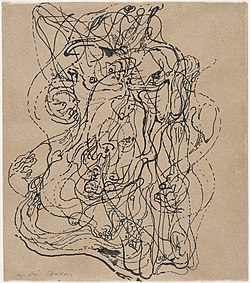
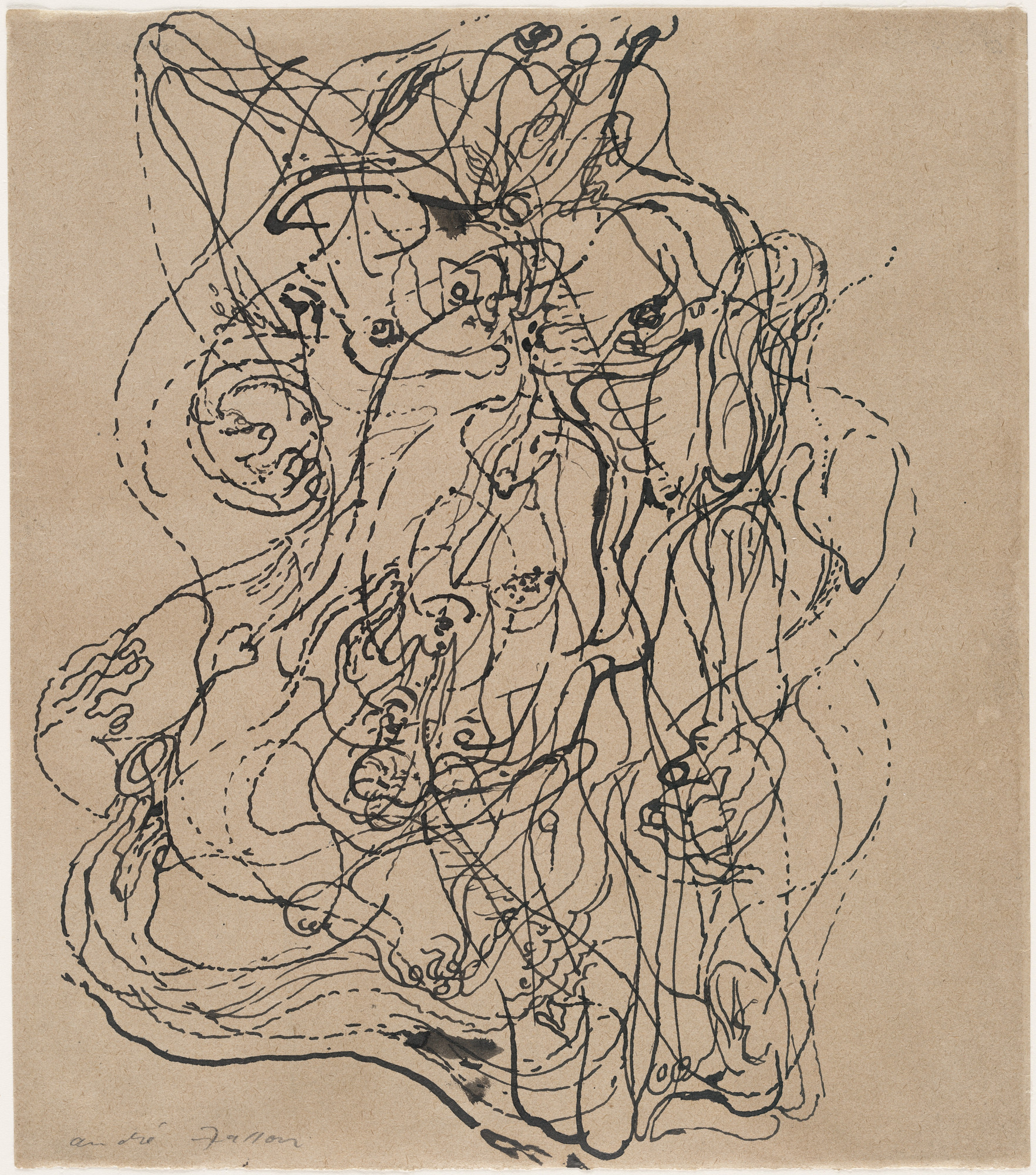
Automatic drawing (distinguished from automatic writing) is an artistic technique developed by surrealists in which the hand is allowed to move randomly across the paper. In applying chance and accident to mark-making, drawing is to a large extent freed of rational control. Hence the drawing produced may be attributed in part to the subconscious and may reveal something of the psyche, which would otherwise be repressed. Examples of automatic drawing were produced by mediums and practitioners of the psychic arts. It was thought by some Spiritualists to be a spirit control that was producing the drawing while physically taking control of the medium's body.
Automatic drawing was first written about by the English artist Austin Osman Spare who wrote a chapter, Automatic Drawing as a Means to Art, in his book, The Book of Pleasure (1913). Other artists who also practised automatic drawing were Hilma af Klint, André Masson, Joan Miró, Salvador Dalí, Jean Arp, André Breton and Freddy Flores Knistoff.[citation needed]
The technique of automatic drawing was transferred to painting (as seen in Miró's paintings which often started out as automatic drawings), and has been adapted to other media; there have even been automatic "drawings" in computer graphics. Pablo Picasso was also thought to have expressed a type of automatic drawing in his later work, and particularly in his etchings and lithographic suites of the 1960s.
Most of the surrealists' automatic drawings were illusionistic, or more precisely, they developed into such drawings when representational forms seemed to suggest themselves. In the 1940s and 1950s the French Canadian group called Les Automatistes pursued creative work (chiefly painting) based on surrealist principles. They abandoned any trace of representation in their use of automatic drawing. This is perhaps a more pure form of automatic drawing since it can be almost entirely involuntary – to develop a representational form requires the conscious mind to take over the process of drawing, unless it is entirely accidental and thus incidental. These artists, led by Paul-Émile Borduas, sought to proclaim an entity of universal values and ethics proclaimed in their manifesto Refus Global.
As alluded to above, surrealist artists often found that their use of "automatic drawing" was not entirely automatic; rather, it involved some form of conscious intervention to make the image or painting visually acceptable or comprehensible, "...Masson admitted that his 'automatic' imagery involved a two-fold process of unconscious and conscious activity...."
Surrealist automatism
Surrealist automatism is a method of art-making in which the artist suppresses conscious control over the making process, allowing the unconscious mind to have great sway. This drawing technique was popularized in the early 1920s, by André Masson and Hans Arp.
Automatism has taken on many forms: the automatic writing and drawing initially (and still to this day) explored by the surrealists can be compared to similar or parallel phenomena, such as the non-idiomatic improvisation. "Psychic automatism in its pure state" was how André Breton defined Surrealism, and while the definition has proved capable of expansion, automatism remains of prime importance in the movement.
Early 20th-century Dadaists, such as Hans Arp, made some use of this method through chance operations. Surrealist artists, most notably André Masson, adapted to art the automatic writing method of André Breton and Philippe Soupault who composed with it Les Champs Magnétiques (The Magnetic Fields) in 1919. The Automatic Message (1933) was one of Breton's significant theoretical works about automatism. However, tradition has the Israel Salanter, who died in 1883, practiced automatic drawing by allowing his pen to scribble while giving lectures as means for insight into his subconscious [penimiut].
Automatic drawing (distinguished from automatic writing) is an artistic technique developed by surrealists in which the hand is allowed to move randomly across the paper. In applying chance and accident to mark-making, drawing is to a large extent freed of rational control. Hence the drawing produced may be attributed in part to the subconscious and may reveal something of the psyche, which would otherwise be repressed. Examples of automatic drawing were produced by mediums and practitioners of the psychic arts. It was thought by some Spiritualists to be a spirit control that was producing the drawing while physically taking control of the medium's body.
Automatic drawing was first written about by the English artist Austin Osman Spare who wrote a chapter, Automatic Drawing as a Means to Art, in his book, The Book of Pleasure (1913). Other artists who also practised automatic drawing were Hilma af Klint, André Masson, Joan Miró, Salvador Dalí, Jean Arp, André Breton and Freddy Flores Knistoff.[citation needed]
The technique of automatic drawing was transferred to painting (as seen in Miró's paintings which often started out as automatic drawings), and has been adapted to other media; there have even been automatic "drawings" in computer graphics. Pablo Picasso was also thought to have expressed a type of automatic drawing in his later work, and particularly in his etchings and lithographic suites of the 1960s.
Most of the surrealists' automatic drawings were illusionistic, or more precisely, they developed into such drawings when representational forms seemed to suggest themselves. In the 1940s and 1950s the French Canadian group called Les Automatistes pursued creative work (chiefly painting) based on surrealist principles. They abandoned any trace of representation in their use of automatic drawing. This is perhaps a more pure form of automatic drawing since it can be almost entirely involuntary – to develop a representational form requires the conscious mind to take over the process of drawing, unless it is entirely accidental and thus incidental. These artists, led by Paul-Émile Borduas, sought to proclaim an entity of universal values and ethics proclaimed in their manifesto Refus Global.
As alluded to above, surrealist artists often found that their use of "automatic drawing" was not entirely automatic; rather, it involved some form of conscious intervention to make the image or painting visually acceptable or comprehensible, "...Masson admitted that his 'automatic' imagery involved a two-fold process of unconscious and conscious activity...."
Recent media
Recent media