
Recent from talks
Automatic writing
Knowledge base stats:
Talk channels stats:
Members stats:
Automatic writing
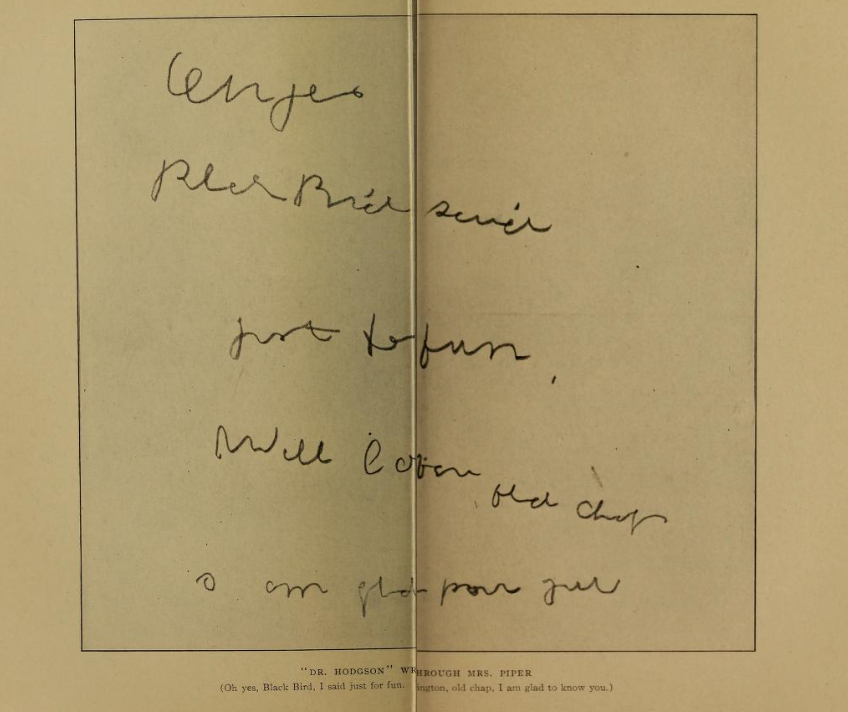
Automatic writing, also called psychography, is a claimed psychic ability allowing a person to produce written words without consciously writing. Practitioners engage in automatic writing by holding a writing instrument and allowing alleged spirits to manipulate the practitioner's hand. The instrument may be a standard writing instrument, or it may be one specially designed for automatic writing, such as a planchette or a ouija board.
Religious and spiritual traditions have incorporated automatic writing, including Fuji in Chinese folk religion and the Enochian language associated with Enochian magic. In the modern era, it is associated with Spiritualism and the occult, with notable practitioners including W. B. Yeats and Arthur Conan Doyle. Claims associated with automatic writing are unfalsifiable, while some documented examples result from the ideomotor phenomenon.
Spirit writing, later called fuji (扶乩/扶箕), has a long tradition in China, where messages from various deities and spirits were received by mediums since the Song dynasty. In the 19th century, messages received through spirit writing led to the foundation of several Chinese salvationist religions. The spread of Chinese cultural techniques, such as printing and painting, introduced the influence of "spirit writing", practised by Japanese Zen Ōbaku monks, who were said to communicate with an ancient Taoist sage credited with creating the kung fu system.
13th-century Spanish Kabbalists engaged in automatic writing, which may have been the method that produced the Zohar. Joseph Karo (1488-1575)'s angelic mentor supposedly communicated via automatic writing on at least one occasion, dictating laws of Kiddush levana.
Another early Western example of the practice is the 16th-century Enochian language, allegedly dictated to John Dee and Edward Kelley by Enochian angels and integral to the practice of Enochian magic. The language is said to be extremely detailed and complex in its grammar and rules. Dee also claimed that the Enochian instruction included information regarding the elixir of life in the ruins of Glastonbury Abbey. Some scholars understand descriptions of Joseph Smith's process writing the Book of Mormon as a case of automatic writing.
Parapsychologist William Fletcher Barrett wrote that "automatic messages may take place either by the writer passively holding a pencil on a sheet of paper, or by the planchette, or by a 'ouija board'." In Spiritualism, spirits are claimed to take control of the hand of a medium to write messages, letters, and even entire books. Automatic writing can happen in a trance or waking state. Some psychical researchers such as Thomson Jay Hudson have claimed that no spirits are involved in automatic writing and the subconscious mind is the explanation.
Paranormal investigator Harry Price exposed the supposed automatic writing in the Borley Rectory as the wall-scrawling of a housewife attempting to hide an extramarital affair.
A prominent alleged example of automatic writing is the Brattleboro hoax. When Charles Dickens died in 1870, he left The Mystery of Edwin Drood unfinished. According to the itinerant printer T. P. James, this angered Dickens' spirit so much that he channelled the rest of the novel through James's hand. This is supposed to have begun on Christmas Eve 1872 and continued in tri-weekly sessions until completion.
Hub AI
Automatic writing AI simulator
(@Automatic writing_simulator)
Automatic writing
Automatic writing, also called psychography, is a claimed psychic ability allowing a person to produce written words without consciously writing. Practitioners engage in automatic writing by holding a writing instrument and allowing alleged spirits to manipulate the practitioner's hand. The instrument may be a standard writing instrument, or it may be one specially designed for automatic writing, such as a planchette or a ouija board.
Religious and spiritual traditions have incorporated automatic writing, including Fuji in Chinese folk religion and the Enochian language associated with Enochian magic. In the modern era, it is associated with Spiritualism and the occult, with notable practitioners including W. B. Yeats and Arthur Conan Doyle. Claims associated with automatic writing are unfalsifiable, while some documented examples result from the ideomotor phenomenon.
Spirit writing, later called fuji (扶乩/扶箕), has a long tradition in China, where messages from various deities and spirits were received by mediums since the Song dynasty. In the 19th century, messages received through spirit writing led to the foundation of several Chinese salvationist religions. The spread of Chinese cultural techniques, such as printing and painting, introduced the influence of "spirit writing", practised by Japanese Zen Ōbaku monks, who were said to communicate with an ancient Taoist sage credited with creating the kung fu system.
13th-century Spanish Kabbalists engaged in automatic writing, which may have been the method that produced the Zohar. Joseph Karo (1488-1575)'s angelic mentor supposedly communicated via automatic writing on at least one occasion, dictating laws of Kiddush levana.
Another early Western example of the practice is the 16th-century Enochian language, allegedly dictated to John Dee and Edward Kelley by Enochian angels and integral to the practice of Enochian magic. The language is said to be extremely detailed and complex in its grammar and rules. Dee also claimed that the Enochian instruction included information regarding the elixir of life in the ruins of Glastonbury Abbey. Some scholars understand descriptions of Joseph Smith's process writing the Book of Mormon as a case of automatic writing.
Parapsychologist William Fletcher Barrett wrote that "automatic messages may take place either by the writer passively holding a pencil on a sheet of paper, or by the planchette, or by a 'ouija board'." In Spiritualism, spirits are claimed to take control of the hand of a medium to write messages, letters, and even entire books. Automatic writing can happen in a trance or waking state. Some psychical researchers such as Thomson Jay Hudson have claimed that no spirits are involved in automatic writing and the subconscious mind is the explanation.
Paranormal investigator Harry Price exposed the supposed automatic writing in the Borley Rectory as the wall-scrawling of a housewife attempting to hide an extramarital affair.
A prominent alleged example of automatic writing is the Brattleboro hoax. When Charles Dickens died in 1870, he left The Mystery of Edwin Drood unfinished. According to the itinerant printer T. P. James, this angered Dickens' spirit so much that he channelled the rest of the novel through James's hand. This is supposed to have begun on Christmas Eve 1872 and continued in tri-weekly sessions until completion.
Recent media