Hubbry Logo
SuswaSuswaMain
Open search
Suswa
Community hub
Suswa
logo
8 pages, 0 posts
0 subscribers
Be the first to start a discussion here.
Suswa
Suswa
from Wikipedia

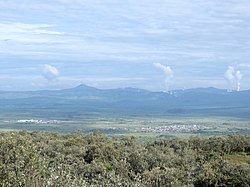
Suswa is a small town along the main road from Nairobi to Narok town and at the foot of Mount Suswa in Narok County. Suswa is also a ward in Narok East sub-county. The Suswa sub-station is located just outside town and electricity that is generated at Lake Turkana Wind Power Station is transmitted here through the 428 km Loiyangalani–Suswa High Voltage Power Line.[1]

Key Information

The town is a tourism hotspot due to its proximity to the Mount Suswa Conservancy[2] and the lava caves[3] on Mount Suswa.

Transport

[edit]

SGR

[edit]

Suswa is served by a train station on the Nairobi–Malaba Standard Gauge Railway (SGR), which was inaugurated in October 2019.[4]

MGR

[edit]

There is an old unused railway station called Suswa station located along the old Metre Gauge Railway (MGR) section from Nairobi to Naivasha. Although it is named Suswa station, it is located 46 kilometres (by road) away from Suswa town between Mount Longonot and Naivasha Town.

References

[edit]
Revisions and contributorsEdit on WikipediaRead on Wikipedia
from Grokipedia
Suswa is a small town and administrative ward in the Narok East sub-county of , southwestern . Situated along the –Narok Highway (B8) at the foot of , a prominent , it lies approximately 80 km northwest of and serves as a key stopover for travelers en route to National Reserve. The area is predominantly inhabited by the , who engage in and trade at the local weekly livestock market. As part of , which recorded a population of 1,157,873 in the 2019 Kenya census, Suswa contributes to the region's economy through , livestock rearing, and emerging linked to Mount Suswa's volcanic landscapes. The town's strategic location fosters cultural exchanges and supports community-led conservation efforts around the mountain.

Geography

Location and setting

Suswa is a small town located in , , specifically within the Suswa ward of Narok East sub-county. It lies along the A104 road, also known as the Nairobi-Narok highway, which serves as a major transit route through the region. The town is situated approximately 80 kilometers west of Nairobi, the capital of Kenya, and approximately 50 kilometers east of Narok town, positioning it at the eastern edge of the Great Rift Valley. Its approximate coordinates are 1°05′S 36°23′E, encompassing a compact urban area amid the surrounding semi-arid landscape. Administratively, Suswa falls under Narok County, which it borders to the east with Nakuru County and to the south with Kajiado County. As a key stop on the highway, it functions as a gateway to the Maasai Mara National Reserve, accessible via the nearby town of Narok. The town derives its name from the adjacent Mount Suswa, a prominent volcanic landmark in the area.

Topography and relation to Mount Suswa

Suswa is situated on the floor of the at an elevation ranging from approximately 1,600 to 1,900 meters above , featuring undulating plains interspersed with rocky outcrops formed from ancient volcanic activity. The terrain consists of semi-arid scrubland dominated by acacia-dotted , which transitions into higher volcanic highlands as one approaches the surrounding mountains. This landscape supports through grazing lands but limits arable due to the shallow, nutrient-poor volcanic soils and irregular rainfall patterns. The area's volcanic-ash soils, primarily Andosols, contribute to topographical challenges such as high rates and vulnerability to flash floods, exacerbated by steep gradients and seasonal that swell during heavy rains. These features create a dynamic environment where bare patches of land and gullies are common, particularly in the semi-arid conditions with sparse vegetation cover. The town of Suswa lies at the northwestern base of , a rising to 2,356 meters above , with the mountain's outer rim visible from the settlement and accessible within approximately 5-10 kilometers. This close proximity integrates the town's landscape with the volcano's gently sloping flanks, where pahoehoe and a'a lava flows form distinctive rocky terrains that influence local drainage and soil composition.

History

Maasai settlement and pre-colonial era

The Suswa region in Kenya's was originally inhabited by the Keekonyokie sub-clan of the , who settled in the area as part of broader Maasai pastoral expansions across the highlands and savannas. This migration, driven by the search for viable grazing lands, positioned the Keekonyokie as key occupants of the Suswa landscape, integrating it into the expansive Maasai territories that spanned from northern to central before the imposition of colonial boundaries. The traditional lifestyle of the Keekonyokie Maasai in Suswa centered on , with herding as the economic and social cornerstone, supported by the region's fertile grasslands and seasonal rivers that provided essential water sources for livestock during dry periods. Herds of , , and sheep were moved rotationally to prevent , allowing the community to sustain their semi-nomadic way of life in harmony with the local . Mount Suswa held profound cultural significance for the Keekonyokie, particularly its extensive caves, which served as shelters during migrations and sites for important ceremonies, including pre-initiation rituals where young men spent nights in preparation for adulthood. These caves, adorned with ancient Maasai drawings, functioned as shrines reinforcing spiritual and communal bonds within the broader Maasai territories. Pre-colonial inter-tribal relations in the Suswa area involved interactions with neighboring Kikuyu and Kamba groups, characterized by livestock trade exchanges and occasional conflicts over access to grazing lands amid competition for resources in the . These dynamics, including raids and intermarriages, shaped social networks until disruptions from European colonial incursions in the late began altering traditional Maasai .

Colonial period and modern development

During the late 19th and early 20th centuries, the British colonial administration significantly altered the landscape around Suswa through infrastructure projects and land policies targeting Maasai territories. The construction of the , completed in 1901 as part of the Meter Gauge Railway (MGR) network, extended from through to and beyond, bypassing Suswa directly but facilitating trade and settlement in adjacent areas by improving access to markets and resources. This railway spurred economic activity in nearby regions, indirectly influencing Suswa's role as a transit point for and goods among Maasai communities. Concurrently, under the British , Maasai lands faced systematic alienation to accommodate white settlers, with the 1904 Anglo-Maasai Agreement dividing traditional territories into northern and southern reserves separated by the railway line. The 1904 agreement prompted initial relocations, confining many Maasai groups to the Southern Reserve, which encompassed areas from Suswa southward to Ngong along the Mbagathi River, displacing communities from more fertile northern pastures. This was followed by the 1911 Anglo-Maasai Agreement, which further consolidated the reserves by moving northern Maasai southward, creating the 1911 reserves that formalized land restrictions and led to additional displacements around Suswa to prioritize farms and ranches. Post-World War II, colonial policies shifted toward promoting cultivation, such as and , in the surrounding , intensifying pressure on Maasai lands near Suswa and accelerating land enclosures for commercial agriculture. Following Kenya's independence in 1963, Suswa integrated into the newly formed Narok District, which later evolved into under the 2010 Constitution, marking a transition from centralized administration to localized governance. in 2013 formalized Suswa as a distinct ward within Narok East Sub-County, empowering local decision-making on development and resource management. In the 2010s, community-led initiatives established the Conservancy, a Maasai-managed area promoting and wildlife protection around the , with revenues supporting local conservation efforts. More recently, in May 2025, the opening of the modern Suswa Market under the national Economic Stimulus Program provided infrastructure for over 200 traders, addressing longstanding issues of open-air vending and enhancing economic resilience in the area.

Demographics

Population and growth

Suswa's , encompassing the town and its immediate surroundings, was recorded at 14,302 in the 2019 Kenya and , with 7,373 males and 6,929 females across 2,850 households. Projecting forward using County's annual growth rate of 2.7%, the figure reaches approximately 16,800 by 2025. The area has experienced steady demographic expansion, increasing from about 3,383 inhabitants in the 1999 census to the total, reflecting an average annual growth of around 7% over that period, though recent trends align more closely with the county's 2-3% rate driven by broader regional dynamics. This growth stems primarily from migration seeking economic opportunities in the area. The opening of the modern Suswa Market in May 2025 is expected to further accelerate this trend by creating jobs in trade and services. Settlement in Suswa features dispersed Maasai homesteads, known as bomas, scattered across the surrounding rangelands, with rising to about 43 persons per square kilometer overall but concentrating higher along the main where commercial activities draw residents. The community remains predominantly Maasai, influencing these patterns through traditional pastoral lifestyles adapted to proximity with urban amenities.

Ethnic composition and culture

The ethnic composition of Suswa is dominated by the , particularly the Keekonyokie sub-clan, who constitute the core of the local population as semi-nomadic pastoralists. The area reflects a growing cosmopolitan character within North Sub-County. Maasai cultural practices in Suswa emphasize vibrant traditions, including the wearing of colorful cloths and elaborate that denote age, gender, and marital status. The age-set system structures society into cohorts that progress through life stages, with young morans (warriors) responsible for and defense. Social life revolves around enkangs, circular village enclosures that host gatherings for , dances, and ceremonies, while contemporary events like cattle auctions integrate economic exchange with communal bonding. The primary language spoken in Suswa is Maa, a Nilotic tongue integral to oral traditions and daily communication among the Maasai. serves as a in markets and inter-ethnic interactions, while English is used in formal and administration. Social organization in Suswa follows a patriarchal clan-based system, where councils of elders, known as ilpayiani, hold authority to mediate conflicts, allocate resources, and preserve customs. Laibons, traditional spiritual leaders, complement the elders by offering ritual guidance and healing practices rooted in ancestral beliefs in a single . , introduced via evangelical missions starting in the 1980s, has gained traction alongside these traditions, with many households blending biblical teachings and church participation with indigenous spirituality.

Economy

Agriculture and livestock

The economy of Suswa is predominantly driven by Maasai , which emphasizes the rearing of , , and sheep on communal lands across the volcanic plains surrounding . In , where Suswa is located, the livestock population includes approximately 1.5 million , 2.6 million sheep, and 1 million , with the majority being indigenous breeds suited to semi-arid conditions. Annually, around 45,000 are traded through local markets like Suswa, supporting household income and cultural practices central to Maasai identity. Crop farming in Suswa is limited due to the and volcanic soils, occupying roughly 20% of the land suitable for agriculture in the broader lowlands, with average farm sizes ranging from 2 to 5 s. Farmers primarily cultivate drought-resistant crops such as , beans, and potatoes, which are grown under rain-fed systems in the more fertile pockets near the . Yields typically average 1-2 tons per hectare for , influenced by variable rainfall and soil quality, providing supplementary alongside products. Key challenges to agricultural and livestock production in Suswa include resulting from on fragile volcanic terrain and periodic flash floods that damage pastures and crops. exacerbates these issues, particularly during dry seasons, though it has been partially mitigated by the drilling of boreholes in the area since the early , including extensions to Suswa town and community projects funded by and NGO initiatives. Support for these activities comes from veterinary programs, which provide subsidized animal health services and to improve resilience, alongside cooperatives established in the that facilitate milk collection, into products like and , and handling for local . These systems enhance and , linking production directly to nearby trading hubs.

Trade and recent market developments

Traditional trade in Suswa has long centered on weekly markets held along the Nairobi-Narok , particularly on Wednesdays, where approximately 200 traders engage in and cash transactions for goats, sheep, , and fresh produce destined for buyers in and . These markets serve as vital hubs for Maasai herders and small-scale farmers, facilitating the exchange of agricultural products such as , , and meat, though traders often face challenges like exposure to weather and limited . In May 2025, President inaugurated the Suswa Modern Market under the national Economic Stimulus Program (ESP), a Sh56.7 million facility constructed jointly by the county and national governments to modernize local commerce. This 200+ stall structure includes display areas, cold storage rooms, a , loading zones, ramps for , a , an ICT hub, and water facilities, enabling efficient handling of fresh produce and meat while reducing post-harvest losses. The market is expected to significantly enhance trader incomes and local economic activity by providing a stable trading environment, as part of a broader initiative to build over 400 modern wholesale and fresh produce markets nationwide aimed at supporting micro, small, and medium enterprises (MSMEs). Early reports indicate improved business growth and livelihoods for Suswa's traders, who previously operated under harsh conditions, with the facility projected to spur job creation and better . Beyond the market, Suswa's commerce includes small roadside shops selling fuel and essentials to highway travelers, as well as popular nyama choma (grilled meat) eateries that draw locals and passersby using Maasai-raised livestock. Remittances from urban Maasai workers in and other cities further supplement household incomes, supporting trade and consumption in the area.

Tourism and attractions

Mount Suswa access and activities

Suswa town acts as the key gateway for accessing , with the outer crater rim reachable via a roughly 14 km dirt road branching off the Mai Mahiu-Narok route; a 4x4 vehicle is essential due to the rocky terrain. Guided tours often depart from the town center, with packages typically costing KSh 2,000 to 8,000 per person for locals as of 2025, covering entry, guides, and basic provisions. Key activities center on the mountain's volcanic features, including a 4- to 6-hour round-trip hike (approximately 10 km) to the inner at 2,356 meters above . Visitors can also explore an extensive network of caves formed by ancient flows, some of which serve as shelters for troops of olive baboons, often referred to as the "Baboons' ." Overnight is popular at designated rim sites, offering panoramic views of the under starry skies. The site is managed by the Conservancy, a community-led initiative run by local Maasai landowners and established in 2008 to promote and conservation. This has aligned with Kenya's national efforts to develop adventure tourism, as outlined in the 2025–2030 National Tourism Strategy. For safety, mandatory local guides (KES 1,000–2,000 per group as of 2025) are required for explorations to navigate unstable terrain and encounters; the dormant poses no eruption risk, but flash floods can occur on access roads during rainy seasons, so travelers should check weather conditions.

Local sites and community experiences

In the vicinity of Suswa, traditional Maasai villages known as bomas provide visitors with immersive cultural experiences, including homestays where guests can observe daily life and participate in vibrant dances performed by local warriors. These enkang settlements, circular enclosures made from thorny branches, mud, and dung, often feature demonstrations of branding, a key ritual symbolizing ownership and community bonds among the pastoralist Maasai. Visitors are welcomed by elders who share stories of Maasai heritage, emphasizing the importance of in their semi-nomadic lifestyle. Natural attractions beyond the mountain include geothermal vents indicating ongoing volcanic activity, set against a dramatic volcanic . Along the nearby , scenic viewpoints provide sweeping panoramas of the floor, dotted with acacia savannahs and distant . opportunities abound in the Suswa Plains, where species such as eagles, vultures, and buzzards thrive due to the area's geothermal vents and cliffs, alongside occasional sightings of ground-dwelling birds like the bird in the surrounding grasslands. Community-led initiatives in the 2020s have bolstered eco-tourism efforts, with the Conservancy promoting sustainable practices such as tree-planting campaigns to combat on the volcanic slopes and preserve . Local nyama choma spots, where grilled meats are savored amid communal gatherings, serve as vibrant social hubs fostering interactions between residents and travelers. Day trips in Suswa often combine visits to bustling local markets—stocked with Maasai beaded jewelry and colorful shukas—with guided cultural talks on traditions like and , all while entry fees of KSh 500 per person as of 2025 directly support the conservancy's conservation and community programs. These experiences position Suswa as a gateway to authentic immersion, distinct from its volcanic adventures.

Transport

Road connections

Suswa is primarily accessed via the A104 Nairobi-Nakuru Highway, which branches toward and the National Reserve, providing a paved route approximately 80-90 kilometers from with a typical time of 1.5 to 3 hours depending on traffic conditions. This highway experiences heavy truck traffic due to its role as a key supply corridor for the region, facilitating the transport of goods and tourists. Local roads in Suswa include gravel tracks linking the town to Mount Suswa's base, spanning about 10-15 kilometers and requiring four-wheel-drive vehicles for safe navigation, particularly during rainy seasons. Upgrades to the Ngong-Suswa road, an alternative route bypassing congested sections of the A104, were completed in 2025, improving connectivity to nearby settlements and reducing travel times to western destinations. Public transport services consist of matatus, or minibuses, operating frequent routes to for fares of around KSh 400 and to for similar rates between KSh 300 and 500, with departures from Suswa's main stage throughout the day. Boda bodas, or motorcycle taxis, provide affordable intra-town and short-distance travel within Suswa and surrounding areas, typically costing KSh 50-100 per ride. Road challenges in the area include seasonal flooding along the Mai Mahiu-Suswa stretch of the highway, which has repeatedly caused closures and stranded vehicles, as well as potholes on local gravel roads that exacerbate during heavy rains. To address these issues, expansion works on the 87-kilometer Kamandura-Mai Mahiu-Narok road, encompassing Suswa, began in November 2025, aiming to enhance resilience and capacity. Road connections integrate with the nearby Suswa railway station for multimodal options, allowing seamless transfers for longer journeys.

Rail infrastructure

The Meter Gauge Railway (MGR), constructed between 1896 and 1901 as part of the British-built , extends from to and passes near Suswa, facilitating historical freight transport of goods such as and other agricultural products from the region. This narrow-gauge line (1,000 mm) has long served local economies but has faced declining usage due to aging and competition from modern alternatives, though restoration efforts continue on segments like the Uplands-Kijabe-Longonot line near Suswa, with over 70% completion as of November 2025 and full reopening expected by December 2025 for improved local freight operations. In contrast, the (SGR), a 1,435 mm broad-gauge network financed largely by Chinese loans, includes a 120 km extension from to Suswa that opened on October 16, 2019, as Phase 2A of the Mombasa-Nairobi line. The Suswa station, a modern facility, accommodates both passenger and cargo services, with amenities including ticketing counters, waiting areas, and paid parking for vehicles to support "park and ride" options. SGR operations feature one daily each way on weekends ( to ) for long-distance service to Suswa via the Suswa Leisure Train, plus weekday commuter runs to nearby Ngong, reducing -Suswa travel to about 1.5-2 hours compared to longer road journeys. Since the , SGR integration at Suswa has enhanced regional by streamlining handling for exports like geothermal-related and agricultural goods, with freight volumes on the broader network rising 21% in 2023 despite MGR's persistence for short-haul local deliveries. connections complement rail access by linking Suswa station to surrounding areas.

References

Add your contribution
Related Hubs
User Avatar
No comments yet.