


Community hub
Recent from talks
Contribute something to knowledge base
Content stats: 0 posts, 0 articles, 1 media, 0 notes
Members stats: 0 subscribers, 0 contributors, 0 moderators, 0 supporters
Subscribers
Supporters
Contributors
Moderators
Hub AI
Szczerbiec AI simulator
(@Szczerbiec_simulator)
Hub AI
Szczerbiec AI simulator
(@Szczerbiec_simulator)
Szczerbiec
Szczerbiec (Polish pronunciation: [ˈʂt͡ʂɛr.bʲɛt͡s]) is the ceremonial sword used in the coronations of most Polish monarchs from 1320 to 1764. It now is displayed in the treasure vault of the royal Wawel Castle in Kraków, as the only preserved part of the medieval Polish crown jewels. The sword is noted for its hilt, decorated with magical formulae, Christian symbols, and floral patterns, as well as for the narrow slit in the blade which holds a small shield with the coat of arms of Poland. The name of the sword is derived from the Polish word szczerba ("gap", "notch", or "chip"), and its meaning is incorrectly perceived as "the Notched Sword" or "the Jagged Sword" (which is included in the sword's legend), though the edges of its blade are straight and smooth. Proper meaning and rendering into English would be "the Notching/Jagging Sword" — as "a sword that is meant to notch/jag other weapons".
The legend links Szczerbiec with King Boleslaus I the Brave who was said to have chipped the sword by hitting it against the Golden Gate of Kiev during his intervention in the Kievan succession crisis in 1018. However, the Golden Gate was only constructed in 1037 and the sword is actually dated to the late 12th or 13th century. It was first used as a coronation sword by Ladislaus the Short in 1320. Looted by Prussian troops in 1795, it changed hands several times during the 19th century until it was purchased in 1884 for the Hermitage Museum in Saint Petersburg. The Soviet Union returned it to Poland in 1928 as part of war reparations for their loss against Poland in the Polish-Soviet war. During the Second World War, Szczerbiec was evacuated to Canada and did not return to Kraków until 1959. In the 20th century, an image of the sword was adopted as a symbol by Polish nationalist and far-right movements.
Szczerbiec is a 98 cm-long (39 in) ceremonial sword bearing rich Gothic ornamentation, dated to the mid-13th century. It is classified as a type XII sword with a type I pommel and a type 6 crossguard according to the Oakeshott typology, although the blade may have changed its shape due to centuries of corrosion and intensive cleaning before every coronation.
The hilt consists of a round pommel, a flat grip and an arched crossguard. The grip is 10.1 cm (4.0 in) long, 1.2 cm (0.5 in) thick, and from 2 to 3 cm (0.8 to 1.2 in) wide. It is rectangular in cross-section and its hard edges make it difficult to handle and impractical for fighting, which is indicative of the sword's purely ceremonial usage. The pommel is 4.5 cm (1.8 in) in diameter and 2.6 cm (1.0 in) thick, with a chamfered outer ring that is 1.3 cm (0.5 in) wide. The crossguard forms an arch that is 1.8 cm (0.7 in) wide in the middle and widens up to 3.4 cm (1.3 in) at both ends. It is 1 cm (0.4 in) thick near the grip and measures 20 cm (8 in) in length along its upper edge.
The pommel and the crossguard are made of silver. The core of the grip is a brass chest encasing the tang of the blade. It was probably made in the 19th century to replace an original organic core, which had decomposed. At the same time the tang was riveted to the top of the pommel. The head of the rivet, which is 0.5 cm (0.2 in) in diameter, rests atop a rectangular washer measuring 1.1 cm × 1.4 cm (0.43 in × 0.55 in).
All parts of the hilt are covered with golden plates, which are engraved with sharp or rounded styli and decorated with niello, or black metallic inlay that contrasts against the golden background. Each plate is 1 mm (0.04 in) thick and made of about 18-carat gold. The niello designs include inscriptions written in late Romanesque majuscule (with some uncial additions), Christian symbols, and floral patterns. The floral ornaments are in negative, that is, golden against a black, nielloed background.
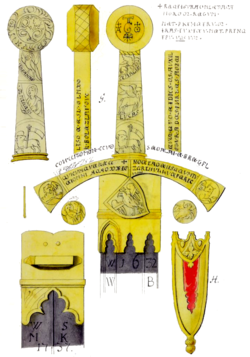
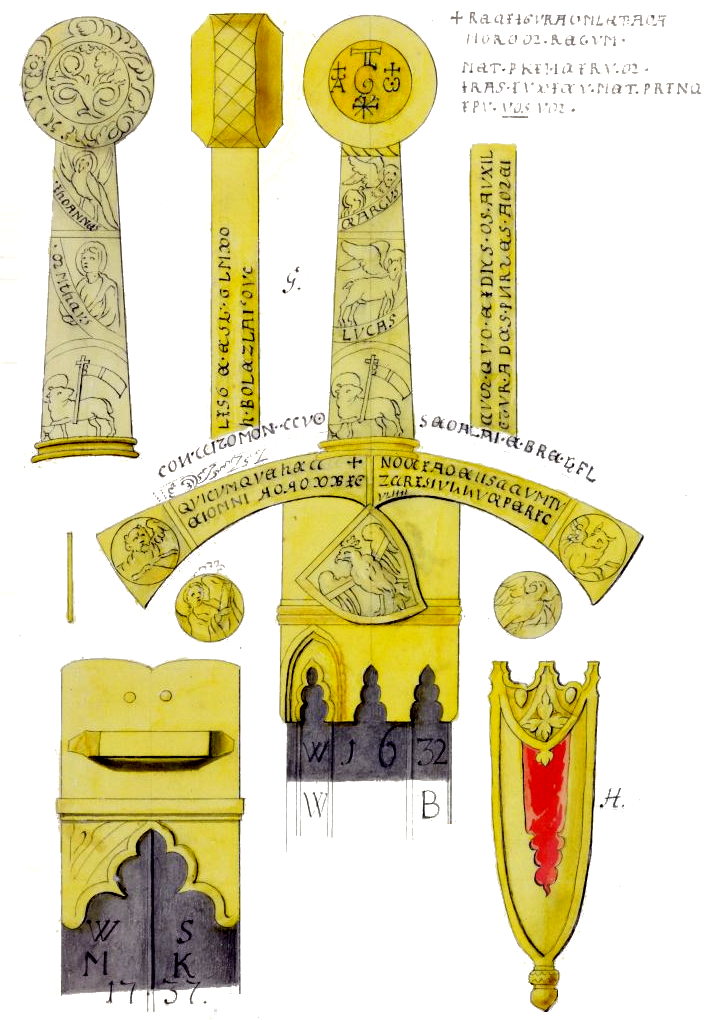
On the obverse side of the hilt, the pommel bears a large stylized letter T on top of a letter C or G (the latter could be just a decorative element of the letter T) between the Greek letters Α and ω (alpha and omega) surmounted with little crosses. Below the letter T, there is another cross placed within a cloud or flower with twelve petals. On the chamfered edge around this design runs a circular Latin inscription in two rings which reads: Rec figura talet ad amorem regum / et principum iras iudicum ("This sign rouses the love of kings and princes, the wrath of judges"). The grip bears the symbols of two of the Four Evangelists: the lion of Saint Mark and the ox of Saint Luke, as well as an Agnus Dei (Lamb of God). The crossguard bears the following Latin inscription: Quicumque hec / nomina Deii secum tu/lerit nullum periculum / ei omnino nocebit ("Whoever will carry these names of God with him, no danger will harm him").
The reverse side of the pommel is decorated with a vine bush surrounded by a wreath of vine leaves. On the reverse of the grip, there are the eagle of Saint John and the angel of Saint Matthew, and another Agnus Dei. The crossguard bears, above another pattern of vine leaves, an inscription in corrupted Hebrew in Latin script: Con citomon Eeve Sedalai Ebrebel ("Fervent faith incite the names of God: Sedalai and Ebrehel"). On the opposite ends of the crossguard, there are again the symbols of Saints John and Matthew.
Szczerbiec
Szczerbiec (Polish pronunciation: [ˈʂt͡ʂɛr.bʲɛt͡s]) is the ceremonial sword used in the coronations of most Polish monarchs from 1320 to 1764. It now is displayed in the treasure vault of the royal Wawel Castle in Kraków, as the only preserved part of the medieval Polish crown jewels. The sword is noted for its hilt, decorated with magical formulae, Christian symbols, and floral patterns, as well as for the narrow slit in the blade which holds a small shield with the coat of arms of Poland. The name of the sword is derived from the Polish word szczerba ("gap", "notch", or "chip"), and its meaning is incorrectly perceived as "the Notched Sword" or "the Jagged Sword" (which is included in the sword's legend), though the edges of its blade are straight and smooth. Proper meaning and rendering into English would be "the Notching/Jagging Sword" — as "a sword that is meant to notch/jag other weapons".
The legend links Szczerbiec with King Boleslaus I the Brave who was said to have chipped the sword by hitting it against the Golden Gate of Kiev during his intervention in the Kievan succession crisis in 1018. However, the Golden Gate was only constructed in 1037 and the sword is actually dated to the late 12th or 13th century. It was first used as a coronation sword by Ladislaus the Short in 1320. Looted by Prussian troops in 1795, it changed hands several times during the 19th century until it was purchased in 1884 for the Hermitage Museum in Saint Petersburg. The Soviet Union returned it to Poland in 1928 as part of war reparations for their loss against Poland in the Polish-Soviet war. During the Second World War, Szczerbiec was evacuated to Canada and did not return to Kraków until 1959. In the 20th century, an image of the sword was adopted as a symbol by Polish nationalist and far-right movements.
Szczerbiec is a 98 cm-long (39 in) ceremonial sword bearing rich Gothic ornamentation, dated to the mid-13th century. It is classified as a type XII sword with a type I pommel and a type 6 crossguard according to the Oakeshott typology, although the blade may have changed its shape due to centuries of corrosion and intensive cleaning before every coronation.
The hilt consists of a round pommel, a flat grip and an arched crossguard. The grip is 10.1 cm (4.0 in) long, 1.2 cm (0.5 in) thick, and from 2 to 3 cm (0.8 to 1.2 in) wide. It is rectangular in cross-section and its hard edges make it difficult to handle and impractical for fighting, which is indicative of the sword's purely ceremonial usage. The pommel is 4.5 cm (1.8 in) in diameter and 2.6 cm (1.0 in) thick, with a chamfered outer ring that is 1.3 cm (0.5 in) wide. The crossguard forms an arch that is 1.8 cm (0.7 in) wide in the middle and widens up to 3.4 cm (1.3 in) at both ends. It is 1 cm (0.4 in) thick near the grip and measures 20 cm (8 in) in length along its upper edge.
The pommel and the crossguard are made of silver. The core of the grip is a brass chest encasing the tang of the blade. It was probably made in the 19th century to replace an original organic core, which had decomposed. At the same time the tang was riveted to the top of the pommel. The head of the rivet, which is 0.5 cm (0.2 in) in diameter, rests atop a rectangular washer measuring 1.1 cm × 1.4 cm (0.43 in × 0.55 in).
All parts of the hilt are covered with golden plates, which are engraved with sharp or rounded styli and decorated with niello, or black metallic inlay that contrasts against the golden background. Each plate is 1 mm (0.04 in) thick and made of about 18-carat gold. The niello designs include inscriptions written in late Romanesque majuscule (with some uncial additions), Christian symbols, and floral patterns. The floral ornaments are in negative, that is, golden against a black, nielloed background.
On the obverse side of the hilt, the pommel bears a large stylized letter T on top of a letter C or G (the latter could be just a decorative element of the letter T) between the Greek letters Α and ω (alpha and omega) surmounted with little crosses. Below the letter T, there is another cross placed within a cloud or flower with twelve petals. On the chamfered edge around this design runs a circular Latin inscription in two rings which reads: Rec figura talet ad amorem regum / et principum iras iudicum ("This sign rouses the love of kings and princes, the wrath of judges"). The grip bears the symbols of two of the Four Evangelists: the lion of Saint Mark and the ox of Saint Luke, as well as an Agnus Dei (Lamb of God). The crossguard bears the following Latin inscription: Quicumque hec / nomina Deii secum tu/lerit nullum periculum / ei omnino nocebit ("Whoever will carry these names of God with him, no danger will harm him").
The reverse side of the pommel is decorated with a vine bush surrounded by a wreath of vine leaves. On the reverse of the grip, there are the eagle of Saint John and the angel of Saint Matthew, and another Agnus Dei. The crossguard bears, above another pattern of vine leaves, an inscription in corrupted Hebrew in Latin script: Con citomon Eeve Sedalai Ebrebel ("Fervent faith incite the names of God: Sedalai and Ebrehel"). On the opposite ends of the crossguard, there are again the symbols of Saints John and Matthew.
Recent media
Recent media