

TEP70
View on Wikipedia | This article relies largely or entirely on a single source. (December 2014) |
| TEP70 | |||||||||||
|---|---|---|---|---|---|---|---|---|---|---|---|
 | |||||||||||
| |||||||||||
| |||||||||||
| |||||||||||
The TEP70 is a main line single-unit diesel locomotive, rated at 2,964 kW (3,975 hp), with AC/DC transmission and individual axle traction control, designed to haul passenger trains on the Russian gauge railway network of eastern Europe. As of 2022, it is still in service in Russia, Ukraine, Belarus, Estonia, Latvia, Lithuania, and Kazakhstan. It is the successor to the TEP60, with many design elements is derived from that locomotive; however, the engine was replaced by a four-stroke one. TEP70, especially its experimental batch (first 7 locomotives), incorporated some features of British Rail HS4000,[1] for example, its bogies and some elements of driving control equipment. Later batches of this locomotive incorporated some design features from TEP75 experimental locomotive and predecessor TEP70. Final batches, produced until 2006, also had several important improvements.
The TEP70 diesel locomotive has been used as the basis of two other sub classes, the TEP70BS and the TEP70U.[2]
The TEP70 also shares a number of components with the 2TE70 two-unit freight locomotive.
Operators
[edit]Gallery
[edit]-
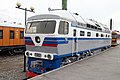 TEP70-0007 at the Central Museum of Railway Transport, Russian Federation, at Varshavsky Rail Terminal, Saint Petersburg
 -
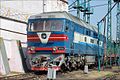 TEP70-0156 of Ukrainian Railways
 -
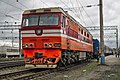 TEP70-0493
 -
 TEP70BS-093
 -
 TEP70BS-239
 -
 TEP70BS-140 of Uzbek Railways
 -
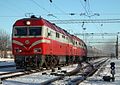 TEP70BS-002 of Lithuanian Railways
 -
 TEP70U-014


See also
[edit]- The Museum of the Moscow Railway, at Paveletsky Rail Terminal, Moscow
- Rizhsky Rail Terminal, Moscow, Home of the Moscow Railway Museum
- Varshavsky Rail Terminal, St.Petersburg, Home of the Central Museum of Railway Transport, Russian Federation
- History of rail transport in Russia
References
[edit]
- ^ "HS4000 Kestrel, Hawker Siddeley, 16LVA24".
- ^ "TEP70 Passenger Diesel Locomotive". Archived from the original on 2012-07-16. Retrieved 2011-08-14.
 | This diesel locomotive-related article is a stub. You can help Wikipedia by expanding it. |
TEP70
View on GrokipediaOverview and Specifications
General Characteristics
The TEP70 is a diesel-electric mainline passenger locomotive featuring AC/DC transmission and individual axle traction control for enhanced performance on broad-gauge networks.[6] It employs a Co′Co′ wheel arrangement under the UIC classification, consisting of two three-axle bogies with all axles powered.[9] Designed for the 1,520 mm Russian broad gauge, the locomotive's configuration prioritizes stability and traction for passenger services.[6] Manufactured by the Kolomna Locomotive Works in the USSR and later Russia, the TEP70 incorporates a robust frame and body structure optimized for high-speed passenger operations.[10] Its full service weight measures 135 tonnes (129 tonnes at 2/3 fuel and sand), distributed across six axles to yield an axle load of approximately 22.5 tonnes (21.5 tonnes at 2/3 fuel and sand).[11] The overall length between buffers is 21.7 meters, providing a compact yet capacious design for coupling with long passenger consists.[9] The TEP70 shares significant mechanical components, including the prime mover and main generator, with the related 2TE70 freight locomotive variant, allowing for commonality in maintenance and parts supply across both passenger and freight applications.[11] This design philosophy underscores the locomotive's role as a versatile platform in Soviet-era rail engineering.[3]Performance and Dimensions
The TEP70 locomotive is powered by a 16ЧН26/26 four-stroke diesel engine, featuring a 16-cylinder V-configuration with turbocharging, rated at 1,000 rpm.[12] This prime mover delivers a continuous power output of 2,942 kW (4,000 hp) at the crankshaft, enabling efficient high-speed passenger service.[4] The engine's design emphasizes reliability and fuel efficiency, supporting sustained operation under demanding conditions.[13] The transmission system employs an AC/DC electric configuration, where the main synchronous generator produces three-phase alternating current that is rectified to direct current for supply to six traction motors—one per axle.[14] These traction motors are individual DC series-wound units of the ED-119 type, each rated at approximately 411 kW, incorporating an automatic transition from series to parallel connection to optimize torque and speed across operating ranges.[15] This setup allows for precise control of power distribution to the Co'Co' wheel arrangement. Key operational performance metrics include a maximum speed of 160 km/h (99 mph), suitable for mainline passenger duties.[4] The starting tractive effort reaches 280 kN (62,900 lbf), providing strong acceleration for heavy trains, while the continuous tractive effort is 167 kN (37,600 lbf) at 50 km/h, balancing power output with thermal limits for prolonged runs.[16] Fuel capacity stands at 6,000 kg, complemented by a sand capacity of 800 kg for adhesion enhancement, ensuring extended range without frequent refueling. Braking is handled by a combination of pneumatic and dynamic (rheostatic) systems, with later models incorporating regenerative braking to recover energy during deceleration and improve overall efficiency.[14] These systems maintain safe stopping distances even at high speeds, with the locomotive's overall length of 21.7 m accommodating the integrated components without compromising stability.[9]| Parameter | Value |
|---|---|
| Power Output | 2,942 kW (4,000 hp) |
| Maximum Speed | 160 km/h (99 mph) |
| Starting Tractive Effort | 280 kN (62,900 lbf) |
| Continuous Tractive Effort | 167 kN (37,600 lbf) at 50 km/h |
| Fuel Capacity | 6,000 kg |
| Sand Capacity | 800 kg |