Hubbry Logo
VL80VL80Main
Open search
VL80
Community hub
VL80
logo
8 pages, 0 posts
0 subscribers
Be the first to start a discussion here.
VL80
VL80
from Wikipedia
VL80
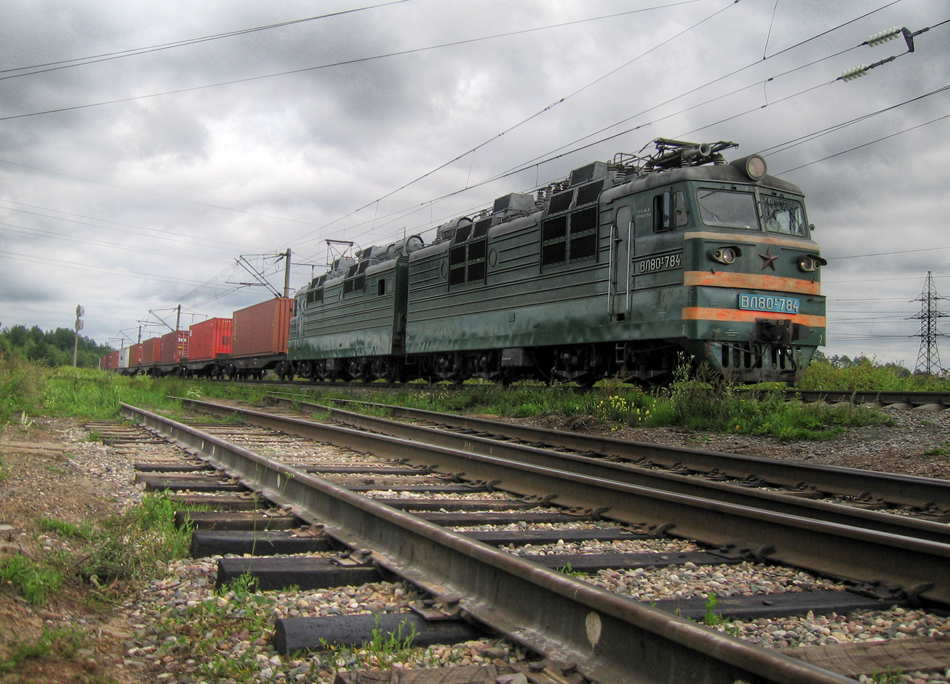
VL80t-784 passing through the Sharya Kostromskaya region
Type and origin
Power typeElectric
BuilderNEVZ SUN RUS
Build date1961 - 1995
Total produced4,921
Specifications
Configuration:
 • UICBo′Bo′+Bo′Bo′
Gauge1,520 mm (4 ft 11+2732 in)
Length32.48 m (106 ft 7 in)
Height5.1 m (16 ft 9 in)
Electric system/s25 kV 50 Hz AC Catenary
Current pickupPantograph
Traction motors8×НБ-418К6 (en: NB-418K6)
Loco brake?
Train brakesMechanical pneumatic
Performance figures
Maximum speed110 km/h (68 mph)
Power output4,880 or 6,400 kW (6,540 or 8,580 hp) (depending on model)
Career
OperatorsРЖД, БЧ, КТЗ, УЗ, OTY
LocaleRussia Russia
Soviet Union Soviet Union
Belarus Belarus
Kazakhstan Kazakhstan
Ukraine Ukraine
Uzbekistan Uzbekistan

The VL80 (ru: ВЛ80) is a Soviet (and later Russian) built electric AC mainline freight locomotive. The initials VL are those of Vladimir Lenin (ru: Владимир Ленин), after whom the class is named.

History

[edit]

Designed by the Всероссийский научно-исследовательский и проектно-конструкторский институт электровозостроения (en: All-Russian scientific research and design-engineering institute of electric locomotive construction) – usually abbreviated to ВЭлНИИ – the VL80 had the longest production span of any Soviet electric locomotive at 33 years from 1961 to 1994. All variants of the series were built at the Novocherkassk Electric Locomotive Plant (NEVZ; ru: НЭВЗ) with all mechanical parts, traction engines, and auxiliary electric machinery manufactured there as well. Some of the important components, such as the tractive transformer, were sourced from other factories.

The first VL80s were characterised by their mercury arc rectifiers. Later, they were replaced with silicon ones, thus giving birth to the ВЛ80К (en: VL80K) series. The К stands for кремний, the Russian word for silicon. Between the years 1961 and 1973, a total of 695 VL80Ks had been produced.

Currently, the VL80 series is used on all electrified routes in Russia, as well as in Kazakhstan, Uzbekistan, Belarus, and Ukraine.

Technical data

[edit]

The VL80 is a dual-section (or articulated) locomotive composed of two identical units, each resting on two two-axle bogies, powered by eight НБ-418К6 (en: NB-4186K6) electric tractive motors equipped with axle-support suspension. In order to pick up the current from overhead lines, the VL80 is fitted with two pantographs; one above the driver's cab on each section. Similarly, each section of the locomotive is equipped with one ОДЦЭ-5000/25Б (en: ODCE-5000/25B) tractive transformer. The VL80T and ВЛ80С (en: VL80S) models are furnished with dynamic brakes.

VL80T

[edit]

Manufactured between 1961 and 1980, the VL80T (ru: ВЛ80т) introduced a markedly different electrical system, as well as an improved lateral support system which improved the locomotive's stability. Originally, the series used spring suspension similar to that found in the VL80K, but all models built since 1971 have cradle suspension. A total of 2,107 units were made during the 19 years in which the series was in production.

VL80R

[edit]

Designed for use along the difficult sections of the Krasnoyarsk, Eastern Siberia, and Far Eastern routes – as well as the "Батайск" (en: Bataysk) depot in the North Caucasus – the VL80R (ru: ВЛ80Р) has the same tractive capabilities as the VL80T and the VL80S. The difference between the VL80R and the two aforementioned models is that it has an improved anti-wheelslip system which continuously regulates the amount of voltage supplied to the traction engines, thus ensuring that an increase in thrust doesn't result in jerks, which invariably lead to wheelslip. The VL80R gets its R designation from the fact that it is fitted with regenerative braking (ru: рекуперативное торможение) mechanism.

Several locomotives, assigned to the Krasnoyarsk section, have been modernised and are capable of participating in MU operations with consists containing 3 coupled units.

Despite having been in production for almost 20 years (1967-1986), a mere 373 examples rolled out of the NEVZ plant.

Notable examples

[edit]

ВЛ80Р-1549 was used as an exhibit at the Электро-77 (en: Elektro-77) expo held in Moscow in June 1977.

Built in 1982, ВЛ80Р-1718 became the 10,000th locomotive to be produced by NEVZ, since the plant's inception in 1936.

ВЛ80Р-1685 featured in the Soviet film Магистраль (en: Mainline) and has obtained cult status amongst Russian rail enthusiasts.

VL80S

[edit]

The VL80S (ru: ВЛ80с) is simply a VL80T which has been modified for use in MU operations. The 'S' in its name derives from the first letter of the Russian term for multiple-unit train control: Система Многих Единиц (literally: Multiple Unit System) and commonly shortened to СМЕ.

The first VL80Ss to roll off the production line were designed to work with only two or four coupled units (or sections). In 1982, unit numbers 550, 551, and 552 were built to work with sets of two, three, or four sections. All VL80Ss built since 1983 (ВЛ80с-697 being the first of these) have this capability. The only restriction is that the consist cannot be a third trailer section equipped with dynamic brakes. Due to the needed design modifications, the new certified weight became 192 t (212 short tons).

A total of 2,746 examples were built at the NEVZ works between 1979 and 1994.

VL80SM

[edit]

The last of the VL80 series, only 4 VL80SMs (ru: ВЛ80см) were built during the model's three year, post-Soviet production life (1991-1994). All four units are currently housed at the Bataysk depot in the North Caucasus.

Revisions and contributorsEdit on WikipediaRead on Wikipedia
from Grokipedia
The VL80 is a series of two-section electric mainline freight locomotives developed in the for operation on 25 kV 50 Hz AC electrified railways, featuring a and produced from 1961 to 1995 by the . Designed by the All-Union Electric Transport Research Institute (VElNII), the VL80 series addressed the need for powerful on the expanding Soviet rail network, with the "VL" designation honoring and the "80" indicating its sequential development in the VL line. The locomotives measure approximately 32.8 meters in length, weigh around 184 tonnes, and achieve a top speed of 110 km/h, powered by eight traction motors delivering between 4,880 kW and 6,400 kW of hourly power depending on the variant. Over 4,900 units were built across multiple sub-variants, making it one of the most prolific electric locomotives in Soviet and post-Soviet rail history, primarily used for heavy freight on lines in , , , , and . Key variants include the VL80K, the first mass-produced model from 1963 with rectifiers replacing earlier mercury-arc types for improved efficiency; the VL80T, introduced in 1967 with rheostatic braking for better ; the VL80R from 1973, featuring control and ; and the VL80S, the most numerous subtype with 2,746 units produced starting in 1980, allowing operation in up to four coupled sections for ultra-heavy loads. Experimental models like the VL80A, VL80B, and VL80V explored advanced features but saw limited production. The series' robust design contributed to its longevity, with some units still in service as of 2025 after modernizations such as the VL80SM variant in the 1990s.

Development and Production

Historical Background

The VL80 series of electric locomotives originated in the late 1950s, when the faced increasing freight transportation demands on its expanding electrified rail network. To address the need for more powerful and efficient locomotives capable of handling heavier loads, the All-Union Scientific Research and Design Institute for Electric Locomotives (VELNII) initiated the design of an advanced AC-powered freight model. This effort was driven by the rapid of mainlines and the limitations of existing DC locomotives in meeting industrial output goals during the economic recovery. The design drew significant influence from the earlier VL10 series, a successful DC electric , by adapting its proven mechanical components for AC operation on the emerging 25 kV 50 Hz system. This shift to AC was pivotal, as it allowed for higher voltages and greater efficiency over long distances, aligning with the Soviet strategy to standardize across vast territories. VELNII engineers focused on creating a two-section, eight-axle configuration to optimize traction and stability for heavy freight services. Initial prototypes, designated N81001 and N81002, were constructed and subjected to rigorous testing in on electrified test sections, evaluating performance under various load conditions and speeds. These trials demonstrated the locomotive's potential for reliable operation, leading to approval for series production by at the (NEVZ). The positive outcomes from prototype testing paved the way for the VL80 to become a cornerstone of Soviet . Early VL80 models initially incorporated mercury arc rectifiers for converting AC to DC power for the traction motors, but this technology proved bulky and less efficient. Starting with the VL80K variant in 1963, the design transitioned to silicon rectifiers, which offered improved reliability, reduced maintenance, and higher efficiency, marking a key technological advancement in Soviet .

Manufacturing and Output

The VL80 series was manufactured exclusively at the (NEVZ) from to 1995, spanning 34 years of continuous production. A total of 5,140 units were built across all variants during this period. Early production from to 1964 involved a limited series of the base VL80 configuration with mercury-arc rectifiers (24 units total), followed by mass production of the VL80K variant starting in 1963, which laid the foundation for subsequent developments. Output reached its peak during the and , driven by expanded manufacturing of variants including the VL80T and VL80S to meet growing freight demands on electrified lines. Production concluded in the mid-1990s as NEVZ transitioned to advanced designs.

Design and Technical Specifications

Overall Configuration

The VL80 electric locomotive features a dual-section design optimized for heavy freight on electrified lines, classified under the UIC as Bo′Bo′+Bo′Bo′, with each section supported by two two-axle bogies for enhanced stability and traction. This configuration allows the locomotive to distribute power across eight axles, enabling it to handle substantial loads while navigating standard curves on broad-gauge tracks. Key dimensions of the VL80 include an overall length of 32.48 meters between the couplers, a height of 5.1 meters from the railhead to the lowered , and a width of approximately 3.24 meters, all tailored to the Russian broad gauge of 1,520 mm. These proportions ensure compatibility with the overhead system and constraints of Soviet-era and post-Soviet networks. The locomotive's service weight varies between 184 and 192 tons depending on variant-specific modifications and sand reserves, resulting in an of about 23 tons that balances with track loading limits. Structurally, the two sections are permanently linked via a central articulated , which facilitates load sharing and maneuverability, while each section mounts a single centrally on the roof for collecting 25 kV AC power from the . This setup provides redundancy in power collection and contributes to the locomotive's robust, modular architecture for long-term reliability in freight operations.

Electrical and Mechanical Systems

The VL80 electric locomotive draws power from a 25 kV, 50 Hz AC overhead catenary system via roof-mounted pantographs, one per section, enabling reliable collection of electrical energy for mainline freight operations. The AC supply is fed into main step-down transformers that reduce voltage to suitable levels, followed by diode rectifiers that convert it to DC for the traction circuit; this configuration ensures efficient power delivery while accommodating voltage fluctuations in the 19-29 kV range. Auxiliary circuits, including compressors and fans, are powered by separate transformer windings. At the core of the propulsion system are eight НБ-418К6 DC traction , arranged as four per in an axle-hung, nose-suspended configuration that minimizes unsprung weight and optimizes transmission to the wheels through gear drives. These series-wound , cooled by dedicated blower fans, deliver an hourly power rating of 6,520 kW and a continuous rating of 6,160 kW in the early production designs, with later configurations in the series achieving up to 7,200 kW through improved and control enhancements. The system supports a maximum speed of 110 km/h and provides a starting of approximately 450 kN, sufficient for hauling heavy freight consists on undulating . Braking is achieved through a combination of dynamic and mechanical systems, where dissipates as heat in onboard resistors during deceleration, supplemented by pneumatic air brakes acting on all axles for emergency and parking functions. While the base VL80 relies primarily on to control speed and dissipate energy during descent, mechanical brakes serve as the primary backup to ensure safe stopping distances. Control of acceleration involves switching of taps to vary output voltage, augmented by starting resistors to limit inrush currents to the motors and prevent wheel slip; anti-slip mechanisms, such as field weakening and sanders, were refined in subsequent series iterations for better under varying conditions.

Variants

VL80 and VL80K

The VL80 served as the foundational model of the series, introduced in as a two-section designed for heavy freight service on the Soviet Union's 25 kV electrified lines, with only 19 units built from to 1962. Equipped with mercury arc rectifiers to convert to for the traction motors, it marked an early step in modernizing freight with eight powered axles arranged in a + configuration. These locomotives were initially deployed on major mainlines, including the , where they handled substantial cargo loads in demanding conditions such as extreme cold and long distances. The VL80K emerged as an upgraded iteration, replacing the mercury arc rectifiers with silicon-based units for enhanced power conversion efficiency and operational reliability. This transition addressed key shortcomings of the original rectifier technology, which was prone to unreliability in applications due to issues like arc instability and mercury handling. A total of 695 VL80K units were built as the first mass-produced variant, focusing on sustained freight performance without introducing more extensive redesigns like later braking systems. Both the VL80 and VL80K emphasized straightforward freight duties but faced elevated maintenance demands from their rectifier systems, particularly the mercury arc components that required specialized upkeep and posed environmental risks from mercury vapor. These factors contributed to their progressive replacement by subsequent variants offering solid-state advancements and reduced servicing needs, though many remained in service across successor states into the late .

VL80T

The VL80T variant of the VL80 series represents an evolution in Soviet mainline electric freight locomotives, emphasizing reliability and efficiency on 25 kV AC electrified lines. Produced at the from 1967 to 1980, a total of 1,317 units were manufactured, making it one of the most numerous subtypes in the series. Key enhancements in the VL80T included a redesigned electrical , an improved lateral support mechanism that boosted track stability particularly on curved sections, and the integration of rheostatic ( as a standard feature. These modifications reduced wheel wear compared to prior models and supported consistent performance in demanding conditions. With a service weight of 184 tons, the locomotive was optimized for heavy freight hauling, featuring a Bo'Bo'+Bo'Bo' and a top speed of 110 km/h. The VL80T achieved widespread adoption across the Soviet Union's railway network, serving primarily in general freight operations until the , where it played a central role in transporting bulk goods on major lines.

VL80R

The VL80R variant of the VL80 series was developed to incorporate advanced and improved traction control systems, addressing limitations in earlier models for enhanced reliability on electrified lines. Production commenced with the VL80R-300 in at the (NEVZ), followed by additional prototypes in 1969 and 1973, and serial output from 1974 to 1986, yielding a total of 373 units. These locomotives maintained a service weight of 192 tons and an of 24 tons, with a top speed of 110 km/h, while integrating thyristor-based converters for smoother operation. Key technical upgrades in the VL80R focused on braking and control enhancements, including a full system that inverted back to for return to the contact network, achieving up to 12% average and forces of 358 kN at 50 km/h. The advanced anti-wheelslip system utilized stepless voltage regulation via rectifiers, providing improved traction control in slippery conditions by preventing abrupt wheel spin during and enabling higher in power recovery compared to non-regenerative predecessors. This configuration allowed for better performance on gradients and in adverse weather, with traction parameters aligned to those of contemporary VL80 variants. Notable examples of the VL80R include VL80R-1549, which was displayed at the Electro-77 exhibition in to showcase its regenerative capabilities; VL80R-1718, marking NEVZ's 10,000th produced in late ; and VL80R-1685, which gained cultural prominence as a featured in the 1983 Soviet film Magistral (Mainline), depicting railway operations. These units exemplified the variant's role in heavy freight service. The VL80R was specialized for challenging terrains, primarily operating on heavy-haul sections of the , East Siberian, and Far Eastern railways within , as well as lines extending to neighboring states in the former , where its slip prevention and braking efficiencies proved vital for reliable in rugged, variable conditions.

VL80S

The VL80S represents the most produced variant in the VL80 series, with 2,746 units manufactured at the from 1979 to 1995. This extended production run solidified its role as the backbone of Soviet and post-Soviet freight operations on 25 kV AC electrified lines, outnumbering all other subtypes combined. A primary adaptation of the VL80S was its design for multiple-unit (MU) control, enabling synchronized operation of up to four sections from a single cab to handle exceptionally heavy freight trains. Initial models supported configurations of two or four sections, but from onward—with the introduction of unit VL80S-697—enhanced MU systems allowed for two, three, or four sections, excluding certain dynamic brake trailers in triple setups. These modifications included improved electrical and mechanical couplings for transmission, which increased traction efficiency and stability on steep gradients and for loads exceeding 6,000 tons. The locomotive's service weight of 192 tons further supported its suitability for demanding hauls, with an optimized for heavy rail infrastructure. As the final major variant before the VL80 series concluded in , the VL80S transitioned seamlessly into post-Soviet operations, remaining a staple for operators in , , and well into the . Its MU scalability addressed the growing demands of industrial freight corridors, such as the , where it often operated in multi-section formations for maximum pulling power.

VL80SM

The VL80SM was a short-production variant of the VL80 series, developed as an experimental modernization of the VL80S to incorporate advanced control and enhancements. Only four units, numbered 3001 to 3004, were constructed between 1991 and 1994 at the , marking it as a limited-run rather than a full series. These locomotives featured microprocessor-based automatic control systems for improved and reliability. Key upgrades focused on electrical and traction components, including the replacement of NБ418К6 traction motors with more efficient NБ514 models, expanding positions from 32 to 36 for finer . Redesigned rectifiers, transformers, and reactors minimized power losses, boosting overall by 2% and yielding annual savings of approximately 0.833 million kWt-h per unit. Inclined traction links further optimized force utilization by 5-7%, while the design achieved 85% unification of mechanical and electrical parts with emerging standards. Adapted for harsh environmental conditions ranging from -50°C to +60°C, the VL80SM served as a transitional bridge to the series, testing concepts for future replacements of the VL80 lineup before serial production plans were curtailed. Today, all four VL80SM units are preserved at the Bataysk depot of the Railway, having been withdrawn from operational service in October 2016.

Operations and Legacy

Primary Operators

The primary operator of VL80 locomotives is (RZD), which maintains the largest fleet and deploys them extensively on electrified mainlines, including the for heavy freight haulage. As of 2024, these locomotives continue to see regular service across RZD's network, with modernization programs extending their operational life through upgrades to electrical systems and reliability enhancements. Ongoing efforts, such as those highlighted in recent depot overhauls, ensure their continued role in Russia's vast rail infrastructure. Other significant operators include the , which runs VL80S variants on its freight routes, with examples like VL80S-592 documented in active use as recently as 2021. In , Kazakhstan Temir Zholy (KTZ) focuses VL80 locomotives on freight operations across its extensive network, though the operator is actively phasing them out in favor of newer models, with contracts signed in for 117 replacement electric locomotives capable of hauling up to 9,000-ton trains. Ukrzaliznytsia in operates a reduced number of VL80 units post-2014 due to geopolitical disruptions and infrastructure challenges, but continues to procure spare parts and perform repairs to sustain the remaining fleet for AC-electrified lines. Uzbekistan employs VL80 series locomotives on central Asian freight corridors, where they handle varying route difficulties in sectional configurations. As of 2025, many VL80 units remain operational across these networks, supported by routine maintenance to address wear on aging components. The locomotives' design aligns with the 1,520 mm broad gauge and 25 kV AC electrification standards prevalent in former Soviet states, enabling seamless cross-border operations and regional adaptability without major modifications.

Notable Uses and Preservation

The VL80 series locomotives were instrumental in hauling heavy freight along key electrified corridors in the Soviet Union, including the Trans-Siberian Railway and lines connecting industrial heartlands to ports, where they supported the transport of raw materials and goods essential to the planned economy. Following the dissolution of the USSR in 1991, these locomotives continued to underpin post-Soviet economic recovery by facilitating bulk cargo movement across vast distances in Russia, Ukraine, Kazakhstan, and other successor states, often operating in extreme winter conditions that tested their robust design. Their reliability in such environments contributed to sustained freight volumes, with variants like the VL80S remaining active on networks such as Kazakhstan Temir Zholy into the 2020s. Preservation efforts highlight the VL80's enduring significance as a hallmark of Soviet-era railway electrification. Several units have been retired and maintained as static exhibits, including VL80-1980 (built 1978), preserved at the Museum of the Amur Bridge in , showcasing its role in the electrification of the at the Amur Bridge. Another example is on display at the Novosibirsk Open-Air Railway Museum, where a VL80 represents the evolution of AC electric traction in . Operational heritage persists at active depots, such as Bataysk in Russia's Rostov region, where VL80K and VL80SM units are maintained for occasional heritage runs and training. The VL80's influence extended beyond the USSR through exports and technology transfers, notably serving as the basis for the Chinese Railways 8G series, with approximately 100 units built between 1987 and 1990 and adapted for domestic heavy freight service. In China, preserved 8G locomotives—direct derivatives of the VL80—include 8G-002 at the China Railway Museum in Beijing and 8G-076 at the Taiyuan Railway Locomotive and Rolling Stock Works, underscoring the design's global legacy. Overall, the series symbolizes the pinnacle of Soviet heavy-haul engineering, with many units upgraded with modern thyristor controls to extend service life amid ongoing electrification projects.

References

Add your contribution
Related Hubs
User Avatar
No comments yet.