Hubbry Logo
VL85VL85Main
Open search
VL85
Community hub
VL85
logo
8 pages, 0 posts
0 subscribers
Be the first to start a discussion here.
VL85
VL85
from Wikipedia
VL85
Type and origin
BuilderNovocherkassk Electric Locomotive Plant
Build date1983 - 1994
Total produced270
Specifications
Configuration:
 • UICBo'Bo'Bo'+Bo'Bo'Bo'
Gauge1,524 mm (5 ft)
1,520 mm (4 ft 11+2732 in) Russian gauge
Wheel diameter1,250 mm (4 ft 1 in)
Minimum curve125 m (410 ft)
Length45.00 m (147 ft 8 in)
Width3.24 m (10 ft 8 in)
Height5.1 m (16 ft 9 in)
Loco weight288 t (283 long tons; 317 short tons)
Electric system/s25 kV 50 Hz AC Catenary
Current pickupPantograph
Traction motors12×НБ-514 (en: NB-514)
Loco brakeRegenerative
Performance figures
Maximum speed110 km/h (68 mph)
Power output9,360 kW (12,550 hp) Continuous 10,020 kW (13,440 hp) Short Term
Career
OperatorsРЖД (RZhD)
Nicknamesбык (Ox)
LocaleRussia Russia
Soviet Union Soviet Union

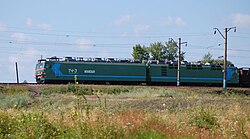
The VL85 (Russian: ВЛ85) is a Soviet (and later Russian) built electric mainline freight locomotive manufactured at the Novocherkassk Electric Locomotive Plant (NEVZ) and designed under the management of V.Ya.Sverdlov (ru:В.Я.Свердлов).[1]

History

[edit]

Designed by the Vsesoyuzny nauchno-issledovatel'ski i proektno-konstruktorski institut elektrovozostroeniya (en: USSR national scientific research and design-engineering institute of electric locomotive construction) – the VL85 was at the time of its introduction the most powerful production locomotive in the world. The first prototypes were built in 1983 and were tested on the experimental ring at the All-Russian Research Institute of Railway Transport (VNIIZhT). Further testing was performed on the North-Caucasian Railway. Full production began in 1985 and continued until 1994. A total of 270 units were built. All VL85 locomotives operate on the East-Siberian Railway and the Krasnoyarsk Railway, from depots at Ilanskaya, Taishet, Nizhneudinsk, and Ulan-Ude.

Technical characteristics

[edit]

The VL85 is twin-section electric locomotive consisting of two identical units, resting on three two axle bogies, and powered by twelve NB-514 traction motors delivering a continuous output of 12,450 horsepower (9.28 MW). The VL85 operates on single-phase alternating current. The locomotives are equipped for regenerative braking and are designed to operate in temperatures from −50 to 40 °C (−58 to 104 °F), and at altitudes up to 1,400 meters (4,600 ft). The minimum radius of curvature it can negotiate is 125 meters (410 ft). Total weight is 288 metric tons (283 long tons; 317 short tons).

Traction and braking forces are transmitted to the body via inclined rods. The end bogies on each unit have a cradle suspension, while the central Jacobs bogie has a set of swinging compressed elastic rods to allow for lateral movement through curves.[2]

To provide current collection there is a pantograph above each cab. Each unit has a 7,100 kVA traction transformer, model ONDTSE-10000/25-82UHL2. Each transformer has a high voltage winding and three traction windings. Each section also has three VIP-4000 rectifiers. Each is powered by its own traction winding and provides power to two parallel connected traction motors on a bogie. These rectifiers use thyristor control and also convert power back to alternating current during regenerative braking.

The first two prototypes used the same NB-418K6 traction motors as the VL80 series. Production units use the NB-514 model. Improvements in the aerodynamics of the ventilation ducts reduced the number of cooling fans for this motor by half.

A new feature of the cab is a single large control panel in the centre, replacing separate panels for the driver and assistant. In service these locomotives are nicknamed 'Ox' because of their size. Despite the theoretically greater adhesion that should be provided by the new suspension system (the point of transfer is below the axles) these units are noted as being slightly less 'grippy' than their VL80R predecessor, possibly due to difficulty in attaining perfect weight distribution across the three bogies.

References

[edit]
Revisions and contributorsEdit on WikipediaRead on Wikipedia
from Grokipedia
The VL85 (Russian: ВЛ85) is a two-section, 12-axle AC electric mainline freight locomotive designed for heavy-haul operations in severe climatic conditions, such as those on the Baikal-Amur Mainline (BAM). It features a maximum speed of 110 km/h and is powered by a 25 kV, 50 Hz overhead system, with a total power output of up to 10 MW delivered through twelve NB-514 traction motors. Developed as a successor to earlier models like the series, the VL85 incorporates advanced features including and independent excitation systems for enhanced traction and efficiency, achieving 15-20% improvements in force and braking over serial predecessors. Manufactured by the (NEVZ) from 1983 to 1994, approximately 270 units were produced, primarily for the Soviet and later Russian railway networks, including the and lines in eastern . The locomotive's rigid two-section design, with three-axle bogies per section utilizing ball-joint and elastic rod suspensions, allows it to handle steep gradients and curved tracks while maintaining stability under high loads. Despite production ceasing over three decades ago, VL85 units remain in active service on , valued for their reliability in and ongoing adaptations for improved electrical performance. Recent studies highlight its continued relevance, with traction motors like the NB-514 enduring thermal and vibrational stresses up to 170 MPa, prompting design refinements for longevity.

History

Development

In the early 1980s, the Soviet Union faced increasing demands for enhanced freight transport capacity along its expanding electrified rail network, particularly with the ongoing electrification of major mainlines such as the Trans-Siberian Railway and the Baikal-Amur Mainline (BAM), which required locomotives capable of hauling heavy resource-laden trains through challenging Siberian terrain. This need drove the development of a new generation of alternating current (AC) electric freight locomotives optimized for 25 kV 50 Hz systems, aiming to support the USSR's industrial and resource extraction goals in eastern regions. The conceptual design of the VL85 was led by the All-Union (VEI, or VЭлНИИ), which addressed limitations in existing multi-section locomotives like the VL80S by proposing a twin-section layout with twelve axles total to simplify equipment duplication, improve maintenance efficiency, and better handle heavy freight loads exceeding previous capabilities. VEI's requirements emphasized compatibility with the 25 kV 50 Hz AC electrification standard and a focus on high for steep grades, culminating in key milestones such as the selection of NB-514 asynchronous traction motors to achieve the targeted power output. Prototyping began in 1983 at the (NEVZ), where the first unit, VL85-001, was constructed in May, followed by VL85-002 later that year; these initial prototypes used NB-418K6 motors before transitioning to the more efficient NB-514 in production models. Testing protocols were coordinated by the All-Russian Railway Research Institute (VNIIZhT), including traction-energy evaluations on VNIIZhT's experimental ring for VL85-002 and dynamic braking plus track impact assessments on the North Caucasian Railway's Belorechenskaya-Maykop section for VL85-001, with operational trials conducted on Siberian routes like Mariinsk-Krasnoyarsk-Tayshet and Abakan-Tayshet-Lena to simulate real-world conditions. During prototyping, engineers encountered challenges in balancing high power output exceeding 9,000 kW—achieved through the ' enhanced current and voltage ratings—with reliability in extreme cold climates down to -50°C, addressed via Class F insulation on for improved and resistance. These issues were resolved through iterative testing, paving the way for serial production starting in 1985.

Production

Full-scale production of the VL85 began in 1985 at the (NEVZ), following the successful trials of prototypes constructed in 1983. That year, NEVZ assembled an initial installation batch of five units to expand testing and refine manufacturing processes before scaling up. Serial production commenced in 1986, marking the transition to regular output for deployment on electrified lines. The run spanned to , resulting in a total of 270 units manufactured at NEVZ. Output followed distinct phases: an initial series in –1986 focused on validation and limited expansion, reaching peak rates in the late to meet demand for heavy freight haulage in eastern , and gradually tapering in the early amid economic disruptions. involved streamlined assembly lines at NEVZ, where sections were constructed on bogies and integrated with key electrical components, including traction transformers such as the ODCzE model and pantographs sourced from Soviet-era suppliers. Production ceased in 1994 due to the dissolution of the USSR, which led to funding shortages and breakdowns in the post-Soviet era, prompting a shift toward more advanced designs like the VL86 series.

Introduction to service

The VL85 electric locomotives entered service in 1985 on the electrified lines of the Soviet rail network, with the initial production batch of five units deployed primarily for freight operations on the East n Railway. These locomotives were designed to handle heavy freight traffic in the harsh conditions of eastern , supporting the expansion of the 25 kV AC system. Initial testing in on the East Siberian Railway included load trials with heavy ore and trains along sections such as Mariinsk–Krasnoyarsk–Tayshet and Abakan–Tayshet–Lena, where the units successfully achieved their design tractive efforts over 5,000 km of operations with super-heavy consists. Based on early field feedback, minor adaptations were implemented, including improvements to crew via a unified control panel in the driver's cabin. The VL85 contributed significantly to the Soviet rail electrification program in the 1980s by boosting freight capacity on 25 kV AC lines, particularly aiding the and operation of the Baikal-Amur Mainline (BAM) through enhanced hauling of massive loads in extreme temperatures ranging from -50°C to +40°C. In operational use, the locomotives acquired the nickname (Бык in Russian) among crews, reflecting their robust and powerful build akin to the animal's strength for towing enormous trains.

Design

Configuration and structure

The VL85 is a twin-section electric locomotive comprising two identical sections, each featuring a with six powered axles, connected by a vestibule that facilitates passage between sections for operational flexibility. This configuration allows independent operation of each section or coupled multiple-unit control from any cab, enhancing efficiency on heavy freight routes. The overall dimensions measure 45 m in over buffers, 5.1 m in , and approximately 3.2 m in width, with each section supported by three two-axle bogies to distribute the 288 t service evenly. The structural framework utilizes welded for robustness against the demanding Siberian environment, including insulated cabs rated for temperatures as low as -50°C to ensure crew comfort and equipment reliability in extreme cold. Each employs an articulated design with primary suspension via coil springs and secondary suspension through rubber-metal elements, enabling the to handle tight track curves with radii down to 150 m while maintaining stability under the full of about 24 t. The body rests on the s via long, pivoting supports that allow lateral and vertical movement, contributing to smooth negotiation of uneven terrain common in eastern Siberian rail networks. The cab layout centers control functions in a single driver's compartment per section, providing space for two crew members along with essential amenities such as heating, ventilation, and storage, all integrated around a unified control desk for efficient operation. This design prioritizes ergonomics and accessibility, supporting extended shifts in remote, harsh conditions.

Electrical and propulsion systems

The draws power from a single-phase 25 kV 50 Hz AC overhead system, utilizing two pantographs—one mounted on each of its twin sections—for reliable current collection across varying operational conditions. This configuration ensures stable energy intake for heavy freight duties in electrified networks, particularly in eastern Siberian regions with challenging environmental factors. Power from the catenary is transformed via an oil-immersed main , model ONDCE-10000/25-82UHL2, installed on each section; this unit features multiple winding taps to regulate output voltage dynamically under load variations, optimizing efficiency during acceleration and sustained traction. The transformer's oil-air cooling system supports prolonged operation in extreme temperatures, a key adaptation for the locomotive's intended service areas. The propulsion system employs 12 asynchronous traction motors of the NB-514 type, with six motors per section in a bogie-mounted arrangement; these are supplied through a rectifier-inverter configuration consisting of three VIP-4000 units per section, which rectify the transformer's AC output to DC and then invert it to variable-frequency AC for precise and high delivery. This setup enhances power conversion efficiency compared to earlier resistive systems, minimizing energy losses in asynchronous motor operation. Propulsion is managed via thyristor-based control integrated into the VIP-4000 converters and the KM-87 master controller, enabling smooth phase-angle regulation for and delivering a high starting of approximately 740 kN to haul heavy trains from rest. The electronic management blocks, such as BUVIP-113, automate voltage and frequency adjustments to maintain optimal motor performance across speed ranges. Regenerative capabilities are inherent in the design, with the NB-514 motors functioning as generators during deceleration; the VIP-4000 units invert the recovered DC to 50 Hz AC, feeding energy back into the to reduce reliance on mechanical braking and extend component lifespan. This feature was a significant advancement for Soviet-era AC locomotives, improving overall in freight operations.

Braking and control systems

The VL85 locomotive employs a combined braking system that integrates regenerative electric braking with pneumatic mechanical brakes to ensure efficient deceleration across various operating conditions. Regenerative braking, facilitated by the VIP-4000 converter units, allows the traction motors to operate as generators, returning electrical energy to the contact network during deceleration, which enhances energy efficiency and reduces wear on mechanical components. For low-speed operations or when regenerative braking is insufficient, such as below approximately 10-15 km/h, the system transitions to pneumatic braking, utilizing compressed air from the main reservoirs to apply mechanical force via brake cylinders and pads on the wheels. This hybrid approach, including an optional rheostatic mode for dissipating excess energy as heat in resistors during prolonged low-speed stops, minimizes brake pad consumption by up to 3% compared to purely mechanical systems. Control systems are centralized at the driver's desk, featuring the KM-87 traction controller for managing power and speed, alongside the 395-3 driver's valve for precise pneumatic brake application. The desk includes dedicated handles for traction effort, independent and automatic braking modes, and raising/lowering, enabling seamless operation of the twin-section in multiple-unit (MU) configurations. Compatibility with (ATC) systems, such as SAUT-CM for train braking automation, allows for from any cab and enforces speed limits via trackside signals. The mechatronic control incorporates microprocessor-based BUVIP-133 blocks with loops to maintain stable braking force and optimize regenerative . Safety features include a deadman's switch, which requires periodic pedal activation by the driver to prevent unintended movement, triggering an emergency brake application if unattended. Overload protection is provided by dedicated relays that monitor current and voltage, automatically disconnecting circuits to avert electrical faults, while sanders deliver metered sand from onboard bunkers to the rails via nozzles for improved on icy or slippery surfaces. The crew interface emphasizes with a single large control desk in later units, equipped with analog gauges for monitoring pantograph voltage, traction current, pipe pressure, and motor temperatures to facilitate real-time adjustments. Communication capabilities were enhanced in subsequent modifications with the addition of radios for coordination with dispatchers and yard personnel. Maintenance of the braking and control systems benefits from a , allowing straightforward access to pads, cylinders, and electronic control modules during overhauls; for instance, the pneumatic block and panels can be isolated and serviced without full disassembly, reducing in depot operations.

Operations

Deployment and operators

The VL85 electric locomotives are operated exclusively by (RZhD), as the primary successor to the Soviet railway system that introduced the series, with no variants produced for export to other countries. These heavy freight machines were designed specifically for the 25 kV AC electrified networks in eastern , ensuring their deployment remains confined to domestic operations under RZhD management. Since their introduction, VL85 locomotives have been assigned to key depots on the East Siberian Railway and Krasnoyarsk Railway, including Ilanskaya, Taishet, Nizhneudinsk, and . These facilities support the locomotives' intensive use on Siberia's demanding terrain. Initial prototypes underwent assembly and preliminary testing at the on the North Caucasian Railway in the early 1980s, followed by operational trials on the starting in 1985. By 1987, production units were permanently allocated to the eastern networks, with basing at the specified depots to handle regional freight demands. The deployment emphasizes heavy freight service across , where VL85 units haul long trains loaded with coal, ore, and timber along electrified segments of the and related lines. This focus aligns with the locomotive's robust design for cold climates and high-traction needs in mountainous and forested areas. Maintenance responsibilities fall to RZhD's regional depots, where overhauls and servicing occur according to standardized schedules to sustain operational reliability.

Performance and usage

The VL85 exhibits strong , enabling it to haul freight trains weighing up to 6,000 tons at speeds of 110 km/h, particularly on multi-grade sections of Siberian rail networks. Its system enhances operational efficiency by recovering energy during descent, reducing overall power consumption in demanding heavy-haul scenarios. In usage patterns, the VL85 is predominantly deployed for winter operations in East Siberia, where it reliably manages snow, ice, and extreme cold down to -55°C, supporting year-round freight movement on lines like the Trans-Siberian and Baikal-Amur Mainline. Units typically accumulate high annual mileage, with depot-level totals exceeding 20 million km in intensive service years, underscoring their role in sustained heavy freight transport. Reliability data indicates low overall failure rates for the traction systems, with reversible converter-equipped models like the VL85 outperforming many contemporaries in harsh conditions; traction motor failures occur at approximately 7.3 per million km, primarily due to insulation issues exacerbated by moisture in cold weather. Occasional pantograph-related problems, such as icing in sub-zero temperatures, have been noted in extreme conditions, though these are mitigated through regular maintenance protocols. Notable events include the VL85's involvement in heavy-haul operations during the , where it supported record-level freight volumes on Siberian routes amid post-Soviet challenges. Minor overload incidents have occurred, often linked to exceeding normative train weights, but these have not significantly impacted overall fleet performance. Economically, the VL85 contributed to bolstering rail freight capacity during the post-Soviet transition by enabling efficient of eastern lines, sustaining and exports despite fleet aging and capacity constraints on key corridors.

Current status and preservation

As of 2025, the VL85 fleet consists of approximately 270 units originally produced, with nearly all remaining in regular service on (RZhD), excluding those lost to accidents or fires. Modernization efforts by RZhD in recent years have focused on upgrading control systems and instrumentation, including the installation of modern electronic electricity meters to replace outdated electromechanical devices and unification of the driver's control panel during overhauls. These locomotives continue to operate primarily on the 25 kV AC electrified lines of the East Siberian Railway and Krasnoyarsk Railway, hauling heavy freight on secondary routes in Siberia, such as the Mariinsk to Zabaykalsk corridor, where their high power output remains suitable for demanding gradients. Preservation activities are limited, with no major units documented in operational museums; however, enthusiast groups have expressed interest in restoration projects for retired examples, though no active initiatives were identified as of late 2025. Looking ahead, the aging fleet (over 30 years old) faces gradual replacement by newer AC electric models, though VL85 units are expected to persist in niche heavy-haul roles through the late due to their robust design.

Technical specifications

Power and speed

The VL85 delivers a continuous power output of 9,360 kW at the rail, enabling sustained high-performance hauling on heavy freight routes. Its hourly rating reaches 10,020 kW, allowing for intensified operation over shorter durations to handle demanding gradients and loads. These power levels position the VL85 among the most potent AC-driven freight locomotives developed in the late . The locomotive's maximum operational speed is 110 km/h, with continuous power maintained effectively up to 105 km/h, optimizing for long-haul freight on electrified lines. Starting stands at 726 kN, providing robust initial for trains exceeding 4,000 tonnes. limits, typically around μ ≈ 0.25 on dry rails, govern the acceleration profile, ensuring stable performance without wheel slip under nominal conditions. With a of approximately 32.5 kW per —calculated from its 9,360 kW continuous output and 288-tonne service weight—the VL85 achieves exceptional specific power for an AC locomotive, facilitating superior retention on curved sections of track and earning it the moniker "curve straightener" in operational contexts.

Dimensions and weight

The VL85 electric locomotive measures 45.00 m in length over the couplers, with a body width of 3.24 m and a height of 5.10 m to the lowered pantograph. These dimensions ensure compatibility with the standard Russian broad gauge of 1,520 mm, utilizing automatic SA-3 couplers positioned at a nominal axis height of 1040–1080 mm above the railhead for seamless integration with freight rolling stock. The total service weight of the VL85 is 288 t in its standard configuration, distributed evenly across 12 axles for an of 24 t. Later variants, such as those with reduced sand reserves (2/3 capacity), achieve a weight of 276 t and an of 23 t, providing flexibility for routes with varying limits. This weight distribution supports operation on bridges and tracks rated for up to 25 t per , minimizing structural stress while maintaining stability. Each features a nominal of 1,250 mm and a rigid of 2,900 mm, contributing to the locomotive's smooth navigation through curves with a minimum radius of 125 m. The three s per section are arranged to align with the 22.53 m section over couplers, ensuring balanced load transfer without exceeding track tolerances.

Environmental and operational limits

The is designed to operate within a temperature range of -50°C to +40°C, ensuring reliability in extreme cold and moderate heat typical of continental climates. This range applies to the overall locomotive structure, while electrical equipment can withstand up to +60°C internally, supported by integrated heating systems for critical components in sub-zero conditions and ventilation for cooling during warmer operations. The locomotive's altitude limit is 1,400 meters above , where reduced air density affects power intake and cooling efficiency, necessitating design adjustments in traction and auxiliary systems to maintain performance without . Key components feature protections against dust and moisture to safeguard electrical and pneumatic equipment from external environmental impacts, enabling suitability for harsh conditions along Siberian and routes with variable weather exposure. The mechanical structure supports operation on tracks with a minimum curve radius of 125 meters at speeds up to 10 km/h and 300 meters under general conditions, contributing to stability in windy environments through robust design. The design incorporates low measures, aligning with 1980s Soviet standards for rail equipment to minimize disruptions to signaling and communication systems along electrified lines.

References

Add your contribution
Related Hubs
User Avatar
No comments yet.