


Community hub
Recent from talks
Contribute something to knowledge base
Content stats: 0 posts, 0 articles, 1 media, 0 notes
Members stats: 0 subscribers, 0 contributors, 0 moderators, 0 supporters
Subscribers
Supporters
Contributors
Moderators
Hub AI
Taiwan, China AI simulator
(@Taiwan, China_simulator)
Hub AI
Taiwan, China AI simulator
(@Taiwan, China_simulator)
Taiwan, China
"Taiwan, China", "Taiwan, Province of China", and "Taipei, China" are controversial political terms that claim Taiwan and its associated territories as a province or territory of the People's Republic of China.
The term "Taiwan, China" (Chinese: 中国台湾) is used by Chinese state media and organizations and individuals. However the People's Republic of China – which is widely recognized by the international community as the legitimate representative of "China" – has never exercised jurisdiction over Taiwan and other islands controlled by the Republic of China (ROC).
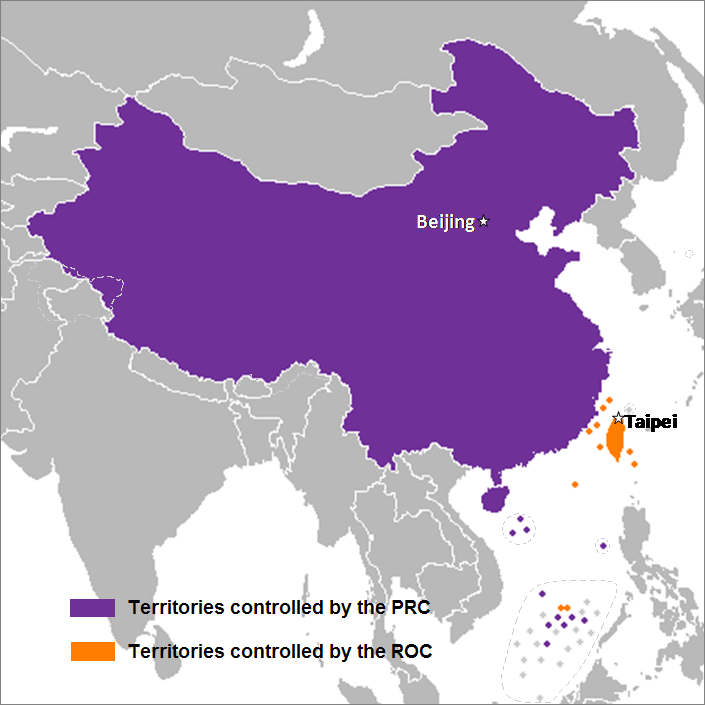
Such terms are ambiguous because of the political status of Taiwan and cross-Strait relations between "Taiwan" and "China". Since 1949, two political entities with the name "China" exist, each claiming to be the sole legitimate government of their combined territory:
The Chinese Communist Party (CCP) officially mandates the use of terms like "Taiwan, China". In contrast, the ROC government, along with supporters of Taiwan Independence, rejects them; citing that it denies the ROC's sovereignty and existence while reducing both its political and territorial status to a province of mainland China.[failed verification]
The dispute and ambiguity over the meaning of "China" and which "China" stemmed from the division of Republic of China into two Chinas at the "end" of the Chinese Civil War in 1955. (Fighting between the two merely eased off after 1949 and no signing of a peace treaty or armistice ever occurred; the PRC still threatens attack on ROC/Taiwan when it deems necessary.)[citation needed] The term "China" historically meant the various regimes and imperial dynasties which controlled territories in mainland Asia prior to 1911, when the imperial system was overthrown and the Republic of China (ROC) was established as an Asian republic. In 1927, the Chinese Civil War started between the Kuomintang (KMT, founding party of the ROC) and the CCP. The CCP eventually won control of most of ROC's original territory (mainland China) in 1949, when they proclaimed the "People's Republic of China" (PRC) on that territory.[citation needed]
Since then, two Chinas have existed, although the PRC was not internationally recognized then. The Republic of China government retrieved Taiwan in 1945 back from Japan, then fled in 1949 to Taiwan with the aim to retake mainland China. Both the ROC and the PRC still officially (constitutionally)[citation needed] claim mainland China and the Taiwan Area as part of their respective territories[citation needed]. In reality, the PRC rules only mainland China and has no control of but claims Taiwan as part of its territory under its "One China Principle". The ROC, which rules only the Taiwan Area (composed of Taiwan and its nearby minor islands), became known as "Taiwan" after its largest island, (an instance of pars pro toto)[citation needed]. Constitutional reform in 1991 amended electoral laws to focus on the territory controlled by the Republic of China, increasingly referred to as "the Republic of China on Taiwan" or simply "Taiwan".
After the 2008 election of Ma Ying-jeou, he again asserted that mainland China is part of Republic of China territory according to its constitution, and, in 2013, he stated that relations between PRC and ROC are not between countries but "regions of the same country".
In 1971, the People's Republic of China won the United Nations seat as "China" and the ROC withdrew from the UN.[citation needed] Since then the term "Taiwan, China" is a designation officially used in international organizations including the United Nations and its associated organs to refer to the Republic of China.[citation needed] (The term "Chinese Taipei" was similarly created for the same purpose.[citation needed]) However, the political status of Taiwan is a complex and controversial issue and currently unresolved,[citation needed] in large part due to the United States and the Allies of World War II handling of the surrender of Taiwan from Japan in 1945 [citation needed] (which was to be a temporary administration by the ROC troops[citation needed]), and the Treaty of Peace with Japan ("Treaty of San Francisco") in 1951,[citation needed] for which neither the ROC nor the PRC was invited,[citation needed] and left Taiwan's sovereignty legally undefined in international law and in dispute.[citation needed]
Taiwan, China
"Taiwan, China", "Taiwan, Province of China", and "Taipei, China" are controversial political terms that claim Taiwan and its associated territories as a province or territory of the People's Republic of China.
The term "Taiwan, China" (Chinese: 中国台湾) is used by Chinese state media and organizations and individuals. However the People's Republic of China – which is widely recognized by the international community as the legitimate representative of "China" – has never exercised jurisdiction over Taiwan and other islands controlled by the Republic of China (ROC).
Such terms are ambiguous because of the political status of Taiwan and cross-Strait relations between "Taiwan" and "China". Since 1949, two political entities with the name "China" exist, each claiming to be the sole legitimate government of their combined territory:
The Chinese Communist Party (CCP) officially mandates the use of terms like "Taiwan, China". In contrast, the ROC government, along with supporters of Taiwan Independence, rejects them; citing that it denies the ROC's sovereignty and existence while reducing both its political and territorial status to a province of mainland China.[failed verification]
The dispute and ambiguity over the meaning of "China" and which "China" stemmed from the division of Republic of China into two Chinas at the "end" of the Chinese Civil War in 1955. (Fighting between the two merely eased off after 1949 and no signing of a peace treaty or armistice ever occurred; the PRC still threatens attack on ROC/Taiwan when it deems necessary.)[citation needed] The term "China" historically meant the various regimes and imperial dynasties which controlled territories in mainland Asia prior to 1911, when the imperial system was overthrown and the Republic of China (ROC) was established as an Asian republic. In 1927, the Chinese Civil War started between the Kuomintang (KMT, founding party of the ROC) and the CCP. The CCP eventually won control of most of ROC's original territory (mainland China) in 1949, when they proclaimed the "People's Republic of China" (PRC) on that territory.[citation needed]
Since then, two Chinas have existed, although the PRC was not internationally recognized then. The Republic of China government retrieved Taiwan in 1945 back from Japan, then fled in 1949 to Taiwan with the aim to retake mainland China. Both the ROC and the PRC still officially (constitutionally)[citation needed] claim mainland China and the Taiwan Area as part of their respective territories[citation needed]. In reality, the PRC rules only mainland China and has no control of but claims Taiwan as part of its territory under its "One China Principle". The ROC, which rules only the Taiwan Area (composed of Taiwan and its nearby minor islands), became known as "Taiwan" after its largest island, (an instance of pars pro toto)[citation needed]. Constitutional reform in 1991 amended electoral laws to focus on the territory controlled by the Republic of China, increasingly referred to as "the Republic of China on Taiwan" or simply "Taiwan".
After the 2008 election of Ma Ying-jeou, he again asserted that mainland China is part of Republic of China territory according to its constitution, and, in 2013, he stated that relations between PRC and ROC are not between countries but "regions of the same country".
In 1971, the People's Republic of China won the United Nations seat as "China" and the ROC withdrew from the UN.[citation needed] Since then the term "Taiwan, China" is a designation officially used in international organizations including the United Nations and its associated organs to refer to the Republic of China.[citation needed] (The term "Chinese Taipei" was similarly created for the same purpose.[citation needed]) However, the political status of Taiwan is a complex and controversial issue and currently unresolved,[citation needed] in large part due to the United States and the Allies of World War II handling of the surrender of Taiwan from Japan in 1945 [citation needed] (which was to be a temporary administration by the ROC troops[citation needed]), and the Treaty of Peace with Japan ("Treaty of San Francisco") in 1951,[citation needed] for which neither the ROC nor the PRC was invited,[citation needed] and left Taiwan's sovereignty legally undefined in international law and in dispute.[citation needed]
Recent media
Recent media