


Community hub
Recent from talks
Contribute something
Nothing was collected or created yet.
Talbot effect
View on Wikipedia
The Talbot effect is a diffraction effect first observed in 1836 by Henry Fox Talbot.[1] When a plane wave is incident upon a periodic diffraction grating, the image of the grating is repeated at regular distances away from the grating plane. The regular distance is called the Talbot length, and the repeated images are called self images or Talbot images. Furthermore, at half the Talbot length, a self-image also occurs, but phase-shifted by half a period (the physical meaning of this is that it is laterally shifted by half the width of the grating period). At smaller regular fractions of the Talbot length, sub-images can also be observed. At one quarter of the Talbot length, the self-image is halved in size, and appears with half the period of the grating (thus twice as many images are seen). At one eighth of the Talbot length, the period and size of the images is halved again, and so forth creating a fractal pattern of sub images with ever-decreasing size, often referred to as a Talbot carpet.[2] Talbot cavities are used for coherent beam combination of laser sets.
Calculation of the Talbot length
[edit]Lord Rayleigh showed that the Talbot effect was a natural consequence of Fresnel diffraction and that the Talbot length can be found by the following formula (page 204):[3]

where is the period of the diffraction grating and is the wavelength of the light incident on the grating. For , the Talbot length is approximately given by:


Fresnel number of the finite size Talbot grating
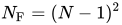
[edit]The number of Fresnel zones that form first Talbot self-image of the grating with period and transverse size is given by exact formula .[4] This result is obtained via exact evaluation of Fresnel-Kirchhoff integral in the near field at distance .[5]



The atomic Talbot effect
[edit]Due to the quantum mechanical wave nature of particles, diffraction effects have also been observed with atoms—effects which are similar to those in the case of light. Chapman et al. carried out an experiment in which a collimated beam of sodium atoms was passed through two diffraction gratings (the second used as a mask) to observe the Talbot effect and measure the Talbot length.[6] The beam had a mean velocity of 1000 m/s corresponding to a de Broglie wavelength of = 0.017 nm. Their experiment was performed with 200 and 300 nm gratings which yielded Talbot lengths of 4.7 and 10.6 mm respectively. This showed that for an atomic beam of constant velocity, by using , the atomic Talbot length can be found in the same manner.

Nonlinear Talbot effect
[edit]The nonlinear Talbot effect results from self-imaging of the generated periodic intensity pattern at the output surface of the periodically poled LiTaO3 crystal. Both integer and fractional nonlinear Talbot effects were investigated.[7]
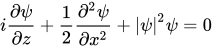
In cubic nonlinear Schrödinger's equation , nonlinear Talbot effect of rogue waves is observed numerically.[8]
The nonlinear Talbot effect was also realized in linear, nonlinear and highly nonlinear surface gravity water waves. In the experiment, the group observed that higher frequency periodic patterns at the fractional Talbot distance disappear. Further increase in the wave steepness lead to deviations from the established nonlinear theory, unlike in the periodic revival that occurs in the linear and nonlinear regime, in highly nonlinear regimes the wave crests exhibit self acceleration, followed by self deceleration at half the Talbot distance, thus completing a smooth transition of the periodic pulse train by half a period.[9]
Applications of the optical Talbot effect
[edit]The optical Talbot effect can be used in imaging applications to overcome the diffraction limit (e.g. in structured illumination fluorescence microscopy).[10]
Moreover, its capacity to generate very fine patterns is also a powerful tool in Talbot lithography.[11]
The Talbot cavity is used for the phase-locking of the laser sets.[12]
In experimental fluid dynamics, the Talbot effect has been implemented in Talbot interferometry to measure displacements [13][14] and temperature,[15][16] and deployed with laser-induced fluorescence to reconstruct free surfaces in 3D,[17] and measure velocity.[18]
See also
[edit]References
[edit]- ^ Talbot, H.F. (1836). "LXXVI. Facts relating to optical science. No. IV". The London, Edinburgh, and Dublin Philosophical Magazine and Journal of Science. 9 (56): 401–407. doi:10.1080/14786443608649032.
- ^ Case, William B.; Tomandl, Mathias; Deachapunya, Sarayut; Arndt, Markus (2009). "Realization of optical carpets in the Talbot and Talbot–Lau configurations". Opt. Express. 17 (23): 20966–20974. Bibcode:2009OExpr..1720966C. doi:10.1364/OE.17.020966. PMID 19997335.
- ^ Rayleigh, Lord (1881). "XXV. On copying diffraction-gratings, and on some phenomena connected therewith". The London, Edinburgh, and Dublin Philosophical Magazine and Journal of Science. 11 (67): 196–205. doi:10.1080/14786448108626995.
- ^ Okulov, A. Yu. (1993). "Scaling of diode-array-pumped solid-state lasers via self-imaging". Opt. Commun. 99 (5–6): 350–354. Bibcode:1993OptCo..99..350O. doi:10.1016/0030-4018(93)90342-3.
- ^ Okulov, A. Yu. (1990). "Two-dimensional periodic structures in nonlinear resonator". JOSA B. 7 (6): 1045–1050. Bibcode:1990JOSAB...7.1045O. doi:10.1364/JOSAB.7.001045.
- ^ Chapman, Michael S.; Ekstrom, Christopher R.; Hammond, Troy D.; Schmiedmayer, Jörg; Tannian, Bridget E.; Wehinger, Stefan; Pritchard, David E. (1995). "Near-field imaging of atom diffraction gratings: The atomic Talbot effect". Physical Review A. 51 (1): R14 – R17. Bibcode:1995PhRvA..51...14C. doi:10.1103/PhysRevA.51.R14. PMID 9911659.
- ^ Zhang, Yong; Wen, Jianming; Zhu, S. N.; Xiao, Min (2010). "Nonlinear Talbot Effect". Physical Review Letters. 104 (18) 183901. Bibcode:2010PhRvL.104r3901Z. doi:10.1103/PhysRevLett.104.183901. PMID 20482176.
- ^ Zhang, Yiqi; Belić, Milivoj R.; Zheng, Huaibin; Chen, Haixia; Li, Changbiao; Song, Jianping; Zhang, Yanpeng (2014). "Nonlinear Talbot effect of rogue waves". Physical Review E. 89 (3) 032902. arXiv:1402.3017. Bibcode:2014PhRvE..89c2902Z. doi:10.1103/PhysRevE.89.032902. PMID 24730908. S2CID 41885399.
- ^ Rozenman, Georgi Gary; Schleich, Wolfgang P.; Shemer, Lev S. N.; Arie, Ady (2022). "Periodic Wave Trains in Nonlinear Media: Talbot Revivals, Akhmediev Breathers, and Asymmetry Breaking". Physical Review Letters. 128 214101. Bibcode:2022PhRvL.128u4101R. doi:10.1103/PhysRevLett.128.214101. PMID 35687471. S2CID 249140572.
- ^ Chowdhury, S.; Chen, J.; Izatt, J.A. (2018). "Structured illumination fluorescence microscopy using Talbot self-imaging effect for high-throughput visualization". arXiv:1801.03540 [physics.optics].
- ^ Isoyan, A.; Jiang, F.; Cheng, Y. C.; Cerrina, F.; Wachulak, P.; Urbanski, L.; Rocca, J.; Menoni, C.; Marconi, M. (2009). "Talbot lithography: Self-imaging of complex structures". Journal of Vacuum Science & Technology B: Microelectronics and Nanometer Structures Processing, Measurement, and Phenomena. 27 (6): 2931–2937. Bibcode:2009JVSTB..27.2931I. doi:10.1116/1.3258144.
- ^ Okulov, A Yu (1991). "The effect of roughness of optical elements on the transverse structure of alight field in a nonlinear Talbot cavity". J. Mod. Opt. 53 (11): 1887–1890. Bibcode:1991JMOp...38.1887O. doi:10.1080/09500349114551991.
- ^ Spagnolo, G Schirripa; Ambrosini, D.; Paoletti, D. (2002). "Displacement measurement using the Talbot effect with a Ronchi grating". Journal of Optics A: Pure and Applied Optics. 4 (6): S376 – S380. Bibcode:2002JOptA...4S.376S. doi:10.1088/1464-4258/4/6/383.
- ^ Shakher, Chandra; Agarwal, Shilpi (2018). "Low-frequency in-plane vibration monitoring/measurement using circular grating Talbot interferometer". Optical Engineering. 57 (5) 054112. Bibcode:2018OptEn..57e4112A. doi:10.1117/1.OE.57.5.054112. S2CID 125924183.
- ^ Shakher, Chandra; Daniel, A. J. Pramila (1994). "Talbot interferometer with circular gratings for the measurement of temperature in axisymmetric gaseous flames". Applied Optics. 33 (25): 6068–6072. Bibcode:1994ApOpt..33.6068S. doi:10.1364/AO.33.006068. PMID 20936022.
- ^ Agarwal, Shilpi; Kumar, Manoj; Shakher, Chandra (2015). "Experimental investigation of the effect of magnetic field on temperature and temperature profile of diffusion flame using circular grating Talbot interferometer". Optics and Lasers in Engineering. 68: 214–221. Bibcode:2015OptLE..68..214A. doi:10.1016/j.optlaseng.2015.01.004.
- ^ Florou, Eirini I.; Fort, Charles; Habukawa, Masayuki; André, Matthieu A.; Bardet, Philippe M. (2023). "Surface reconstruction in three-dimensional space using structured illumination". Experiments in Fluids. 64 (4): 70. Bibcode:2023ExFl...64...70F. doi:10.1007/s00348-023-03608-9. S2CID 257604959.
- ^ Fort, Charles; André, Matthieu A.; Pazhand, Hatef; Bardet, Philippe M. (2020). "Talbot-effect structured illumination: pattern generation and application to long-distance μ-MTV". Experiments in Fluids. 61 (2): 40. Bibcode:2020ExFl...61...40F. doi:10.1007/s00348-019-2870-7. S2CID 213543686.