Hubbry Logo
Tap tapTap tapMain
Open search
Tap tap
Community hub
Tap tap
logo
8 pages, 0 posts
0 subscribers
Be the first to start a discussion here.
Tap tap
Tap tap
from Wikipedia
A tap tap bus used for longer journeys

Tap taps (Haitian Creole: Taptap, pronounced [taptap]) are gaily painted buses[1] or pick-up trucks with metal covers[2] that serve as share taxis in Haiti. They may also be referred to as camionettes.[3]

Literally meaning "quick quick",[4] these vehicles for hire are privately owned and ornately decorated.[1] They follow fixed routes, won't leave until filled with passengers, and riders can disembark at any point in the journey.[5]

Decoration

[edit]
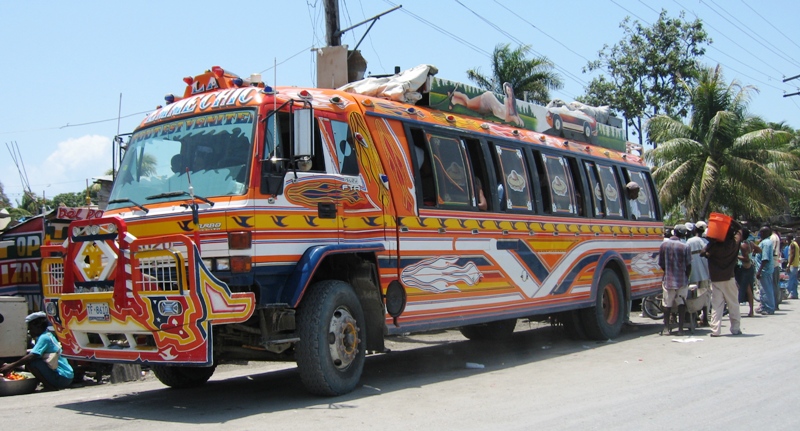
Tap tap in Port-au-Prince.

Often painted with religious names or slogans,[4] the tap tap is known for its lavish decoration, and many feature wild colors, portraits of famous people such as Justin Bieber and Michael Jackson, and intricate, hand-cut wooden window covers. Some window covers are also made of metal.[1]

Travel warnings

[edit]
Tap tap cab in Port-au-Prince

Many developed countries inform their citizens to not take tap taps when visiting Haiti.

Canada

[edit]

While saying not to use any form of public transport in Haiti, the Foreign Affairs and International Trade Canada advises against tap tap travel especially.[6]

United States

[edit]

The US State Department warns travelers not to use tap taps "because they are often overloaded, mechanically noisy, and driven unsafely".[7]

See also

[edit]

References

[edit]
Revisions and contributorsEdit on WikipediaRead on Wikipedia
from Grokipedia
Tap taps are vibrantly painted buses or pick-up trucks used as shared taxis for public transportation in , often featuring elaborate artwork and serving routes across the country while accommodating passengers, goods, and sometimes livestock. The name "tap tap" derives from the term "taptap," meaning "quick quick," and also from the onomatopoeic sound of passengers tapping on the vehicle's metal body to signal the driver to stop. These vehicles emerged as a practical and affordable solution to Haiti's limited formal transit infrastructure, where only about 3% of the population owns a (as of 2010), making tap taps essential for daily commuting in urban areas like and rural routes alike. Privately owned and operated, they typically depart when full—often carrying 20 to 25 passengers squeezed onto wooden benches or standing in open-air setups—and charge fares typically around 10-25 Haitian gourdes (approximately as of 2024), though high fuel costs have increased them in recent years and can limit service frequency. Tap taps come in various forms, from repurposed U.S. school buses in cities to modified pick-up trucks with metal roofs in the countryside, and they navigate challenging roads at speeds around 10 km/h, fostering impromptu social interactions among riders who share stories, songs, and laughter. Culturally, tap taps embody Haitian resilience and creativity, especially evident in their iconic artwork that blends religious motifs like images of , political figures such as , pop culture references including , and vibrant abstract designs influenced by styles from to realism. Owners invest significantly in these decorations—up to $1,200 for a full job—despite low average incomes of around US$200-300 monthly (as of 2025), believing that eye-catching attract more passengers and signal reliability; vehicles are often repainted periodically to maintain appeal. This tradition persisted and even thrived after the 2010 earthquake, symbolizing community endurance amid adversity, as tap taps continue to transport people and goods while reflecting themes of faith, hope, and national pride.

Etymology and Overview

Name and Origins

The term "tap tap" originates from taptap, which literally translates to "quick quick," reflecting the rapid and efficient service these vehicles provide in navigating Haiti's congested urban routes. This etymology underscores the informal, demand-responsive nature of the transport system, designed to meet the fast-paced needs of daily commuters. An alternative theory posits that the name is onomatopoeic, derived from the tapping sound passengers make on the vehicle's metal body to signal their desired stop, emphasizing the interactive and audible communication between riders and drivers. The concept of tap taps emerged in the mid-20th century, coinciding with Haiti's accelerated , particularly in , where rural-to-urban migration swelled the population and strained existing infrastructure. As formal systems proved inadequate amid economic challenges and limited government investment, tap taps arose as a privately operated, informal solution to fulfill the growing demand for affordable mobility, filling a critical gap in connectivity for low-income residents. Unlike other share taxi systems in the Caribbean, such as Jamaica's route taxis or Trinidad's maxi-taxis, tap taps are distinguished by their unique Haitian Creole naming convention, which encapsulates the cultural and linguistic flair of the region, often complemented by vibrant vehicle decorations that serve as visual identifiers. This nomenclature highlights the localized, community-driven evolution of the system, rooted in Haiti's distinct socio-economic and historical context.

General Characteristics

Tap taps are privately owned vehicles, typically gaily painted buses or modified pick-up trucks with covers, that operate as share on fixed routes throughout , particularly in urban centers such as . These vehicles provide collective passenger transport, often accommodating up to 14 seated passengers plus standing room, and are imported second-hand from the before local modifications. The name "tap-tap" reflects their quick and responsive service, akin to "quick-quick" in English. Key operational features include departing from designated stations only when full, which maximizes efficiency for operators while ensuring affordability for riders, and the flexibility to stop anywhere along the route upon passenger request. There are approximately 162 fixed routes served by tap taps from 94 stations in the metropolitan area (as of 2021), with services typically running from early morning around 5-6 a.m. until evening between 5-8 p.m. Fares are nominally regulated by the state but adjusted by operators based on route length and duration, often amounting to just a few cents per short trip. Economically, tap taps serve as an informal, low-cost alternative to formal bus services, fulfilling up to 56% of passenger needs in urban (as of ) and providing essential daily mobility for low-income populations amid limited , which stands at only about 1% nationwide as of 2024. This system supports livelihoods for small-scale entrepreneurs and low-skilled workers, who rent or own these aging vehicles—averaging 27 years old (as of )—as their primary income source in a fragmented sector.

History

Early Development

Tap-taps emerged in during the mid-20th century as an informal response to the rapid and inadequate public transportation infrastructure under the Duvalier regime (1957–1986). In the 1950s, less than 10% of 's population of approximately 3 million lived in urban areas, but this shifted dramatically with annual urban growth rates reaching 5% by the , swelling 's population to over 700,000. The Duvalier government's policies exacerbated rural economic decline through faulty agricultural reforms and widespread deforestation, pushing mass migration from rural areas to urban centers like in the 1960s and . This influx created overwhelming demand for affordable mobility, which formal systems could not meet, leading to the rise of privately operated, truck-based vehicles adapted as shared —early precursors to modern tap-taps. These informal systems filled critical gaps in connectivity, particularly for low-income migrants settling in expanding slums, where two-thirds of 's residents lived by the late due to unchecked urban primacy during the Duvalier era. Converted pickup trucks, often imported from the , became the backbone of this network, operating on fixed routes with flexible stops to serve densely populated neighborhoods. By the late 1970s, tap-taps had solidified as the dominant mode of urban in , handling the majority of passenger trips amid limited state investment in roads and buses. Early regulatory efforts by the Haitian government in the sought to formalize these operations amid growing congestion and concerns, though remained weak. A January 3, 1977, decree established the Service de Controle du Poids des Vehicules under the Ministry of Public Works, Transport, and Communications to monitor vehicle weights and prevent road damage from overloaded trucks. This was followed by a January 2, 1978, decree setting limits at 8,000 kg for single s and 15,000 kg for tandem axles, with total vehicle weight capped at 40,000 kg, accompanied by fines of per excess axle and per excess total weight. Operators were required to register with police and obtain special plates, but there were no broader restrictions on entry into the industry, allowing the informal sector to proliferate with minimal oversight. Urban tariffs, including those for tap-taps, were nominally set by the Department of Labor and enforced by police, though the sector overall faced only minimal regulation.

Modern Evolution and Challenges

In the 1980s and 1990s, Haiti's economic policies shifted toward liberalization, including trade and tariff reforms under President (1995–2000), which encouraged growth and imports of approximately 4,000 annually in the late 1980s. This expansion bolstered the informal system, with tap taps emerging as a dominant mode amid rising and demand in . By 2011, the tap tap fleet had grown to around 13,000 vehicles in the metropolitan area, comprising a significant portion—nearly 40%—of the overall fleet and handling up to 56% of passenger trips. The 7.0-magnitude on January 12, 2010, devastated Port-au-Prince's transportation , destroying key roads, terminals, and a substantial number of vehicles, including many tap taps, while displacing over a million people and halting much of the city's mobility. In the aftermath, tap tap operations were severely limited, with rubble and damaged routes exacerbating congestion and reducing service coverage. Rebuilding efforts from 2010 to 2015 relied heavily on international aid, including World Bank-funded projects totaling millions for urban transport recovery, such as $500,000 for short-term tap tap turnarounds and $5 million for longer-term bypass routes to improve fleet access and resilience. These initiatives indirectly supported tap tap operators by enhancing durability against future shocks, though the vehicles themselves largely retained their traditional converted-pickup designs due to cost constraints. Since 2021, escalating gang violence has triggered recurrent fuel shortages by blocking refineries, ports, and distribution routes, crippling tap tap services and forcing many operators to suspend routes or raise fares amid black-market premiums. In Port-au-Prince, these disruptions have compounded operational challenges, with gangs extorting drivers and limiting fuel access, leading to widespread service interruptions in urban centers. As of 2025, gang violence continues to escalate, with tap taps navigating burning barricades and ongoing extortion, further disrupting mobility amid over 1.3 million displacements.

Vehicle Design and Decoration

Types of Vehicles

Tap taps in are predominantly converted pick-up s, often models like the , which form the backbone of this informal public transportation system. These vehicles are adapted by adding sturdy metal roofs or covers over the open to shield passengers from the elements while maintaining an open-air design for accessibility. Smaller variants include compact vans and repurposed American school buses, which offer slightly more enclosed space but follow similar conversion principles. Less common are builds on bus , typically reserved for longer routes where higher capacity is needed. Key modifications focus on maximizing passenger capacity and durability, with truck beds fitted with custom wooden benches or planks—such as one-by-six boards bolted along the edges—to seat multiple riders facing each other. These adaptations allow tap taps to carry up to 25 passengers, far exceeding standard vehicle limits, through reinforced loading areas that accommodate overloading with people, goods, and . Side panels, often hand-fabricated from wood or metal, are cut to include openings for ventilation and easy entry, ensuring airflow in Haiti's while securing the structure. Exteriors may feature vibrant decorative paintings as personal expressions by owners. The evolution of tap tap vehicles reflects Haiti's reliance on affordable imports, beginning with Japanese models like prevalent since the for their reliability in rugged terrain. As of 2024, trucks remain the primary models used.

Artistic Elements and Symbolism

Tap-taps in Haiti are renowned for their vibrant and intricate decorations, which transform the vehicles into mobile artworks reflecting the nation's cultural vibrancy. Common motifs include bold, eye-catching colors such as reds, yellows, and blues, often applied in kaleidoscopic patterns that draw passengers and signal the vehicle's appeal. Religious icons dominate these designs, featuring depictions of Christ in either a traditional Western style with blonde hair or a darker-skinned version with , alongside verses and phrases like "Trust in God," "Jesus Saves," and "Nothing but God." while pop culture portraits of figures such as , , and soccer stars add contemporary flair. Political slogans and revolutionary icons, like , provide , and landscapes or airplanes bolted to roofs evoke aspirations for travel and escape. The craftsmanship behind these decorations is a specialized passed down among local artists in workshops around , where vehicles are meticulously hand-painted using durable enamels to withstand the and heavy use. Artisans like Rockfelet Victor and St-Jean Berly begin with outlines priced around $600, progressing to full designs costing around $1,200, a process that can take 15 to 22 days depending on the vehicle's size. These painters incorporate diverse styles—from and flourishes to realism—often collaborating with carpenters who hand-cut ornate wooden elements like geometric window frames. Owners commission repaints every few months to every few years as funds allow, viewing the artwork not only as aesthetic enhancement but as a competitive edge in attracting riders. This labor-intensive practice underscores the economic role of tap-tap art in a context where most operators earn less than $60 monthly. Symbolically, tap-tap decorations embody Haitian resilience and , serving as affirmations of and survival amid adversity. Religious motifs, appearing on a majority of vehicles, reflect the profound influence of in daily life, offering spiritual protection and hope to drivers and passengers navigating Haiti's challenging roads. Pop culture and political elements highlight social aspirations and critiques, portraying icons of global fame or rebellion as emblems of defiance against and . Overall, these artworks symbolize communal , as seen in the cooperative spirit of rides that persist through crises like fuel shortages, reinforcing Haiti's capacity to adapt and thrive through collective creativity.

Operations and Usage

Routes, Fares, and Service

Tap taps primarily operate on fixed urban routes within major cities like , where they cover the metropolitan area spanning 312 km² across seven municipalities, including connections from the capital to suburbs such as , Delmas, , and Tabarre. In total, the network includes 162 designated routes serviced by vehicles departing from 94 organized stations, with operators adhering to these paths to ensure efficient coverage of daily commutes. While tap taps focus on intra-city travel, similar services operate in other cities like , where local mapping efforts have documented principal routes and stops to improve accessibility planning. Fares for tap tap rides are regulated by Haiti's Ministry of Social Affairs and Labor but adjusted by operators based on route length and location, typically ranging from 10 to 65 Haitian gourdes (approximately 0.08 to 0.50 USD as of November 2025) for short urban trips. Payments are collected onboard by gadyen, the vehicle assistants who manage loading, fare handling, and route calls, often earning around 1,000 gourdes (about 8 USD) daily. Prices tend to be lower in central areas and higher toward peripherals like , reflecting the informal yet structured pricing model that keeps transport affordable for the majority of users. The service model for tap taps is privately driven and informal, accounting for up to 56% of passenger transport in Port-au-Prince, with vehicles typically rented from owners and operated by independent drivers working 10 to 11 hours daily, six days a week. Departures are regulated from guild-affiliated stations, where low-membership associations primarily represent vehicle owners and coordinate schedules during peak demand periods from 6 a.m. to 9 p.m. Passengers signal stops by tapping the vehicle or calling out, ensuring flexible yet route-bound operations that prioritize high occupancy before departure. This system, marginally overseen by the Ministry of Public Works and Transport, supports widespread mobility despite limited formal infrastructure.

Passenger Experience and Etiquette

Passengers typically hail tap-taps along their fixed routes or at designated stands in Haitian cities like , by asking the driver or conductor in , such as "Bonjou, [destination]?" to confirm the vehicle is heading to the desired location. Once signaled to board, riders climb into the back, often squeezing onto wooden benches or the floor of pickup trucks or repurposed buses designed for 15 to 20 people but frequently accommodating far more, up to 25 or even 40 in overcrowded conditions. Priority is generally given to women, children, and the elderly, with other passengers assisting them in finding space or holding goods like bags and buckets during boarding. Etiquette during the ride emphasizes and in the communal setting, where passengers help rearrange items or support one another on bumpy roads, and newcomers are expected to pay the standard fare—often around 25 Haitian gourdes (HTG) for short urban trips—without prior negotiation, simply following what others contribute. To signal a stop, riders tap on the metal body, side, or roof of the vehicle, or call out "Mèsi!" () to the driver or conductor upon reaching their destination. Patience is key, as vehicles may wait for additional passengers or delay due to loading goods, fostering a sense of shared endurance among riders. The sensory experience of a tap-tap ride is intensely communal and vibrant, with passengers packed closely together—often jostling on turns or sharing laps with children and bundles—amid the noise of conversations, market haggling, and loud sound systems playing music in urban areas. Riders may sing or chat to pass the time on rough roads that cause the vehicle to creak and moan, creating a lively atmosphere despite the physical discomfort of heat, dust, and prolonged proximity to strangers. Typical urban routes last 20 to , blending daily utility with moments of social interaction, such as with children or exchanging stories.

Cultural and Social Significance

Role in Haitian Society

Tap taps serve as a cornerstone of Haiti's , providing essential opportunities in a context where informal activities account for approximately 86% of the labor force and generate around 60% of GDP. In , the capital and economic hub, an estimated 13,000 tap tap vehicles operate, each typically staffed by a and a conductor, thereby supporting livelihoods for tens of thousands in driving, operations, and related maintenance roles. This sector is particularly vital amid high , with official rates hovering around 15% as of 2024 but labor underutilization affecting a far larger portion of the due to limited formal job opportunities. Beyond economics, tap taps fulfill key social functions by enabling community connections and access to essential services, especially in underserved areas. They transport vendors, including the Madan Sara who represent about 80% of Haiti's informal labor market and dominate informal trade, allowing them to carry goods to markets and sustain local commerce in a country where rural-urban mobility is critical for economic survival. During crises, such as the 2021 fuel shortages exacerbated by blockades and scarcity, tap taps demonstrated resilience by continuing operations where possible, with drivers protesting disruptions but maintaining vital links for and daily necessities despite widespread transport halts. As of 2024-2025, amid surging violence displacing over one million people, tap taps continue to symbolize endurance by maintaining essential mobility where possible, though operations face increased disruptions. In terms of and class dynamics, tap taps are the primary mode for working-class , disproportionately benefiting women who face barriers to private vehicle ownership. Market women and vendors depend heavily on these affordable vehicles for their daily commutes and goods , as confirmed by gender diagnostics highlighting tap taps' role in supporting female economic participation amid cost constraints.

Representation in Media and Art

Tap taps, the vibrantly painted minibuses central to Haitian transportation, have been prominently featured in films and documentaries that capture their role in and cultural resilience. Following the 2010 earthquake, a PBS NewsHour segment titled "Haiti's 'Tap Tap' Bus Art Flourishes After Quake" highlighted how the tradition of decorating these vehicles persisted amid devastation, portraying them as symbols of creativity and continuity in a time of crisis. In 2012, the released a five-part called "Tap Tap," using humor to depict passengers navigating post-disaster challenges aboard a tap tap, aiming to foster community awareness and relief through relatable storytelling. Earlier, the 2007 Canadian TV movie Tap-Tap, filmed on location in , incorporated the vehicles into narratives exploring local customs and . Beyond cinema, tap taps exert a strong influence on , inspiring works that extend their bold into broader cultural expressions. The elaborate decorations on tap taps—often featuring religious motifs, political slogans, and vibrant colors—serve as a foundational source for these artistic interpretations. In 2018, the Cultural Complex developed a tap tap bus adorned with Haitian designs as part of a initiative, blending traditional motifs with contemporary expressions to engage visitors and celebrate diaspora heritage. Photography has similarly elevated tap taps, as seen in the 2010 exhibit "Tap-Tap: Celebrating the Art of Haiti" at International University's Frost Art Museum, where images documented the vehicles' intricate paintings as exemplars of naive art and folk expression. In music, particularly the kompa genre, tap taps appear as metaphors for communal journeys and festivity. The 2005 carnival track "Tap Tap" by King Posse evokes the rhythmic, crowded rides through upbeat and melodies, embedding the vehicles in Haiti's popular soundscape as emblems of social vibrancy. Tap taps also feature in tourism media, where they have been promoted since the as quintessential experiences of Haiti's dynamic . Travel blogs from the era, such as detailed accounts of riding these colorful buses, emphasize their role in immersing visitors in authentic street life and artistry. However, by the , critiques on platforms have emerged, accusing such depictions of romanticizing by glossing over the economic strains and risks inherent in relying on tap taps amid Haiti's ongoing hardships.

Safety and Regulations

Common Risks and Issues

Tap taps in frequently operate beyond their designed capacity, often carrying passengers at 150% or more of the standard 14-seat limit, with reports indicating up to 26 individuals per vehicle during peak times and pick-up variants accommodating as many as 30 people. This overloading, combined with poor vehicle maintenance and mechanical failures, significantly contributes to accidents, as tap taps are regularly involved in crashes due to substandard repairs and lack of standards. 's road death rate stands at approximately 19.9 per 100,000 population annually, with vehicles like tap taps exacerbating this risk through and inadequate upkeep. Driving hazards are compounded by reckless speeding and aggressive maneuvers on poorly maintained roads riddled with deep potholes, broken surfaces, and inadequate lighting, where right-of-way rules are rarely observed. Driver from extended working hours further heightens dangers, as operators navigate chaotic without lane demarcations or consistent enforcement. Additionally, tap taps remain vulnerable to hijackings, kidnappings, and assaults in unstable regions, where armed gangs control key routes and target for robberies. Health concerns arise from the cramped, overcrowded conditions in tap taps, which facilitate the spread of infectious diseases despite their open-air designs offering some ventilation. These risks intensified during the from 2020 to 2022, when mandatory masking in was decreed but faced minimal enforcement, with social pressures and leading to widespread non-compliance among passengers and operators.

International Travel Advisories and Reforms

Several international governments have issued strong advisories against using for travel in due to significant safety and security risks. The maintains a Level 4 "Do Not Travel" advisory for overall, updated July 15, 2025, citing , , civil unrest, and limited . Specifically, U.S. citizens are advised to avoid all public transportation, including , because of high risks of such as and assault, as well as mechanical failures from poorly maintained vehicles lacking basic safety features like seatbelts. Embassy personnel are prohibited from using , and the advisory highlights gang-related incidents, including roadblocks and stray bullets that endanger passengers. The similarly recommends avoiding all travel to , with its advisory updated November 13, 2025 emphasizing the dangers of public transportation. Tap taps are singled out as particularly hazardous due to their unreliable operation, drivers' frequent disregard for traffic laws, and vehicles that are often in poor condition or overloaded, leading to serious accidents with injuries or fatalities. The advisory links these issues to broader poor road safety in , where chaotic roads and aggressive driving exacerbate risks. Overloading in tap taps is frequently cited as a key risk factor contributing to accidents, as noted in both U.S. and Canadian advisories. In response to such concerns, Haitian regulatory efforts have included diagnostic assessments and proposed reforms to improve safety. A 2024 report by the Public-Private Infrastructure Advisory Facility (PPIAF) highlights the lack of national regulations for tap taps and recommends mandating GPS tracking for vehicles to enhance monitoring and requirements to protect operators and passengers. Additionally, it advocates for NGO-led programs for drivers to address safety gaps, though remains limited amid ongoing instability. Pilot initiatives in urban areas have aimed at reducing accidents through better vehicle maintenance and awareness campaigns, but comprehensive enforcement of these measures for the estimated thousands of tap taps in operation has been slow.

References

Add your contribution
Related Hubs
User Avatar
No comments yet.