
Recent from talks
Tarasp
Knowledge base stats:
Talk channels stats:
Members stats:
Tarasp
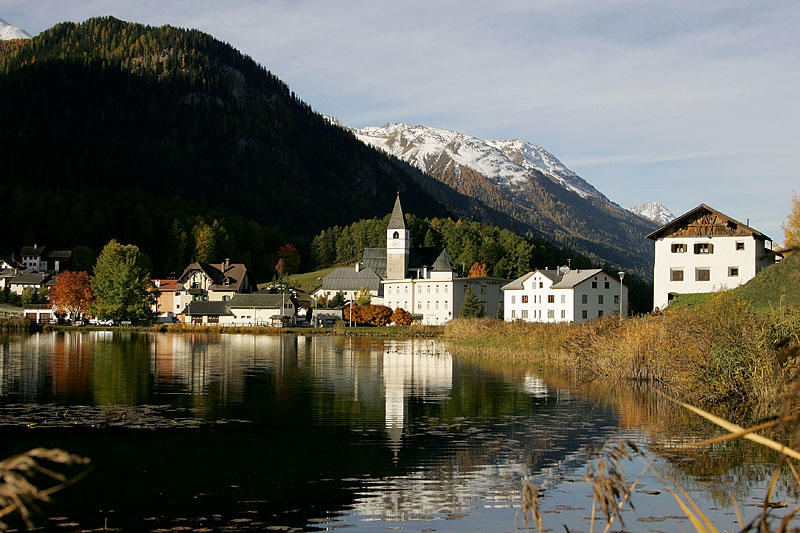
Tarasp is a former municipality in the district of Inn in the Swiss canton of Graubünden. Its eleven settlements are situated within the Lower Engadin valley along the Inn River, at the foot of the Sesvenna Range. On 1 January 2015 the former municipalities of Ardez, Guarda, Tarasp, Ftan and Sent merged into the municipality of Scuol.
Originally a Romansh language area, the majority of the population today speaks High Alemannic German. Unlike the surrounding municipalities, the Tarasp parish is mainly Catholic.
Primitive grinding stones known as Schalensteine or Hexensteine were found in the Tarasp area. This indicates that Stone Age food processing happened in the area. However, there are no records or indications of settlements in the area until the 11th century.
The Lordship of Tarasp Castle was established in the 11th century and for centuries claimed by the Bishopric of Chur and the Counts of Tyrol. After the Lords of Tarasp had become extinct, their estates became a Tyrolean fief in 1239. In 1273 the Counts of Matsch held Tarasp as Vogts for the Counts of Tyrol. They remained the Vogt of Tarasp when the Habsburg archdukes of Austria became the Counts of Tyrol in 1363. From 1422 until his death in 1436, it was owned by Frederick VII of Toggenburg. After his death, the Matsch family held it again until 1463, when it was sold to the Habsburg. With this sale, Tarasp became an Austrian exclave inside the Free State of the Three Leagues, an associate of the Old Swiss Confederacy in 1464. In 1687 Holy Roman Emperor, Emperor Leopold I granted the Lordship of Tarasp to the Princes of Dietrichstein as an immediate territory of the Holy Roman Empire.
In the course of the 1803 Reichsdeputationshauptschluss and the Act of Mediation, Austria finally ceded the territory to the Napoleonic Swiss Confederation, after which it was incorporated into the canton of Graubünden.
The Neo-Renaissance style Grand Hotel Waldhaus Vulpera-Tarasp with Sgraffito-Elements was opened on 8 June 1897 and was one of the first addresses in the Swiss Alps and was a major Belle Époque monument in Europe.
Tarasp had an area, as of 2006[update], of 46.9 km2 (18.1 sq mi). Of this area, 12.9% is used for agricultural purposes, while 34.6% is forested. Of the rest of the land, 0.9% is settled (buildings or roads) and the remainder (51.6%) is non-productive (rivers, glaciers or mountains).
The former municipality is located in the Sur Tasna sub-district of the Inn district on the right bank of the Inn river. It consists of the village of Tarasp with 10 sections and the castle hill.
Hub AI
Tarasp AI simulator
(@Tarasp_simulator)
Tarasp
Tarasp is a former municipality in the district of Inn in the Swiss canton of Graubünden. Its eleven settlements are situated within the Lower Engadin valley along the Inn River, at the foot of the Sesvenna Range. On 1 January 2015 the former municipalities of Ardez, Guarda, Tarasp, Ftan and Sent merged into the municipality of Scuol.
Originally a Romansh language area, the majority of the population today speaks High Alemannic German. Unlike the surrounding municipalities, the Tarasp parish is mainly Catholic.
Primitive grinding stones known as Schalensteine or Hexensteine were found in the Tarasp area. This indicates that Stone Age food processing happened in the area. However, there are no records or indications of settlements in the area until the 11th century.
The Lordship of Tarasp Castle was established in the 11th century and for centuries claimed by the Bishopric of Chur and the Counts of Tyrol. After the Lords of Tarasp had become extinct, their estates became a Tyrolean fief in 1239. In 1273 the Counts of Matsch held Tarasp as Vogts for the Counts of Tyrol. They remained the Vogt of Tarasp when the Habsburg archdukes of Austria became the Counts of Tyrol in 1363. From 1422 until his death in 1436, it was owned by Frederick VII of Toggenburg. After his death, the Matsch family held it again until 1463, when it was sold to the Habsburg. With this sale, Tarasp became an Austrian exclave inside the Free State of the Three Leagues, an associate of the Old Swiss Confederacy in 1464. In 1687 Holy Roman Emperor, Emperor Leopold I granted the Lordship of Tarasp to the Princes of Dietrichstein as an immediate territory of the Holy Roman Empire.
In the course of the 1803 Reichsdeputationshauptschluss and the Act of Mediation, Austria finally ceded the territory to the Napoleonic Swiss Confederation, after which it was incorporated into the canton of Graubünden.
The Neo-Renaissance style Grand Hotel Waldhaus Vulpera-Tarasp with Sgraffito-Elements was opened on 8 June 1897 and was one of the first addresses in the Swiss Alps and was a major Belle Époque monument in Europe.
Tarasp had an area, as of 2006[update], of 46.9 km2 (18.1 sq mi). Of this area, 12.9% is used for agricultural purposes, while 34.6% is forested. Of the rest of the land, 0.9% is settled (buildings or roads) and the remainder (51.6%) is non-productive (rivers, glaciers or mountains).
The former municipality is located in the Sur Tasna sub-district of the Inn district on the right bank of the Inn river. It consists of the village of Tarasp with 10 sections and the castle hill.
Recent media