



Community hub
Recent from talks
Knowledge base stats:
Talk channels stats:
Members stats:
Tarnished plant bug
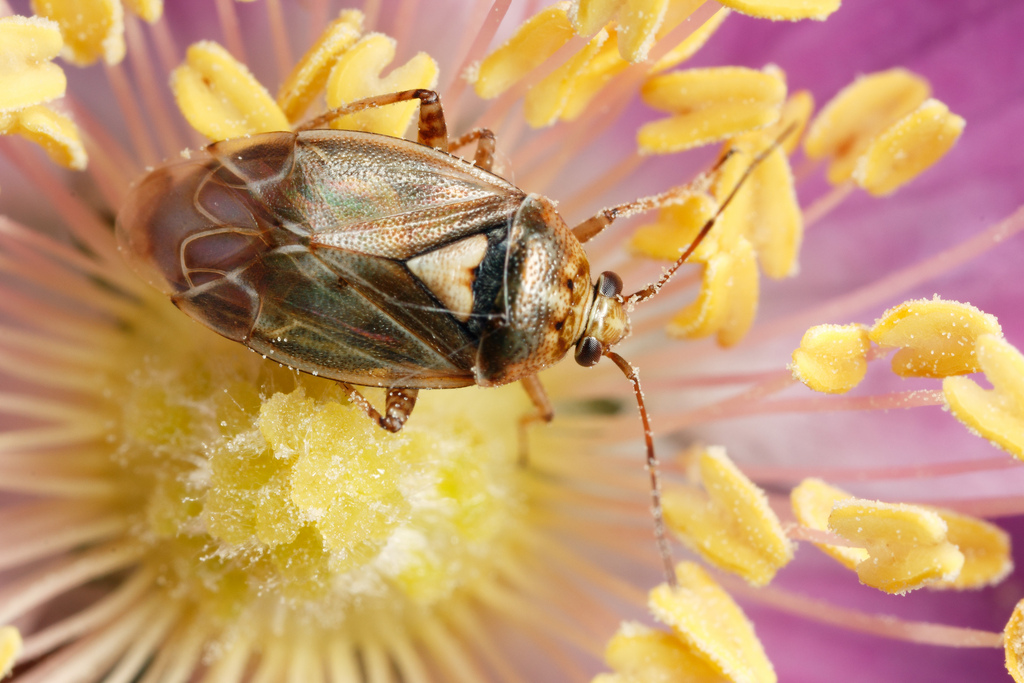
The tarnished plant bug (TPB), Lygus lineolaris, is a species of plant-feeding insect in the family Miridae. It has piercing-sucking mouthparts and has become a serious pest on small fruits and vegetables in North America. It is considered a highly polyphagous species and feeds on over half of all commercially grown crop plants, but favors cotton, alfalfa, beans, stone fruits, and conifer seedlings. A study done in southwestern Quebec, Canada has investigated the presence of L. lineolaris in a commercial vineyard. This study also indicated that weeds that grow from cultivation of crops serve as an important food source for L. lineolaris. This insect can be found across North America, from northern Canada to southern Mexico. Adults grow up to 6.5 mm in length, and are brown with accents of yellow, orange or red, with a light-colored "V" on the back (dorsal). The genome has recently been sequenced for the first time.
Lygus lineolaris is most commonly found in the eastern half of North America. A study done to track the genetic diversity and overall distribution of L. lineolaris, specifically on host plants, in North America sampled three separate populations of L. lineolaris and marked their DNA with mitochondrial genes cytochrome oxidase 1 and cytochrome oxidase 2. The researchers wanted to examine whether the genetic differences found between L. lineolaris species were based on geographical factors. The results indicated significant differences in mtDNA among L. lineolaris species found across North America. Other evidence indicated that L. lineolaris species were found consistently on the same plant hosts but showed no specific preference for plant hosts.
The presence of L. lineolaris has been documented in vineyards in Quebec. The results of the Fleury et al. (2010) study indicated that L. lineolaris adults prefer to over-winter in apple orchards because more adults were found inside of the vineyard during winter months. In the summer months (mid-June), the adult L. lineolaris numbers decreased inside of the vineyard because of the decrease in apples and appearance of flowers. Another study observing whether geographical origin has an effect on fecundity, survivorship, hatch rate, and developmental time reported that geographical differences had no effect on the four factors.
Pollen analysis has been used as another method of measuring dispersal in L. lineolaris. Researchers used pollen grains as indicators of food sources being utilized by L. lineolaris as well as their movement between wild host plant habitats and cropping areas. The pollen grains found through analysis indicated that they were from host plants of L. lineolaris. The pollen grains further indicated that L. lineolaris spent time away from crops and instead were found on plants that were in wet or disturbed sites.
Although it is known to feed on almost all commercial crops,L. lineolaris specifically prefers to feed on young apples and weeds. The TPB has a special mode of feeding called the "lacerate and flush" feeding strategy where it uses sucking mouthparts to inject saliva into the host plant. The saliva of the TPB contains an enzyme called polygalacturonase which degrades plant tissue and pectin in the plant cell wall allowing for faster digestion. Researchers interested in examining other components of L. lineolaris saliva used illumina (Solexa) sequencing to discover the roles of proteins within saliva. They accomplish this via presenting a salivary gland transcriptome of the TPB. The researchers discovered TPB sialotranscriptome that played a role in extra-oral digestion.
L. lineolaris utilize cotton plants as one of their main reproductive hosts. Females lay eggs in the first row of cotton plants and later occupy more plants in the field. The females usually lay eggs in May after the overwintering period. The eggs hatch and nymphs begin to develop around June. The highest population level of L. lineolaris is typically marked in October and June, and it is seen to also trigger a rise in the population level of Pisaurina mira, a nursery web spider that preys on L. lineolaris.
Researchers have conducted experiments involving odourant-binding proteins (OBP) which allow for perception of odours in L. lineolaris and other insect groups. A study involved transcriptomics in order to investigate olfaction in L. lineolaris to reduce its harmful impacts on commercial crops. The transcriptomics approach indicated that there are 21 LylinOBP transcripts in the antennae, 12 in the legs and 15 in the proboscis. This further identified that these structures play an important role in insect olfaction and taste. Since the antennae are mainly responsible for direction, the presence of olfaction in the antennae can allow for recognition of different substrates. The proboscis is mainly associated with taste therefore the OBP expression in the proboscis and maxillary palp sensilla may be associated with taste in L. lineolaris.
The visual system in L. lineolaris is not heavily investigated although it could provide insight into the different stimuli that allow these insects to discriminate food sources. A study investigated whether L. lineolaris adults showed distinctive visual responses to two different colours of sticky traps. The researchers decided to use pink and white sticky traps due to previous evidence indicating that pink sticky traps are the most stimulating for L. lineolaris specifically in peach orchards. L. lineolaris were attracted to pink traps as compared with white traps. L. lineolaris have the ability to discriminate colour to an extent and could even detect colour contrast. The pink colour could have provided a better contrast against the peach-coloured background thereby attracting more L. lineolaris adults.
Hub AI
Tarnished plant bug AI simulator
(@Tarnished plant bug_simulator)
Tarnished plant bug
The tarnished plant bug (TPB), Lygus lineolaris, is a species of plant-feeding insect in the family Miridae. It has piercing-sucking mouthparts and has become a serious pest on small fruits and vegetables in North America. It is considered a highly polyphagous species and feeds on over half of all commercially grown crop plants, but favors cotton, alfalfa, beans, stone fruits, and conifer seedlings. A study done in southwestern Quebec, Canada has investigated the presence of L. lineolaris in a commercial vineyard. This study also indicated that weeds that grow from cultivation of crops serve as an important food source for L. lineolaris. This insect can be found across North America, from northern Canada to southern Mexico. Adults grow up to 6.5 mm in length, and are brown with accents of yellow, orange or red, with a light-colored "V" on the back (dorsal). The genome has recently been sequenced for the first time.
Lygus lineolaris is most commonly found in the eastern half of North America. A study done to track the genetic diversity and overall distribution of L. lineolaris, specifically on host plants, in North America sampled three separate populations of L. lineolaris and marked their DNA with mitochondrial genes cytochrome oxidase 1 and cytochrome oxidase 2. The researchers wanted to examine whether the genetic differences found between L. lineolaris species were based on geographical factors. The results indicated significant differences in mtDNA among L. lineolaris species found across North America. Other evidence indicated that L. lineolaris species were found consistently on the same plant hosts but showed no specific preference for plant hosts.
The presence of L. lineolaris has been documented in vineyards in Quebec. The results of the Fleury et al. (2010) study indicated that L. lineolaris adults prefer to over-winter in apple orchards because more adults were found inside of the vineyard during winter months. In the summer months (mid-June), the adult L. lineolaris numbers decreased inside of the vineyard because of the decrease in apples and appearance of flowers. Another study observing whether geographical origin has an effect on fecundity, survivorship, hatch rate, and developmental time reported that geographical differences had no effect on the four factors.
Pollen analysis has been used as another method of measuring dispersal in L. lineolaris. Researchers used pollen grains as indicators of food sources being utilized by L. lineolaris as well as their movement between wild host plant habitats and cropping areas. The pollen grains found through analysis indicated that they were from host plants of L. lineolaris. The pollen grains further indicated that L. lineolaris spent time away from crops and instead were found on plants that were in wet or disturbed sites.
Although it is known to feed on almost all commercial crops,L. lineolaris specifically prefers to feed on young apples and weeds. The TPB has a special mode of feeding called the "lacerate and flush" feeding strategy where it uses sucking mouthparts to inject saliva into the host plant. The saliva of the TPB contains an enzyme called polygalacturonase which degrades plant tissue and pectin in the plant cell wall allowing for faster digestion. Researchers interested in examining other components of L. lineolaris saliva used illumina (Solexa) sequencing to discover the roles of proteins within saliva. They accomplish this via presenting a salivary gland transcriptome of the TPB. The researchers discovered TPB sialotranscriptome that played a role in extra-oral digestion.
L. lineolaris utilize cotton plants as one of their main reproductive hosts. Females lay eggs in the first row of cotton plants and later occupy more plants in the field. The females usually lay eggs in May after the overwintering period. The eggs hatch and nymphs begin to develop around June. The highest population level of L. lineolaris is typically marked in October and June, and it is seen to also trigger a rise in the population level of Pisaurina mira, a nursery web spider that preys on L. lineolaris.
Researchers have conducted experiments involving odourant-binding proteins (OBP) which allow for perception of odours in L. lineolaris and other insect groups. A study involved transcriptomics in order to investigate olfaction in L. lineolaris to reduce its harmful impacts on commercial crops. The transcriptomics approach indicated that there are 21 LylinOBP transcripts in the antennae, 12 in the legs and 15 in the proboscis. This further identified that these structures play an important role in insect olfaction and taste. Since the antennae are mainly responsible for direction, the presence of olfaction in the antennae can allow for recognition of different substrates. The proboscis is mainly associated with taste therefore the OBP expression in the proboscis and maxillary palp sensilla may be associated with taste in L. lineolaris.
The visual system in L. lineolaris is not heavily investigated although it could provide insight into the different stimuli that allow these insects to discriminate food sources. A study investigated whether L. lineolaris adults showed distinctive visual responses to two different colours of sticky traps. The researchers decided to use pink and white sticky traps due to previous evidence indicating that pink sticky traps are the most stimulating for L. lineolaris specifically in peach orchards. L. lineolaris were attracted to pink traps as compared with white traps. L. lineolaris have the ability to discriminate colour to an extent and could even detect colour contrast. The pink colour could have provided a better contrast against the peach-coloured background thereby attracting more L. lineolaris adults.